Archive for the ‘Geosciences’ Category

New papers confirm solar effects could bring on little ice ages

October 10, 2011

There seems to be a renewal of interest in solar effects on climate change and especially on little ice ages. It would be too much to expect an early abandonment of the carbon dioxide hypothesis. Equally unlikely is any acknowledgement that carbon dioxide in the atmosphere is of insignificant influence for climate. But the acknowledgement of solar influences on climate helps to redress some of the balance.

The UK Met office research referred to in yesterday’s Sunday Times article might well refer to this paper in Nature Geoscience published online yesterday which makes the link between UV radiation variation during solar cycles and cold winters in the Northern hemisphere. The authors are from the Met Office Hadley Centre, Oxford and Imperial College.

Solar forcing of winter climate variability in the Northern Hemisphere by Sarah Ineson, Adam A. Scaife, Jeff R. Knight, James C. Manners, Nick J. Dunstone, Lesley J. Gray & Joanna D. Haigh  Nature Geoscience (2011) doi:10.1038/ngeo1282

Sarah Ineson – Met Office Hadley Centre, FitzRoy Road, Exeter, Devon EX1 3PB, UK 

Abstract:An influence of solar irradiance variations on Earth’s surface climate has been repeatedly suggested, based on correlations between solar variability and meteorological variables. Specifically, weaker westerly winds have been observed in winters with a less active sun, for example at the minimum phase of the 11-year sunspot cycle. With some possible exceptions, it has proved difficult for climate models to consistently reproduce this signal. Spectral Irradiance Monitor satellite measurements indicate that variations in solar ultraviolet irradiance may be larger than previously thought. Here we drive an ocean–atmosphere climate model with ultraviolet irradiance variations based on these observations. We find that the model responds to the solar minimum with patterns in surface pressure and temperature that resemble the negative phase of the North Atlantic or Arctic Oscillation, of similar magnitude to observations. In our model, the anomalies descend through the depth of the extratropical winter atmosphere. If the updated measurements of solar ultraviolet irradiance are correct, low solar activity, as observed during recent years, drives cold winters in northern Europe and the United States, and mild winters over southern Europe and Canada, with little direct change in globally averaged temperature. Given the quasiregularity of the 11-year solar cycle, our findings may help improve decadal climate predictions for highly populated extratropical regions.

A sceond paper in Nature Geoscience also released online yesterday reports that simulations with a climate model using new observations of solar variability suggest a substantial influence of the Sun on the winter climate in the Northern Hemisphere.

Atmospheric science: Solar cycle and climate predictions by Katja Matthes Nature Geoscience (2011) doi:10.1038/ngeo1298

Katja Matthes is at the Helmholtz Centre Potsdam, GFZ German Research Centre for Geosciences, Telegrafenberg, 14473 Potsdam, Germany

Interestingly a paper from 2001 with Michael Mann and Gavin Schmidt  (of climategate infamy) as co-authors has similar findings:

Solar Forcing of Regional Climate Change During the Maunder Minimum by Drew T. Shindell, Gavin A. Schmidt, Michael E. Mann, David Rind and Anne Waple,  Science 7 December 2001: Vol. 294 no. 5549 pp. 2149-2152 DOI: 10.1126/science.1064363

Abstract:We examine the climate response to solar irradiance changes between the late 17th-century Maunder Minimum and the late 18th century. Global average temperature changes are small (about 0.3° to 0.4°C) in both a climate model and empirical reconstructions. However, regional temperature changes are quite large. In the model, these occur primarily through a forced shift toward the low index state of the Arctic Oscillation/North Atlantic Oscillation as solar irradiance decreases. This leads to colder temperatures over the Northern Hemisphere continents, especially in winter (1° to 2°C), in agreement with historical records and proxy data for surface temperatures.

Update! The BBC reports on this story here but takes great care to pay due respect to global warming orthodoxy with the statement “The researchers emphasise there is no impact on global warming”.

Of course not – It’s only the sun stupid! And what can the sun possibly have to do with warming the planet?!

Related:

Colder winters to come and solar influence on climate beginning to get its due

Is the Landscheidt minimum a precursor for a grand minimum? 

The coming gas glut: Shale gas gets going in Poland

September 19, 2011

An estimate of the world’s recoverable shale gas reserves in 32 countries is as at least as much again as the world’s proven natural gas reserves as of 2010. This does not include large parts of Africa and Russia, the Middle East and SE Asia. It does not include known resources within the 32 countries but which have not yet been assessed. Fears of any kind of “peak” gas scenario being attained are rapidly disappearing into the future.

US EIA: The initial estimate of technically recoverable shale gas resources in the 32 countries examined is 5,760 trillion cubic feet. Adding the U.S. estimate of the shale gas technically recoverable resources of 862 trillion cubic feet results in a total shale resource base estimate of 6,622 trillion cubic feet for the United States and the other 32 countries assessed. To put this shale gas resource estimate in some perspective, world proven reserves of natural gas as of January 1, 2010 are about 6,609 trillion cubic feet, and world technically recoverable gas resources are roughly 16,000 trillion cubic feet, largely excluding shale gas. Thus, adding the identified shale gas resources to other gas resources increases total world technically recoverable gas resources by over 40 percent to 22,600 trillion cubic feet.

Outside of the US the recovery of shale gas is being planned in many countries. In Europe the rush to recover and use shale gas is being led by Poland which has been dependant upon its own coal and on Russian gas. The shale is not very deep down and is mainly in thinly populated areas. And now the recovery has started and commercial production should start within 10 – 20 months.

Shale gas is abundant in Poland: map via Wikipedia

Wall Street Journal: Shale gas is burning in Poland after gas firm PGNiG SA torched a flare on one of its rigs. Poland wants to become one of the major players in the European gas market within the next two decades, with the state-controlled natural gas firm starting commercial production in 2014.

PGNiG has begun technical production of natural gas from its shale gas concession in Lubocino, a village in northern Poland, and plans successive drilling as the company hopes to tap the country’s potentially vast unconventional hydrocarbon reserves.

Outside the U.S., Poland is the first country where companies are making a serious effort to develop shale gas, which Polish Prime Minister Donald Tusk has called the country’s “great chance,” as it could reduce Poland’s dependence on Russia for gas, create tens of thousands of jobs and fill state coffers.

PGNiG now plans to drill horizontally and conduct further fracturing procedures on this concession, which may be completed in 10-20 months and will enable commercial extraction. …….

Prime Minister Tusk Sunday said he was “moderately optimistic” commercial shale gas production would begin in 2014, which would by 2035 free it from its overreliance on Russia’s OAO Gazprom for natural gas supplies and allow it to be a major player in Europe’s gas.

“After years of dependence on our large neighbor, today we can say that my generation will see the day when we will be independent in the area of natural gas and we will be setting terms,” Mr. Tusk said. Poland’s domestically produced shale gas should be competitively priced compared to gas imported from Russia, a government official said earlier. Exploration in Poland won’t pose a danger to the environment, he added.

China and India have not yet even fully mapped all the shale gas reserves they have but plans for commercial gas production from the reserves already known to exist are being prepared. With the slow-down expected in building nuclear plant the gas “glut” comes just in time for the gas based power production that will be needed when the economic recovery is established. Moreover all intermittent, subsidised renewable energy (solar and wind) need capacity back-up and the only viable option is gas based power plants.

Diamonds from the deep: Carbon cycle extends down to earth’s lower mantle

September 16, 2011
S-waves do not pass through the Earth's core, ...

Image via Wikipedia

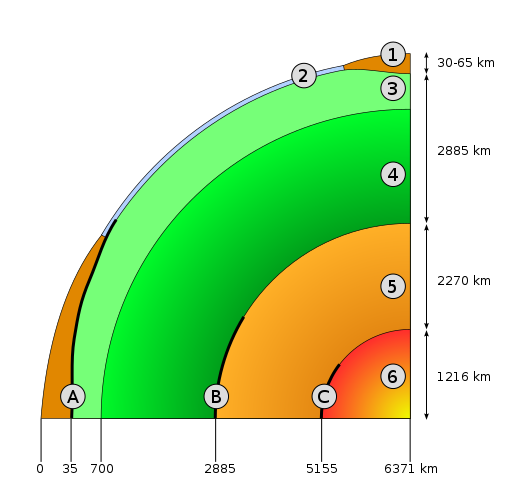
What we know about the layers forming the interior of the earth are mostly inferred from mapping the propagation and refraction of earthquake waves. The earth’s lower mantle starts some 700km down and extends to a depth of about 2900km. The upper and lower mantle demonstrate – in fluid dynamic terms – a viscous chaotic flow but the mechanisms by which material is exchanged between the upper and lower mantle are not fully understood.

Science Daily: Michael Walter of the University of Bristol and colleagues in Brazil and the United States analyzed a set of “superdeep” diamonds from the Juina kimberlite field in Brazil. Most diamonds excavated at Earth’s surface originated at depths of less than 200 kilometers. Some parts of the world, however, have produced rare, superdeep diamonds, containing tiny inclusions of other material whose chemistry indicates that the diamonds formed at far greater depths

M. J. Walter, S. C. Kohn, D. Araujo, G. P. Bulanova, C. B. Smith, E. Gaillou, J. Wang, A. Steele, S. B. Shirey. Deep Mantle Cycling of Oceanic Crust: Evidence from Diamonds and their Mineral Inclusions. Science, 2011; DOI: 10.1126/science.1209300

ABSTRACT

A primary consequence of plate tectonics is that basaltic oceanic crust subducts with lithospheric slabs into the mantle. Seismological studies extend this process to the lower mantle, and geochemical observations indicate return of oceanic crust to the upper mantle in plumes. There has been no direct petrologic evidence, however, of the return of subducted oceanic crustal components from the lower mantle. We analyzed superdeep diamonds from Juina-5 kimberlite, Brazil, which host inclusions with compositions comprising the entire phase assemblage expected to crystallize from basalt under lower mantle conditions. The inclusion mineralogies require exhumation from the lower to upper mantle. Because the diamond hosts have carbon isotope signatures consistent with surface-derived carbon, we conclude that the deep carbon cycle extends into the lower mantle.

“This study shows the extent of Earth’s carbon cycle on the scale of the entire planet, connecting the chemical and biological processes that occur on the surface and in the oceans to the far depths of Earth’s interior,” according to Nick Wigginton, associate editor at Science.

The carbon cycle generally refers to the movement of carbon through the atmosphere, oceans, and the crust. Previous observations suggested that the carbon cycle may even extend to the upper mantle, which extends roughly 400 kilometers into Earth. In this region, plates of ocean crust — bearing a carbon-rich sediment layer — sink beneath other tectonic plates and mix with the molten rock of the mantle.

Seismological and geochemical studies have suggested that oceanic crust can sink all the way to the lower mantle, more than 660 kilometers down. But actual rock samples with this history have been hard to come by

File:Slice earth.svg

Schematic view of the interior of Earth. 1. continental crust - 2. oceanic crust - 3. upper mantle - 4. lower mantle - 5. outer core - 6. inner core - A: Mohorovičić discontinuity - B: Gutenberg Discontinuity - C: Lehmann discontinuity: image Wikipedia

PhysOrg: The diamonds were analyzed for carbon at Carnegie. Four of the diamonds contained low amounts of carbon-13, a signature not found in the lower mantle and consistent with an ocean-crust origin at Earth’s surface. “The carbon identified in other super-deep, lower mantle diamonds is chiefly mantle-like in composition,” remarked co-author Steven Shirey  at Carnegie. “We looked at the variations in the isotopes of the carbon atoms in the diamonds. Carbon originating in a rock called basalt, which forms from lava at the surface, is often different from that which originates in the mantle, in containing relatively less carbon-13. These super-deep diamonds contained much less carbon-13, which is most consistent with an origin in the organic component found in altered oceanic crust.

Hamza subterranean “river” criticised by Petrobras geologist – a case of “sour grapes”?

August 28, 2011

It seems that a Petrobras geologist – Dr. Jorge Figueiredo – does not like all the attention that Hamza and Pimental are getting. He may well have a point but there seems to be a touch of “sour grapes” about his carping. The data was Petrobras data available to their own geologists after all. Perhaps if the river had been named after him Dr. Figueiredo would not be quite so petulant.

If the flow is regular and serves to drain the Amazon then I think it can be called a river even if it is only a tiny seepage through the pores in rocks. The key is that the flow should be regular. Continuity of flow or the velocity of flow cannot be the arbiter. Even surface rivers can be seasonal and discontinuous, can completely dry up at times but they all regularly return from the same source to the same sink.

BBC:

…. Valiya Hamza and Elizabeth Tavares Pimentel, from the Brazilian National Observatory, deduced the existence of the “river” by using temperature data from boreholes across the Amazon region. The holes were dug by the Brazilian oil company Petrobras in the search for new oil and gas fields, and Petrobras has since released its data to the scientific community.

Using mathematical models relating temperature differences to water movement, the scientists inferred that water must be moving downwards through the ground around the holes, and then flowing horizontally at a depth of several km.

They concluded that this movement had to be from West to East, mimicking the mighty Amazon itself. A true underground river on this scale – 6,000km (4,000 miles) long – would be the longest of its kind in the world by far. But Professor Hamza told BBC News that it was not a river in the conventional sense. “We have used the term ‘river’ in a more generic sense than the popular notion,” he said.

In the Amazon, he said, water was transported by three kinds of “river” – the Amazon itself, as water vapour in atmospheric circulation, and as moving groundwater. “According to the lithologic sequences representative of Amazon [underground sedimentary] basins, the medium is permeable and the flow is through pores… we assume that the medium has enough permeability to allow for significant subsurface flows.”

The total calculated volume of the flow – about 4,000 cubic metres per second – is significant, although just a few percent of the amount of water transported by the Amazon proper. The underground flow could be confirmed with coastal measurements, scientists suggest. But the speed of movement is even slower than glaciers usually display, never mind rivers.

And whether water really is transported right across the region in this way is disputed by Jorge Figueiredo, a geologist with Petrobras. “First of all, the word ‘river’ should be burned from the work – it’s not a river whatsoever,” he told BBC News.

Water and other fluids could indeed flow through the porous sedimentary rock, he said, but would be unlikely to reach the Atlantic Ocean because the sedimentary basins containing the porous rock were separated by older rock deposits that would form an impermeable barrier. “But the main problem is that at depths of 4,000m, there is no possibility that we have fresh water – we have direct data that this water is saline,” said Dr Figueiredo. “My colleagues and I think this work is very arguable – we have a high level of criticism.” 

The research – Indications of an Underground “River” beneath the Amazon River: Inferences from Results of Geothermal Studies – was presented at the 12th International Congress of the Brazilian Geophysical Society in Rio de Janeiro, and has not been published in a peer-reviewed scientific journal.

The team has named the underground flow the “Hamza River”.

The Hamza – a subterranean river to rival the Amazon: 6,000km long, 4,000 m down

August 25, 2011

Subterranean rivers are the stuff of mythology and there is something dark and mysterious and yet wonderful about them. Greek mythology includes the Styx, Phlegethon, Acheron, Cocytus, and Lethe as rivers within the Underworld. The Saraswati River is believed to have drained the north and northwest region of India in ancient times, supporting over 16,000 settlements. Although the river does not have a physical existence today many still believe that it flows underground. The River Fleet is London’s largest subterranean river. Forced underground by the city’s burgeoning populace the river still flows from its source in Hampstead Heath to its mouth where it joins London’s main waterway, the Thames. The longest known subterranean river was the Disu Subterranean river in Du’an, Guangxi Province, China – until now.

Forbes / AP: Sao Paulo

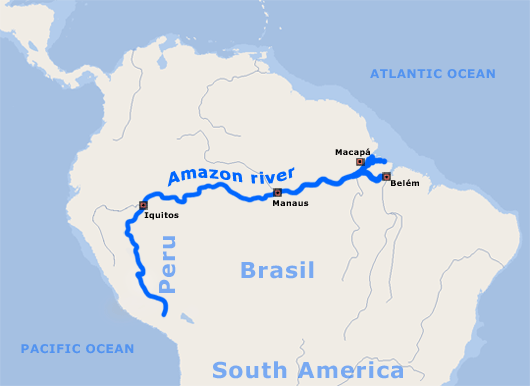
A huge underground river appears to be flowing thousands of feet beneath the Amazon River, Brazilian scientists said Thursday. Valiya Hamza of Brazil’s National Observatory said researchers found indications the subterranean river is 3,700 miles (6,000 kilometers) long, about the same length as the Amazon on the surface. Hamza said the discovery of the possible underground river came from studying temperature variations at 241 inactive oil wells drilled in the 1970s and 1980s by Brazil’s state-run oil company, Petrobras.

He said the “thermal information” provided by Petrobras allowed his team of researchers to identify the movement of water 13,100 feet (4,000 meters) under the Amazon River.

map of the amazon river

map of the amazon river image - 2.bp.blogspot.com

Their findings were presented last week in Rio de Janeiro at a meeting of the Brazilian Geophysical Society. The apparent underground river has been named after Hamza, honoring him as the head of the research team that found the signs of the flowing water. He said the existence of an underground river that also flows west to east would mean that the Amazon rain forest has two drainage systems – the Amazon and Hamza rivers.

There is much about the earth we still don’t know that we don’t know.

And the sense of wonder will remain alive as long as that is so.

UPDATE! Dr. Hamza explains the discovery in an email “interview” with The Hindu. 

Discovery of Icelandic ocean current unsettles “settled” climate theories

August 23, 2011

So much for settled science.

A new paper overturns previous thinking that the East Greenland Current was the main source of the Atlantic Meridional Overturning Circulation (AMOC). The newly discovered North Icelandic Jet (NIJ) is now thought to dominate the return of dense water south through gaps in the Greenland-Scotland Ridge to keep the “great ocean conveyor belt” moving.

Kjetil Våge, Robert S. Pickart, Michael A. Spall, Héðinn Valdimarsson, Steingrímur Jónsson, Daniel J. Torres, Svein Østerhus & Tor Eldevik. Significant role of the North Icelandic Jet in the formation of Denmark Strait overflow waterNature Geoscience, 21 August 2011 DOI:10.1038/ngeo1234

graphic by Reuters

 Science Daily reports:

ScienceDaily (Aug. 21, 2011) — An international team of researchers, including physical oceanographers from the Woods Hole Oceanographic Institution (WHOI), has confirmed the presence of a deep-reaching ocean circulation system off Iceland that could significantly influence the ocean’s response to climate change in previously unforeseen ways. 

The current, called the North Icelandic Jet (NIJ), contributes to a key component of the Atlantic Meridional Overturning Circulation (AMOC), also known as the “great ocean conveyor belt,” which is critically important for regulating Earth’s climate. As part of the planet’s reciprocal relationship between ocean circulation and climate, this conveyor belt transports warm surface water to high latitudes where the water warms the air, then cools, sinks, and returns towards the equator as a deep flow.

Crucial to this warm-to-cold oceanographic choreography is the Denmark Strait Overflow Water (DSOW), the largest of the deep, overflow plumes that feed the lower limb of the conveyor belt and return the dense water south through gaps in the Greenland-Scotland Ridge.

For years it has been thought that the primary source of the Denmark Overflow is a current adjacent to Greenland known as the East Greenland Current. However, this view was recently called into question by two oceanographers from Iceland who discovered a deep current flowing southward along the continental slope of Iceland. They named the current the North Icelandic Jet and hypothesized that it formed a significant part of the overflow water.

Now, in a paper published in the Aug. 21 online issue of the journal Nature Geoscience, the team of researchers — including the two Icelanders who discovered it — has confirmed that the Icelandic Jet is not only a major contributor to the DSOW but “is the primary source of the densest overflow water.” ……..

La Niña is back and will persist till 2012

August 22, 2011

In February Klaus Wolter came to the conclusion that there was an even chance that La Niña conditions could extend into 2012. He wrote then:

While La Niña conditions are guaranteed well into 2011, it remains to be seen whether it can rally once more to cross the -2 sigma barrier, and/or whether it will indeed last into 2012, as discussed six months ago on this page. I believe the odds for a two-year event remain well above 50%, made even more likely by the continued unabated strength in various ENSO indices.

Bob Tisdale points out at WUWT that

NINO3.4 SST anomalies (a commonly used El Niño-Southern Oscillation Index) have dropped significantly below the -0.5 deg C threshold of a La Niña Event. They are presently at approximately -0.74 deg C.

NINO3.4 SST anomalies

NOAA has yet to update its El Niño / La Niña forecasts but has called a “La Niña watch” but Bob Tisdale is ahead of them in calling the return of La Niña which is not too far away from Wolter’s forecast.

Update!! 8th September: NOAA now calls it:  La Niña is back

But Agriculture.com reports that the money is already betting on La Niña conditions for this winter and into 2012:

Sentiment towards commodities lying in the traditional path of conditions known as La Nina is starting to turn more bullish, exacerbated by supply shortages in a number of products like iron ore and coal.

Forecasting models by the U.S. National Weather Service’s Climate Prediction Center predict La Nina will redevelop this autumn. “Atmospheric patterns continue to reflect La Nina-like conditions,” the weather body said.

La Nina is a periodic climatic phenomenon that brings more rain to the western Pacific, and to a lesser extent, to the eastern Pacific. Climatologists blamed La Nina for last year’s floods that gripped Australia, resulting in major losses to coal and iron ore stockpiles. 

But while it isn’t clear what impact La Nina might have on the production and shipment of commodities, its return isn’t expected to cause the same serious problems as in 2010. That’s because historically the La Nina weather phenomenon occurs in bursts of three consecutive years, with the first one being the worst and the next two much milder. ……

Joe Vaclavik, grains broker at Chicago-based MF global, said from an agricultural commodity markets perspective, the biggest fear of a second La Nina would be the continuation of the current drought in the U.S. southern plains, causing further damage to the winter wheat crop. ….. Matt Rogers, President of Maryland-based Commodity Weather Group, warned that possible effects from the second round of La Nina could bring above-normal precipitation in eastern Australia, but would actually benefit the wheat and barley crops in terms of moisture. Yet, dryness concerns could be an issue for Argentina and southern Brazil, which would experience lower amounts of rainfall, causing damage to wheat, corn and soybean yields.

And Indian and Japanese forecasters have already called La Niña conditions.

The Indian Meteorological Department (IMD) has forecast an active wet spell for northwest India during the next five days and over east and adjoining central India during the next three days. This came about on a day when Japanese scientists assessed that the predicted return of La Nina conditions may already be happening.

Dr Jing-Jia Luo, Senior Scientist with the Climate Variation Predictability and Applicability Research Programme Research at RIGC, wrote to Business Lineon Friday that the La Nina condition is currently on the way back. This condition is forecast to persist until early next year, Dr Jing-Jia says, adding that a weak positive Indian Ocean Dipole (IOD), which mimics EL Nino-La Nina in the Indian Ocean, also may occur during the next few months.

Positive IOD refers to the warming of seas-surface temperatures in the western part of the Indian Ocean, and vice versa. Positive IOD has been found to favour a concurrent monsoon. Regional forecast from the RIGC said that the La Nina would bring cool to wet conditions over southern Africa, Australia, and Brazil during the southern hemisphere summer.

The confirming indicators for a La Niña event are accumulating – from the Indian monsoon to greater evaporation leading to increased rains expected in the Western Pacific in Australia, less rain in the Eastern Pacific on the western coast of S. America (coastal Chile and Peru) but increased rain on the east coast in southern Brazil and  northern Argentina.

Just coincidence? Burst of solar activity (Kp index) and 18 Indonesian volcanoes move to alert status

August 7, 2011

It may just be coincidence but I am inclined to believe that the sun does influence geo-magnetic activity on earth.

1.  The K7RA Solar Update

08/05/2011

Solar activity markedly increased this week, with the sunspot number rising to 130 on Monday, August 1 — the highest since a reading of 131 on April 14, 2011. The average daily sunspot numbers more than doubled this week compared to last, rising nearly 54 points to 99.3. ……

NOAA’s Space Weather Prediction Center: “Three coronal mass ejections (CMEs) are currently en route to Earth, with the commencement of geomagnetic storming expected early to mid-day on August 5 with the arrival of the CMEs associated with the August 2-3 events. The third of the string, seemingly the fastest CME, may catch up with the first two in the next 12-18 hours, compressing the plasma and enhancing the embedded magnetic field. Storming levels are expected to attain G3 (strong) conditions. The current Solar Radiation Storm may experience a kick with the shocks and attain S2 (moderate) thresholds.

“Some level of geomagnetic disturbance is expected to continue through August 7 as the series of CMEs affect the Earth. Continued activity is likely from these regions as they continue to rotate off the visible solar disk over the next seven days. The Space Weather Prediction Center will continue to monitor this event as it unfolds.”

 Estimated 3-hour Planetary Kp-index


article image

2. The Jakarta Post:

Sun, 08/07/2011 1:05 PM

Eighteen Indonesian volcanoes are on “alert” status, two of which are at Alert Level 3, which is called “Siaga”, the Volcanology and Geology Disaster Mitigation Center says. Center head Surono said Sunday in Jakarta the erupting Mount Lokon in North Sulawesi and Mount Ibu in North Maluku were the two volcanoes at Siaga status. The center has adopted four levels of alert status: “Normal” (Level 1), “Waspada” (Level 2), “Siaga” (Level 3) and “Awas” (Level 4).

Surono said the conditions at Mt Lokon and Mt Ibu were currently considered most worrisome because they had been consistently erupting searing clouds affecting a radius of 2.5 kilometers. …… 

Surono added that 16 other volcanoes were at Level 2 alert status, “Waspada”, including Mt. Papandayan and Mt. Guntur in West Java. “Locals have reported several quakes,” he said. ….

Surono said that President Susilo Bambang Yudhoyono had summoned him on Saturday to report the volcanoes’ status and the center’s preparations to anticipate possible disasters.

H/T – http://climaterealists.com/index.php

Related: 

Solar effects will give increased volcanic and earthquake activity in the next 2 years

Measurements show climate models get the energy balance wrong (again)

July 27, 2011

Settled science?

The deification of climate models and the development of the Global Warming religion will be remembered as one of man’s great follies.

A new paper in Remote Sensing Remote Sens. 2011, 3, 1603-1613; doi:10.3390/rs3081603 

On the Misdiagnosis of Surface Temperature Feedbacks from Variations in Earth’s Radiant Energy Balance

by Roy W. Spencer  and William D. Braswell
ESSC-UAH, University of Alabama in Huntsville, Cramer Hall, Huntsville, AL 35899, USA;  
E-Mail: danny.braswell@nsstc.uah.edu

A University of Alabama Huntsville news release (via Dr. Pielke Snr.)  

Climate models get energy balance wrong, make too hot forecasts of global warming

HUNTSVILLE, Ala. (July 26, 2011) — Data from NASA’s Terra satellite shows that when the climate warms, Earth’s atmosphere is apparently more efficient at releasing energy to space than models used to forecast climate change have been programmed to “believe.”

The result is climate forecasts that are warming substantially faster than the atmosphere, says Dr. Roy Spencer, a principal research scientist in the Earth System Science Center at The University of Alabama in Huntsville.

The previously unexplained differences between model-based forecasts of rapid global warming and meteorological data showing a slower rate of warming have been the source of often contentious debate and controversy for more than two decades.

In research published this week in the journal “Remote Sensing” http://www.mdpi.com/2072-4292/3/8/1603/pdf, Spencer and UA Huntsville’s Dr. Danny Braswell compared what a half dozen climate models say the atmosphere should do to satellite data showing what the atmosphere actually did during the 18 months before and after warming events between 2000 and 2011.

“The satellite observations suggest there is much more energy lost to space during and after warming than the climate models show,” Spencer said. “There is a huge discrepancy between the data and the forecasts that is especially big over the oceans.”

Not only does the atmosphere release more energy than previously thought, it starts releasing it earlier in a warming cycle. The models forecast that the climate should continue to absorb solar energy until a warming event peaks. Instead, the satellite data shows the climate system starting to shed energy more than three months before the typical warming event reaches its peak.

“At the peak, satellites show energy being lost while climate models show energy still being gained,” Spencer said.

This is the first time scientists have looked at radiative balances during the months before and after these transient temperature peaks.

Applied to long-term climate change, the research might indicate that the climate is less sensitive to warming due to increased carbon dioxide concentrations in the atmosphere than climate modelers have theorized. A major underpinning of global warming theory is that the slight warming caused by enhanced greenhouse gases should change cloud cover in ways that cause additional warming, which would be a positive feedback cycle.

Instead, the natural ebb and flow of clouds, solar radiation, heat rising from the oceans and a myriad of other factors added to the different time lags in which they impact the atmosphere might make it impossible to isolate or accurately identify which piece of Earth’s changing climate is feedback from manmade greenhouse gases.

“There are simply too many variables to reliably gauge the right number for that,” Spencer said. “The main finding from this research is that there is no solution to the problem of measuring atmospheric feedback, due mostly to our inability to distinguish between radiative forcing and radiative feedback in our observations.”

For this experiment, the UA Huntsville team used surface temperature data gathered by the Hadley Climate Research Unit in Great Britain. The radiant energy data was collected by the Clouds and Earth’s Radiant Energy System (CERES) instruments aboard NASA’s Terra satellite.

The six climate models were chosen from those used by the U.N.’s Intergovernmental Panel on Climate Change. The UA Huntsville team used the three models programmed using the greatest sensitivity to radiative forcing and the three that programmed in the least sensitivity.

Dr. Roy Spencer writes about his paper:

Well, our paper entitled On the Misdiagnosis of Surface Temperature Feedbacks from Variations in Earth’s Radiant Energy Balance which refutes Dessler’s claim, has just been accepted for publication. In it we show clear evidence that cloud changes DO cause a large amount of temperature variability during the satellite period of record, which then obscures the identification of temperature-causing-cloud changes (cloud feedback).

Along with that evidence, we also show the large discrepancy between the satellite observations and IPCC models in their co-variations between radiation and temperature.


Earthquakes this week

June 29, 2011

Following the Weather Action warning last week ,

Earthquakes so far this week (23rd – 29th June).

University of Edinburgh earthquake locator

>= 6.5 6 – 6.5 5 – 6 4 – 5 < 4

Earthquake report is here.