Archive for the ‘Geosciences’ Category

Underwater robot will dive down to 6,000m

November 2, 2010

The Fraunhofer Institute issued a press release today regarding their new underwater robot POSEIDON which will be able to dive down to 6,000m.

Robots do not have to breathe. For this reason they can dive longer than any human. Equipped with the necessary sensor technology they inspect docks or venture down to the ocean fl oor to search for raw materials. At present, researchers are developing a model which will carry out routine tasks independently, without help from humans.


The torpedo-shaped underwater robot will be able to dive down to 6,000 meters. (© Fraunhofer AST)


Even when equipped with compressed-air bottles and diving regulators, humans reach their limits very quickly under water. In contrast, unmanned submarine vehicles that are connected by cable to the control center permit long and deep dives. Today remote-controlled diving robots are used for research, inspection and maintenance work. The possible applications of this technology are limited, however, by the length of the cable and the instinct of the navigator. No wonder that researchers are working on autonomous underwater robots which orient themselves under water and carry out jobs without any help from humans.

In the meantime, there are AUVs (autonomous underwater vehicles) which collect data independently or take samples before they return to the starting points. “For the time being, the technology is too expensive to carry out routine work, such as inspections of bulkheads, dams or ships’ bellies,” explains Dr. Thomas Rauschenbach, Director of the Application Center System Technology AST Ilmenau, Germany at the Fraunhofer Institute for Optronics, System Technologies and Image Exploitation IOSB. This may change soon. Together with the researchers at four Fraunhofer Institutes, Rauschenbach’s team is presently working on a generation of autonomous underwater robots which will be smaller, more robust and cheaper than the previous models. The AUVs shall be able to find their bearings in clear mountain reservoirs equally well as in turbid harbor water. They will be suitable for work on the floor of the deep sea as well as for inspections of shallow concrete bases that offshore wind power station have been mounted on.

The engineers from Fraunhofer Institute for Optronics, System Technologies and Image Exploitation in Karlsruhe, Germany are working on the “eyes” for underwater robots. Optical perception is based on a special exposure and analysis technology which even permits orientation in turbid water as well. First of all, it determines the distance to the object, and then the camera emits a laser impulse which is reflected by the object, such as a wall. Microseconds before the reflected light flash arrives, the camera opens the aperture and the sensors capture the incident light pulses. At the Ilmenau branch of the Fraunhofer Institute for Optronics, System Technologies and Image Exploitation, Rauschenbach‘s team is developing the “brain“ of the robot: a control program that keeps the AUV on course in currents such as at a certain distance to the wall that is to be examined. The Fraunhofer Institute for Biomedical Engineering IBMT in St. Ingbert provides the silicone encapsulation for the pressure-tolerant construction of electronic circuits as well as the “ears” of the new robot: ultrasound sensors permit the inspection of objects. Contrary to the previously conventional sonar technology, researchers are now using high-frequency sound waves which are reflected by the obstacles and registered by the sensor. The powerful but lightweight lithium batteries of the Fraunhofer ISIT in Itzehoe that supply the AUV with energy are encapsulated by silicone. A special energy management system that researchers at the Fraunhofer Institute for Environmental, Safety and Energy Technology UMSICHT in Oberhausen, Germany have developed saves power and ensures that the data are saved in emergencies before the robot runs out of energy and has to surface.

A torpedo-shaped prototype two meters long that is equipped with eyes, ears, a brain, a motor and batteries will go on its maiden voyage this year in a new tank in Ilmenau. The tank is only three meters deep, but “that’s enough to test the decisive functions,“ affirms Dr. Rauschenbach. In autumn 2011, the autonomous diving robot will put to sea for the first time from the research vessel POSEIDON: Several dives up to a depth of 6,000 meters have been planned.
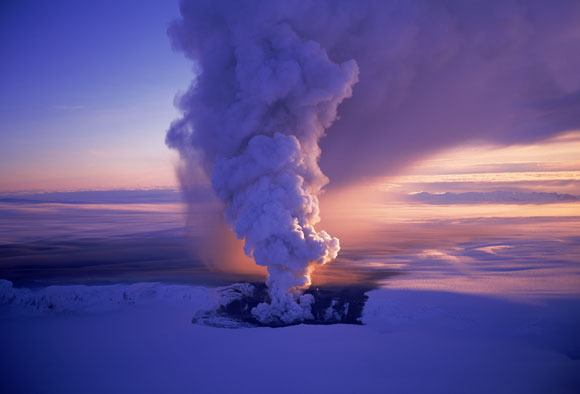
Iceland on watch for new volcano eruption

November 1, 2010

Reuters:

Meltwater is flooding from the Grimsvotn glacial lake in Iceland and could signal the volcano underneath is about to erupt, a spokeswoman at the Icelandic Civil Protection Department told Reuters on Monday.

Water now pouring from Iceland’s biggest glacier, Vatnajokull, which sits on top of a number of volcanic hotspots, could be a sign of fresh geological activity, Civil Protection Department spokeswoman Gudrun Johannesdottir told Reuters.

In April, clouds of ash from an eruption under the Eyjafjallajokull glacier grounded flights across Europe for a week, causing billions of dollars in losses for airlines and other industries. Eyjafjallajokull is about 100 km southeast of Vatnajokull.

“We have to check if there will be an eruption,” Johannesdottir said. “Sometimes it initiates an eruption when a glacial outburst flood starts, but not every the time. So we are monitoring the situation closely.”

The latest eruption at Grimsvotn, in 2004, caused short-term disruptions to airline traffic into Iceland.


Smoke from a subglacial volcanic eruption rises above the Vatnajökull ice cap (file photo by Oddur Sigurdsson)


German twin satellites now orbiting in close formation

October 15, 2010

The German aerospace centre announced today that

On 14 October 2010, the radar satellite TanDEM-X moved into close formation with its ‘twin’, TerraSAR-X. Before this, the two satellites were orbiting 20 kilometres apart – a flight time of almost three seconds. Now, there are only 350 metres separating the pair, which means their antennas are able to acquire radar images of the same area simultaneously.


 Premiere – TerraSAR-X and TanDEM-X now flying in close formation

Premiere – TerraSAR-X and TanDEM-X now flying in close formation


The objective of the mission is to create a high-precision, three-dimensional digital elevation model of Earth’s land surface. The project needs the satellites to operate in parallel for a period of three years. The transition to close formation flight marks the beginning of the final preparatory stage of the TanDEM-X mission. The routine operations phase is due to start in early January next year.

The TerraSAR-X and TanDEM-X orbit trajectories, patented by DLR researchers, are like the strands of a double helix – they circle around one another without crossing. The team of scientists based in DLR Oberpfaffenhofen took just three days to carry out the approach in preparation for the final formation flight. “First, we had to manoeuvre TanDEM-X to reduce its orbital period, so that the satellite could ‘catch up’, reducing the 20 kilometre gap between it and TerraSAR-X. After two further manoeuvres we brought the distance between the pair down to 350 metres,” explains DLR flight dynamics expert Ralph Kahle.

The reduced distance between the satellites means that the two radar systems can be synchronised for the first time. TerraSAR-X and TanDEM-X can also monitor each other’s ‘health’ via an inter-satellite link. “This is completely uncharted territory. Never before have two satellites worked in such close formation over a period of several years,” says Manfred Zink, Project Manager for the TanDEM-X Ground Segment. Eckard Settelmeyer, Director of Earth Observation and Science at Astrium, adds: “This dual mission will give another boost to satellite-supported applications and science.”

Read the whole article:

http://www.dlr.de/en/desktopdefault.aspx/tabid-1/117_read-27086/

With a “good” monsoon in the bag Indian GDP should exceed 11%

October 11, 2010

The 4 month monsoon season in India ended on 30th September and total rainfall was 2% over the long term average, about 25% higher than last year and about 5% above the long range forecast made in the spring.


Total rainfall 2010 Monsoon: IMD


Expectations that a good monsoon could lead to double digit growth are stronger with the IMF now predicting a 9.7% growth rate for the calendar year 2010.

“India’s macroeconomic performance has been vigorous, with industrial production at a two-year high. Leading indicators — the production manufacturing index and measures of business and consumer confidence — continue to point up,” the IMF said.

“Growth is projected at 9.7 per cent in 2010 and 8.4 per cent in 2011, led increasingly by domestic demand. Robust corporate profits and favorable external financing will encourage investment,” it said.

“Recent activity (10 per cent year-over year growth in real GDP at market prices in the second quarter) was driven largely by investment and the contribution from net exports is projected to turn negative in 2011 as the strength in investment further boosts imports,” the IMF said.

But in spite of the IMF’s caveat on net exports turning down, I think the trickle-down effects of a good monsoon may have been under-estimated. Agricultural growth which was low should pick up and domestic demand will ensure the industrial growth continues. For the Fiscal Year 2010/11 (till 31st March 2011) I fully expect that the GDP will grow by just over 11%.

The establishing La Niña probably helped the monsoon somewhat.

A “moderate to strong” La Niña, which appeared in July, was now well estabished according to the WMO, and forecasts showed “rather a strengthening of this La Niña episode for the next four to six months.” La Niña is characterised by unusually cool ocean temperatures in the eastern equatorial Pacific and has been associated with strong rainfall in Asia and Australia, bitter cold snaps in North America, as well as drought in South America.


Evaporation from land increased from 1982 to 1998 and then stopped

October 10, 2010

Interesting paper but the headlines it generates are even more interesting.

A new Letter to  Nature:

Recent decline in the global land evapotranspiration trend due to limited moisture supply

Martin Jung et al, NatureDOI:10.1038/nature09396

The authors write:

Our results suggest that global annual evapotranspiration increased on average by 7.1 ± 1.0 millimetres per year per decade from 1982 to 1997. After that, coincident with the last major El Niño event in 1998, the global evapotranspiration increase seems to have ceased until 2008. This change was driven primarily by moisture limitation in the Southern Hemisphere, particularly Africa and Australia.

But the New Scientist in its wisdom reports this under the headline:

Water cycle goes bust as the world gets warmer

That evapotranspiration should decrease if the moisture is not there in the first place seems perfectly reasonable.  That we will have to use technology to get ground water levels back up as water usage increases is also fairly obvious.

It occurs to me that global temperatures have been stable if not declining over the last decade which also fits the period when they measured the stable evapotranspiration.

I note – in passing – that evaporation from ocean surfaces is some 7 times greater than the evaporation from land surfaces while precipitation over the oceans is about 4 times greater than that over land.

But the NS headline is a little bizarre.


Tenacious life: Biological oasis found in Yellowstone Lake

October 6, 2010
att=Yellowstone Lake Aerial

Image via Wikipedia: Yellowstone Lake

From Science Daily:

Montana State University researchers have discovered a rare oasis of life in the midst of hundreds of geothermal vents at the bottom of Yellowstone Lake.

A colony of moss, worms and various forms of shrimp flourishes in an area where the water is inky black, about 90 degrees Fahrenheit, and a cauldron of nutrients, gases and poisons, the researchers reported in the September issue of Geobiology.

The vent is close to 100 feet below the surface of Yellowstone Lake and a third of a mile offshore in the West Thumb region. The worms and shrimp live among approximately two feet of moss that encircles the vent. The researchers said that the Fontinalis moss is not known to grow in the conditions they found on the floor of Yellowstone Lake and that a worm found associated with the moss had never been reported in North America. The researchers also noted that this was the first in-depth published study of the biology associated with any geothermal vent in Yellowstone Lake.

“The proliferation of complex higher organisms in close association with a Yellowstone Lake geothermal vent parallels that documented for deep marine vents, although to our knowledge this is the first such documentation for a freshwater habitat”

D. Lovalvo, S. R. Clingenpeel, S. McGinnis, R. E. Macur, J. D. Varley, W. P. Inskeep, J. Glime, K. Nealson, T. R. McDermott. A geothermal-linked biological oasis in Yellowstone Lake, Yellowstone National Park, WyomingGeobiology, 2010; DOI: 10.1111/j.1472-4669.2010.00244.x

Science Daily article:

http://www.sciencedaily.com/releases/2010/10/101004141327.htm

Magna Germania: Ptolemy’s map deciphered

October 2, 2010

Der Spiegel reports: Berlin Researchers Crack the Ptolemy Code

A 2nd century map of Germania by the scholar Ptolemy has always stumped scholars, who were unable to relate the places depicted to known settlements. Now a team of researchers have cracked the code, revealing that half of Germany’s cities are 1,000 years older than previously thought.

Magna Germania

Link to larger map.

A group of classical philologists, mathematical historians and surveying experts at Berlin Technical University‘s Department for Geodesy and Geoinformation Science has produced an astonishing map of central Europe as it was 2,000 years ago.

Ptolemy: Bildarchiv Hansmann/Interfoto

The map shows that both the North and Baltic Seas were known as the “Germanic Ocean” and the Franconian Forest in northern Bavaria was “Sudeti Montes.” The map indicates three “Saxons’ islands” off the Frisian coast in northwestern Germany — known today as Amrum, Föhr and Sylt.

It also shows a large number of cities. The eastern German city that is now called Jena, for example, was called “Bicurgium,” while Essen was “Navalia.” Even the town of Fürstenwalde in eastern Germany appears to have existed 2,000 years ago. Its name then was “Susudata,” a word derived from the Germanic term “susutin,” or “sow’s wallow” — suggesting that the city’s skyline was perhaps less than imposing.

This unusual map draws on information from the mathematician and astronomer Ptolemy, who, in 150 AD, embarked on a project to depict the entire known world. Living in Alexandria, in the shadow of its monumental lighthouse, the ancient scholar drew 26 maps in colored ink on dried animal skins — a Google Earth of the ancient world, if you will.

Read the full article

The Roman Empire in 116 AD and Germania Magna,...

Image via Wikipedia. Roman Empire in 116 AD

Kilimanjaro ice loss was due to tree felling

September 26, 2010

Mt. Kilimanjaro: blog.gohoto.com

The New Scientist reports a new paper by Nicholas Pepin from the University of Portsmouth and his colleagues which suggests that extensive local deforestation in recent decades has likely reduced this flow of  warm, moist air up the Kilimanjaro mountainside depleting the mountain’s icy hood. Trees play an important role here by providing moisture through transpiration which add to the ice cap.

The montane circulation on Kilimanjaro, Tanzania and its relevance for the summit ice fields: Comparison of surface mountain climate with equivalent reanalysis parameters

by N.C. Pepin, W.J. Duane and D.R. Hardy

Article in press: Global and Planetary Change

Of course it’s possible that global warming led – by some unknown mechanism – to the deforestation — but it seems highly unlikely.

Doomsday postponed!

September 17, 2010
Ozone Hole

Ozone hole - Wikipedia

There is hope. Doomsday is being postponed

But no doubt some new catastrophic scenarios will be found (invented).

    Further proof that glaciers are not well understood

    September 16, 2010

    http://www.sciencedaily.com/releases/2010/09/100915140119.htm

    Glacial armoring

    A new paper in Nature shows that glaciers can both help mountains grow as well as cause erosion. The stubborn certainty displayed by Pachauri and the IPCC about glaciers seems all the more ridiculous.

    Stuart N. Thomson, Mark T. Brandon, Jonathan H. Tomkin, Peter W. Reiners, Cristián Vásquez, Nathaniel J. Wilson.Glaciation as a destructive and constructive control on mountain buildingNature, 2010; 467 (7313): 313 DOI:10.1038/nature09365

    Glaciers can help actively growing mountains become higher by protecting them from erosion, according to a University of Arizona-led research team. The finding is contrary to the conventional view of glaciers as powerful agents of erosion that carve deep fjords and move massive amounts of sediment down mountains. Mountains grow when movements of the Earth’s crust push the rocks up. The research is the first to show that the erosion effect of glaciers — what has been dubbed the “glacial buzzsaw” — reverses on mountains in colder climates.

    Glaciers atop mountains in temperate latitudes flow downhill, scouring away the surface of the mountain. Over millennia, such erosion can reduce the height and width of a mountain range by miles. However in very cold climates such as the Patagonian Andes, rather than scraping away the surface of the mountain, the team found that glaciers protect the mountain top and sides from erosion. The team dubs the action of the cold-climate glaciers “glacial armoring.”

    “Climate, especially through glaciers, has a really big impact on how big mountains get,” said Reiners, a UA professor of geosciences.