Archive for the ‘Politics’ Category

A “British Solution” for a federal Britain

May 11, 2015

The “British Solution” has traditionally been to draw new lines on maps. In India, in Africa, in Arabia and the Middle East and even in the Eastern US and Canada, the British expertise at and love of cartography has provided the “solutions” of the day. Notwithstanding any tribal affiliations and nomadic behaviour, ethnic and religious and political divisions have been enshrined – and confined – in situ by drawing lines on maps to keep the warring parties separated.

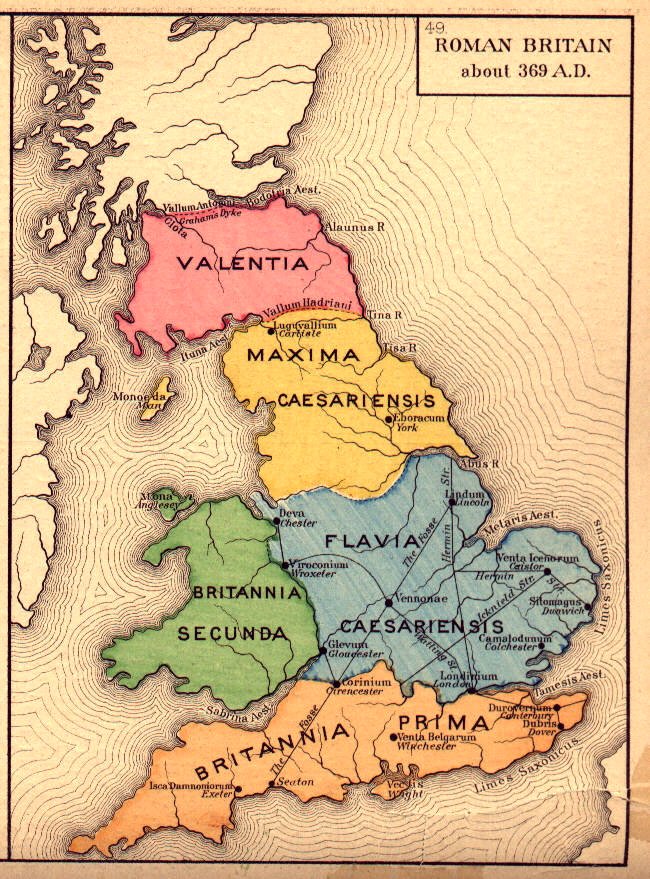
After this election, a federal Britain is now in the realm of the possible – if not yet probable. And the British Solution should be applicable without really inventing anything new. 1,800 years ago the Romans already drew the lines that could be applied.

roman britain (thedockyards.com)

roman britain (thedockyards.com)

Of course this requires that Scotland be split into a northern and a southern part and they would, obviously, be called Upper Scotland and Lower Scotland. England would have to split into three parts (with a somewhat expanded Wales). Upper England, Middle England and Lower England would be quite fitting.. Wales would of course be called Cymru. Northern Ireland (Ulster) could pretty much stay as it is (geographically). Manx, the Channel Islands, the Falklands and the Hebrides could be independent Crown territories and could serve as tax and gambling havens (since any self-respecting federal, monarchic, republic must have these).

The great job-creation opportunity is that 9 parliaments (8 national and one federal parliament) could be set up, each with its supporting paraphernalia and bureaucracy.  And it could be 10 parliaments if the House of Lords is kept as a tourist attraction.

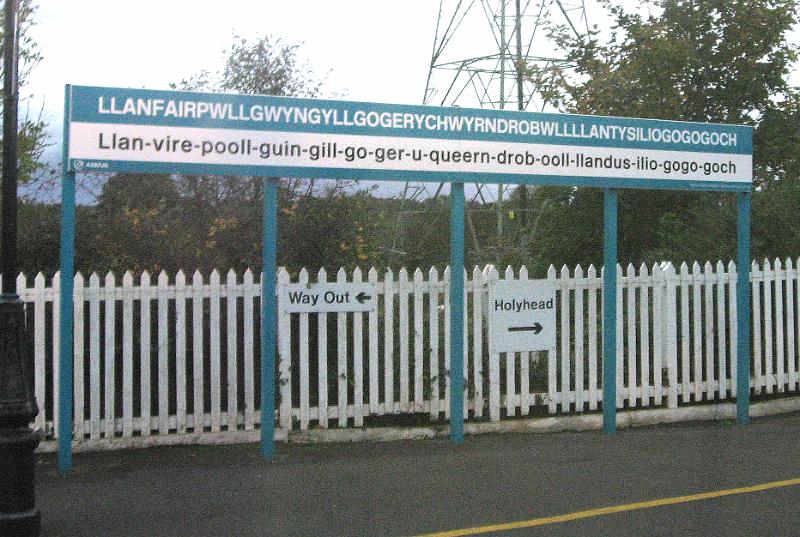
And Welsh place names would continue to be used.

lllanfair pg station

llanfair pg station


The value of a vote

May 10, 2015

In all democracies it is universally assumed that “one man, one vote” is sacrosanct. The “vote” is not earned in any way. Just being born and then being of the minimum age is sufficient to be bestowed with “one vote”. The value of a vote has no connection to merit.

In Scandinavia and most of Europe proportional representation means that one votes for political parties rather than for individuals as representatives of a constituency. The number of seats won by a party is then generally proportional to the total number of votes cast and this leads to an over-representation of minority parties but an under-representation of minorities defined in other ways (gender, ethnicity, age). But the party lists from which the “elected officials” are chosen are produced by the members of the party and the names on the list may or may not have been chosen democratically. The value of the vote of a member of a party is something more than one since that vote also has a say in choosing the party list.

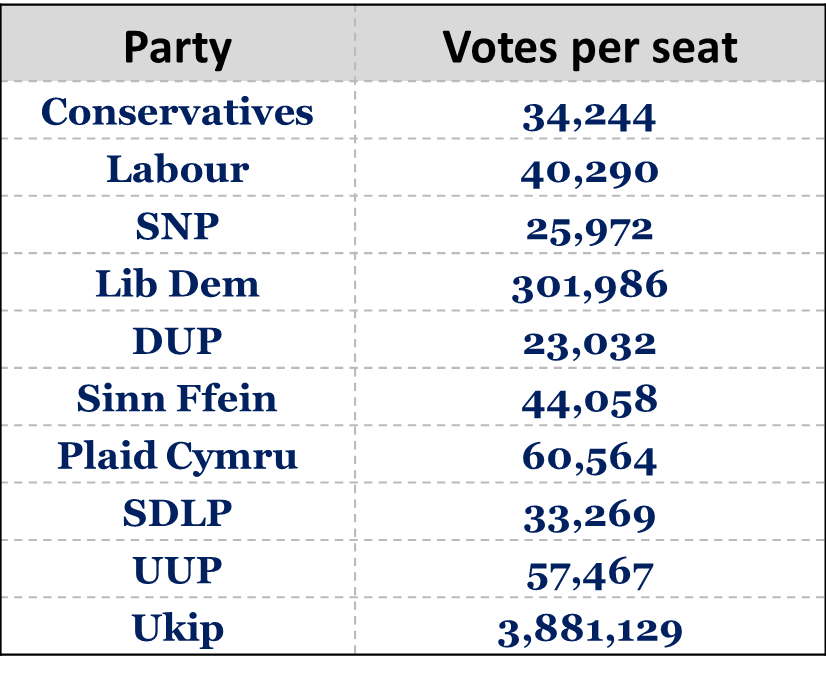
In “first past the post” systems as in the UK, every constituency has an identified representative. In spite of party affiliation, in theory, the elected member represents the entire constituency including its minorities. Of course the elected member then mostly behaves as his party dictates. In the recent UK election the number of votes needed to win a seat in parliament varied from just 25,000 for those supporting the SNP to almost 4 million for a UKIP voter. An SNP vote had a weight 160 times greater than than that of a Ukip voter and 12 times greater than that of a Lib Dem voter.

The Telegraph:

UK votes per seat

UK votes per seat

But it seems to me that in both systems (PR or first-past-the-post), it is irrational that the value of a vote is not graduated and somehow proportional to the value or the merit of the voter.  It seems illogical that a “vote bought” is equal to a “vote freely given” or that a “fool” has the same vote as a “wise man” (however those are defined).

(It is) mere existence as an individual that suffices to have an “equal vote”. And if everyone has the vote it is assumed that “democracy” has been attained – as if it were some sort of state of grace.  The only real criterion is that of age, even if some countries still have some other criteria in force. The merit of the individual is irrelevant. Votes can and are bought by promises or by free meals or by money or by a bus-ride. A “bought” or coerced vote weighs as heavy as one that is freely given. (There is nothing wrong in buying or selling votes – the flaw lies in that the seller has a vote equal to that of free elector). A fool has the same vote as a wise man. A large tax contributor is equated to a small tax contributor. Government servants paid for by taxes have the same weight of vote as the tax payers. Priests and politicians have the vote. The behaviour of an individual does not affect his vote. Experience, intelligence, wisdom, competence or criminality are all considered equally irrelevant. …..  One hundred and one idiots take precedence over one hundred wiser men. 

Of course, measuring “merit” is no easy thing and to get agreement would be extremely difficult – but not impossible.

There is no good reason why all votes should be equal. If there is such a thing as a “good” citizen, or if you accept – as I do – that individuals are not equal in ability and competence and their contribution to a society, then constraining everybody to the same value of vote is itself unjust. Votes must be given weight, I think, according to the “goodness” of the voter. It should not be beyond the wit of man to see to it that an individual had a way of “earning” extra value for his vote by those aspects of his performance or achievements which had value to society. We might then get closer to a “true democracy”. Of course that would also imply that other “anti-social” behaviour or lack of competence could get penalised by having some value of a vote taken away. I can imagine that a “good” citizen or an accomplished citizen could perhaps have a vote with a value enhanced from a base value of one to be – say – 1.5 or 1.8, while a “bad citizen” might have it reduced to – say – 0,5.  A murderer or a fraud serving time could perhaps have their vote value reduced to – say – 0.5. Instead of just being endowed with a vote on reaching the age of 18, an 18-year old could perhaps have 0.2 of a vote increasing to the base value of 1.0 on reaching 23 (when his brain is fully developed).

Such a system is not practical – for the moment. But I would prefer if the right to vote was “earned” in some way and that the value of an individual’s vote had some connection to merit.

Russel Brand and The Guardian have helped cement Cameron’s majority

May 8, 2015

On Tuesday last week (28th April) Ed Miliband met with Russel Brand with the goal of “making the election more interesting”.

On Monday this week (4th May) The Guardian (in the shape of columnist Owen Jones) published an article “Russel Brand has endorsed Labour and the Tories should be worried”. Now Owen Jones is a 4th generation socialist and a defender of and an apologist for the stereotyped “chav”. The Guardian has the Lib Dems as their primary favourites with Labour coming close behind.

In the event, The Guardian and Russel Brand have been almost classically, and doubly, counter-productive. Russel Brand’s self-admitted “big mouth and laptop” are not as persuasive as he and some others would like to think. Jones wrote:

He has nearly 10 million Twitter followers; his YouTube interview with Ed Miliband received well over a million hits and counting; he is listened to by hundreds of thousands of disillusioned Britons, particularly young people who have been repeatedly kicked over the last few years. Russell Brand matters.

And however much bluff and bluster the Tories now pull – maybe more playground abuse from David Cameron, who called Brand a “joke” – his endorsement of Labour in England and Wales will worry them. More people have registered to vote than ever before: between the middle of March and the deadline to register, nearly 2.3 million registered, over 700,000 of them 24 years old or younger.

The Brand effect has been compounded by The Guardian effect. Brand’s mouth and his laptop have certainly been irritating enough to have pushed some few – maybe the critical few – towards Cameron. The Guardian stridency has helped in the collapse of the Lib Dem vote and has sent more of them towards anybody rather than Labour. Brand and The Guardian have effectively provided the icing on Camron’s cake. Twenty four hours ago it was unthinkable that the Tories would have gained any seats and the expectation was for prolonged coalition negotiations. That the Tories could possibly have a majority was not even an outlier in the polls or for the political pundits. And now even the SNP must dampen some of their expectations of influence in Westminster since the Tories have a clear majority of 10 (which is in practice a majority of between 15 and 20 considering the Sinn Fein, the DUP and the Speaker).

As the Spectator writes:

Elsewhere, commentators hailed Brand as the man who has ‘access to voters politicians can’t reach’. Brand was treated as a celeb conduit, a connector of the political class with the plebs, someone who could actually turn things around. ‘The Tories should be worried.’ People seriously said that.

We can laugh at it all now, and we should – in fact, it’s important that we do. Because it turns out that Brand’s ability to get people lining up behind Miliband was pure bluster.

And Russel Brand has compromised his “Don’t Vote” stand for ever and has ensured a Tory majority into the bargain.


UK election night entertainment

May 7, 2015

It should be an interesting next few hours as real results come in. If the main exit poll proves to be correct then it will be quite a coup for David Cameron and a mighty success for Nicola Sturgeon. It will be a humiliating fiasco for Nick Clegg and a great relief to the markets that “Red” Moses Milibrand has a bloody nose. But The YouGov exit poll shows quite different results.


UPDATES!

0530CET: It does look as if the Tories will have 5 -10 seats more than in 2010 and that might be just enough (312 – 317 seats with 323 needed for an effective majority) to try running with a minority government.

The markets will be not too unhappy though the SNP’s clean sweep (almost) in Scotland and their almost communistic tendencies could be a bit worrying. On the other hand the Scots could never be as profligate as Greece has been.

It’s time for a nap before breakfast.


0430 CET: Ed Davey has lost his seat. He must take the prize for knowing less about energy and energy production than any other Energy Minister – other than a former Energy Minister of the UP government . Davey also had the remarkable ability to always ask the wrong questions.


0400CET: Mhairi Black of the SNP is the youngest MP since 1667. She thrashed her Labour opponent. (But at 20 years old, we know that she is formally still an adolescent since her prefrontal cortex will not be fully developed till she is about 25)!

Great campaigns – giving great defeats? It is amazing how every Labour or Lib Dem spokesperson talks about how Miliband and Clegg have both run “fantastic campaigns” but have produced a fiasco in the one case and a melt-down in the other.


0330 CET:  There is talk of both Nick Clegg and Ed Miliband resigning tomorrow. It would be appropriate if Russel Brand also retired from public life  – at least for a few weeks.

If Farage also loses then he will also have to go.

Sturgeon and Cameron the winners.

The Tories may be just short of a majority on their own


Some polls are going to be proven quite wrong.

The UKIP bubble would have burst.

The Pound strengthened by 1% on the eit poll.

Cameron could still just have a majority with the Lib Dems but the Lib Dems would be a very junior partner indeed.

But this is only an exit poll and there is a long – and hopefully entertaining – night ahead.

The election campaign had few fireworks and all the entertainment value is concentrated around the results.

A little bit like the Eurovision Song Contest. No substance in the songs or the singers and all the excitement in the counting of the result.

EU judges don’t have the discernment necessary to tell Sky from Skype

May 6, 2015

Any 5-year old today can tell you what Skype is. In a country where Sky operates the child will also tell you the channel number on cable.

But EU judges – by their own admission –  have not the discernment necessary to be able to tell the difference.  They seem terribly confused  but they try to blame the confusion on the “general public”. But I am afraid I find them (the EU judges) either blatantly partisan or unashamedly unintelligent.

BBC: Video chat software Skype’s name is so similar to the broadcaster Sky’s that the public is likely to be confused between the two, an EU court has ruled.

The judgement prevents Microsoft from registering a trademark for Skype’s name and bubble-design logo. The US company intends to appeal against the decision.

Judges at the General Court of the European Union said: “Conceptually, the figurative element conveys no concept, except perhaps that of a cloud.”

“[That] would further increase the likelihood of the element ‘Sky’ being recognised within the word element ‘Skype’, for clouds are to be found ‘in the sky’ and thus may readily be associated with the word ‘sky’.”

I don’t think that EU judges really lack the intelligence to tell the difference. But they do bend to what is considered to be politically correct in a bigoted EU world. And in that world, EU judges do not easily rule against an EU corporation if pitted against a US (or any non-European) corporation.

After all Skype is now owned by a US corporation

Skype was later acquired by Microsoft in May 2011 for $8.5 billion. Microsoft’s Skype division headquarters are in Luxembourg, but most of the development team and 44% of the overall employees of the division are still situated in Tallinn and Tartu, Estonia.

But Sky is European and the EU judges know what is politically correct.

Sky plc is a British-based pan-European satellite broadcasting, on-demand Internet streaming media, broadband and telephone services company headquartered in London, with operations in the United Kingdom, Ireland, Germany,Austria and Italy. Sky is Europe’s biggest and leading media company and the largest pay-TV broadcaster in Europe, with over 20 million subscribers.

I am afraid that for the EU General Court and its judges, whatever is “politically correct” comes first and any pretense to fairness or being equitable comes a distant second.

The conundrum of putting adolescents into positions of power

May 5, 2015

The prefrontal cortex of the brain, we are told,  mediates decision making, is selectively involved in the retrieval of remote long-term memory and is the seat of good judgement.

The prefrontal cortex (PFC) is located in the very front of the brain, just behind the forehead. In charge of abstract thinking and thought analysis, it is also responsible for regulating behavior. This includes mediating conflicting thoughts, making choices between right and wrong, and predicting the probable outcomes of actions or events. This brain area also governs social control, such as suppressing emotional or sexual urges. Since the prefrontal cortex is the brain center responsible for taking in data through the body’s senses and deciding on actions, it is most strongly implicated in human qualities like consciousness, general intelligence, and personality.

We are also told that the prefrontal cortex is not fully developed till the age of 25 years or even later. Until the prefrontal cortex is fully developed a human is “adolescent”.

BBCChild psychologists are being given a new directive which is that the age range they work with is increasing from 0-18 to 0-25.

There are three stages of adolescence – early adolescence from 12-14 years, middle adolescence from 15-17 years and late adolescence from 18 years and over.

Neuroscience has shown that a young person’s cognitive development continues into this later stage and that their emotional maturity, self-image and judgement will be affected until the prefrontal cortex of the brain has fully developed. Alongside brain development, hormonal activity is also continuing well into the early twenties.

Most countries allow voting at age 18. Some allow voting even earlier:

Those with a national minimum age of 17 include East Timor, Indonesia, North Korea, South Sudan and Sudan. The minimum age is 16 in Argentina, Austria, Brazil, Cuba, Ecuador, Nicaragua and the Isle of Man, Jersey and Guernsey (three self-governing British Crown Dependencies). People aged 16–18 can vote in Bosnia, Serbia and Montenegro if employed.

The mystery is why adolescents whose power of judgement is not yet fully developed are allowed to exercise this undeveloped judgement.

Even more perplexing is why adolescents with undeveloped judgement ability (those < 25 years old) are allowed not only to become armed soldiers and police but also politicians and even members of parliaments? We put them into positions of power where they must exercise their partially-developed judgement – even over others whose judgement is fully developed.

Why?

Statistics in Sweden are quite comprehensive and numbers for voters and politicians in the age group 18 – 29 are readily available. Conservatively, I take the age group 18 – 25 to be the majority (>50%) of the 18-29 age group.

Age group 18 – 25

  1. Proportion of electorate for parliament elections                           >10%
  2. Proportion of candidates                                                                       >6.5%
  3. Proportion of elected members of parliament                                  >5.5%

There is no getting away from the conclusion that over 5% of elected, Swedish members of parliament are adolescents whose brains are not fully developed and whose judgement is less than what it should be.

Interestingly, the proportion of the electorate older than 65 is 25% but the proportion of elected members of parliament over 65 is only 2.9%.

The only explanation I have is that in Sweden, “youth” has been made into a “politically correct” fetish with religious and mystical – if not electoral – significance.

It is not difficult to observe that many in the Swedish parliament today, and even some in government, are remarkably childish and quite clearly demonstrate that they are still adolescent.

Bolivia tries to recover lost territories by unlikely appeal to the ICJ

May 5, 2015

Bolivia has appealed in a case with the International Court of Justice that Chile be forced to negotiate in “good faith” to provide access to the sea. Worth trying I suppose, but it seems to be an attempt unlikely to succeed in recovering some of the territory lost to its neighbours over the last 150 years.

The case is interesting because Bolivia really has no legal case that I can see but is trying to make it into a “moral case”.  It is trying to get the ICJ – and thence the world – to accept that access to the sea is a “fundamental country right”!! International courts are not known for always exercising common sense and a “win” for Bolivia could be a very interesting precedent. There are 47 landlocked countries in the world today. Perhaps Mongolia and Nepal and Switzerland and even Liechtenstein could then also claim their fundamental right to have access to the sea.

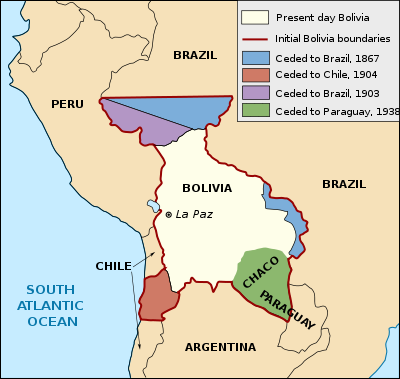
Bolivia has been effectively landlocked since 1880 though only enshrined by treaty since 1904. Currently they pay trans-shipping costs to but are not charged tariffs by Chile.

 LOC: The border between the two countries was last set in a 1904 Treaty of Peace and Friendship, signed in Santiago, Chile, on October 20, 1904. Under that agreement, Bolivia lost 400 kilometers of coastline and 120,000 square kilometers of territory to Chile, following the War of the Pacific of 1879-1884. 

Since that time, Bolivia has been attempting to reclaim the lost territory and the outlet to the sea and has severed relations with Chile repeatedly. Bolivia still maintains a limited navy on Lake Titicaca which lies partly in Peru and partly in Bolivia. Bolivia haa long history of its mestizos being exploited by the wealthy Spanish citizenry but has not been served very well by a long line of its politicians – not least Manuel Isidoro Belzú Humerez (President of Bolivia from 1848 to 1855)  and later Mariano Melgarejo (18th President of Bolivia, from 1864, to 1871) whose international achievements were a little less than dismal

Smithsonian: (Melgarejo) delighted by the gift of a fine gray horse from the Brazilian government, he called for a map of his country, placed one hoof on the border, drew around it and then ceded the resulting horseshoe-shaped chunk of Bolivian territory to Brazil. According to a second dubious anecdote, the president ordered his army to go to the aid of the French during the Franco-Prussian War; told this would mean an ocean voyage, he snapped: “Don’t be stupid. We’ll take a short cut through the brush.”

In any event Bolivia now has only about 50% of the territory it had before 1850.

The changing shape of Bolivia, showing the loss of the coastal province of Antofagusta in 1904. (Although the transfer of territory was ratified in 1904, Antofagusta had been seized by Chile as early as 1880.) Bolivia still seeks the recovery of her coastline, and maintains a navy on Lake Titicaca. Map: Wikicommons vi Smithsonian

The changing shape of Bolivia, showing the loss of the coastal province of Antofagusta in 1904. (Although the transfer of territory was ratified in 1904, Antofagusta had been seized by Chile as early as 1880.) Bolivia still seeks the recovery of her coastline, and maintains a navy on Lake Titicaca. Map: Wikicommons via Smithsonian

On April 15, 2014, Bolivia submitted to the International Court of Justice (ICJ) a memorandum with arguments supporting its lawsuit filed against Chile for the purpose of reclaiming access to the Pacific Ocean. Bolivia lost that access to the coast in a 19th-century war with Chile, leaving it landlocked. Chile has stated that Bolivia’s claims have no historical or legal grounds.

Court proceedings have now opened

ReutersLandlocked Bolivia went to the World Court on Monday, seeking to force Chile to negotiate the granting of a corridor of sovereign territory giving it access to the sea for its natural gas and mineral exports.

Opening proceedings at the International Court of Justice in The Hague, Chile asked judges to throw out the lawsuit, saying the tribunal had no jurisdiction over the matter.

Bolivia bases its claim that the ICJ has jurisdiction under the 1948 Bogota Pact and their request is only that Chile be forced to negotiate in “good faith”. Chile claims that the ICJ has no jurisdiction and that “good faith” negotiations – anyway – are not obligatory.

LOC: The Chilean government has expressed confidence that Bolivia’s claims will not be recognized because they amount to a unilateral dismissal of the 1904 treaty commitment that has established the two countries’ common border and that remains in force.

Bolivia bases its claims on legal, historical, and economic arguments. It demands that the ICJ consider two main points: the recognition of Bolivia’s sovereign right to access to the Pacific Ocean and the requirement that Chile negotiate the issue with Bolivia. Bolivia considers the economic damage caused by its lack of sea access to be extensive. Chile has benefited from the exploitation of natural fertilizers, sulfur, and salt by British companies interested in the profits derived from these materials. The richest copper deposits are located in the land that Bolivia lost to Chile and are key to the prosperity of the Chilean economy.

Bolivia’s Ridiculously Weak ICJ Case Against Chile

Bolivia´s Reasonably Strong ICJ Case against Chile

If Miliband is Moses does that make Cameron the Pharaoh?

May 4, 2015

“Red” Ed Miliband, aka Milibrand, aka Moses, is getting much attention from the photoshoppers with his 8ft high limestone tablet of “commandments.

Moses Miliband

But that would make Cameron the Pharaoh to Moses Miliband.

And if my memory serves, Aaron, Moses’ elder brother acted as his spokesperson, his “prophet”, because Moses could not speak very well.

I suppose Nicola Sturgeon could be a Miriam to “Red” Ed Moses Milibrand and Nigel Farage would be best suited as the High Priest of Amun.

(Nick Clegg does not count).

But whether Moses won or Ramses II won depends on who tells the story. After all Ramses managed to expel Moses and his people and continued to rule for a very long time.

India (finally) puts Ford Foundation and Greenpeace on watch list

April 25, 2015

The Indian government has put the Ford Foundation and Greenpeace on their “watch” list. It was about time. The Ford Foundation serves as an instrument of the CIA and the US government in prosecuting foreign policy and Greenpeace has degenerated into a home for the far-left and the communists who have been left homeless since the collapse of Marxist (and Maoist) ideologies.

NGOs, “not for profit” organisations and charities often take advantage of the misperception of an implied objectivity or impartiality or of being apolitical. A very few such organisations may come close to being so but the vast majority exist to promote a particular view or support a particular group of people or to carry out particular kinds of projects. In every instance they are deeply – and inevitably – political. Nothing wrong with that of course but it is a common misperception to think that being non-profit they are somehow above politics. They are sometimes funded by governments, sometimes used by governments and sometimes used by opposition to governments. They are sometimes used as a cover for espionage (industrial and by states) and sometimes to “promote democracy” by undermining some other view. They sometimes provide much needed education and health care. And sometimes they use education or health services as a cover for carrying out political or religious indoctrination. Madrasas funded from Saudi Arabia as being educational are purely religious and political. The ostensible reason for the existence of the organisation is often used to cloak a hidden agenda. So-called charity workers and others in the field may not even be aware of the hidden agenda they are promoting.

In most cases these organisations enjoy tax breaks. When they receive government funding it is often to enable governments to covertly act in a manner they can not as a government. They are sometimes used for money laundering and sometimes are just a scam for extracting funds from donors. Even so-called charities may actually donate to others less than 10% of the money they raise. Sometimes they do good and often they don’t.

But the bottom line is that they are all – without exception – political. The political standpoint may be implicit or it may be explicit but it is always there. There is no “human rights” charity or NGO which does not have a political agenda. There is no “centre for democracy” which does not have some political agenda which – perforce – is in conflict with the prevailing “authority” or “government”. ISIS, after all, would qualify as a “not for profit” NGO. There is no “wildlife protection” NGO which does not promote a political agenda which may be as simple as preventing poor farmers from clearing forests to grow more crops, or the development of a highway.

I have no doubt that some NGOs – and usually those without the backing of Big Funds – bring attention to and take action in areas that are desperately necessary but which fall between the cracks of government or public policy. But when an NGO is funded by the Ford Foundation or the Bill & Melinda Gates Foundation, I am automatically suspicious about the hidden agenda in that organisation’s objectives.

Many organisations – Greenpeace, the WWF and the FoE as examples – which once had some worthy aims and even did some good work have -since 1991 – been hijacked by the far-left and communists who had no place else to go. In India it is not surprising that the Maoists and the Naxals and other “dissenting and seditious” groups have become the beneficiaries of such NGOs. During my time in the Indian corporate world (2000 -2007) I met with many NGOs seeking corporate funds – but I was not too impressed. Even less so when I found that at remote sites where we were executing projects, the protection money (sometimes even ransom money for our engineers) being demanded by local mafiosos were to be channeled through some ostensibly do-gooding NGO.

The Ford Foundation has for long been used and is still used by the CIA (and the US government) as a vehicle for promoting US policy.

Global Research: The CIA uses philanthropic foundations as the most effective conduit to channel large sums of money to Agency projects without alerting the recipients to their source. From the early 1950s to the present the CIA’s intrusion into the foundation field was and is huge. A U.S. Congressional investigation in 1976 revealed that nearly 50% of the 700 grants in the field of international activities by the principal foundations were funded by the CIA (Who Paid the Piper? The CIA and the Cultural Cold War, Frances Stonor Saunders, Granta Books, 1999, pp. 134-135). The CIA considers foundations such as Ford “The best and most plausible kind of funding cover” (Ibid, p. 135). The collaboration of respectable and prestigious foundations, according to one former CIA operative, allowed the Agency to fund “a seemingly limitless range of covert action programs affecting youth groups, labor unions, universities, publishing houses and other private institutions” (p. 135). The latter included “human rights” groups beginning in the 1950s to the present. One of the most important “private foundations” collaborating with the CIA over a significant span of time in major projects in the cultural Cold War is the Ford Foundation.

….. History and contemporary experience tells us a different story. At a time when government over-funding of cultural activities by Washington is suspect, the FF fulfills a very important role in projecting U.S. cultural policies as an apparently “private” non-political philanthropic organization. The ties between the top officials of the FF and the U.S. government are explicit and continuing. A review of recently funded projects reveals that the FF has never funded any major project that contravenes U.S. policy.

So I was not too surprised to read that the Ford Foundation and Greenpeace India have been put on the Indian government’s watch list.  My surprise is that the Ford Foundation with its CIA connections has been allowed to fund – albeit indirectly – dissension and sedition within India for so long.

Zee News (PTI): The United States on Friday expressed concern over India’s crackdown on Ford Foundation and Greenpeace, and said it is seeking “clarification” on the action.

“We are aware that the (Indian) Ministry of Home Affairs suspended the registration of Greenpeace India and has placed the Ford Foundation on a prior permission watch list,” State Department Deputy Acting Spokesperson, Marie Harf, told reporters at her daily news conference.

“We remain concerned about the difficulties caused to civil society organisations by the manner in which the Foreign Contributions Regulations Act has been applied,” she said in response to a question.

“We are concerned that this recent ruling limits the necessary and critical debate within Indian society and we are seeking a clarification on this issue with the appropriate Indian authorities,” Harf said.

In a crackdown on foreign funding to NGOs, the Union Home Ministry has put the Ford Foundation of the US on its “watch list” and ordered that all funds coming from the international organisation have to be routed only with its nod due to “national security concerns”.

The Home Ministry said it has decided to keep a watch on all activities funded by Ford Foundation and by exercising the powers conferred under Section 46 of Foreign Contribution Regulation Act 2010, directed Reserve Bank of India to ensure that funds coming from it be brought to the notice of the Home Ministry.

The Ministry said it wanted to ensure that funds coming from Ford Foundation is utilised for “bonafide welfare activities without compromising on concerns of national interest and security”.

The move came after Gujarat government asked the Home Ministry to take action against Ford Foundation as it alleged that the US-based organisation was “interfering in the internal affairs” of the country and also “abetting communal disharmony” through an NGO run by social activist Teesta Setalvad.

Early this month, the Home Ministry had frozen seven bank accounts of Greenpeace India and barred it from receiving foreign funds for allegedly violating FCRA and “prejudicially” affecting the country’s public and economic interests.

Non-profit does not mean non-partisan or apolitical.

For me NGOs is a dirty word.
“They’re off” in the great UK entertainment stakes

March 30, 2015

The UK General Election campaign kicked off today. There are 38 days of campaigning and I am looking forward to some entertainment from the antics of the menagerie.

  • From the duck I expect that the many insults will just roll of its back, that it will not produce any deep or profound thoughts but that it may make some dreadful (and hopefully entertaining) gaffes.
  • I expect the poodle to spend much effort in denying it is a poodle, trying to appear pro-business while soaking the rich and denying that it is really a communist.
  • I expect that Nicola Sturgeon may compete in a show of fangs with Alex Salmond to demonstrate who is the more dangerous hyena. Possibly they will split the work-load with Salmond harrying the poodle while Sturgeon goes after the duck.
  • The jackal will race after any wounded prey in sight and may also look for unattended carcasses to feed from. It will be fascinating to see if the lame duck manages to land any kicks on the sneaky but nimble jackal as it cavorts around.
  • The chameleon will continue being all things to all men (and women), but may stand exposed as it changes colour too slowly to keep up with the changes in its background. But the illusions it weaves could be compelling for those with a hallucinatory frame of mind.
  • The green slug will slither along in its slime, first one way then another, in great confusion, but it could provide some interesting contortionist tricks.

UK general election menagerie


It’s not a bad cast from an entertainment perspective. From the viewpoint of leadership or vision, it is a pretty useless bunch. The duck has the advantage of having been at the top table for some time. But it may have outstayed its welcome and could provide a succulent feast for a clever predator (though cleverness is conspicuously lacking among the predators on show).