Archive for the ‘Science’ Category

Physics Nobel today – Higgs? but (hopefully) not CERN! Update – awarded to François Englert and Peter W. Higgs

October 8, 2013

UPDATE 2!

There is more speculation doing the rounds as to why the awards were delayed by one hour.

There are some suggestions that this time was used to kill the ridiculous notion of having CERN – the organisation – as the third award winner! If that was the reason then it was time well spent!

The deliberations of the awards committee will not be released for 50 years.

=============================================

UPDATE!

The Physics Nobel award has been awarded to François Englert and Peter W. Higgs

NO CERN thankfully.

=============================================

  • 106 Nobel Prizes in Physics have been awarded between 1901-2012.
  • 47 Physics Prizes have been given to one Laureate only.
  • women have been awarded the Physics Prize so far.
  • person, John Bardeen, has been awarded the Physics Prize twice.
  • 25 years was the age of the youngest Physics Laureate ever, Lawrence Bragg, when he was awarded the 1915 Physics Prize together with his father.
  • 55 is the average age of the Physics Laureates the year they were awarded the prize.

==============================================

The speculation this morning on Swedish Radio is that the Higgs Boson will be recognised. There was some speculation that Higgs himself could lose out but that CERN – as an organisation – could be a winner. I hope not. The Radio commentators all seem to have the impression that the Higgs particle was discovered by CERN last year. But my understanding is that nothing was actually found. Something – not inconsistent with a Higgs particle – was indicated and the Higgs particle was “tentatively confirmed to exist on 14 March 2013” (though “tentative” and “confirmation” is a contradiction in terms).

In any event, I think the Nobel should stick to individuals and not go the way of the discredited Peace Prize and name an organisation like CERN. Professor Higgs would be acceptable even though it would be preferable to wait – but not CERN.

We shall see. (The announcement is due in about 3 hours).

Thomson Reuters predictions:

PHYSICS

François Englert and Peter W. Higgs
For their prediction of the Brout-Englert-Higgs boson

Hideo Hosono
For his discovery of iron-based superconductors

Geoffrey W. Marcy and Michel Mayor and Didier Queloz
For their discoveries of extrasolar planets

Nobel Prize time again: Medicine to Rothman, Schekman and Südhof

October 7, 2013

UPDATE:

The Nobel Prize in Physiology or Medicine 2013 was awarded jointly to James E. Rothman, Randy W. Schekman and Thomas C. Südhof“for their discoveries of machinery regulating vesicle traffic, a major transport system in our cells”.

===========================================

It is that time of the year again. But the Nobel Peace Prize and that for Economics are a travesty and ought to be discontinued. The Peace Prize especially takes more away from the Nobel brand than it offers. Without the Nobel brand to prop it up the Peace Prize would be considered a nonsense with very little to do with Peace. The Literature prize is also very politically correct which detracts from its importance to literature.

My hope is that the blatant lobbying by the PR apparatus of the CERN group will NOT be recognised with a Nobel.

The schedule beginning today is:

Monday 7 October, 11:30 a.m. at the earliest – The Nobel Prize in Physiology or Medicine
The prize will be announced by Göran K. Hansson, Secretary of the Nobel Committee for Physiology or Medicine.

Tuesday 8 October, 11:45 a.m. at the earliest – The Nobel Prize in Physics
The prize will be announced by Staffan Normark, Permanent Secretary of the Royal Swedish Academy of Sciences.

Wednesday 9 October, 11:45 a.m. at the earliest – The Nobel Prize in Chemistry
The prize will be announced by Staffan Normark, Permanent Secretary of the Royal Swedish Academy of Sciences.

Friday 11 October, 11:00 a.m. – The Nobel Peace Prize
The prize will be announced by Thorbjørn Jagland, Chairman of the Norwegian Nobel Committee.

Monday 14 October, 1:00 p.m. at the earliest – The Sveriges Riksbank Prize in Economic Sciences in Memory of Alfred Nobel
The prize will be announced by Staffan Normark, Permanent Secretary of the Royal Swedish Academy of Sciences.

The Nobel Prize in Literature
According to tradition, the Swedish Academy will set the date for its announcement of the Nobel Prize in Literature later. The Prize will be announced by Peter Englund, Permanent Secretary of the Swedish Academy.

Thomson-Reuters have made their predictions:

The 2013 Thomson Reuters Citation Laureates by Nobel Prize category are:

CHEMISTRY

A. Paul Alivisatos  and Chad A. Mirkin and Nadrian C. Seeman
For contributions to DNA nanotechnology

Bruce N. Ames
For the invention of the Ames test of mutagenicity

M.G. Finn and Valery V. Fokin and K. Barry Sharpless
For the development of modular click chemistry

PHYSICS

François Englert and Peter W. Higgs
For their prediction of the Brout-Englert-Higgs boson

Hideo Hosono
For his discovery of iron-based superconductors

Geoffrey W. Marcy and Michel Mayor and Didier Queloz
For their discoveries of extrasolar planets

PHYSIOLOGY or MEDICINE

Adrian P. Bird and Howard Cedar and Aharon Razin
For their fundamental discoveries concerning DNA methylation and gene expression

Daniel J. Klionsky and Noboru Mizushima and Yoshinori Ohsumi
For elucidating the molecular mechanisms and physiological function of autophagy

Dennis J. Slamon
For his pioneering research identifying the HER-2/neu oncogene, leading to more effective cancer therapy

ECONOMICS
Joshua D. Angrist and David E. Card and Alan B. Krueger
For their advancement of empirical microeconomics

Sir David F. Hendry and M. Hashem Pesaran and Peter C.B. Phillips
For their contributions to economic time-series, including modeling, testing and forecasting

Sam Peltzman and Richard A. Posner
For extending economic theories of regulation

Solar Cycle 24 has passed its maximum – 25 years of cooling to be expected in this Landscheidt minimum

October 4, 2013

The September sunspot numbers are now out and it would seem that Solar Cycle 24 has passed its maximum. It looks very much like SC23, SC24 and the coming SC25 will be comparable to SC4, 5 and 6. Solar Cycles 5 and 6 were responsible for the Dalton Minimum. SC 24 and 25 will constitute the Landscheidt Minimum and we can now expect some 25 additional years of global cooling (which has of course already started – about 6 or 7 years ago).

LSC: This month was recorded as the lowest month since Jan 2011 which was the beginning of the rampup for SC24. Cycle max is close or passed with the northern hemisphere changing polarity and the south still somewhat floundering. The southern hemisphere just outweighing the northern hemisphere, showing the south is not meeting expectations by some that a second peak will occur. … SIDC 36.9, NOAA unadjusted at 55.0 (prov). 

NASA has made its latest prediction:

SC24 prediction October 2013

SC24 prediction October 2013

The transition from SC 23 to SC 24 looks very similar to that from SC4 to SC5.

SC4-6 and Dalton

SC4-6 and Dalton

Of course the IPCC makes little of any solar effects and while the variation of direct total irradiance is small, they are rather nonchalant about the very many profound ways in which solar effects manifest themselves in climate (via cloud formation and ocean cycles for example). But the global warmists and the IPCC have now so much invested in their increasingly dubious hypothesis that they are prepared to make the most convoluted contortions to deny the hiatus and that global cooling has started.

Judith Curry: 

Section 8.4.1 of the IPCC AR5 Report provides 2 pages of discussion on observations of solar irradiance.  But they conclude that all this doesn’t matter for the climate.  I agree that the TSI RF variations are much less than projected increased forcing due to the GHG.  But the solar-climate connection is probably a lot more complex than this statement implies. …..

…. Henrik Svensmark has an essay While the Sun Sleeps, …..

Solar activity has always varied. Around the year 1000, we had a period of very high solar activity, which coincided with the Medieval Warm Period. But after about 1300 solar activity declined and the world began to get colder. It was the beginning of the episode we now call the Little Ice Age.

It’s important to realise that the Little Ice Age was a global event. It ended in the late 19th Century and was followed by increasing solar activity. Over the past 50 years solar activity has been at its highest since the medieval warmth of 1000 years ago. But now it appears that the Sun has changed again, and is returning towards what solar scientists call a “grand minimum” such as we saw in the Little Ice Age.

The match between solar activity and climate through the ages is sometimes explained away as coincidence. Yet it turns out that, almost no matter when you look and not just in the last 1000 years, there is a link. Solar activity has repeatedly fluctuated between high and low during the past 10,000 years. In fact the Sun spent about 17 per cent of those 10,000 years in a sleeping mode, with a cooling Earth the result.

You may wonder why the international climate panel IPCC does not believe that the Sun’s changing activity affects the climate. The reason is that it considers only changes in solar radiation. That would be the simplest way for the Sun to change the climate – a bit like turning up and down the brightness of a light bulb.

Satellite measurements have shown that the variations of solar radiation are too small to explain climate change. But the panel has closed its eyes to another, much more powerful way for the Sun to affect Earth’s climate. In 1996 we discovered a surprising influence of the Sun – its impact on Earth’s cloud cover. High-energy accelerated particles coming from exploded stars, the cosmic rays, help to form clouds.

[C]limate scientists try to ignore this possibility.  If the Sun provoked a significant part of warming in the 20th Century, then the contribution by CO2 must necessarily be smaller.

The outcome may be that the Sun itself will demonstrate its importance for climate and so challenge the theories of global warming. No climate model has predicted a cooling of the Earth – quite the contrary. ….


In the Mediterranean temperatures indicate long-term trends which are decreasing

September 30, 2013

Well Now!

Michael Mann’s splicing of temperature records onto tree ring proxies and his trick of hiding the decline to create his hockey stick begins to look decidedly fishy. And the IPCC is beginning to smell.

And this coming at the same time as the release of the IPCC’s AR5 Summary emphasises how far removed the IPCC is from science.

Ingo Heinrich, Ramzi Touchan, Isabel Dorado Liñán, Heinz Vos, Gerhard HelleWinter-to-spring temperature dynamics in Turkey derived from tree rings since AD 1125Climate Dynamics, 2013; 41 (7-8): 1685, DOI:10.1007/s00382-013-1702-3

AbstractIn the eastern Mediterranean in general and in Turkey in particular, temperature reconstructions based on tree rings have not been achieved so far. Furthermore, centennial-long chronologies of stable isotopes are generally also missing. Recent studies have identified the tree species Juniperus excelsa as one of the most promising tree species in Turkey for developing long climate sensitive stable carbon isotope chronologies because this species is long-living and thus has the ability to capture low-frequency climate signals. We were able to develop a statistically robust, precisely dated and annually resolved chronology back to AD 1125. We proved that variability of δ13C in tree rings of J. excelsa is mainly dependent on winter-to-spring temperatures (January–May). Low-frequency trends, which were associated with the medieval warm period and the little ice age, were identified in the winter-to-spring temperature reconstruction, however, the twentieth century warming trend found elsewhere could not be identified in our proxy record, nor was it found in the corresponding meteorological data used for our study. Comparisons with other northern-hemispherical proxy data showed that similar low-frequency signals are present until the beginning of the twentieth century when the other proxies derived from further north indicate a significant warming while the winter-to-spring temperature proxy from SW-Turkey does not. Correlation analyses including our temperature reconstruction and seven well-known climate indices suggest that various atmospheric oscillation patterns are capable of influencing the temperature variations in SW-Turkey.

Alpha Galileo reports: 

For the first time a long temperature reconstruction on the basis of stable carbon isotopes in tree rings has been achieved for the eastern Mediterranean. An exactly dated time series of almost 900 year length was established, exhibiting the medieval warm period, the little ice age between the 16th and 19th century as well as the transition into the modern warm phase. Moreover, Ingo Heinrich from the GFZ German Research Centre for Geosciences and colleagues revealed that the modern warming trend cannot be found in the new chronology. “A comparison with seasonal meteorological data also demonstrates that at several places in the Mediterranean the winter and spring temperatures indicate long-term trends which are decreasing or at least not increasing”, says Ingo Heinrich. “Our results stress the need for further research of the regional climate variations.”

It seems that especially temperature reconstructions derived from extreme sites such as high mountain zones and high latitudes do not always correctly reflect the climate of the different geographical regions. The past temperature variations in the lowlands of central Europe and in the Mediterranean are not well understood yet. The analysis of carbon isotope ratios (13C/12C) in tree rings aims to close this research gap. By focusing on the months January to May the researchers detected the period in which the trees shift from dormancy in late winter to re-activation of growth in early spring. The carbon isotope ratios measured in individual tree rings largely depends on the environmental conditions; thus, the varying tree-ring isotope values are good indicators for changes in the environment. The carbon isotope ratios in the trees from Turkey indicate a temperature sensitivity of the trees during late winter to early spring. In cold winters the cambium and the leaves are damaged more than usual and the following recovery in spring takes longer. Low spring temperatures further delay the photosynthesis or slow down the rate of photosynthesis, with negative effects on the cambial activity.


Feynman lectures now on-line

September 22, 2013

File:The Feynman Lectures on Physics.jpgRichard Feynman is one of my heroes.

The Feynman Lectures on Physics

Caltech and The Feynman Lectures Website are pleased to present this online edition of The Feynman Lectures on Physics. Now, anyone with internet access and a web browser can enjoy reading a high-quality up-to-date copy of Feynman’s legendary lectures. This edition has been designed for ease of reading on devices of any size or shape; text, figures and equations can all be zoomed without degradation.

(This is a work in progress. Initially we are publishing Volume I; We hope to eventually publish Volumes II and III, and lectures will be posted as time and funds permit.)

Some Feynman quotes: (Especially for Global Warmists)

  • The first principle is that you must not fool yourself and you are the easiest person to fool.
  • It doesn’t matter how beautiful your theory is, it doesn’t matter how smart you are. If it doesn’t agree with experiment, it’s wrong  
  • There is a computer disease that anybody who works with computers knows about. It’s a very serious disease and it interferes completely with the work. The trouble with computers is that you ‘play’ with them!
  • If you thought that science was certain – well, that is just an error on your part.
  • Science is the belief in the ignorance of experts.
  • No government has the right to decide on the truth of scientific principles, nor to prescribe in any way the character of the questions investigated. 
  • An ordinary fool isn’t a faker; an honest fool is alright. But a dishonest fool is terrible.

Citation stacking rife in Brazil

September 3, 2013

The impact factor of an academic journal is a measure of the average number of citations for articles in the journal. In the academic world it is always better to have your papers published by a “high impact” journal. For editors and publishing houses, impact factor is directly related to revenues earned. Over the years the methods of increasing the number of citations (not self citations, by articles in other journals and preferably from a different publishing house) and the impact factors of journals have become increasingly sophisticated.

Citation stacking has been the method that has developed where editors of journals – sometimes even from quite different publishing houses – have colluded to see to it that articles in their journals cited articles in the others. This has been going on for some time and a year ago THE reported that Thomson Reuters had suspended 26 journals for citation stacking.

“Anomalous citation patterns” is a euphemism for excessive citation of other articles published in the same journal. It is generally assumed to be a ruse to boost a journal’s impact factor, which is a measure of the average number of citations garnered by articles in the journal over the previous two years.

Impact factors are often used, controversially, as a proxy for journal quality and, even more contentiously, for the quality of individual papers published in the journal and even of the people who write them.

When Thomson Reuters discovers that anomalous citation has had a significant effect on a journal’s impact factor, it bans the journal for two years from its annual Journal Citation Reports (JCR), which publishes up-to-date impact factors.

In Brazil the Ministry of Education is obsessed by impact factor. In consequence publishing in high impact factor journals has become a matter of survival in academia.  Journals have been caught in a vicious cycle where nobody wants to publish in their pages because their impact factor is too low and their impact factor falls further because they have insufficient citations.

“By 2009, editors of eight Brazilian journals decided to take measures into their own hands”. 

Ciencia Brasil has been pointing out dubious cases in Brazilian journals for some time. The Brazilian scam has now reached the pages of Nature as Thomson Reuters suspends some Brazilian journals from its rankings for ‘citation stacking:

Brazilian citation scheme outed

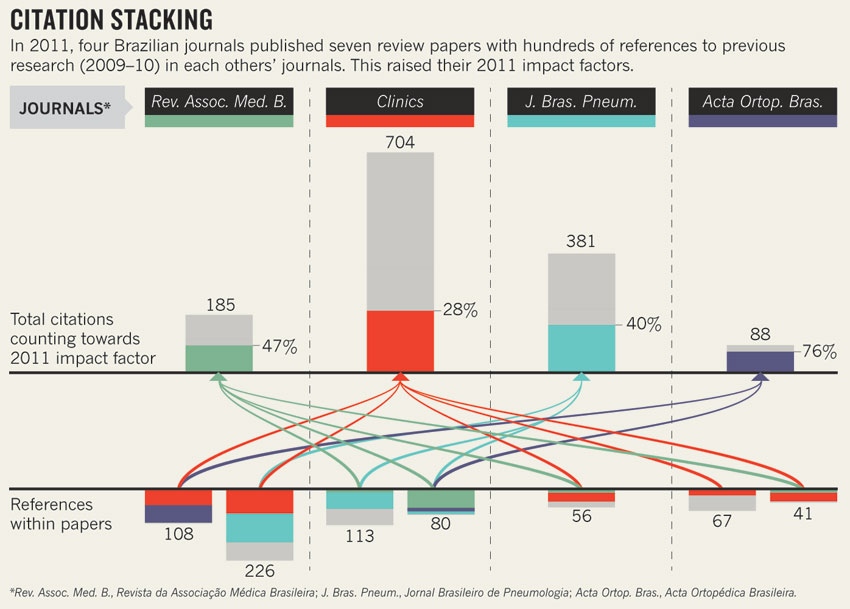
Mauricio Rocha-e-Silva thought that he had spotted an easy way to raise the profiles of Brazilian journals. From 2009, he and several other editors published articles containing hundreds of references to papers in each others’ journals — in order, he says, to elevate the journals’ impact factors.

Because each article avoided citing papers published by its own journal, the agreement flew under the radar of analyses that spot extremes in self-citation — until 19 June, when the pattern was discovered. Thomson Reuters, the firm that calculates and publishes the impact factor, revealed that it had designed a program to spot concentrated bursts of citations from one journal to another, a practice that it has dubbed ‘citation stacking’. Four Brazilian journals were among 14 to have their impact factors suspended for a year for such stacking. And in July, Rocha-e-Silva was fired from his position as editor of one of them, the journal Clinics, based in São Paulo.

…. Editors have tried before to artificially boost impact factors, usually by encouraging the citation of a journal’s own papers. Each year, Thomson Reuters detects and cracks down on excessive self-citation. This year alone, it red-flagged 23 more journals for the wearily familiar practice. But the revelation that journals have gained excessively from citations elsewhere suggests that some editors may be searching for less detectable ways to boost their journals’ profiles. In some cases, authors may be responsible for stacking, perhaps trying to boost citations of their own papers.

The journals flagged by the new algorithm extend beyond Brazil — but only in that case has an explanation for the results emerged. Rocha-e-Silva says the agreement grew out of frustration with his country’s fixation on impact factor. In Brazil, an agency in the education ministry, called CAPES, evaluates graduate programmes in part by the impact factors of the journals in which students publish research. As emerging Brazilian journals are in the lowest ranks, few graduates want to publish in them. This vicious cycle, in his view, prevents local journals improving.

Abel Packer, who coordinates Brazil’s system of free government-sponsored journals, known as SciELO, says that the citation-stacking venture was “unfortunate and unacceptable”. But he adds that many editors have long been similarly critical of the CAPES policy because it encourages local researchers to publish in high-impact journals, increasing the temptation for editors to artificially boost their own impact factors, he says.

Nature 500, 510–511 (29 August 2013) 

Read the articledoi:10.1038/500510a

Black Holes are not as voracious as they are made out to be

August 30, 2013

I don’t understand the physics of black holes.

But I certainly had the impression that the relentless pull of gravity meant that they ruthlessly devoured everything in their paths and that they were bottomless pits. Everything beyond the event horizon – by definition – was entirely unknown and the stuff – possibly – of new Universes.

Not so – according to NASA. “Contrary to what some people think, black holes do not actually devour everything that’s pulled towards them. Sgr A* is apparently finding much of its food hard to swallow.” And so the black hole spits out what it can’t swallow!

Q. D. Wang, M. A. Nowak, S. B. Markoff, F. K. Baganoff, S. Nayakshin, F. Yuan, J. Cuadra, J. Davis, J. Dexter, A. C. Fabian, N. Grosso, D. Haggard, J. Houck, L. Ji, Z. Li, J. Neilsen, D. Porquet, F. Ripple, and R. V. Shcherbakov. Dissecting X-ray–Emitting Gas Around the Center of Our GalaxyScience, 2013; 341 (6149): 981-983 DOI:10.1126/science.1240755

NASA Press Release:

New Chandra images of Sagittarius A* (Sgr A*), which is located about 26,000 light-years from Earth, indicate that less than 1 percent of the gas initially within Sgr A*’s gravitational grasp ever reaches the point of no return, also called the event horizon. Instead, much of the gas is ejected before it gets near the event horizon and has a chance to brighten, leading to feeble X-ray emissions.

These new findings are the result of one of the longest observation campaigns ever performed with Chandra. The spacecraft collected five weeks’ worth of data on Sgr A* in 2012. The researchers used this observation period to capture unusually detailed and sensitive X-ray images and energy signatures of super-heated gas swirling around Sgr A*, whose mass is about 4 million times that of the sun.

“We think most large galaxies have a supermassive black hole at their center, but they are too far away for us to study how matter flows near it,” said Q. Daniel Wang of the University of Massachusetts in Amherst, who led of a study published Thursday in the journal Science. “Sgr A* is one of very few black holes close enough for us to actually witness this process.”

The researchers found that the Chandra data from Sgr A* did not support theoretical models in which the X-rays are emitted from a concentration of smaller stars around the black hole. Instead, the X-ray data show the gas near the black hole likely originates from winds produced by a disk-shaped distribution of young massive stars.

“This new Chandra image is one of the coolest I’ve ever seen,” said co-author Sera Markoff of the University of Amsterdam in the Netherlands. “We’re watching Sgr A* capture hot gas ejected by nearby stars, and funnel it in towards its event horizon.”

To plunge over the event horizon, material captured by a black hole must lose heat and momentum. The ejection of matter allows this to occur.

“Most of the gas must be thrown out so that a small amount can reach the black hole”, said Feng Yuan of Shanghai Astronomical Observatory in China, the study’s co-author. “Contrary to what some people think, black holes do not actually devour everything that’s pulled towards them. Sgr A* is apparently finding much of its food hard to swallow.”

The gas available to Sgr A* is very diffuse and super-hot, so it is hard for the black hole to capture and swallow it. The gluttonous black holes that power quasars and produce huge amounts of radiation have gas reservoirs much cooler and denser than that of Sgr A*. ….

For Chandra images, multimedia and related materials, visit: http://www.nasa.gov/chandra

Nature Editorial – All change but no change (because the heat is hidden)

August 29, 2013

A very peculiar Nature Editorial.

First they confirm that there has been a hiatus in global temperature.Then they report on recent papers trying to invoke ocean cycles and their impact on global temperatures. This is followed by a claim that this does not explain the “missing heat” but fail to say that there may be no “missing heat” at all if global warming has slowed-down or ceased. By assuming that there must be “missing heat” they then claim that the underlying science has not changed. The key point of course is that if ocean cycles can cause global cooling they can also cause global warming. Natural processes can then well explain all the temperature observations of the last 150 years. Carbon dioxide concentration in the atmosphere and the 5% of global emission that is man-made emissions of carbon dioxide become irrelevant and unnecessary to the explanations for changes to climate.

“Hidden heat” that cannot be found is just a convenient excuse to avoid having to scrap most of the existing climate models. And what Nature fails to mention is that if there is no “missing heat” then the entire edifice that is the man-made global warming hypothesis comes crashing down.

Nature: Hidden heat

Nature 500, 501 (29 August 2013), doi:10.1038/500501a

This week, Nature publishes a study online suggesting that a recent cooling trend in the tropical Pacific Ocean can explain the current hiatus in global warming. Authored by a pair of scientists at the Scripps Institution of Oceanography in La Jolla, California, the paper does not say why the Pacific seems to have entered a prolonged ‘La Niña’ phase, in which cooler surface waters gather in the eastern equatorial Pacific. It is also silent on where the missing heat is going. But it does suggest that this phenomenon — affecting as little as 8% of Earth’s surface — could temporarily counteract the temperature increase expected from rising greenhouse-gas emissions

(Y. Kosaka and S.-P. Xie  Nature, http://dx.doi.org/10.1038/nature12534; 2013).

Previous modelling studies have linked the pause to La-Niña-like conditions that have prevailed since 1999, suggesting that heat that would otherwise go into the atmosphere is getting buried deeper in the ocean. And scientists at the National Center for Atmospheric Research in Boulder, Colorado, have a study in the press indicating that decades in which global air temperature rises rapidly — including the 1980s and 1990s — are associated with warmer temperatures in the tropical Pacific, as exemplified by La Niña’s opposite effect, El Niño (G. A. Meehl et al. J. Climate http://doi.org/nkw; 2013). The Scripps researchers also confirmed that El-Niño-like conditions can boost global temperatures.

Scientists seem to be homing in on an important lever in the climate system. And none too soon. Although a prolonged hiatus in warming does not necessarily contradict prevailing theory, this one came as a surprise and has been used to discredit the climate-science community. The story will probably not end there. Scientists know that the Sun has been in a prolonged solar minimum for several years, which means less incoming energy, and there may yet be a role for sunlight-blocking aerosols — human pollution and volcanic ash — and other factors in the hiatus. But at least a better explanation of the climate system is beginning to take shape.

All of this comes as the Intergovernmental Panel on Climate Change (IPCC) prepares to release the first instalment of its fifth assessment report. The hiatus in warming is at the centre of an ongoing debate about ‘equilibrium climate sensitivity’, which is the amount of warming that would be expected over the long term owing to a doubling of atmospheric carbon dioxide levels. Several papers have assessed the most recent data and conclude that the climate may not be as sensitive to greenhouse gases as was previously thought. The latest draft of the IPCC summary for policy-makers accounts for this — just. It suggests a likely climate sensitivity of 1.5–4.5 °C, compared with a range of 2–4.5 °C in the IPCC’s last assessment report.

Some argue that recent temperature trends show that the climate problem is less urgent. One can only hope that this is so, and scientists will continue to probe the matter. But policy-makers would be foolhardy to think that the danger has receded. Although scientists understand the basic physics, nobody can know how the numbers will turn out, as shown by the various temperature projections. Plenty of other lines of evidence, including palaeoclimate data and modern modelling experiments, support the higher end of these.

Ultimately, the decision over how to characterize climate sensitivity will fall to government officials who will approve — under the watchful eye of scientists — the latest IPCC documents in Stockholm next month. Whatever their decision, the underlying science has not changed.

This 2007 ClimateGate quote seems timely:

“What if climate change appears to be just mainly a multidecadal natural fluctuation? They’ll kill us probably…”

[Via Barry Woods; Tommy Wills, Swansea University to the mailing list for tree-ring data forum ITRDB, 28 Mar 2007]

Noted in passing 29th August 2013 – Silly season 2013 comes to an end

August 29, 2013

The varied headlines on all fronts today tell their tale. Silly season 2013 has come to an end.

David Cameron’s rush to war got a slap in the face: Back from the brink: PM forced to retreat over Syria.

Barack Obama does not want to be seen to be following in Bush’s footsteps: U.S. Facing Test on Proof to Back Taking Action on Syria

In Australia Kevin Rudd is desperate to join the big table: Rudd demands ‘robust’ response to Syrian chemical attack

Angela Merkel is beginning to campaign seriously for the German elections: Greece should never have been allowed to join euro: Merkel

Finally the main stream media are realising that global warming stopped some time ago: Global warming slowdown linked to cooler Pacific waters

Sweden’s equivalent of Eton, the elite Lundsberg school, was closed down by the authorities after some vicious ragging incidents: Swedish boarding school shut down after bullying claims

The gloss on the surface of Incredible India is getting badly tarnished: Economix: India’s Economic Crisis

We are all Martians: Earth life ‘may have come from Mars’

The oldest archaeological sites in the Amazon region: 10,000-year-old remains of settlements are unearthed in Bolivia

A clash between righteous do-gooders: Wind farms are a breach of human rights says UN. No, really.

Even articles in Nature are showing that the IPCC’s reliance on climate models rather than real observations is beginning to look particularly inane: Overestimated global warming over the past 20 years

Surprise! Surprise! Forensic Experts May Be Biased by the Side That Retains Them

Tony Blair continues his money-grubbing ways: TONY BLAIR EN MISSION POUR LA PAIX… SUR UN YACHT

A late spring and a short summer has led to Arctic ice melting much slower than for many years: IS ARCTIC SEA ICE REBOUNDING?

Global warming hiatus confirmed – now the Pacific is to “blame”

August 28, 2013

Speculation is rife as to why there has been no global warming for the last 17 or 18 years. Some of this speculation is by those who believe the science is settled and is merely to try and “save” the discredited climate models used by the IPCC. Others – the real scientists – actually use it as an opportunity to investigate something that is not very well understood at all.

The lack of warming has been “blamed” on a variety of reasons. Some have blamed mysterious heat storage in the deep ocean where the heat has actually been transported from and through colder temperatures to higher temperatures! Others say that aerosols and soot in the atmosphere – due to pollution – have distorted the warming trend by hiding the sun. Some few point out that the models really don’t know how to treat clouds and moisture in the atmosphere and what actually drives cloud formation is still an unknown unknown. And there are those – like me – who put it down to natural variation which in turn is ultimately driven – via many still unknown mechanisms – by the Sun.

The El Nino-Southern Oscillation, has a major impact on global climate and is usually acknowledged but a new paper in Nature now suggests that the lack of warming is due to the Pacific Decadal Oscillation that lasts for a much longer period of time (15 – 30 years).  There may well be some influence of the Pacific Decadal Oscillation and no doubt it should be investigated further. But it does first need an acknowledgement that there is something to be investigated. As the authors begin “Despite the continued increase in atmospheric greenhouse gas concentrations, the annual-mean global temperature has not risen in the twenty-first century, challenging the prevailing view that anthropogenic forcing causes climate warming”.

Yu Kosaka & Shang-Ping Xie, Recent global-warming hiatus tied to equatorial Pacific surface cooling, Nature Letter (2013),

doi:10.1038/nature12534

Despite the continued increase in atmospheric greenhouse gas concentrations, the annual-mean global temperature has not risen in the twenty-first century, challenging the prevailing view that anthropogenic forcing causes climate warming. Various mechanisms have been proposed for this hiatus in global warming, but their relative importance has not been quantified, hampering observational estimates of climate sensitivity. Here we show that accounting for recent cooling in the eastern equatorial Pacific reconciles climate simulations and observations. We present a novel method of uncovering mechanisms for global temperature change by prescribing, in addition to radiative forcing, the observed history of sea surface temperature over the central to eastern tropical Pacific in a climate model. Although the surface temperature prescription is limited to only 8.2% of the global surface, our model reproduces the annual-mean global temperature remarkably well with correlation coefficient r = 0.97 for 1970–2012 (which includes the current hiatus and a period of accelerated global warming). Moreover, our simulation captures major seasonal and regional characteristics of the hiatus, including the intensified Walker circulation, the winter cooling in northwestern North America and the prolonged drought in the southern USA. Our results show that the current hiatus is part of natural climate variability, tied specifically to a La-Niña-like decadal cooling. Although similar decadal hiatus events may occur in the future, the multi-decadal warming trend is very likely to continue with greenhouse gas increase.