Archive for the ‘Science’ Category

Chang’e-2 enters penultimate lunar orbit

October 8, 2010

http://news.xinhuanet.com/english2010/sci/2010-10/08/c_13547437.htm

China’s second unmanned lunar probe, Chang’e-2, has successfully completed its second braking at perilune on Friday, which decelerated the satellite and allowed it to enter a 3.5-hour orbit, according to the Beijing Aerospace Control Center (BACC).

Chang’e-2, following instructions from the center, started the second braking at 10:45 a.m. and entered the 3.5-hour elliptical moon orbit 17 minutes later, said Ma Yongping, vice-director of the BACC.

The second braking was to decelerate the satellite to prepare it for the final braking and its entering the designed 118-minute working orbit, Ma said.

Previous posts on Chang’e-2

https://ktwop.wordpress.com/2010/10/08/change-2-starts-transmitting-data-from-lunar-orbit/

https://ktwop.wordpress.com/2010/10/06/change-2-enters-12-hour-lunar-orbit/

https://ktwop.wordpress.com/2010/10/03/change-2-mission-on-track/

https://ktwop.wordpress.com/2010/09/30/chinas-second-moon-probe-change-2-to-launch-this-weekend/

Graphene: Urban legend in the making?

October 8, 2010

As I posted earlier, the Nobel Prize in Physics 2010 was awarded jointly to Andre Geim and Konstantin Novoselov “for groundbreaking experiments regarding the two-dimensional material graphene”

It seems there is no controversy that “the first graphene samples formed were produced by pulling atom thick layers from a sample of graphite using sticky tape”.

But whether the graphite sample was actually lead flakes from a pencil and whether the sticky tape was actually Scotch tape is more uncertain. Nevertheless, it is now the stuff of urban legend and the subject of cartoons.


Nobel physics 2010.png

sticky tape + pencil = graphene


http://blogs.nature.com/strippedscience/2010/10/06/nobel-prize-in-physics-2010-catoon

Socio-economic measures can help adapt crops for climate change

October 8, 2010

The headline in the Telegraph is both remarkable and irresponsible.

Climate change threatens UK harvest

The article is about a new paper in Environmental Research Letters:

Increased crop failure due to climate change: assessing adaptation options using models and socio-economic data for wheat in China

Andrew J Challinor, Elisabeth S Simelton, Evan D G Fraser, Debbie Hemming and Mathew Collins Environ. Res. Lett.5 034012  doi: 10.1088/1748-9326/5/3/034012

This paper deals with simulations of  crop failures due to heat and water stress in North east China, where the simulations are themselves based on climate model output taken from the coupled atmosphere–ocean simulations of the Hadley centre for the period 1990 – 2099. The base-line for climate was for the period 1950-1989.


Grain crops China: Xinhua News Agency


The authors conclude that based on their simulations

The results from this study suggest that climate change will result in increasing spring wheat crop failure in northeast Chinadue to increasing extremes of both heat and water stress.

But the authors also studied socio-economic adaptation factors. Access to capital and land, increasing fertilizer, per capita investments in agriculture, and falling numbers of rural households all of which reduce vulnerability. They find that “measures to adapt may include institutional policies to support adaptation; schemes to ensure that the requisitecrop varieties are available to farmers; crop insuranceschemes or weather derivatives to aid management ofclimate variability; plant breeding; and building capacity foragricultural extension services to effectively prepare farmers for extreme events”. They go on to conclude that

The simulations show significant potential for adaptation throughboth socio-economic and biophysical measures. The methods used could form part of a methodology to link climate andcrop models, socio-economic analyses and crop variety trialdata. By examining at the regional scale the range of abioticstresses likely to be experienced by crop production systemsin the future, the relative importance of these stresses couldbe determined using a risk-based or probabilistic framework.This work could in turn be used with analyses of current andpotential future germplasm, and socio-economic conditions,in order to prioritize efforts to adapt regional-scale cropproduction to climate change, using a range of measures suchas policy, plant breeding and biotechnology.

But The Telegraph somehow can only see the alarmist side. They also manage to bring the UK Met Office into the story and create a remarkable headline from these simulations of North East China! Louise Gray writes:

Climate change threatens UK harvest

Climate change could push up food prices by causing large-scale crop failures in Britain, the Met Office has warned. Rising temperatures could mean events such as the drought in Russia this summer, which pushed up grain prices, hit countries like the UK.

Why Forecasts need to be wrong

October 7, 2010


The Lorenz attractor is an example of a non-li...

Image via Wikipedia


This started yesterday as a short comment on the changing forecasts by Hathaway on solar activity in Solar Cycle 24 but has now become something else.

As clarification, I  distinguish here between prophecies and forecasts  where:

  • I take prophecies to be a promise about the future  based primarily on faith and made by prophets , witchdoctors, soothsayers and politicians such as “You will be doomed to eternal damnation if you don’t do as I say”,
  • I take “forecasts” to be an estimate of future conditions based on known data with the use of calculations, logic, judgement, some intuition and even some faith. They are extrapolations of historical conditions to anticipate – and thereby plan for -future conditions.

(more…)

Tenacious life: Biological oasis found in Yellowstone Lake

October 6, 2010
att=Yellowstone Lake Aerial

Image via Wikipedia: Yellowstone Lake

From Science Daily:

Montana State University researchers have discovered a rare oasis of life in the midst of hundreds of geothermal vents at the bottom of Yellowstone Lake.

A colony of moss, worms and various forms of shrimp flourishes in an area where the water is inky black, about 90 degrees Fahrenheit, and a cauldron of nutrients, gases and poisons, the researchers reported in the September issue of Geobiology.

The vent is close to 100 feet below the surface of Yellowstone Lake and a third of a mile offshore in the West Thumb region. The worms and shrimp live among approximately two feet of moss that encircles the vent. The researchers said that the Fontinalis moss is not known to grow in the conditions they found on the floor of Yellowstone Lake and that a worm found associated with the moss had never been reported in North America. The researchers also noted that this was the first in-depth published study of the biology associated with any geothermal vent in Yellowstone Lake.

“The proliferation of complex higher organisms in close association with a Yellowstone Lake geothermal vent parallels that documented for deep marine vents, although to our knowledge this is the first such documentation for a freshwater habitat”

D. Lovalvo, S. R. Clingenpeel, S. McGinnis, R. E. Macur, J. D. Varley, W. P. Inskeep, J. Glime, K. Nealson, T. R. McDermott. A geothermal-linked biological oasis in Yellowstone Lake, Yellowstone National Park, WyomingGeobiology, 2010; DOI: 10.1111/j.1472-4669.2010.00244.x

Science Daily article:

http://www.sciencedaily.com/releases/2010/10/101004141327.htm

New Research – “A stronger sun cools the earth”??

October 6, 2010

New research and like all good research poses more questions than it answers. And the caveat is that the 3 year period of the research may not be very significant in the rythms of the sun. But it only emphasises to me that climate models which ignore the sun are not really worth very much. And climate models will only begin to become interesting when the sun’s influences and mechanisms by which they apply are far better understood.

From The Telegraph:

An increase in solar activity from the Sun actually cools the Earth, suggests new research that will renew the debate over the science behind climate change.

A stronger Sun actually cools the Earth

Stronger Sun actually cools the Earth??

Focused on a three-year snapshot of time between 2004 and 2007, as solar activity waned at the end of one of the Sun’s 11-year cycles, the new data shows the amount of light and heat reaching the Earth rose rather than fell. Its impact on melting polar ice caps, and drying up rivers could therefore have been exaggerated by conventional climate models during the period.

Scientists also believe it may also be possible that during the next upturn of the cycle, when solar activity increases, there might be a cooling effect at the Earth’s surface.

In the New Scientist:

Joanna Haigh of Imperial College London studied satellite measurements of solar radiation between 2004 and 2007, when overall solar activity was in decline.

Haigh’s measurements showed that visible radiation increased between 2004 and 2007, when it was expected to decrease, and ultraviolet radiation dropped four times as much as predicted. Haigh then plugged her data into an atmospheric model to calculate how the patterns affected energy filtering through the atmosphere. Previous studies have shown that Earth is normally cooler during solar minima.Yet the model suggested that more solar energy reached the planet’s surface during the period, warming it by about 0.05 °C.

An influence of solar spectral variations on radiative forcing of climate

by Joanna D. Haigh, Ann R. Winning, Ralf Toumi & Jerald W. Harder

(Nature, DOI: 10.1038/nature09426).

The effect is slight, but it could call into question our understanding of the sun’s subtle effects on climate. Or could it? Stefan Brönnimann of the University of Bern in Switzerland says Haigh’s study shows the importance of looking at radiation changes in detail but cautions that her the results could be a one-off. He points out that the sun’s most recent cycle is known to have been atypical

Chemistry Nobel to 3 for palladium catalysis

October 6, 2010

The Nobel Prize in Chemistry 2010 was awarded jointly to Richard F. Heck, Ei-ichi Negishi and Akira Suzuki “for palladium-catalyzed cross couplings in organic synthesis”.

Translated from Svenska Dagbladet:

Their research has led to improved possibilities to produce sophisticated chemicals. It’s all about complex organic molecules for which the need is steadily increasing. The need for new drugs to treat cancer, for example, or slow deadly viruses. Even agriculture can benefit from this technology to protect crops.
Their work  “has improved the chemists’ ability to better meet all these aspirations”.
Even the electronics industry makes use of this research for OLED‘s composed of organic molecules that are transparent and can be used to produce super-thin displays. The palladium-catalyzed cross-coupling is one of the keys in the process.

Another example is  discodermolide which in the future could be a life-saving chemotherapy. This substance was discovered  in the 1980’s when a marine sponge  was discovered at 33 meters depth in the Caribbean Sea. The creature does not have eyes and legs, and because of its inability to escape has become a master at making complex toxic molecules. Their’ methodology has made it possible to produce discodermolide artificially and studies have shown that it can fight cancer cells. The element palladium can act as a meeting place for carbon atoms and can then act as a catalyst.

The uniqueness of this method is that it can be implemented “under mild conditions and with high precision “.

Richard Heck, 79 years old, is a U.S. citizen and a Professor at University of Delaware.

Ei-Ichi Negishi, Japan, is 75 years old. He is a Professor at Purdue University in West Lafayette, USA.

The 80-year-old Akira Suzuki is a Japanese citizen and Professor at Hokkaido University in Sapporo, Japan.

Chang’e-2 enters 12 hour lunar orbit

October 6, 2010

Chang’e-2 enters 12 hour lunar orbit

China’s second unmanned lunar probe  Chang’e-2, completed its first braking Wednesday, which decelerated the spacecraft and successfully allowed it to enter a 12-hour orbit, according to the Beijing Aerospace Control Center (BACC). Chang’e-2, following instructions from the center, started the first braking at 11:06 a.m. and entered the 12-hour elliptical moon orbit 32 minutes later. It was the first braking for Chang’e-2. The space- probe needs to brake another two times before it can enter the designed 118-minute working orbit. The braking “laid a solid foundation” for Chang’e-2 to carry out scientific explorations in its final orbit, BACC said in a press release.

Compared with Chang’e-1, it is more challenging for Chang’e-2 to brake as it must do so at a closer distance to the moon and at a higher speed. A Long-March-3C carrier rocket carried Chang’e-2 into space blasting off from the Xichang Satellite Launch Center, in southwest China’s Sichuan Province, at about 7 p.m. Friday.

To acquire more detailed moon data, Chang’e-2 will enter a lower lunar orbit about 100 km above the surface, compared with the 200-km altitude of Chang’e-1, according to the control center. Before its first braking, the lunar probe had traveled nearly 350,000 km.

Screen shows the virtual animation of the first braking of Chang'e II lunar probe in Beijing Aerospace Control Center in Beijing, capital of China, Oct. 6, 2010. China's second unmanned lunar probe, Chang'e II, completed its first braking Wednesday, which decelerated the satellite and successfully made it enter a 12-hour orbit, according to the Beijing Aerospace Control Center. (Xinhua/Tian Zhaoyun) (xzj)

Cheng'e - 2 enters 12 hour lunar borbit

Two satellites into orbit

In other news today a Long March 4B rocket carrying two satellites of the “Shijian VI-04” group lifted off from the launch pad in Taiyuan, capital of north China’s Shanxi Province, Oct. 6, 2010. The satellites which have entered their space orbits will carry out probes on space environment and radiation and conduct space science experiments, according to the Taiyuan Satellite Launch Center.

200 new species found in Papua New Guinea

October 6, 2010

With the rate at which new species are being found and extinct species are being rediscovered and with unknown marine species being estimated to be between 1 and 10 million and  micro-organism species thought to be in excess of one billion, I am beginning to wonder if humans are not soon going to be crowded off the planet.

From Reuters today: Some 200 news species of animals and plants, including an orange spider, a jabbing spiny-legged katydid (bush cricket) and a minute long-nosed frog, have been discovered in Papua New Guinea‘s remote jungle-clad mountains. A team of international scientists made the discoveries during a two-month expedition in the remote Nakanai and Muller mountains in 2009, Conservation International said on Wednesday. In the Nakanai mountains on New Britain island, the team found 24 new species of frogs, two new mammals, nine new species of plants, nearly 100 new insects including damselflies, katydids and ants, and approximately 100 new spiders.

new mouse genus discovered in new guinea

new mouse genus discovered in new guinea : Stephen Richards

Several of the katydids and at least one ant and one mammal are so different from any known species that they represent entirely new genera, said the scientists.

Scientific American: One of the new genera is represented by a mouse that was found in the Nakanai range at about 1,590 meters above sea level in April 2009. The rare rodent has narrow feet and looks somewhat like known prehensile-tailed species in New Guinea. But its long, half-white tail is one of the striking features that distinguishes it from others in the region.

The Sun moves to its own music

October 6, 2010

Totally impervious to vulgar 10:10 videos, biodiversity 10.10 campaigns, 0% interest rates and other goings-on on Earth, the Sun moves to its own music.

It was spotless again.

Spotless Sun 5th October 2010: NASA image

Sunspot numbers and 10.7 flux continue to be significantly lower than forecast (and the forecast for Cycle 24 were pretty low to begin with).

2010/10/05 08:00 Today was spotless although Locarno managed to see two groups. The specks were tiny and would be on the fringe of visibility on the original Wolf 64x telescope on a perfect day. What could be old area 1106 may be returning in the next two days.

Yesterday’s adjusted F10.7 flux figures recorded a high of 76.6 (81.4) and a low of 74.7 (78.8), unbelievably low.

F10.7 Radio Flux (including September 2010)

That we are in a solar minimum (the Landscheidt minimum) seems clear but whether it will be a grand minimum remains to be seen.

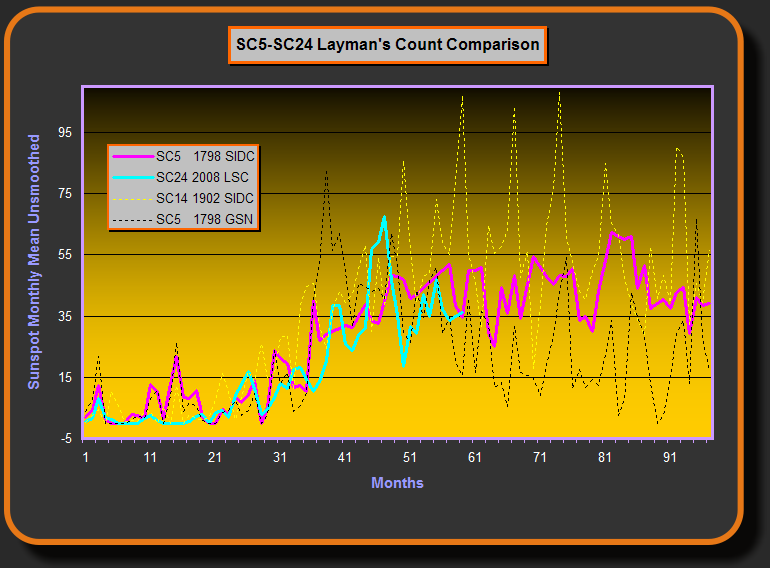
sc5 sc24 comparison

sc5,sc14 comparison with sc24

And the sun will surely impact our climate — but how?

And in any case the sun gets no feedback and it does not much care.