http://www.247mahjong.com/Mahjong.swf
created by Mahjong
Archive for the ‘Uncategorized’ Category
Time-pass
April 18, 2011A new field : Pillaibooks.com
April 1, 2011Books and the marketing of books is a new field for me – but it is fascinating and I am still a beginner at this.
I have established a new website pillaibooks.com specifically for marketing two books:
- 3000 Miles to Freedom by Brig. M.M Pillai MC
- Essence of a Manager
WordPress blogging hiccups
March 24, 2011For the last 24 hours I have been having difficulties and saving and publishing posts has been a little haphazard.
Presumably this is because of the massive attacks WordPress.com has been subjected to though it is not clear to me why such attacks would be motivated.
After having lost a couple of posts I shall take a day or two off from blogging and hope that the hard-pressed staff of WordPress succeed in their efforts to stave off the attacks and make their sites even more robust.
Fukushima Dai-ichi nuclear plant: Reactor #3 control room powered up and cooling pumps to be switched on tomorrow
March 23, 2011Progress at the Fukushima Dai-ihi nuclear plant continues steadily but slowly.External power is now available to all 6 reactors. Highlights today:
- A high-powered water cannon truck has arrived from Australia at a US base in Tokyo to help recovery efforts at the Fukushima Daiichi nuclear power plant. The water cannon can shoot 150 liters of water per second at a target 150 meters away. It can also operate unmanned for 2 to 3 days while pumping seawater. It will be sent o Fukushima if needed.
- A vehicle with a long spraying arm injected water into the No.4 reactor at the troubled Fukushima Daiichi nuclear power plant for about 3 hours on Tuesday. The vehicle, owned by a construction firm in Mie Prefecture in central Japan, began the operation at 5:17 PM Tuesday at the request of the Tokyo Electric Power Company. The vehicle is used in construction of high-rise buildings, and is capable of extending its arm more than 50 meters to pour concrete. The operation ended at about 8:30 PM.

Water spraying into Reactor #4: image nhk
- Tokyo fire department started operation of spraying water to Unit-3 through cooperation with Osaka fire department. Water spraying was conducted for one hour and finished around 16:00. Total amount of water sprayed is more than 3 times the pool capacity.
- TEPCO said on Tuesday that it will restore power to the control rooms of No.3 and No.4 reactors as soon as water-spraying operations are completed to cool down fuel storage pools.
- Defense Minister Kitazawa announced that surface temperature measurement by helicopter will be conducted everyday, weather permitting, and not just twice a week in view of the smoke and steam that has been observed.
TEPCO has restored the electricity supply to the control room of the Number 3 reactor at the quake-damaged Fukushima Daiichi nuclear plant. Lights in the control room were switched on again on Tuesday night.
Eleven days have passed since the massive earthquake devastated northeastern Japan and cut off external power to the Fukushima Daiichi nuclear plant.
TEPCO reconnected power cables to the Number 3 and Number 4 reactors earlier on Tuesday.
TEPCO will now try to reactivate vital monitoring systems in the control rooms, such as those for measuring temperatures inside the reactors and water levels in the spent fuel storage pools. TEPCO says it will transmit electricity to the cooling pump for the Number 3 reactor on Wednesday. The company says if the pump functions normally, it will begin cooling the reactor and the spent fuel storage pool
Andrew – Prince of beggars
March 21, 2011The Telegraph does not much like Prince Andrew and his venal ways. The Duke of York receives a £249,000 annuity from the Queen. Last year the prince spent £620,000 as a trade envoy, including £154,000 on hotels, food and hospitality and £465,000 on travel.

Randy Andy
First there was the sale of his home in Berkshire to Kazakhstan president’s billionaire son-in-law Timur Kulibayev, for £15 million: £3 million over the asking price, although there hadn’t been a single prospective buyer in three years. It now sits unoccupied and in mounting disrepair, suggesting that the property, curiously, isn’t particularly essential to Mr Kulibayev’s portfolio.
There is the Duke’s 16-year friendship with Jeffrey Epstein, an American billionaire who was jailed for 18 months in 2008 for soliciting under-age prostitutes. The Duke – who was snapped in 2001 with a cheery arm around Virginia Roberts, Epstein’s 17-year-old “masseuse” – was also photographed strolling in Central Park with Epstein last December, after the latter was released from jail. Shortly afterwards, Epstein stepped in to pay off £15,000 of the Duchess of York’s debts, a matter which the Duke had reportedly been finessing during the trip.
The Duke of York has been engulfed in a new “cash-for-favours” row after a close friend paid off £50,000 of his ex-wife’s debts. David Rowland, a financier once described as “shady” in Parliament, gave the sum to the Duchess of York’s former press spokesman Kate Waddington, whom the Duchess owed in the region of £85,000.
In May 2010, the Duchess of York, the Prince’s ex-wife, was filmed by a News of the World reporter claiming that Prince Andrew had agreed that if she were to receive £500,000, he, the Prince, would meet the donor and pass on useful top level business contacts. She was filmed receiving, in cash, $40,000 as a down payment. The Prince’s entourage denied he knew of the situation
It would seem that one part of his activities as the UK’s Trade envoy is soliciting money from rather dubious people for the repayment of his ex-wife’s debts. She is also not slow to sell access to him – for whatever it is worth. No doubt there is a point of view that for this scion of the House of Windsor to do his utmost to repay his ex-wife’s debts is an extremely honourable thing to do.
His elder brother and heir to the throne is the epitome of silliness and no great credit to his House either but at least he does not seem to be venal.

Neither up nor down
Oh, The grand old Duke of York,
He had ten thousand men;
He marched them up to the top of the hill,
And he marched them down again.And when they were up, they were up,
And when they were down, they were down,
And when they were only half-way up,
They were neither up nor down.
Plagiarism and the morphing of a Minister
February 18, 2011Misconduct in the scientific world takes months if not years to be investigated and sanctions – if any – are light. But for those riding high in the poltical world the consequences can be swift. It seems unlikely that Googleberg can continue as the German Defence Minister for very long.
Just 4 days ago he was
Baron Dr. Karl-Theodor Maria Nikolaus Johann Jacob Philipp Franz Joseph Sylvester Freiherr von und zu Guttenberg, Defence Minister of the Federal Republic of Germany.

Baron Dr. Karl-Theodor Maria Nikolaus Johann Jakob Philipp Franz Joseph Sylvester Freiherr von und zu Guttenberg (focus.de)
Then his plagiarism was revealed by the Süddeutsche Zeitung earlier this week, and his copying of some 24 passages for his PhD thesis has grown to be the copying of at least 78 passages. Even the first two paragraphs of his introduction appear to have been copied from a 1997 article in the center-right dailyFrankfurter Allgemeine Zeitung.
Der Spiegel dubbed him Merkel’s Minister of Scandals.
Deutsche Welle decided that Googleberg was more appropriate than Guttenberg. Two criminal complaints have now been filed against him, claiming infringement of copyrights and lying in the sworn statement that accompanied the thesis. Others are claiming that he can’t be guilty of plagiarism – it must have been the fault of his ghost writer!
In a desperate damage control exercise after being read the riot act by Angela Merkel, Googleberg said on Friday that he would temporarily renounce his doctorate and relinquish his “doctor” title amid allegations that he plagiarized significant sections of his dissertation.
And now Der Spiegel has baptised him Merkel’s Copycat minister.
In the space of just 3 days,
Herr. Dr. Karl Theodor Maria Nikolaus Johann Jacob Philipp Franz Joseph Sylvester Freiherr von und zu Guttenberg, Defence Minister of the Federal Republic of Germany
has morphed to
Herr Theodor Googleberg, Merkel’s copycat minister.
But at least Googleberg has upheld the reputation of German politicians in the misconduct stakes and managed to reduce the lead that was being being taken by Bunga Bunga Berlusconi in Italy and by the “free loading” ministers of the French Republic.
Light weekend
January 8, 2011Light blogging this weekend to attend a family event.
Frigid December 2010 was no local phenomenon
January 6, 2011The frigid December of 2010 was widespread across the Northern Hemisphere and cannot be dismissed as just a local phenomenon.
Sweden: Coldest December in Sweden in 110 years: http://www.thelocal.se/31072/20101226/
UK: 2010 UK’s coldest December since records began: http://www.bbc.co.uk/news/uk-12122497
Ireland: Met Eireann – coldest December on record: http://www.tv3.ie/article.php?article_id=50973&locID=1.2.&pagename=news
Germany: German Unemployment Unexpectedly Climbs in Coldest December for 40 Years: http://www.bloomberg.com/news/2011-01-04/german-unemployment-unexpectedly-climbs-during-coldest-december-since-1969.html
USA
Illinois’ December was colder and had more snow than average: http://www.bnd.com/2011/01/05/1539495/december-was-colder-and-had-more.html
Virginia: Explaining the weather: December was a bitter one: http://www2.newsadvance.com/weather/2011/jan/04/explaining-weather-december-was-bitter-one-ar-752921/
Florida:
- December coldest on record: http://www.news-journalonline.com/news/local/east-volusia/2011/01/05/december-coldest-on-record.html
- Tallahassee marks coldest December on record: http://www.tallahassee.com/article/20110103/NEWS01/101030308/NWS-Tallahassee-marks-coldest-December-on-record
- N. Carolina: Asheville’s December was 2nd coldest: http://www.citizen-times.com/article/20110104/NEWS/301040038
Korea: Seoul Has Coldest December in 30 Years, Says Weather Bureau: http://www.bloomberg.com/news/2010-12-27/seoul-has-coldest-december-in-30-years-says-weather-bureau.html
China:
Mass evacuations as China’s south battles ‘big freeze”: http://www.bbc.co.uk/news/world-asia-pacific-12117729
Heavy snow grips northern China: http://www.telegraph.co.uk/news/worldnews/asia/china/8228676/Heavy-snow-grips-northern-China.html
India:
Cold wave continues to grip North India: http://www.sify.com/news/cold-wave-continues-to-grip-north-india-news-national-lbfmEdjjaig.html
Bangalore is cold but the outskirts are getting colder: http://www.dnaindia.com/bangalore/report_bangalore-is-cold-but-the-outskirts-are-getting-colder_1483567
Chill in Calcutta: http://www.telegraphindia.com/1110105/jsp/calcutta/story_13392877.jsp
Australia:
NSW had its wettest year in half a century: http://news.smh.com.au/breaking-news-national/nsw-had-its-wettest-year-in-50-years-20110105-19fr7.html
AUSTRALIA has just experienced its wettest year since 1974 and its coolest year of the 21st century: http://www.theaustralian.com.au/news/nation/last-year-australias-wettest-in-36-years-coldest-in-10/story-e6frg6nf-1225979674792
China and the use of rare earth elements trade as a tool for diplomacy
December 28, 2010Currently China produces about 97% of the global demand for “rare earth elements” used industrially but China has only about 36% of the world’s resources. In the last few months the Chinese have created a “crisis” both by throttling exports and by sharp price increases which have alarmed the auto and electronics industry. Japanese industry has been particularly disturbed. But it would seem that China had very clear diplomatic goals for their trade actions.
The 17 “rare earth elements” are not rare at all.

Rare Earth Elements: graphic ggg.gl
From Wikipedia: http://en.wikipedia.org/wiki/Rare_earth_element
Despite their name, rare earth elements (with the exception of the highly unstable promethium) are relatively plentiful in the Earth’s crust, with cerium being the 25th most abundant element at 68 parts per million (similar to copper). However, because of their geochemical properties, rare earth elements are not often found in concentrated and economically exploitable forms. Instead, they are usually found in rare earth minerals. It was the very scarcity of these minerals (previously called “earths”) that led to the term “rare earth”. The first such mineral discovered was gadolinite, acompound of cerium, yttrium, iron, silicon and other elements. This mineral was extracted from a mine in the village of Ytterby, Sweden; many of the rare earth elements bear names derived from this location.
A table listing the seventeen rare earth elements, their atomic number and symbol, the etymology of their names, and their main usages is provided here. Some of the rare earths are named for the scientists who discovered or elucidated their elemental properties, and for their geographical discovery.
| Z | Symbol | Name | Etymology | Selected Usages |
| 21 | Sc | Scandium | from Latin Scandia (Scandinavia), where the first rare earth ore was discovered. | Light Aluminium-scandium alloy for aerospace components, additive in Mercury-vapor lamps. |
| 39 | Y | Yttrium | for the village of Ytterby, Sweden, where the first rare earth ore was discovered. | Yttrium-aluminum garnet (YAG) laser, YBCO high-temperature superconductors, yttrium iron garnet (YIG) microwave filters. |
| 57 | La | Lanthanum | from the Greek “lanthanein”, meaningto be hidden. | High refractive index glass, flint, hydrogen storage, battery-electrodes, camera lenses, fluid catalytic cracking catalyst for oil refineries |
| 58 | Ce | Cerium | for the dwarf planet Ceres. | Chemical oxidizing agent, polishing powder, yellow colors in glass and ceramics, catalyst for self-cleaning ovens, fluid catalytic cracking catalyst for oil refineries |
| 59 | Pr | Praseodymium | from the Greek “prasios”, meaningleek-green, and “didymos”, meaningtwin. | Rare-earth magnets, lasers, core material for carbon arc lighting, colourant in glasses andenamels, additive in Didymium glass used in welding goggles, ferrocerium firesteel (flint) products. |
| 60 | Nd | Neodymium | from the Greek “neos”, meaning new, and “didymos”, meaning twin. | Rare-earth magnets, lasers, violet colors in glass and ceramics, ceramic capacitors |
| 61 | Pm | Promethium | for the Titan Prometheus, who brought fire to mortals. | Nuclear batteries |
| 62 | Sm | Samarium | for Vasili Samarsky-Bykhovets, who discovered the rare earth oresamarskite. | Rare-earth magnets, lasers, neutron capture, masers |
| 63 | Eu | Europium | for the continent of Europe. | Red and blue phosphors, lasers, mercury-vapor lamps |
| 64 | Gd | Gadolinium | for Johan Gadolin (1760–1852), to honor his investigation of rare earths. | Rare-earth magnets, high refractive index glass or garnets, lasers, x-ray tubes, computer memories, neutron capture |
| 65 | Tb | Terbium | for the village of Ytterby, Sweden. | Green phosphors, lasers, fluorescent lamps |
| 66 | Dy | Dysprosium | from the Greek “dysprositos”, meaning hard to get. | Rare-earth magnets, lasers |
| 67 | Ho | Holmium | for Stockholm (in Latin, “Holmia”), native city of one of its discoverers. | Lasers |
| 68 | Er | Erbium | for the village of Ytterby, Sweden. | Lasers, vanadium steel |
| 69 | Tm | Thulium | for the mythological northern land ofThule. | Portable X-ray machines |
| 70 | Yb | Ytterbium | for the village of Ytterby, Sweden. | Infrared lasers, chemical reducing agent |
| 71 | Lu | Lutetium | for Lutetia, the city which later became Paris. | PET Scan detectors, high refractive index glass |
As long as China’s own industry was not sufficiently developed to use these materials there was no crisis and production from resources in many other countries (rare earth elements are quite plentiful around the globe and not “rare” at all) were discontinued in the face of Chinese competition. The current crisis comes about because Chinese industry is now sufficiently advanced to make use of these elements and its industrial volume is large enough to absorb a large part of the production. This allowed China to use of reduction of exports and increase of prices to send strong diplomatic signals. Firstly to counter the US pressure to revalue the Yuan and second to warn Japan regarding their territorial dispute.
But this “crisis” can only be short-lived. The price increase has already led to production of rare earth elements being restarted in the US and many other countries are now planning to start production (Sweden, India, Vietnam and countries in Central Asia for example). China is no doubt well aware that their manufactured “rare earth elements” crisis will only accelerate the production of these elements from alternate sources. But what it shows is that China has the economic muscle and the willingness to now use “trade wars” as a weapon in diplomacy. But what is also a new development is the concerted response from many countries in acting together to find alternate sources and counter the Chinese might.
That Japan feels particularly vulnerable is to be expected since it does not have its own resources and is a major user. The Asahi Shimbun writes:
One reason for China’s dominance in production is the cheap cost of labor. But the country also has an advantage because deposits there can be extracted through relatively rough methods. In southern China, the weathering of a particular type of granite containing large amounts of rare earths has progressed to the right degree. Unwanted substances have been washed away in the rain, leaving soil with high concentrations of rare earth metals exposed on the surface.
“Erosion proceeds quickly in places that are warm and have a high rainfall, but if there is too much rain, erosion proceeds too quickly,” said Mitsuya Hirokawa of Japan Oil, Gas and Metals National Corp. “The necessary conditions are the existence of granite that contain lots of rare earths and the right amount of rainfall.” Southern China fulfills these conditions.
Japan has the right type of granite, but it has not eroded at the proper pace. But environmental concerns are arising from the cheaper method of extraction in China. In normal mines, rare earths are extracted by chemically processing ore that has already been removed from the ground. But in the method used in southern China, the mine itself becomes a processing factory. Acidic liquid is poured on the ground, and the dissolved rare earths are recovered from the liquid that oozes out. If the toxic liquid leaks into rivers, it could have serious consequences for the environment. “There are paddy fields in the vicinity, and there are concerns about the impact on human health,” said a researcher who observed the procedure in southern China.
This is the context under which China cites environmental concerns as the reason for restricting exports of rare earth metals. But this cheaper method of extraction is one reason why production is concentrated in China. Many mines in the United States and elsewhere could not afford to continue operating and were closed down.
Apparently, similar “convenient” deposits exist in Vietnam. Studies are under way, but production there has not yet started.
The Wall Street Journal analyses the Chinese use of trade flows as a tool of diplomacy:
Beijing’s decision earlier this year to stop shipments of rare earth minerals to Japan apparently as part of a territorial dispute raised a lot of concerns about the strategic implications of China’s growing economic strength. And well it should. Up to now, Beijing has worked hard to separate economics from politics on the world stage as part of a strategy to minimize global unease with its rise. That it is now willing to use an economic lever in a political matter suggests that approach is changing in ways that could cause trouble for the rest of the world and for China itself……..
……….Before now, trading partners were willing to take the temporary hit to trade, since they knew the episode would quickly blow over. This time, though, all major trading partners are seriously contemplating alternatives to Chinese markets in rare earth supplies. Japan, naturally, has been most active in looking for alternative sources, signing agreements with Vietnam and Australia to develop new mines or renewing production in existing mines.
Is the Landscheidt minimum a precursor for a grand minimum?
December 23, 2010It took 500 years with reducing solar activity to get from the Medieval maximum to the the grand Maunder minimum. The Dalton minimum came a little over a 100 years later as solar activity was increasing to its modern maximum in the years preceding Solar Cycle 22 (c. 1890 – 1990). Now with the Landscheidt minimum seemingly well established, SC 23 and the current SC 24 show a clear trend of declining solar activity. SC’s 22, 23 and 24 are remarkably similar to SC’s 3, 4 and 5. The Dalton minimum coincided with SC’s 5 and 6.
It is reasonable to assume that climatic conditions over the next 20 – 30 years will resemble those prevailing between 1790 and 1820. But SC24 has a way to go yet and it could be that solar activity for SC24 and 25 will be even lower than during the Dalton minimum and perhaps closer to the Spörer minimum but perhaps not as deep as the Maunder minimum.
But in either case the solar activity to come following the Modern maximum may well resemble the 500 years of decline in solar activity which followed the Medieval maximum.
http://en.wikipedia.org/wiki/Dalton_Minimum
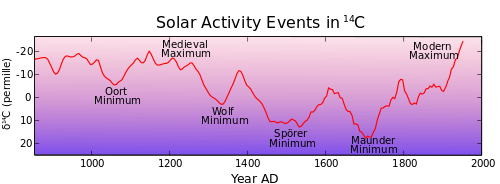
Solar activity events recorded in radiocarbon. Present period is on left. Values since 1950 not shown: Wikipedia
http://en.wikipedia.org/wiki/Maunder_Minimum
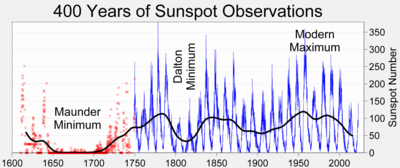
The Maunder minimum in a 400 year history of sunspot numbers: Wikipedia
http://sc25.com/index.php?id=268&linkbox=true&position=10

The excellent historical weather chronology covering 1800 years put together by James A Marusek shows that the period between 1790 and 1820 was characterised not only by colder weather but also by violent fluctuations of seasonal weather. An extract of the chronology during the Dalton minimum is here: (weather chronology Dalton).
I give little credence to AGW Alarmism and the doom-saying regarding the effects of carbon dioxide. Environmentalism which was (and still is) highly admirable when concerned with the improvement of local conditions went off the rails when it went “global” and came to be dominated by the overweening arrogance of ignoring the sun and the presumption of super-computers and inadequate computer models. Rather I am persuaded about the dominance of solar influences on the chaotic system which is our climate.
Whether or not a grand solar minimum is on its way, we are in for a decade of two of reduced activity and a cooling trend during this Landscheidt minimum.

 The k2p blog