Maven to enter Mars orbit tonight and MOM on Wednesday

September 21, 2014

UPDATE:

NASA’s Mars Atmosphere and Volatile Evolution (MAVEN) spacecraft successfully entered Mars’ orbit at 10:24 p.m. EDT Sunday, Sept. 21, where it now will prepare to study the Red Planet’s upper atmosphere as never done before. MAVEN is the first spacecraft dedicated to exploring the tenuous upper atmosphere of Mars.

==============================================

NASA’s Maven will be inserted into Mars orbit later tonight at 2130 pm Eastern time and will be covered live by NASA TV.

India’s MOM should be inserted into Mars Orbit on Wednesday.

(Related: Alternate paths to Mars: NASA’s MAVEN compared to India’s MOM)

Maven planned Mars orbit insertion 20140921 - NASA

Maven planned Mars orbit insertion 20140921 – NASA

The orbit insertion factsheet from NASA is here: MAVEN Orbit Insertion Fact Sheet – NASA

The orbit-insertion maneuver will begin with the brief firing of six small thruster engines to steady the spacecraft. The engines will ignite and burn for 33 minutes to slow the craft, allowing it to be pulled into an elliptical orbit with a period of 35 hours.

Following orbit insertion, MAVEN will begin a six-week commissioning phase that includes maneuvering the spacecraft into its final orbit and testing its instruments and science-mapping commands. Thereafter, MAVEN will begin its one-Earth-year primary mission to take measurements of the composition, structure and escape of gases in Mars’ upper atmosphere and its interaction with the sun and solar wind….

MAVEN launched Nov. 18, 2013, from Cape Canaveral Air Force Station in Florida, carrying three instrument packages. It is the first spacecraft dedicated to exploring the upper atmosphere of Mars. The mission’s goal is to determine how the loss of atmospheric gas to space played a role in changing the Martian climate through time.

ISRO’s press briefing for the MOM Mars orbit insertion is here: MOM press briefing on Mars Orbit Insertion

MOM Mars Orbit insertion planned for 20140924  ISRO

MOM Mars Orbit insertion planned for 20140924 ISRO

So Scotland stays British – but Iceland managed to go it alone

September 19, 2014

Here in Rejkjavik we heard something about how a country of less than 300,000 became independent in 1944. It has not been easy but my perception is that Iceland has battled its way out of the Great Banking Scandal and Financial Crisis of 2008 and is now back on a tourist driven growth path (even though prices are  even higher than I expected).

It is not irrelevant that Iceland has access to such enormous amounts of geothermal energy. It only convinces me even further – if that was possible – that it is access to energy and electricity that is fundamental to humans mastering the global cooling cycle – that is already underway – and the next ice age whenever it comes.

But back to Scotland.

There is no doubt that they could have gone it alone. But I am also glad that there is no change to the world order that I know and the UK that I am familiar with. The Scots will see themselves continuing as part of Britain.

But the English will continue to believe in the supremacy of the English Pound and the Bank of England and the English Queen as being their gifts to Scotland (and the world).

There will always be a Wales!

Light blogging

September 17, 2014

On a trip to Iceland for a few days and blogging will be light.

The Blue Lagoon today.

The purpose of argument …

September 16, 2014

The purpose of argument and the art of disputation

In disputes upon moral or scientific points, let your aim be to come at truth, not to conquer your opponent. So you never shall be at a loss in losing the argument, and gaining a new discovery.”

Arthur Martine 1866 guide to the art of conversation,

If only ….

This post from Judith Curry is well worth reading: How to  criticize with kindness where she refers to this article by Maria Popova in brainpickings.

How to compose a successful critical commentary:

  1. You should attempt to re-express your target’s position so clearly, vividly, and fairly that your target says, “Thanks, I wish I’d thought of putting it that way.
  2. You should list any points of agreement (especially if they are not matters of general or widespread agreement).
  3. You should mention anything you have learned from your target.
  4. Only then are you permitted to say so much as a word of rebuttal or criticism.

Drinking water contamination caused by weak water wells and not by fracking

September 16, 2014

It is fashionable for environmentalists to blame fracking for all manner of evils as a matter of faith. They have proclaimed that fracking causes earthquakes, water table contamination, emission of dangerous gases, damage to house price levels and even damage to crops. Such claims are usually based on no evidence whatsoever but presented as gospel.

A new paper published in PNAS reports on real experimental measurements (not just a computer model) using noble gases to trace methane leakage into drinking water in 130 water wells in Pennsylvania and Texas. They find that drinking water contamination was caused by weak walls and well construction faults and not by fracking.

TH Darrah et al, Noble gases identify the mechanisms of fugitive gas contamination in drinking-water wells overlying the Marcellus and Barnett Shales, 

Significance

Hydrocarbon production from unconventional sources is growing rapidly, accompanied by concerns about drinking-water contamination and other environmental risks. Using noble gas and hydrocarbon tracers, we distinguish natural sources of methane from anthropogenic contamination and evaluate the mechanisms that cause elevated hydrocarbon concentrations in drinking water near natural-gas wells. We document fugitive gases in eight clusters of domestic water wells overlying the Marcellus and Barnett Shales, including declining water quality through time over the Barnett. Gas geochemistry data implicate leaks through annulus cement (four cases), production casings (three cases), and underground well failure (one case) rather than gas migration induced by hydraulic fracturing deep underground. Determining the mechanisms of contamination will improve the safety and economics of shale-gas extraction.

A key source of groundwater contamination (labeled 5, center right) caused by faulty well casings. Credit: Image courtesy of Thomas Darrah, The Ohio State University

Press Release:

….  neither horizontal drilling nor hydraulic fracturing of shale deposits seems to have caused any of the natural gas contamination.

“There is no question that in many instances elevated levels of natural gas are naturally occurring, but in a subset of cases, there is also clear evidence that there were human causes for the contamination,” said study leader Thomas Darrah, assistant professor of earth sciences at Ohio State. “However our data suggests that where contamination occurs, it was caused by poor casing and cementing in the wells,” Darrah said.

In hydraulic fracturing, water is pumped underground to break up shale at a depth far below the water table, he explained. The long vertical pipes that carry the resulting gas upward are encircled in cement to keep the natural gas from leaking out along the well. The study suggests that natural gas that has leaked into aquifers is the result of failures in the cement used in the well.

Antarctic sea ice extent at the highest ever measured

September 16, 2014

Antarctic ice extent is at all time high levels. Since satellite measurement began in 1978, such high levels of ice extent have never been measured.

An area about three times the size of Australia, in the Antarctic region, is now covered by sea ice.

And even the growing ice is blamed by the acolytes on global warming in the atmosphere (which they seem to forget has been absent for 18 years)!! Of course the missing warming is said to be hiding in the deep oceans (among many other places) but not – it would seem – in the Antarctic.

CEO of the Antarctic Climate and Ecosystems CRC, Tony Worby, said the warming atmosphere is leading to greater sea ice coverage by changing wind patterns.

Sunshinehours:

Antarctic Sea Ice Extent Sept 15 2014 – 1,224,000 sq km above the 1981-2010 mean. Data for Day 257. Data here.

18,000 sq km higher than yesterdays record. And 170,000 sq km higher than 2013’s all-time record.

Antarctic sea ice extent 2014 day 257 image sunshinehours

Antarctic sea ice extent 2014 day 257 image sunshinehours

abc.net

Satellite image showing Antarctic sea ice

A satellite image of Antarctica showing sea ice extent. The red line is the average for September – Antarctic Climate and Ecosystems CRC

Sweden votes “against”, but what is Sweden “for”?

September 15, 2014

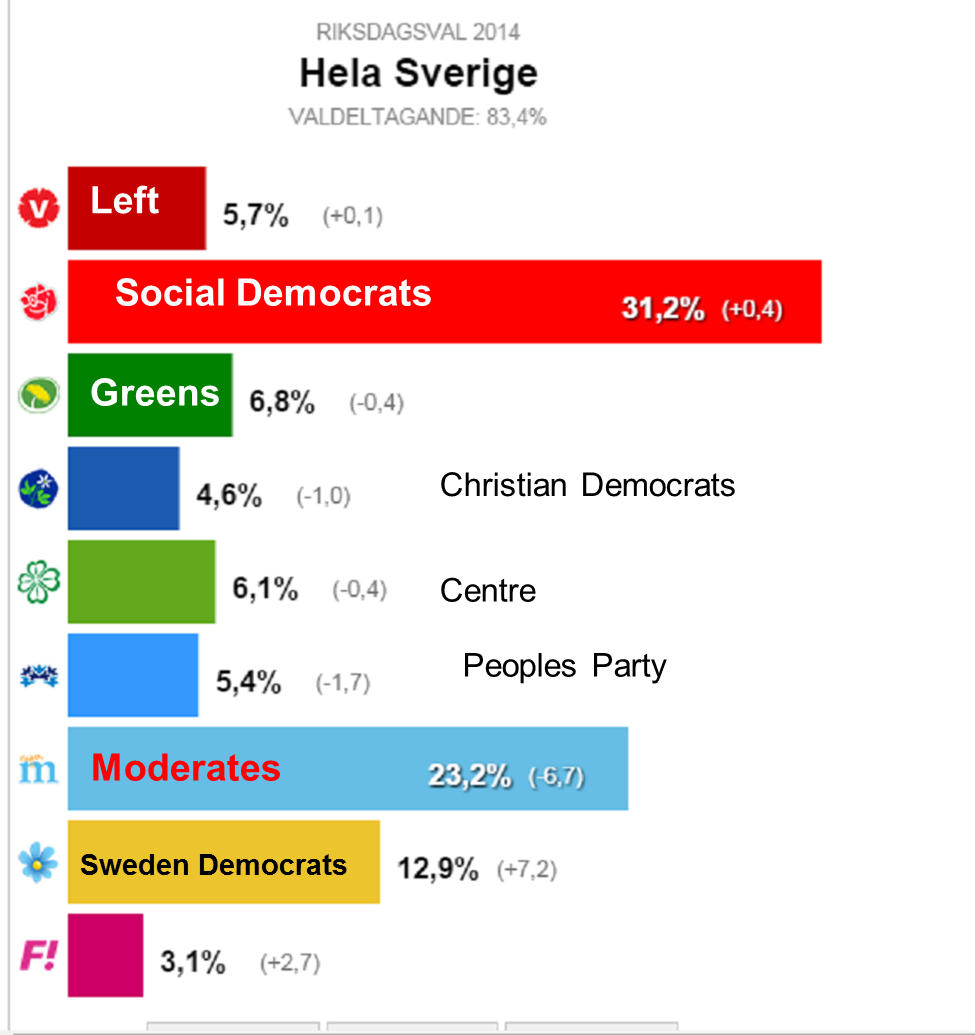
It was quite a high turnout at 83.4% in the general election.

The results show that Sweden has voted “against” many trends but has not really voted “for” anything. The left (red-red-green) will govern while the far-right show the greatest gains. Perhaps this is an indictment of all parties in that none succeeded in presenting any compelling vision of the future. 

After 8 years in power, the free market Alliance have lost power quite decisively, but the Social Democratic block (including the Environment and the Left Party) while clearly the largest grouping, are quite a bit short of an absolute majority. The Moderates lost 6.7% of the vote share. The clear gain is for the anti-Europe, anti-immigration, nationalistic, neo-Nazi party the Sweden Democrats who have more than doubled their vote from 5.7 to 12.9% – a gain of 7.2%. The Social Democrats actually gained virtually nothing (+0.4%). The losers are the small right-of-centre parties supporting the Moderate coalition in government (the Centre Party, Peoples Party and the Christian Democrats). The Environmental Party also lost a bit but will find itself in government anyway. The top 3 parties cover 67% of the vote. As much as 30% of the vote share is split between 6 parties with less than 7% share each. The Left Party (erstwhile communists) are now absolutely necessary to the Social Democrats and may well even be formally in government.

The Feminine Initiative were neither here nor there and ended up as being yet another “spoiler” party.

Sweden election 2014 - graphic from SvD

Sweden election 2014 – graphic from SvD

So a very fractured picture emerges but what strikes me is that voters have generally voted “against” trends they do not like far more than voting “for” anything. Maybe it is simplistic but my reading of the results is that Sweden has expressed strong opposition to:

  1. European meddling in Swedish society
  2. EU bureaucracy
  3. Further immigration (but not necessarily against immigrants)
  4. the Euro
  5. profit – rather than quality – as the basis of health care
  6. profit – rather than quality – as the basis of elderly care
  7. profit – rather than quality – as the basis of schools
  8. ideology in environment

But what Sweden is in favour of is not at all clear.

It will not be easy for the Social Democrats to build a stable government which has any clear direction. The votes “against”  do not allow any block to find a clear way forward – in any direction. Nobody wants to treat – visibly – with the Sweden Democrats. Their votes “for” anything are of little value in themselves and provide neither opportunity or risk to anybody else. They have not the power to get their proposals accepted but they will have the parliamentary votes to stop many things.

I am afraid that we have 4 years of horse-trading and vacillation and drift ahead.

Obsessive fixation on global warming leads to unpreparedness for an ice age

September 14, 2014

This is a postscript to my previous post about the inevitability of this interglacial giving way to glacial conditions, Here Professor Bob Carter addresses how the obsessive fixation with “gentle” global warming leads to an unpreparedness for global cooling in a letter to The Australian:

Heading for ice age

GRAHAM Lloyd has reported on the Bureau of Meteorology’s capitulation to scientific criticism that it should publish an accounting of the corrections it makes to temperature records (“Bureau warms to transparency over adjusted records”, 12/9). Corrections which, furthermore, act to reinforce the bureau’s dedication to a prognosis of future dangerous global warming, by turning cooling temperature trends into warming ones — a practice also known to occur in the US, Britain and New Zealand.

Meanwhile, we have a report by Sue Neales that the size of our grain harvest remains in doubt following severe frosts in southern NSW killing large areas of early wheat crops and also damaging wheat and canola crops in South Australia and Victoria (“Trifecta of calamities to deplete. crop harvest”, 12/9)

Is it unreasonable to be surprised that none of your writers, much less the government, has noticed that leading solar astrophysicists, such as Habibullo Abdussamatov from Pulkovo Observatory in St Petersburg, have for years been commenting on the declining activity of the sun?

These scientists are projecting a significant cooling over the next three decades, and perhaps even the occurrence of another little ice age.

Obsessed as they are with a gentle global warming trend that stopped late last century, should the expected solar cooling eventuate, policy makers will rue the day they failed to heed the advice of independent scientists on climate change issues.

Bob Carter, Townsville, Qld


How will we know when the transition to a new glacial age has started?

September 13, 2014

Once glacial conditions have been established (and they will), they will be unmistakable. Ice sheets will have covered large parts of the northern hemisphere making large swathes uninhabitable. Sea levels would have dropped by about 100 m. Global mean temperature would be around 10-12 ºC rather than the 15 ºC in an interglacial.

Glacials and interglacials graphic http://anthro.palomar.edu/

Habitable and fertile land would have increased around the equator and in the tropics – but not as much as would be rendered uninhabitable by the ice sheets. Modern technology and recourse to energy would still allow some exploitation of resources under the ice sheets. Precipitation levels would reduce however (with so much of the water cycle being bound up in the ice sheets). Some of the equatorial regions would see a desertification. New resources would be available due to the 100 m drop in sea level. Population would probably be significantly lower than during an interglacial but what population could be sustained comfortably will be strongly dependent upon the availability of energy and the ease of energy conversion. River flows and hydropower will dry up. Fossil fuels and nuclear energy is what will make the difference.

Ice sheets graphic http://anthro.palomar.edu

But whenever it comes, it will not happen overnight. It would take not less than a few hundred years for the transition from interglacial to glacial conditions but it might take 1000 years or more.
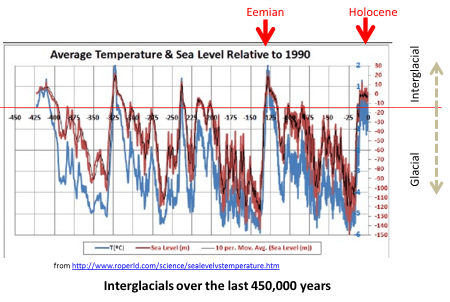
interglacials

The next glacial will come …

But how will we know if the transition has started? What are the signs to look for? For example a few years of reduction of global precipitation may mean nothing if at the same time an increase of water locked up as ice is not also evident.

Probably the most potent feedback loops (forcings) for the transition to glacial conditions is the ice cover on the earth’s surface and the cloud cover in the upper reaches of our atmosphere. Both of these act directly on the sun’s energy being reflected away from the earth and will shift the earth to a different paradigm of solar energy input. There may be other parameters which cause incoming solar insolation to vary but how much the earth reflects away of whatever is coming in is controlled by the ice and the high clouds. We can consider the interglacial and glacial conditions to be semi-stable equilibrium conditions, each representative of a particular level of solar energy input to the earth system.

So the first real indicators will be the growth of ice cover and an increase in high clouds. All other prior indicators  must finally show up as ice cover or high cloud. Even global temperature (which is merely an averaged, composite, weighted artefact) is not of great relevance except when it shows up as ice or cloud. Note that ice cover at a lower latitude is of greater significance since it causes a greater reduction of received solar insolation than at the poles. For ice cover to be on an increasing path we will first see a reduction in the melt of the previous season’s ice – regularly. We should see this not only at both poles but also at lower latitudes on high ground. We will see warming factors being neutralised. We will see a decrease in precipitation but this will probably lag the reduction of ice cover and the reduction of sea level by many years. It might begin to show up first as a reduction of low rain clouds and increase of high clouds. We should see the sea level increase characteristic of an interglacial, level off and then begin to fall – slowly at first and then accelerating.

An impulse or trigger is needed to shift from one semi-stable equilibrium state to another. What that trigger – or those impulses –  might be is unknown. But I note that

  1. A cooling cycle of 30 + years may have begun and may well be a trigger for a transition.
  2. Expected global temperature increase due to the undoubted (but small) effect of carbon dioxide concentration in the atmosphere is not happening and will not any time soon.
  3. Expected increase of sea level (even if based on fallacious CO2 based climate models) is not happening and sea level rise seems to be decelerating.
  4. Antarctic ice cover is at its highest level ever and has been increasing over the last few years.
  5. Arctic ice has recovered from its decrease of a few years ago and is at the same level as about 2 decades ago.
  6. Some unusual sign of fresh glacier formation have been observed on Ben Nevis.
  7. Some Himalayan glaciers. and even Alpen glaciers have shown signs of growth or reduced rates of decrease.

Just indicators of course – and another 50 or so years should tell.

But one thing is clear. Our future depends upon the availability of energy – and that will be primarily fossil and nuclear (and fusion if that has been developed by then). The pointless (and futile) attempts to curtail exploration for and the use of fossil fuels will have to cease – and better they be abandoned sooner rather than later.

Lava flow continues from fissure eruption near Bárðarbunga

September 12, 2014

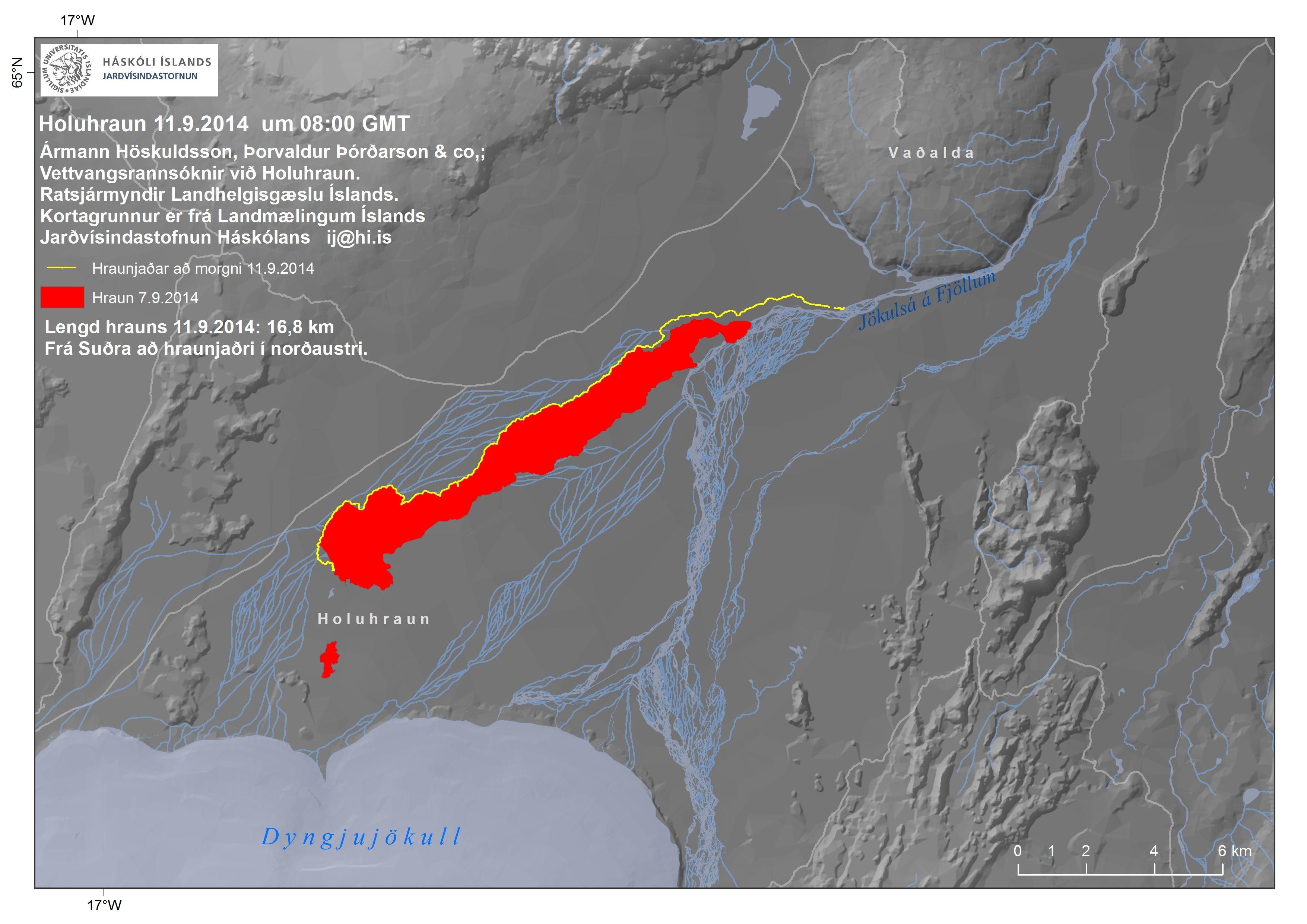
The fissure eruption continues in Iceland. The length of the lava stream is now about 16.8 km.

I am looking forward to visiting Iceland next week.

On 5th September:

Bardarbunga Photo taken 5th September at 0939 by Olafur Freyr Gíslason.

Bardarbunga Photo taken 5th September at 0939 by Olafur Freyr Gíslason.

  • The eruptive activity at Holuhraun continues at similar intensity. Lava flows at similar rates as yesterday. The lava is flowing towards East but widens slightly towards North. The main flow follows the river bed of Jökulsá á Fjöllum. No explosive activity due to the lava and river water interaction has been observed, but steam rises from the lava.
  • Forecasts indicate that high concentrations of sulphuric gases may be expected in the northern part of the Eastern fjords, Fljótsdalur, Hérað, Jökuldalur, and Vopnafjörður. High concentrations could occur in other areas as well.
The extent of the lava, Thursday morning. The edge (yellow line) is creeping closer to mountain Vaðalda

The extent of the lava, Thursday morning. The edge (yellow line) is creeping closer to mountain Vaðalda