Iceland raises Bárðarbunga volcano warning to red

August 23, 2014

The Icelandic Met Office has issued the following warning:

It is believed that a small subglacial lava-eruption has begun under the Dyngjujökull glacier. The aviation color code for the Bárðarbunga volcano has been changed from orange to red.

23rd August 2014 17:08 – status report

Overall assessment from the joint daily status report 230814 of the Icelandic Met Office and the University of Iceland, Institute of Earth Sciences:

The aviation color code has been raised to “red” as the data is currently interpreted as a subglacial eruption. Both the thickness of the ice at the possible contact point (100-400 m) and the volume of lava in possible contact with ice are highly uncertain. It could be 0-20 hours before lava reaches the surface of the ice. It is also possible that the lava will not break through the ice, and the eruption could remain subglacial.

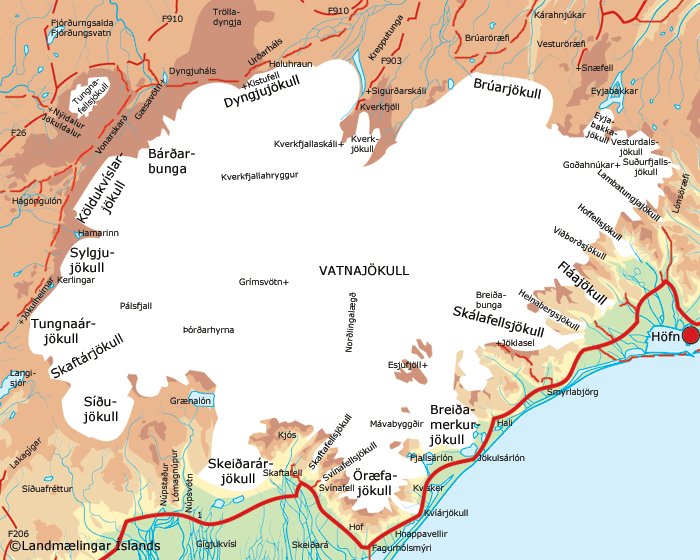
vatnajokull glacier and its volcanoes image wired.com

vatnajokull glacier and its volcanoes image wired.com

There is no telling how large or how small this eruption may be. But it has been 23 years (Pinatubo, 1991) since a VEI 5+ volcano eruption somewhere in the world and such an eruption is now “overdue:

Through the 20th century, an eruption of intensity 5 or greater came at intervals varying from 1 year upto 23 years with an average interval of just under 7 years.

Madras Day, the Coromandel coast and the Yonghy-Bonghy-Bo

August 23, 2014

Madras Day: 22nd August 1639 – 2014

Madras Day was celebrated yesterday as the 375th anniversary of the founding of the city now known as Chennai on the Coromandel coast.

Andrew Cogan and Francis Day’s factory site on an uninhabited sandy strip eventually grew to become one of India’s renowned metropolises, and the capital city of Tamil Nadu. Every year, August 22 is celebrated as Madras Day, and this year, 2014, is Chennai’s 375 birthday.

Excerpt from Edward Lear’s The Courtship of the Yonghi-Bonghi-Bo  (this should be read in its entirety and only be read aloud)

On the Coast of Coromandel
Where the early pumpkins blow,
In the middle of the woods
Lived the Yonghy-Bonghy-Bo.

………….

“On this Coast of Coromandel
Shrimps and watercresses grow,
Prawns are plentiful and cheap,”
Said the Yonghy-Bonghy-Bo.
“You shall have my chairs and candle,
And my jug without a handle!
Gaze upon the rolling deep
(Fish is plentiful and cheap);
As the sea, my love is deep!”
Said the Yonghy-Bonghy-Bo,
Said the Yonghy-Bonghy-Bo.
……….
“Lady Jingly! Lady Jingly! 
Sitting where the pumpkins grow, 
Will you come and be my wife?”
Said the Yonghy-Bònghy-Bò.
……….
Down the slippery slopes of Myrtle,
Where the early pumpkins blow,
To the calm and silent sea
Fled the Yonghy-Bonghy-Bo.
………
From the Coast of Coromandel
Did that Lady never go;
On that heap of stones she mourns
For the Yonghy-Bonghy-Bo.
………
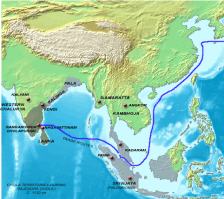
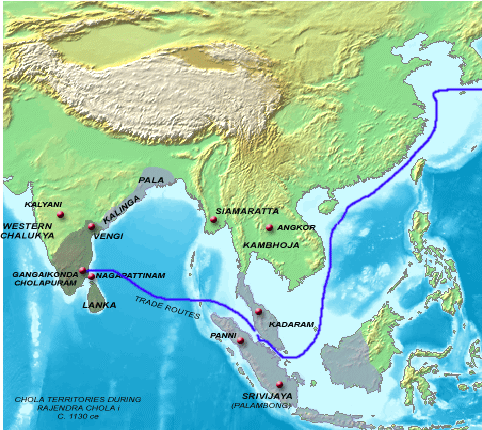
Chola trade under Rajendra Chola c. 1130 Wikimedia

Chola trade under Rajendra Chola c. 1130 Wikimedia

The earliest known settlements in South India date back to more than 2 million years ago in the form of Acheulian stone tools (Lower Paleolithic from about 2.6 million to 300,000 years ago). The oldest human remains (probably homo erectus or archaic homo sapiens)  found is a fossilised infant skull from about 200,000 years ago. The unfortunate and love-sick Yonghi-Bonghi-Bo was never destined to win his Lady Jingly Jones but the Coromandel coast has seen a continuous settlement of humans for over 2 million years. Homo sapiens probably came in two waves; one before the Toba eruption of 74,000 years ago and another perhaps around 50,000 years ago. The Toba eruption was possibly the greatest catastrophe ever visited on humans on that coast. In due course, hunter-gatherers gave way to farmers and the evidence shows that the Neolithic was long established by around 2,600 BCE (4,700 years ago). The early Chola-dynasty rule was established by 100 CE in the Sangam era. They lost power to the Pallavas around 300 CE who in turn were replaced by Pandyas around 600 CE but then the Cholas returned around 900 CE. Whether these medieveal Cholas were truly descendants of the early Cholas is uncertain but they certainly claimed to be. By 1,000 years ago at the height of the Chola Empire, their territories extended well into South-east Asia. Chola traders were finding their way up to today’s Korea, protected by a Navy which even had some blue-water capabilities. The later Cholas were again replaced by the Pandyas in 1279 but the rule of the great Tamil dynasties came to an end with the establishment of the short-lived Madurai Sultanate in 1335 and its many subsequent successors. Then came the colonists. The Portuguese, the Dutch, the British, the Danes and the French. The Portuguese were first. The “realm of the Cholas” in Tamil was “Cholamandalam” and from this came the Portuguese corruption to “C(h)oro-mandel”. Vasco da Gama reached the Western Indian Malabar coast on 20th May 1498. In 1522 they established São Tomé de Meliapore named after St. Thomas who was supposed to have preached at St. Thomas’ Mount between 52 and 70 CE.  The legend is that St. Thomas died here and by 1523, the Portuguese had built a shrine there. “By late 1530 the Coromandel Coast was home to three Portuguese settlements at Nagapattinam, São Tomé de Meliapore, and Pulicat”. The Dutch reached the Coromandel Coast by 1606 and built their Geldria Fort near Pulicat (where the Portuguese were already present) as a staging post to the East Indies. The first British trading post was established in 1610 at Masulipatnam which had been abandoned by the Portuguese. The Danes reached in 1620 in Tranquebar and established a protestant mission. The French were late out and their first permanent colony was not established till they purchased Pondicherry in 1673.

By 1825, the Dutch had lost the last of their trading posts in India. The Danes left Tranquebar in 1845. The British left with Independence in 1947. By 1954 the French had ceded all colonies in India (though not ratified by the French Parliament till 1962). The Portuguese lost all footholds on the Coromandel coast by 1749 and were finally pushed out of India by military action in 1961.

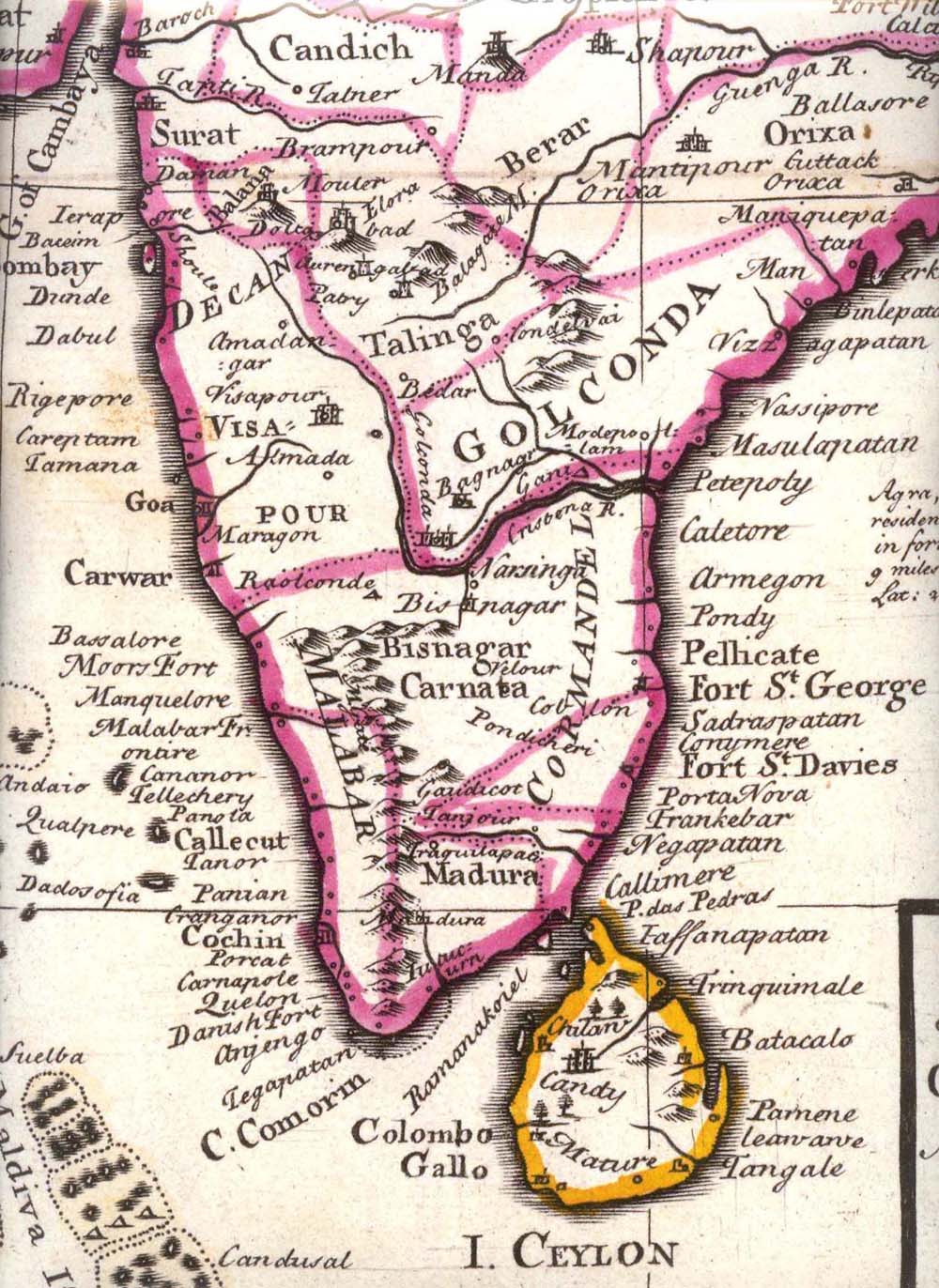
The Coromandel coast 1715
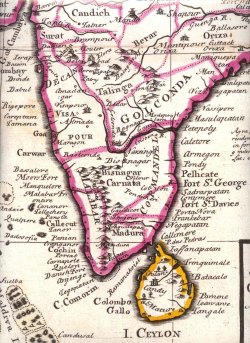
coromandel coast 1715 by moll

coromandel coast 1715 by moll

The British East India Company was quite desperate to find a foothold on the Coromandel coast but their efforts at Pulicat were defeated by the Dutch. They tried at to settle at Peddapalli and Nizampatnam but were laid low by the climate and by disease. The English, after some effort, secured the privilege of building a factory at Masulipatam port.

The Beginnings: 

But they later abandoned their factory and crept away in a small boat to Durgarazpatnam (otherwise known as Armagaon) situated about 35 miles to the north of Pulicat. This place was a miserable port and was too poor to supply the calico cloth which the English wanted for export to Europe. But it was the only safe shelter for the English at the time and here they built a small fort and mounted a few pieces of cannon upon it. But trade did not thrive and the miserable English traders planned to go back to Masulipatam under the protection of a Golden Firman which the Sultan of Golconda was kind enough to give them. But Masulipatam was in the throes of a famine just then ….. 

With Masulipatam unprosperous and Armagaon hopeless, the English traders anxiously looked out for a new site that would be more propitious for them. Mr. Francis Day, the future founder of Madras, who was then a Member of the Masulipatam Council and the Chief of the Armagaon Factory, made a voyage of exploration in 1637 down the coast as far as Pondicherry with a view to choose a site for a new settlement. 

Damarla Venkatapathy Nayak ruled all the coast country from Pulicat to the Portuguese settlement of San Thome now included within the City of Madras. He had his head-quarters at Wandiwash and his brother Ayyappa Nayak resided at Poonamallee, a few miles to the west of Madras, and looked after the affairs of the coast. 

And so it was in August 1639 that Francis Day and Andrew Cogan on behalf of the East India Company purchased a 2 year grant from the Nayak for the village of Madraspattnam and with permission to build a fort and a factory. That became Fort St. George  with the village of Madraspattnam just to the south and a village  – called Chennaipattnam by the locals – to the north.

And the rest is history.

Day and Cogan are commemorated nowhere — except by Madras Day on 22nd August every year. But what is not really known is how the village of Madraspattnam, which clearly existed before Day and Cogan turned up, got its name. In one story it was named after a Christian fisherman named Madresan and in another after a Muslim madrassa in the vicinity. Another story speculates that it was because of the nearby Madre de Dios Church built by the Portuguese in São Tomé de Meliapore. But the story I like best is that it comes from the name of the wealthiest Portuguese family of the time in São Tomé de Meliapore – the Madeiros.

And that is the tale of Chennai on the Coromandel coast which once went by the name of a Portuguese family, where prawns are still plentiful and cheap and where the Yonghy-Bonghy-Bo broke his heart over the Lady Jingly Jones.
Heat is on over weather bureau ‘homogenising temperature records’

August 23, 2014

Reblogged from jennifermarohasy.com.

It really needs little comment, except perhaps that the magnitude of  “homogenisation” or “adjustments”, or “corrections” as applied to the temperature record makes up most of the “global warming” that is claimed.

Homogenisation in Australia, Adjustments in the US. Fancy algorithms to “correct” data, with not a little confirmation bias, could be better described as “fudging”.

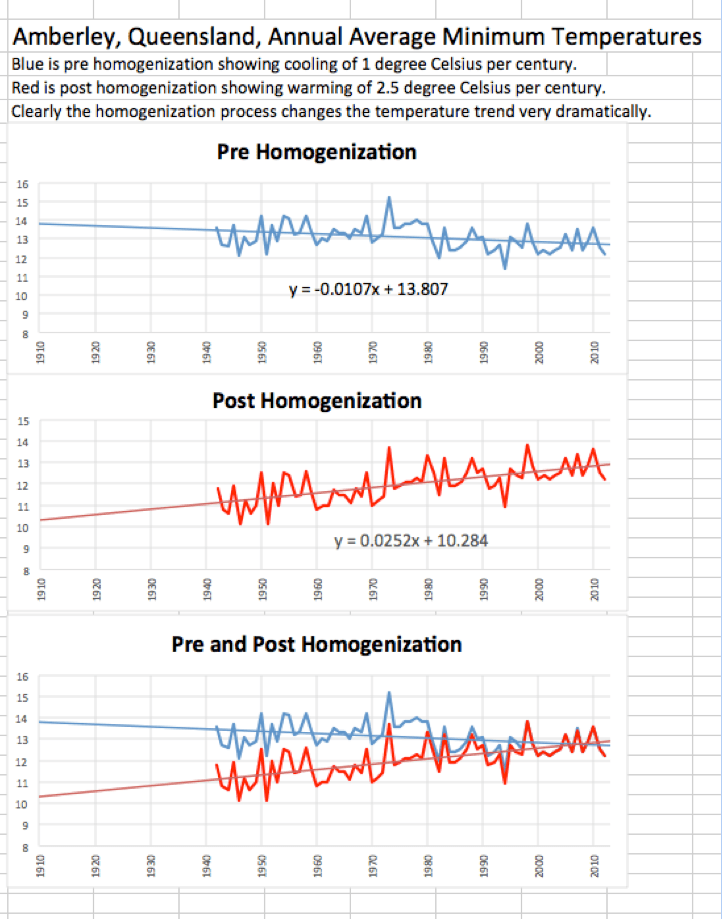
Heat is on over weather bureau ‘homogenising temperature records

EARLIER this year Tim Flannery said “the pause” in global warming was a myth, leading medical scientists called for stronger action on climate change, and the Australian Bureau of Meteorology declared 2013 the hottest year on record. All of this was reported without any discussion of the actual temperature data. It has been assumed that there is basically one temperature series and that it’s genuine.But I’m hoping that after today, with both a feature (page 20) and a news piece (page 9) in The Weekend Australia things have changed forever.

I’m hoping that next time Professor Flannery is interviewed he will be asked by journalists which data series he is relying on: the actual recorded temperatures or the homogenized remodeled series. Because as many skeptics have known for a long time, and as Graham Lloyd reports today for News Ltd, for any one site across this wide-brown land Australia, while the raw data may show a pause, or even cooling, the truncated and homogenized data often shows dramatic warming.

When I first sent Graham Lloyd some examples of the remodeling of the temperature series I think he may have been somewhat skeptical. I know he on-forwarded this information to the Bureau for comment, including three charts showing the homogenization of the minimum temperature series for Amberley.

Mr Lloyd is the Environment Editor for The Australian newspaper and he may have been concerned I got the numbers wrong. He sought comment and clarification from the Bureau, not just for Amberley but also for my numbers pertaining to Rutherglen and Bourke.

I understand that by way of response to Mr Lloyd, the Bureau has not disputed these calculations.

This is significant. The Bureau now admits that it changes the temperature series and quite dramatically through the process of homogenisation.

I repeat the Bureau has not disputed the figures. The Bureau admits that the data is remodelled.

What the Bureau has done, however, is try and justify the changes. In particular, for Amberley the Bureau is claiming to Mr Lloyd that there is very little available documentation for Amberley before 1990 and that information before this time may be “classified”: as in top secret. That’s right, there is apparently a reason for jumping-up the minimum temperatures for Amberley but it just can’t provide Mr Lloyd with the supporting meta-data at this point in time.

Some of the charts I sent to Graham Lloyd earlier this week.

*****
The two articles in The Australian are behind a pay wall here and here. If you don’t already have a subscription to The Australian take one out today, because the articles are important and Graham Lloyd’s work is worth paying for.

If the globe is warming how come relative humidity is decreasing?

August 22, 2014

Increasing temperature leads to a greater capacity for air to hold moisture (the specific humidity). The actual amount of moisture held in a sample of air as a proportion of the capacity of that air to hold moisture is termed the relative humidity and is usually given as a percentage.

Specific humidity (g/kg) versus temperature for air  earthobservatory.nasa.gov

All climate computer models usually assume a constant relative humidity.

NasaIn climate modeling, scientists have assumed that the relative humidity of the atmosphere will stay the same regardless of how the climate changes. In other words, they assume that even though air will be able to hold more moisture as the temperature goes up, proportionally more water vapor will be evaporated from the ocean surface and carried through the atmosphere so that the percentage of water in the air remains constant. Climate models that assume that future relative humidity will remain constant predict greater increases in the Earth’s temperature in response to increased carbon dioxide than models that allow relative humidity to change. The constant-relative-humidity assumption places extra water in the equation, which increases the heating.

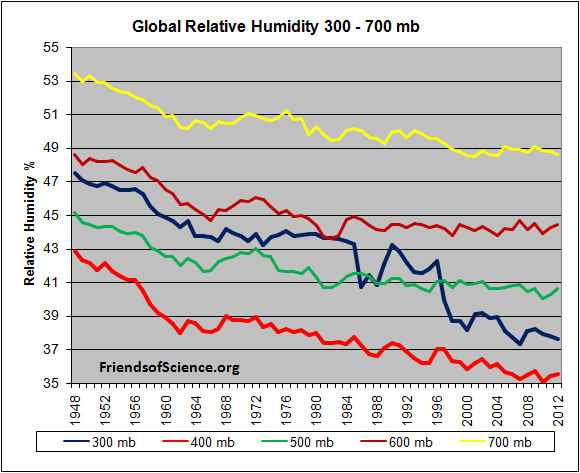
Relative humidity has decreased steadily for over 60 years. All computer models which assume constant relative humidity will overestimate the feedback and the degree of warming.

Forbes carries an article about the mismatch between computer models and actual observations.

ForbesWater vapor is a much more potent greenhouse gas than carbon dioxide, so substantial increases in atmospheric water vapor can certainly cause significant warming. United Nations computer models are programmed to assume that absolute humidity (the total amount of water vapor in the atmosphere) will rise so much that even relative humidity (the percent of water vapor in the atmosphere) will at least keep pace and perhaps even increase. Warmer air is able to hold more water than cooler air, so absolute water vapor would have to increase quite substantially for relative humidity to remain constant or increase in a warming world.

Scientists, however, have been measuring relative humidity for many decades. Rather than keeping pace with modestly warming temperatures, relative humidity is declining. This decline has been ongoing, without interruption, for more than 60 years. After more than six decades of consistent data, we can say with strong confidence that absolute humidity is not rising rapidly enough for relative humidity to keep pace with warming temperatures.

Global Relative Humidity 300 -700mb

Global Relative Humidity 300 – 700mb  (300mb corresponds to about 9,000 m altitude)

The failure of relative humidity to hold constant or rise during recent decades is a lethal dagger in the heart of alarmist global warming claims. According to the UN computer models, rapidly rising absolute humidity will cause substantially more global warming than the modest warming directly caused by rising carbon dioxide levels. Given the potency of water vapor, even a small overstatement of atmospheric humidity levels in UN computer models will cause a very significant overstatement of future warming. And the data show UN computer models assume too much atmospheric humidity.

The effects of this overstatement are apparent in real-world temperature data this century. Precise atmospheric temperature measurements compiled by NASA and NOAA satellite instruments show there has been no global warming since late in the 20th century


Not so random animal sounds may show a stepping stone towards language

August 21, 2014

The manner in which humans came to invent gestures and sounds, then developed these into words, then into language and eventually on into writing is a critical and fascinating story from our past that will probably never be fully known or understood. No doubt for humans there is also a connection to the invention of counting, the use of abstract symbols and the evolution of numeracy and the beginnings of the languages of mathematics.The timeline of these evolutions are also in much doubt. Possibly gestures and sounds go back 300,000 years (or even further), but language was established among humans only by about 50,000 years ago. Words and their earlier sounds must have come much, much earlier and writing very much later. Cave paintings around 30,000 years ago may represent the period when abstract symbolism was taking off. It is thought that writing did not come until agriculture expanded – perhaps from about 12,000 years ago.

Now research on animal sounds suggests that for some species the sounds they make are not as random as they were originally thought to be. They exhibit levels of complexity which are suggestive of stepping-stones along the long road to grammar and language. Such steps may have assisted humans from moving from sounds and words to context-free grammars and thence to language.

The sequence in humans – I speculate – could have been:

(300KYA) gestures>> sounds>> (smiles, laughter?)>> words>> ..(unknown steps)>> simple grammar>> context-free grammar>> language>> symbols>> abstract symbols>> writing (12KYA)

Kershenbaum A, Bowles A, Freeburg T, Dezhe J, Lameira A, Bohn K. 2014. Animal vocal sequences: Not the Markov chains we thought they were. Proceedings of the Royal Society B. rspb.royalsocietypublishing.or… .1098/rspb.2014.1370

PhysOrg reports:

The study, published today in the journal Proceedings of the Royal Society B, analyzed the vocal sequences of seven different species of birds and mammals and found that the vocal sequences produced by the animals appear to be generated by complex statistical processes, more akin to human language. ….

Many species of animals produce complex vocalizations – consider the mockingbird, for example, which can mimic over 100 distinct song types of different species, or the rock hyrax, whose long string of wails, chucks and snorts signify male territory. But while the vocalizations suggest language-like characteristics, scientists have found it difficult to define and identify the complexity.

Typically, scientists have assumed that the sequence of animal calls is generated by a simple random process, called a “Markov process.” Using the Markov process to examine animal vocalization means that the sequence of variables—in this case, the vocal elements—is dependent only on a finite number of preceding vocal elements, making the process fairly random and far different from the complexity inherent in human language. ……. 

…… the study found no evidence for a Markovian process. The researchers used mathematical models to analyze the vocal sequences of chickadees, finches, bats, orangutans, killer whales, pilot whales and hyraxes, and found most of the vocal sequences were more consistent with statistical models that are more complex than Markov processes and more language-like. …… 

“Language is the biggest difference that separates humans from animals evolutionarily, but multiple studies are finding more and more stepping stones that seem to bridge this gap. Uncovering the process underlying vocal sequence generation in animals may be critical to our understanding of the origin of language,” said lead author Arik Kershenbaum, a postdoctoral fellow at the National Institute for Mathematical and Biological Synthesis.

Abstract:

Many animals produce vocal sequences that appear complex. Most researchers assume that these sequences are well characterized as Markov chains (i.e. that the probability of a particular vocal element can be calculated from the history of only a finite number of preceding elements). However, this assumption has never been explicitly tested. Furthermore, it is unclear how language could evolve in a single step from a Markovian origin, as is frequently assumed, as no intermediate forms have been found between animal communication and human language. Here, we assess whether animal taxa produce vocal sequences that are better described by Markov chains, or by non-Markovian dynamics such as the ‘renewal process’ (RP), characterized by a strong tendency to repeat elements. We examined vocal sequences of seven taxa: Bengalese finches Lonchura striata domestica, Carolina chickadees Poecile carolinensis, free-tailed bats Tadarida brasiliensis, rock hyraxes Procavia capensis, pilot whales Globicephala macrorhynchus, killer whales Orcinus orca and orangutans Pongo spp. The vocal systems of most of these species are more consistent with a non-Markovian RP than with the Markovian models traditionally assumed. Our data suggest that non-Markovian vocal sequences may be more common than Markov sequences, which must be taken into account when evaluating alternative hypotheses for the evolution of signalling complexity, and perhaps human language origins.

Climate modelling: Study shows that without access to water fish will die!

August 21, 2014

I am sure all the forecasts based on climate models applied to hydrological models and extrapolated to 2050 are all quite clever. But it is no evidence of anything.

I am not sure why their conclusions are confined to Arizona. I suspect it may be a profound and universal truth that: Without water fish will die!!

My reading of this study (which I put under Trivia):

If the climate develops as we have modelled,

and if the surface water flows are reduced,

and if the connectivity of the water streams is reduced as we have modelled,

then some fish will lose access to water,

and some of those fish will die.

K. L. Jaeger, J. D. Olden, N. A. Pelland. Climate change poised to threaten hydrologic connectivity and endemic fishes in dryland streams. Proceedings of the National Academy of Sciences, 2014; DOI: 10.1073/pnas.1320890111

Significance (In other words an abstract of the abstract)

We provide the first demonstration to our knowledge that projected changes in regional climate regimes will have significant consequences for patterns of intermittence and hydrologic connectivity in dryland streams of the American Southwest. By simulating fine-resolution streamflow responses to forecasted climate change, we simultaneously evaluate alterations in local flow continuity over time and network flow connectivity over space and relate how these changes may challenge the persistence of a globally endemic fish fauna. Given that human population growth in arid regions will only further increase surface and groundwater extraction during droughts, we expect even greater likelihood of flow intermittence and loss of habitat connectivity in the future.

(my bold)

The University of Ohio goes to town with its Press Release : Climate Change will threaten fish…

Fish species native to a major Arizona watershed may lose access to important segments of their habitat by 2050 as surface water flow is reduced by the effects of climate warming, new research suggests. ….. 

“If water is flowing throughout the network, fish are able to access all parts of it and make use of whatever resources are there. But when systems dry down, temporary fragmented systems develop that force fish into smaller, sometimes isolated channel reaches or pools until dry channels wet up again.”…….


Landslides in Hiroshima kill 39, with 7 missing

August 21, 2014

Heavy rain has caused landslides in Hiroshima prefecture in Japan killing at least 39 people including some children with at least a further seven missing.

Hiroshima landslides August 20, 2014 – image Reuters/Japan Times

Japan Times:

The landslides and flooding triggered by torrential rain overnight Wednesday that engulfed residential areas in Hiroshima so far have left 39 people confirmed dead and seven remained missing, and more Self-Defense Forces personnel have been sent in to join the search and rescue effort.

The government boosted the number of SDF personnel deployed for rescue operations to 600 to continue operations through the night. Prime Minister Shinzo Abe, who was taking his summer vacation, cut short a game of golf to return to his office in Tokyo to deal with the disaster.

In Asakita Ward, Hiroshima, one of the hardest-hit areas, a record 217.5 mm of rain fell in the three hours from 1:30 a.m. Wednesday. The city of Hiroshima started issuing evacuation advisories at 4:15 a.m., but an official admitted the action was late.

Japan is perhaps more susceptible to natural disasters than many other parts of the world. Thoughts turn immediately to the 2011 Great Tohoku Earthquake and Tsunami. As of February this year the earthquake and tsunami had claimed 15,889 lives with another 2,609 people unaccounted for and presumed dead. A total of 18,498 deaths.

Even though the nuclear plant at Fukushima actually survived the earthquake but could not cope with the tsunami, it is the incident at the Fukushima nuclear plant which still gets all the headlines and lives on in the collective memory. The 18,498 deaths caused by the earthquake and tsunami are somehow pushed aside by the fears engendered by Fukushima. There was considerable radiation leakage but not a single person was killed at Fukushima. Fears outweigh reality.

The Fukushima Dai-Ichi nuclear accident which followed the Great Tohoku Earthquake and Tsunami of 2011, was about the worst accident that could have happened in a nuclear plant. Hydrogen explosions occurred in the outer containment casings of 2 of the 6 reactors and meltdown of 2 of the cores also took place. A nuclear plant is not a nuclear bomb and a chain reaction leading to an explosion is not a real possibility. It is meltdown of the cores which is the bottom line.

Yet there were no deaths. As the official report from May (2013) this year said:

 No radiation-related deaths or acute effects have been observed among nearly 25,000 workers (including TEPCO employees and contractors) involved at the accident site.

It was the earthquake and tsunami which did the damage, caused some 18,000 deaths  and which led to the nuclear accident. But radiation from the nuclear accident has caused no deaths. And the radiation will cause no deaths.

Why – in terms of media response, knee-jerk government responses and general hysteria – does the awful reality of the earthquake and tsunami get dwarfed and swamped by alarmist but unreal fears? It is as if the nuclear incident had caused the earthquake and tsunami rather than the other way around. It cannot just be due to a fatalistic acceptance of natural catastrophes.

Even with man-made – and therefore presumably avoidable – events, we seem able, after it  has happened, to put even genocide and brutality and several thousands killed to one side and move on. Unless there is a personal connection to the disaster we just file it in our minds in the “Disasters” folder and carry on. Perhaps it is human imagination at work. As long as a risk is unrealised the potential damage is unlimited and we are free to – and we do –  imagine the most unimaginable catastrophes. Once a risk materialises then – no matter how large the disaster – it is finite and capped.

The fear of even an infinitesimal probability of an infinite risk seems to weigh more heavily in the human consciousness than the most awful – but finite – disaster that has occurred. Which insurance companies are very thankful for.

How climate science models are validated

August 20, 2014

Mathematical and computer models are wonderful tools. Once they can be validated they are powerful methods of interpolation. They are useful methods of improving the understanding embodied in the models by extrapolation. The divergence between extrapolated model results and real data can then be used for improving the models to better account for real data. If model results do not fit real data it is time to change the model.

Extrapolated model results are never evidence. They are just indicators of what may come to pass provided that the model – in spite of all its simplifications – does truly apply.

And when climate model results are fudged to move towards climate data which, in turn, has to be fudged to move towards the model results, one wonders whether there is any scientific method left in “climate science”.

This is reported by WUWT from a recent paper from ETH Zurich.

If the model data is corrected downwards, as suggested by the ETH researchers, and

the measurement data is corrected upwards, as suggested by the British and Canadian researchers,

then the model and actual observations are very similar.

Shameless is one adjective that comes to mind.

Fraudulent is another.


Swedish researcher faces disciplinary proceedings for plagiarism

August 20, 2014

Back in March this year, Jesper Johansson, a senior lecturer at Linnaeus University had a 2012 article in the Nordic Journal of Migration Research retracted for plagiarism as reported by Retraction Watch. The University mounted an investigation and the University Vice-Chancellor Stephen Hwang  has now announced that the plagiarism is confirmed and that the University’s Personnel Committee will meet in September to consider disciplinary actions to be taken. Dr. Johansson is currently on leave. It is reported that he has acknowledged his plagiarism. There is also a report that it was a case of self-plagiarism but as Retraction Watch reported some of the material was copied from at least one other author:

The article, Swedish Employers and Trade Unions, Varieties of Capitalism and Labour Migration Policies,” was written by Jesper Johansson, of Linnaeus University in Växjö. It’s available as a PDF here, but not on the website of the publisher, De Gruyter — nor is it listed on Johnansson’s own site.

We chose a sentence a random from the abstract:

Employers are also thought to support policies incentive-compatible with the prevailing mode of capitalism.

And found it in this 2007 preprint of an article, “Varieties of Capitalism and Labor Migration Policy,” by another in researcher Sweden, Gregg Bucken-Knapp, of University West.

We’re guessing this wouldn’t be the only successful fishing expedition — and we wonder why the editors didn’t bother to use plagiarism detection software.

Had they done so, they would have been able to avoid having to issue this retraction notice:

This article has been withdrawn by the editors-in-chief, because it has been found to plagiarise already published work.

Johansson reports 21 publications on his site but does not include the retracted paper.

Johansson Linnaeus

Johansson Linnaeus

Johansson generally takes left-wing positions in his writings. Some extreme, racist parties in Sweden are rubbing their hands with glee.

Iceland warns of potential eruption of Bárðarbunga volcano

August 19, 2014

We are due to visit Iceland next month but that may now depend on how this develops.

The Iceland Met Office has upgraded its warning about a potential eruption of Bárðarbunga volcano and said  there were “strong indications of ongoing magma movement”.

The intense seismic activity that started on 16 of August at Bárðarbunga persists. Very strong indications of ongoing magma movement, in connection with dyke intrusion, is corroborated by GPS measurements. There are currently two swarms: one to the E of Bárðarbunga caldera and one at the edge of Dyngjujökull just E of Kistufell. At 2.37 am on the 18th a strong earthquake (M4) was located in the Kistufell swarm.

This is the strongest earthquake measured in the region since 1996. As evidence of magma movement shallower than 10 km implies increased potential of a volcanic eruption, the Bárðarbunga aviation color code has been changed to orange. Presently there are no signs of eruption, but it cannot be excluded that the current activity will result in an explosive subglacial eruption, leading to an outburst flood (jökulhlaup) and ash emission. 

From Volcano Discovery:

The volcano is hidden beneath the northwestern part of the Vatnajökull glacier, and contains a 700-m-deep caldera that is hidden beneath ice and has extensive flank fissures, from where eruptions have taken place: the Veidivötn fissure extends for over 100 km to the SW, almost reaching Torfajökull volcano, while the Trollagigar fissure extends 50 km to the NE touching Askja volcano.


vatnajokull glacier and its volcanoes image wired.com

vatnajokull glacier and its volcanos image wired.com

The summary issued on Monday says that though intense earthquake swarm continues at Barðarbunga further movement of magma towards the surface has not been detected.

Summary written 18th August at 20:45

Since the onset of the earthquake swarm at Bárðarbunga on Saturday morning 16th August 03:00am, around 2.600 earthquakes have been detected with the earthquake monitoring network of the Icelandic Meteorological Office (IMO), of these around 950 since midnight (17/18th August). Several of these events were larger than magnitude 3. The swarm initially started in the Bárðarbunga caldera and has been migrating in two clusters towards the north and the east of the volcano.

On Sunday 17th of August, these two clusters were active east and north of Bárðarbunga. The activity in both clusters was migrating northeastwards. While the strongest events were located in the northern cluster, the highest number of events was detected in the eastern cluster. The strongest event since the onset of the swarm was detected on Monday morning 02:37 in the northern cluster. Detailed analysis revealed that its magnitude was 4.5 and it was felt in Akureyri and Lón. By Monday evening, activity has significantly decreased in the northern cluster.

The eastern cluster remains active. Two stronger pulses of activity have occurred between 10:45 and 12:00 as well as 16:50 and 17:30 this morning. Within the first pulse around noon, the cluster was again migrating northeastwards, most events are now located between Bárðarbunga and Kverkfjöll. As reported earlier, GPS ground deformation data has evidenced that the earthquake swarm is caused by magma intrusion.

Throughout the whole sequence until now (18th August at 20:45) the majority of events has been at 5-10km depth. No signs of migration towards the surface or any other signs of imminent or ongoing volcanic activity have been detected so far. IMO is monitoring the area around the clock very closely and will update in case of any changes.