Chinese “Last Supper” sold for $23.3 million

October 7, 2013

Last Supper by Zeng Fanzhi image Chinese Avantgarde

In Zeng’s painting, Jesus looks like Obama to me and they are all wearing uniforms which remind me of  “boy scout” uniforms. Judas is distinguished by his yellow tie. They seem to be eating water melons.

The Wall Street Journal reports:

A painting by Zeng Fanzhi sold for US$23.3 million at a Sotheby’s auction on Saturday night in Hong Kong, setting a new record price for a work by an Asian contemporary artist.

Titled “The Last Supper” and inspired by the Leonardo da Vinci’s 15th-century mural of the same name, the large painting­–almost 13 feet wide–was sold after a bidding war that lasted over 10 minutes between two buyers on the phone. A crowd of 600 people in a packed room at the Hong Kong Convention and Exhibition Centre applauded several times as the prices slowly escalated up to the final result.

The winning bidder, who paid more than the presale estimate of 80 (Million) Hong Kong dollars (US$10.3 million) was not identified by the firm.

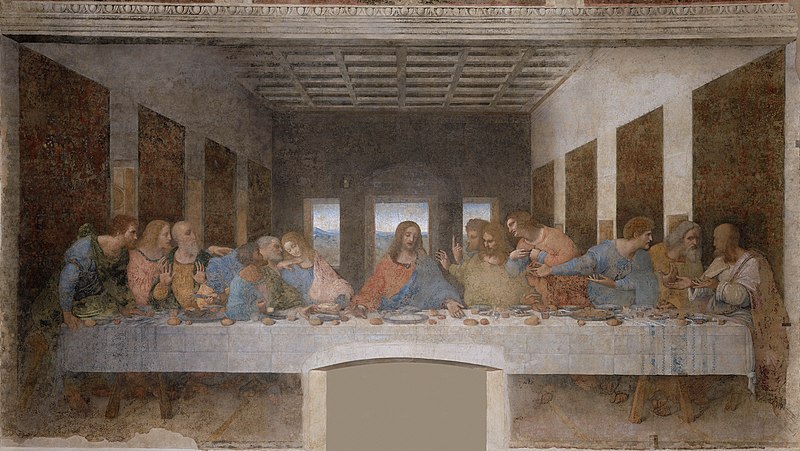
File:Última Cena - Da Vinci 5.jpg

Leonardo Da Vinci’s Last Supper (Wikipedia)

1495-1498. Photographic reproduction: Copyright 2006-2007 HAL9000 S.r.l.

Modern eugenics in all but name: Sex selection by abortion is legal in the UK

October 7, 2013

Eugenics is here even if nobody wants to acknowledge it for fear of being equated with the Nazis. Artificial selection and deselection rather than natural selection will eventually come to dominate the future evolution of humans. In India the abortion of female foetuses is sometimes an extension of female infanticide caused by the fear of the cost of female children and by the social status accorded by a male child. Sex selection by deselecting foetuses of unwanted genders is not just a feature of the developing world. Even in the UK, sex selection by abortion is legal.

The Telegraph:

Doctors have been informed that they can carry out sex-selective abortions in certain circumstances, the Director of Public Prosecutions has disclosed.

The British Medical Association (BMA) updated its guidance in the wake of an investigation by the Telegraph to advise doctors that “there may be circumstances, in which termination of pregnancy on grounds of fetal sex would be lawful”.

The disclosure is expected to spark fury among dozens of MPs who have criticised the medical establishment for seeking to redefine abortion laws.

Keir Starmer, the Director of Public Prosecutions, today publishes a detailed memorandum explaining the controversial decision by the Crown Prosecution Service not to prosecute two doctors who agreed to arrange illegal abortions based on the sex of an unborn baby.

Mr Starmer warns that current guidance for doctors needs to be urgently updated amid widespread concern over practices in clinics which do not appear to fall foul of the letter of the law.

The two doctors at the centre of the controversy were exposed by the Telegraph after being secretly filmed offering to abort baby girls, even though this is widely thought to be illegal.

The CPS decided it would not be in “the public interest” to prosecute the two doctors.

It has today emerged that in guidance published after The Daily Telegraph carried out the investigation, the BMA issued guidance for doctors.

It stated: “It is normally unethical to terminate a pregnancy on the grounds of fetal sex alone.”

However, it then continues: “The pregnant woman’s views about the effect of the sex of the fetus on her situation and on her existing children should nevertheless be carefully considered.”

“In some circumstances doctors may come to the conclusion that the effects are so severe as to provide legal and ethical justification for a termination,” concludes the guidance.

…

Letter from DPP

“…… The law does not, in terms, expressly prohibit gender-specific abortions; rather it prohibits any abortion carried out without two medical practitioners having formed a view, in good faith, that the health risks of continuing with a pregnancy outweigh those of termination. …..

….. The discretion afforded to doctors under the current law in assessing the risk to the mental or physical health of a patient is wide and, having consulted an experienced consultant in Obstetrics and Gynaecology, it appears that there is no generally accepted approach among the medical profession.”

Nobel Prize time again: Medicine to Rothman, Schekman and Südhof

October 7, 2013

UPDATE:

The Nobel Prize in Physiology or Medicine 2013 was awarded jointly to James E. Rothman, Randy W. Schekman and Thomas C. Südhof“for their discoveries of machinery regulating vesicle traffic, a major transport system in our cells”.

===========================================

It is that time of the year again. But the Nobel Peace Prize and that for Economics are a travesty and ought to be discontinued. The Peace Prize especially takes more away from the Nobel brand than it offers. Without the Nobel brand to prop it up the Peace Prize would be considered a nonsense with very little to do with Peace. The Literature prize is also very politically correct which detracts from its importance to literature.

My hope is that the blatant lobbying by the PR apparatus of the CERN group will NOT be recognised with a Nobel.

The schedule beginning today is:

Monday 7 October, 11:30 a.m. at the earliest – The Nobel Prize in Physiology or Medicine
The prize will be announced by Göran K. Hansson, Secretary of the Nobel Committee for Physiology or Medicine.

Tuesday 8 October, 11:45 a.m. at the earliest – The Nobel Prize in Physics
The prize will be announced by Staffan Normark, Permanent Secretary of the Royal Swedish Academy of Sciences.

Wednesday 9 October, 11:45 a.m. at the earliest – The Nobel Prize in Chemistry
The prize will be announced by Staffan Normark, Permanent Secretary of the Royal Swedish Academy of Sciences.

Friday 11 October, 11:00 a.m. – The Nobel Peace Prize
The prize will be announced by Thorbjørn Jagland, Chairman of the Norwegian Nobel Committee.

Monday 14 October, 1:00 p.m. at the earliest – The Sveriges Riksbank Prize in Economic Sciences in Memory of Alfred Nobel
The prize will be announced by Staffan Normark, Permanent Secretary of the Royal Swedish Academy of Sciences.

The Nobel Prize in Literature
According to tradition, the Swedish Academy will set the date for its announcement of the Nobel Prize in Literature later. The Prize will be announced by Peter Englund, Permanent Secretary of the Swedish Academy.

Thomson-Reuters have made their predictions:

The 2013 Thomson Reuters Citation Laureates by Nobel Prize category are:

CHEMISTRY

A. Paul Alivisatos  and Chad A. Mirkin and Nadrian C. Seeman
For contributions to DNA nanotechnology

Bruce N. Ames
For the invention of the Ames test of mutagenicity

M.G. Finn and Valery V. Fokin and K. Barry Sharpless
For the development of modular click chemistry

PHYSICS

François Englert and Peter W. Higgs
For their prediction of the Brout-Englert-Higgs boson

Hideo Hosono
For his discovery of iron-based superconductors

Geoffrey W. Marcy and Michel Mayor and Didier Queloz
For their discoveries of extrasolar planets

PHYSIOLOGY or MEDICINE

Adrian P. Bird and Howard Cedar and Aharon Razin
For their fundamental discoveries concerning DNA methylation and gene expression

Daniel J. Klionsky and Noboru Mizushima and Yoshinori Ohsumi
For elucidating the molecular mechanisms and physiological function of autophagy

Dennis J. Slamon
For his pioneering research identifying the HER-2/neu oncogene, leading to more effective cancer therapy

ECONOMICS
Joshua D. Angrist and David E. Card and Alan B. Krueger
For their advancement of empirical microeconomics

Sir David F. Hendry and M. Hashem Pesaran and Peter C.B. Phillips
For their contributions to economic time-series, including modeling, testing and forecasting

Sam Peltzman and Richard A. Posner
For extending economic theories of regulation

Another alarmist theme debunked: PCF’s and PCB’s don’t affect fertility

October 7, 2013

A major EU study concludes that environmental contaminants have little if any impact on human fertility and certainly much less than the alarmist meme has portrayed for 2 decades. Moreover “data indicates that global warming will not increase the spread of contaminants around the Arctic areas and the rest of the planet”.

ScienceNordic reports:

….

The event marked the culmination the three-year-long EU study ‘Climate Change, Environmental Contaminants and Reproductive Health (CLEAR)’, which is headed by Danish scientists. 

Since 2010 the CLEAR project has aimed at assessing whether global warming causes an increase in the spread of the already widespread environmental contaminants such as PCB and PCF and whether increased exposure is a threat to human reproductive health.

The short answer to both questions is no, said Professor Jens Peter Bonde of the Department of Public Health at Copenhagen University.

“Most people probably feel they already know about the negative effects of environmental contaminants but with this study we can conclude that these contaminants really pose no major threat to human fertility,” he said.

On top of that, he added, their data indicates that global warming will not increase the spread of contaminants around the Arctic areas and the rest of the planet.

Some 1,400 pregnant women and 600 spouses from Greenland, Hungary and Poland were examined for the CLEAR project, which is the largest project so far to study the effect of more than 20 known environmental contaminants’ toxicity on human fertility.

While no major negative effects were found on the subjects’ reproductive health, the scientists did see cases of harmful properties from the contaminants of which most have been banned by the UN since 2004.

”We found some minor correlations between contaminants and lowered sperm quality plus hormone changes in men,” conceded Bonde.

He did, however, add that it these effects may not be of clinical relevance.

”We’d rather emphasize on the fact that we’ve carried out extensive analyses of contaminant levels in men and women and that the general picture looks peaceful.”


Arctic ice past minimum and growing fast and Antarctic ice reaching maximum at record level

October 5, 2013

Arctic ice extent reached its minimum about 2 weeks ago and is now growing fast.

Arctic Ice extent 20131005

Arctic Ice extent 20131005 source: COI

At the Antarctic however, the sea ice extent is just about reaching its maximum level which is at a record level.

Antarctic sea ice extent 20131004

Antarctic sea ice extent 20131004 source: cryosphere


How the map of the Middle East could develop

October 5, 2013

Once upon a time maps were dawn primarily as symbolic and pictorial descriptions of physical geography. Then came the nation states and “Nations of the Mind” became nations on the ground. With their dark under-belly of nationalism and jingoism, maps have become – nearly always – political, religious or ideological maps superimposed on and tied to physical geography. Some day humans will outgrow the limitations of nation-states and nationalism. “Nations” tied to a geography will eventually become obsolete but it will not be in my lifetime.

The dynamics in the Middle East are particularly volatile and give rise to much speculation about how new nations could form and how the map of the region could develop. But much of the new formations – which are already ongoing – are not by design but by the realities on the ground. Many forces are engaged and much blood is being shed as the various parties try to impose their own designs.

A few years ago Ralph Peters imagined a “better Middle East” in  “Blood Borders: How a Better Middle East Would Look” and was heavily criticised for his provocative work.

The map was prepared by Lieutenant-Colonel Ralph Peters. It was published in the Armed Forces Journal in June 2006, Peters is a retired colonel of the U.S. National War Academy. (Map Copyright Lieutenant-Colonel Ralph Peters 2006). The map is included in Peters’ book “Never Quit the Fight“.

Ralph-Peters-Remapped-Middle-East

Ralph-Peters-Remapped-Middle-East

As Geo Currents remarked in 2010:

For all of Peters’s miscues, many of his core ideas are sound. His initial assertion – that misplaced boundaries often generate injustice and strife – is spot on. And he is right to point out that the foreign policy establishment refuses to acknowledge the violence engendered by geopolitical misalignment for fear of opening a Pandora’s Box of separatist demands. Because of that fear, any suggestions for alternative arrangements tend to be dismissed out of hand. Such a stance, Peters argues, is intellectually dishonest. New countries sometimes do appear on the map without ruffling the international order. Think of Montenegro, 2006. Such neophyte states must, however, come into being through the channels of global diplomacy if they want international recognition. Should they emerge on their own, their existence will be denied by the powers that be. In this way the system of international diplomacy that Peters mocks can indeed become a masquerade. Grant diplomatic recognition to Somaliland, the only effectively administered territory in the bedlam called Somalia? Impossibly destabilizing: surely anarchy would be loosed across the Horn of Africa!

The New York Times has just carried an article by Robin Wright returning to the same subject

Imagining a Remapped Middle East

Robin-Wrights-Remapped-Middle-East

Robin-Wrights-Remapped-Middle-East – NYT

THE map of the modern Middle East, a political and economic pivot in the international order, is in tatters. Syria’s ruinous war is the turning point. But the centrifugal forces of rival beliefs, tribes and ethnicities — empowered by unintended consequences of the Arab Spring — are also pulling apart a region defined by European colonial powers a century ago and defended by Arab autocrats ever since.

A different map would be a strategic game changer for just about everybody, potentially reconfiguring alliances, security challenges, trade and energy flows for much of the world, too.

Syria’s prime location and muscle make it the strategic center of the Middle East. But it is a complex country, rich in religious and ethnic variety, and therefore fragile. After independence, Syria reeled from more than a half-dozen coups between 1949 and 1970, when the Assad dynasty seized full control. Now, after 30 months of bloodletting, diversity has turned deadly, killing both people and country. Syria has crumbled into three identifiable regions, each with its own flag and security forces. A different future is taking shape: a narrow statelet along a corridor from the south through Damascus, Homs and Hama to the northern Mediterranean coast controlled by the Assads’ minority Alawite sect. In the north, a small Kurdistan, largely autonomous since mid-2012. The biggest chunk is the Sunni-dominated heartland.

…………

Saudi-Arabia-Remapped-by-Robin-Wright

Saudi-Arabia-Remapped-by-Robin-Wright

GeoCurrents reviews the NYT article:

Wright’s article, however, shows that her purpose is different from that of Peters. Whereas Peters sought to depict a more rationally constituted political map, Wright rather speculates about a map that might be developing on its own, regardless of her personal preferences, much less her country’s geo-strategic designs. In this regard, the map has much to recommend it. Libya, Syria, Yemen, and Iraq could well be in the process of disintegration, splitting into de facto states or state-like entities that might bear some resemblance to the territories depicted by Wright’s map. The likelihood of Iraq and Syria regaining stability as effective states within their internationally recognized boundaries seems remote, given the viciousness of the conflicts currently being waged. As things already stand, the non-country of Iraqi Kurdistan is almost as much of a state as Iraq itself, and arguable more of a nation. Whether Libya and Yemen can politically reintegrate is also an open matter. Mapping how the Middle East appears today, rather than how the international political community thinks it should be configured, is thus an essential task. Thinking about where such processes might lead is equally important. Wright’s thoughts on the subject are generally insightful, and her map has many pertinent and intriguing features. I commend the New York Times for publishing such a provocative piece. ……

…….. My serious misgivings concern Wright’s  treatment of Saudi Arabia. She realizes that she goes out on a limb here, noting that “The most fantastical ideas involve the Balkanization of Saudi Arabia…” Unlike the other countries that she remaps, Saudi Arabia is a relatively stable state, with no serious challenges to its territorial integrity. Imagining the division of this country thus does not involve speculating about the possible end-points of processes already in motion, as is the case in the other countries considered. It is not at all clear, moreover, why Wright has divided Saudi Arabia as she has, as her article is largely silent here. Presumably, her division is based on the idea that the non-Wahhabi peripheries of the country could detach themselves from the Wahhabi core, potentially resulting in the emergence of the new states of North Arabia, Eastern Arabia, South Arabia, and Western Arabia.

Fascinating stuff.

Little Ice Age could well have resulted from reduced solar activity

October 4, 2013

This paper is particularly interesting because the senior author, Thomas Stocker, is the Vice-Chair of the IPCC and presented the summary of AR5 at the Press Conference last week!!

It is very strange then that the IPCC is so nonchalant about solar effects. In any event whatever the various climate models say, the Landscheidt Minimum is here and global cooling will continue for the next two decades or so. As The Register puts it.
” There’s been criticism for the Intergovernmental Panel on Climate Change (IPCC) over its latest AR5 report from many quarters for many reasons. But today there’s new research focusing on one particular aspect of that criticism.The particular part of the IPCC’s science in question is its accounting for the effects of changes in the Sun on the climate of planet Earth. Many climatologists have long sought to suggest that the effects of solar variability are minor, certainly when compared to those of human-driven CO2 emissions. Others, however, while admitting that the Sun changes only a very little over human timescales, think that it might be an important factor. This matters because solar physicists think that the Sun is about to enter a “grand minimum”, a prolonged period of low activity. 
The current 11-year peak in solar action is the weakest seen for a long time, and it may presage a lengthy quiet period. Previously, historical records suggest that such periods have been accompanied by chilly conditions on Earth – perhaps to the point where a coming minimum might counteract or even render irrelevant humanity’s carbon emissions. The “Little Ice Age” seen from the 15th to the 19th centuries is often mentioned in this context.
Lehner, Flavio, Andreas Born, Christoph C. Raible, Thomas F. Stocker, 2013: Amplified Inception of European Little Ice Age by Sea Ice–Ocean–Atmosphere Feedbacks.  J. Climate, 26, 7586–7602.
doi: http://dx.doi.org/10.1175/JCLI-D-12-00690.1
The University of Berne press release writes:
The study that was realized at the OCCR shows that volcanic eruptions and reduced solar radiation caused global cooling between the thirteenth and the fifteenth centuries. The resulting accelerated formation of sea ice in the Northern Seas triggered a positive feedback process that shaped the Little Ice Age. The winter weather in Europe is largely governed by the so-called North Atlantic Oscillation (NAO). ……. Until now, the NAO was believed to be jointly responsible for the cooling in the early fifteenth century along with volcanic eruptions and weakened solar radiation. The subsequent Little Ice Age continued into the nineteenth century. Now, however, Bernese climate researchers Flavio Lehner, Andreas Born, Christoph Raible and Thomas Stocker reveal that the Little Ice Age was also able to take its course without the influence of the NAO, driven purely by the consequences of strong and frequent volcanic eruptions at the time, a reduced solar radiation, or both together.
Using simulations on the CSCS supercomputer “Monte Rosa”, the climate researchers searched for a feedback process that was capable of triggering the Little Ice Age.
….. For the scientists, the fact that all the slightly altered, realistic simulations and the synthetic ice simulation yielded consistent results is solid proof that the Little Ice Age was primarily governed by external triggers. Volcanic activity and less solar radiation initially caused an increase in sea-ice formation independently of atmospheric circulation. Due to the cooling, the mean sea level pressure gradually increased over the Barents Sea, which enabled the cold air to reach Europe. “However, this pressure response is clearly a delayed reaction of the atmosphere to the preceding processes in the ocean,” says Raible.
Abstract: The inception of the Little Ice Age (~1400–1700 AD) is believed to have been driven by an interplay of external forcing and climate system internal variability. While the hemispheric signal seems to have been dominated by solar irradiance and volcanic eruptions, the understanding of mechanisms shaping the climate on a continental scale is less robust. In an ensemble of transient model simulations and a new type of sensitivity experiments with artificial sea ice growth, the authors identify a sea ice–ocean–atmosphere feedback mechanism that amplifies the Little Ice Age cooling in the North Atlantic–European region and produces the temperature pattern suggested by paleoclimatic reconstructions. Initiated by increasing negative forcing, the Arctic sea ice substantially expands at the beginning of the Little Ice Age. The excess of sea ice is exported to the subpolar North Atlantic, where it melts, thereby weakening convection of the ocean. Consequently, northward ocean heat transport is reduced, reinforcing the expansion of the sea ice and the cooling of the Northern Hemisphere. In the Nordic Seas, sea surface height anomalies cause the oceanic recirculation to strengthen at the expense of the warm Barents Sea inflow, thereby further reinforcing sea ice growth. The absent ocean–atmosphere heat flux in the Barents Sea results in an amplified cooling over Northern Europe. The positive nature of this feedback mechanism enables sea ice to remain in an expanded state for decades up to a century, favoring sustained cold periods over Europe such as the Little Ice Age. Support for the feedback mechanism comes from recent proxy reconstructions around the Nordic Seas

Solar Cycle 24 has passed its maximum – 25 years of cooling to be expected in this Landscheidt minimum

October 4, 2013

The September sunspot numbers are now out and it would seem that Solar Cycle 24 has passed its maximum. It looks very much like SC23, SC24 and the coming SC25 will be comparable to SC4, 5 and 6. Solar Cycles 5 and 6 were responsible for the Dalton Minimum. SC 24 and 25 will constitute the Landscheidt Minimum and we can now expect some 25 additional years of global cooling (which has of course already started – about 6 or 7 years ago).

LSC: This month was recorded as the lowest month since Jan 2011 which was the beginning of the rampup for SC24. Cycle max is close or passed with the northern hemisphere changing polarity and the south still somewhat floundering. The southern hemisphere just outweighing the northern hemisphere, showing the south is not meeting expectations by some that a second peak will occur. … SIDC 36.9, NOAA unadjusted at 55.0 (prov). 

NASA has made its latest prediction:

SC24 prediction October 2013

SC24 prediction October 2013

The transition from SC 23 to SC 24 looks very similar to that from SC4 to SC5.

SC4-6 and Dalton

SC4-6 and Dalton

Of course the IPCC makes little of any solar effects and while the variation of direct total irradiance is small, they are rather nonchalant about the very many profound ways in which solar effects manifest themselves in climate (via cloud formation and ocean cycles for example). But the global warmists and the IPCC have now so much invested in their increasingly dubious hypothesis that they are prepared to make the most convoluted contortions to deny the hiatus and that global cooling has started.

Judith Curry: 

Section 8.4.1 of the IPCC AR5 Report provides 2 pages of discussion on observations of solar irradiance.  But they conclude that all this doesn’t matter for the climate.  I agree that the TSI RF variations are much less than projected increased forcing due to the GHG.  But the solar-climate connection is probably a lot more complex than this statement implies. …..

…. Henrik Svensmark has an essay While the Sun Sleeps, …..

Solar activity has always varied. Around the year 1000, we had a period of very high solar activity, which coincided with the Medieval Warm Period. But after about 1300 solar activity declined and the world began to get colder. It was the beginning of the episode we now call the Little Ice Age.

It’s important to realise that the Little Ice Age was a global event. It ended in the late 19th Century and was followed by increasing solar activity. Over the past 50 years solar activity has been at its highest since the medieval warmth of 1000 years ago. But now it appears that the Sun has changed again, and is returning towards what solar scientists call a “grand minimum” such as we saw in the Little Ice Age.

The match between solar activity and climate through the ages is sometimes explained away as coincidence. Yet it turns out that, almost no matter when you look and not just in the last 1000 years, there is a link. Solar activity has repeatedly fluctuated between high and low during the past 10,000 years. In fact the Sun spent about 17 per cent of those 10,000 years in a sleeping mode, with a cooling Earth the result.

You may wonder why the international climate panel IPCC does not believe that the Sun’s changing activity affects the climate. The reason is that it considers only changes in solar radiation. That would be the simplest way for the Sun to change the climate – a bit like turning up and down the brightness of a light bulb.

Satellite measurements have shown that the variations of solar radiation are too small to explain climate change. But the panel has closed its eyes to another, much more powerful way for the Sun to affect Earth’s climate. In 1996 we discovered a surprising influence of the Sun – its impact on Earth’s cloud cover. High-energy accelerated particles coming from exploded stars, the cosmic rays, help to form clouds.

[C]limate scientists try to ignore this possibility.  If the Sun provoked a significant part of warming in the 20th Century, then the contribution by CO2 must necessarily be smaller.

The outcome may be that the Sun itself will demonstrate its importance for climate and so challenge the theories of global warming. No climate model has predicted a cooling of the Earth – quite the contrary. ….


Trigger happy in Washington

October 4, 2013

Just a “little” story with one death of a 34 year old mother in Washington on a day when over 300 would-be migrants from Africa drowned off the Sicilian coast. Yet I find it more disturbing and I wonder why?

A dental hygienist – with her baby in her car – apparently drove over some lowered security bollards outside the White House  and then panicked as security officers went – it seems  – more than a little berserk in trying to stop her. She had her toddler with her in the car. She was unarmed.

But after a hot pursuit she was shot dead in a fusillade of some 15 shots.

Stamford Advocate: A Stamford woman was shot and killed after trying to ram her car into a White House security barrier and leading police on a high-speed chase past the Capitol with her 18-month-old daughter in tow.

Miriam Carey, 34, of 114 Woodside Green, drove her black Infiniti coupe onto a driveway leading to the White House and over a set of lowered barricades.

When Carey couldn’t get through a second barrier, she spun the car in the opposite direction, flipping a Secret Service officer over the hood of the car as she sped away, said B.J. Campbell, a tourist from Portland, Ore.

A representative of Carey’s family in Brooklyn, N.Y., said the family is still gathering information and was surprised by Thursday’s incident.

The family was expected to issue a statement later Thursday night, said Dennis Jones, a friend of the family.

Carey was a licensed dental hygienist and according to a local law enforcement official, she suffered from mental illness, but had no criminal record.

But this is Washington. Where weighty matters such as government shut-downs and debt crises and wars and drone strikes are decided.

Security services protecting the most important people in the US – and therefore the World – have carte blanche when it comes to protecting their charges. I noted that the politicians were very quick to thank their trigger-happy security staff.

So what is just another death of a “disturbed” but unarmed woman who panicked – even if it happened a little closer to home than the great people in Washington are used to? Just some very minor collateral damage in the Great War on Terror.

What disturbs most – I think – is the indiscriminate application of power and brute force on the one hand and the total helplessness of the victim on the other. She drove over a barricade that had been lowered (and effectively was not there). She seems to have been surrounded by screaming armed security and panicked. Who wouldn’t? Once the security staff got their guns out it was only going to end in one way. She was probably doomed from the moment she drove over the lowered security bollards — and everything that followed was then inevitable. And it is that inevitability of her death the moment she drove onto the wrong driveway that disturbs.

But the President is safe and all the Senators and Representatives are safe. A job well-done?

Finally! Toilets before temples says Modi

October 3, 2013

Narendra Modi may have announced his candidature a little early but he knows what needs to be done. Paradoxically, in spite of his image as a Hindu Nationalist and the support he has from the RSS, he may actually have the clout to break the stranglehold that religious mores and nonsense has on development in India. Certainly, judging from his track record in Gujarat, the RSS and the VHP may find Modi rather too hot to handle if he becomes Prime Minister.

In my estimation at least half – and maybe 90% – of the roadside shrines and mosques and temples that spring up at the slightest provocation are eyesores, worthless structures and illegal occupation of land. They usually have more to do with real estate politics than any religious intention. Nearly all new “religious” structures have a motive other than religion. But nobody dares to demolish them. Anything smelling of religious intolerance brings all the cowardice possible to the fore.

This appeal to urban India by Narendra Modi is quite clever. The same message has been put forward by others and they have immediately been opposed by the shirt-sleeve religious sentiments of the RSS and the VHP. But they will not dare oppose Modi. The appeal may not go down quite so well in rural India – but it may not carry many negatives.

DNA: Speaking at a function organised here for the youth, Modi said he dared to say so even though his image as a Hindutva leader did not allow him.

Build toilets first and temples later, said Hindutva icon and BJP’s Prime Ministerial candidate Narendra Modi on Wednesday.

Speaking at a function organised here for the youth, Modi said he dared to say so even though his image as a Hindutva leader did not allow him.

“I am known to be a Hindutva leader. My image does not permit to say so, but I dare to say. My real thought is– Pehle shauchalaya, phir devalaya’ (toilets first,  temples later),” he said.

The Gujarat Chief Minister’s comment could well stoke a controversy from within his party and sister organisations, which are keen to rake up the “temple issue” again ahead of next general elections.

A similar comment on toilets from Union Rural Development Minister Jairam Ramesh that the country needs more toilets than temples had stirred a row with a large number of women organisations and NGOs protesting against the remark.

Touting the slogan of development that could take the country on the path of speedy progress, Modi said lakhs of rupees were spent on temples in villages, but there were no toilets there.

Invoking Mahatma Gandhi’s thoughts, he lamented that it was ironic that women in the country had to go in the open for easing themselves in the absence of toilets.

Modi said it was the quality of a real leader to have the strength to handle all problems and lead the way forward.

He said that for good governance and speedy progress, it was necessary for planners to focus on outlay, outcome and social audit.