Climate “science” reduced to “Retrospective Predictions”

May 13, 2013

Hindsight science

Wow!

Nature and Climate Science are now reduced to publishing “Retrospective Predictions”.  And Predicting the Past is apparently good enough to get published! At least you can never make a prediction which is wrong!

It used to be called  hindsight!


Retrospective prediction of the global warming slowdown in the past decade

by Virginie Guemas, Francisco J. Doblas-Reyes, Isabel Andreu-Burillo & Muhammad Asif

Nature Climate Change (2013) doi:10.1038/nclimate1863

Despite a sustained production of anthropogenic greenhouse gases, the Earth’s mean near-surface temperature paused its rise during the 2000–2010 period. To explain such a pause, an increase in ocean heat uptake below the superficial ocean layer has been proposed to overcompensate for the Earth’s heat storage. Contributions have also been suggested from the deep prolonged solar minimum, the stratospheric water vapour, the stratospheric and tropospheric aerosols. However, a robust attribution of this warming slowdown has not been achievable up to now. Here we show successful retrospective predictions of this warming slowdown up to 5 years ahead, the analysis of which allows us to attribute the onset of this slowdown to an increase in ocean heat uptake. Sensitivity experiments accounting only for the external radiative forcings do not reproduce the slowdown. The top-of-atmosphere net energy input remained in the [0.5–1] W m−2 interval during the past decade, which is successfully captured by our predictions. Most of this excess energy was absorbed in the top 700 m of the ocean at the onset of the warming pause, 65% of it in the tropical Pacific and Atlantic oceans. Our results hence point at the key role of the ocean heat uptake in the recent warming slowdown. The ability to predict retrospectively this slowdown not only strengthens our confidence in the robustness of our climate models, but also enhances the socio-economic relevance of operational decadal climate predictions.

And how many reviewers saw nothing wrong with “Retrospective Predictions”?

Any referendum on continued EU membership only makes sense after invoking Article 50

May 13, 2013

My opinion on whether the UK should remain within the EU or leave has no locus standi and, in that sense, is irrelevant. But I find the sham promises of an EU referendum by politicians is behaviour which is interesting.  Anything which curbs the growth of the EU bureaucracy and the European Parliament is – I think – a good thing. I certainly think that the UK – and Sweden – should continue to stay well clear of the Euro where I think the experiment is failing.

The current noise in the UK around a future referendum about staying in or leaving the EU seems very contrived to me. Prime Minister Cameron promises an EU referendum after the next election only to try and gain the anti-EU support for the purposes of the election. He has no real intention of allowing any referendum to come to a decision to leave and everybody knows it. Any cosmetic re-negotiation of terms of membership will be known by all parties to be cosmetic and will have little focus.

The only way that I can see that any such referendum would be meaningful – in any member state –  is if it is held after the member state invokes Article 50 to leave the EU. The subsequent negotiations for an Agreement to Leave would then have a 2 year time limit and would have no option but to be sharp and focused. There would be no difficulty in withdrawing the invocation of Article 50 provided the referendum was held within the two year dead-line and decided that membership would continue.

Any member state which really wishes to have meaningful negotiations about EU membership must first invoke Article 50. Both options would then be truly open. Without this any referendum would be without teeth and any result “to leave” would be a hollow one.  By far the best negotiating position for a member state would be with an invocation of Article 50 to be followed by immediate negotiations and a referendum about 20 months later.

A parliamentary vote to invoke Article 50, then negotiations culminating in a referendum towards the end of the 2-year period would be the proper way to go.

Lisbon Treaty: Article 50

1. Any Member State may decide to withdraw from the Union in accordance with its own constitutional requirements.
2. A Member State which decides to withdraw shall notify the European Council of its intention. In the light of the guidelines provided by the European Council, the Union shall negotiate and conclude an agreement with that State, setting out the arrangements for its withdrawal, taking account of the framework for its future relationship with the Union. That agreement shall be negotiated in accordance with Article 218(3) of the Treaty on the Functioning of the European Union. It shall be concluded on behalf of the Union by the Council, acting by a qualified majority, after obtaining the consent of the European Parliament.
3. The Treaties shall cease to apply to the State in question from the date of entry into force of the withdrawal agreement or, failing that, two years after the notification referred to in paragraph 2, unless the European Council, in agreement with the Member State concerned, unanimously decides to extend this period.
4. For the purposes of paragraphs 2 and 3, the member of the European Council or of the Council representing the withdrawing Member State shall not participate in the discussions of the European Council or Council or in decisions concerning it. A qualified majority shall be defined in accordance with Article 238(3)(b) of the Treaty on the Functioning of the European Union.
5. If a State which has withdrawn from the Union asks to rejoin, its request shall be subject to the procedure referred to in Article 49.

A scientist, a scholar, a researcher and an Engineer ..

May 12, 2013

A scientist, a scholar, a researcher and an Engineer appeared at the Pearly Gates simultaneously. (Well not quite simultaneously but sufficiently after the previous batch of applicants for entry had been dealt with and close enough in time to be taken as the next batch for consideration of their entry applications).

Saint Peter (who was the Lean Gatekeeper with the task of ensuring that Heaven’s Quality Standards were not only maintained but were subject to Continuous Improvement) looked them over dubiously.

“We don’t have many of your kind here”, he said. “Your lot are all atheists or unbelievers or skeptics. And those few of you who do believe are never satisfied; always looking for something new, always climbing on the shoulders of people who have been here for eternity, always turning the heat up or down and generally making trouble in one way or another. Are you sure you wouldn’t be better off at the Other Place? They have Special Offers for New Entrants you know”.

But the scientist, the scholar, the researcher and the Engineer were quite sure and absolutely adamant. “Now see here”, said the Engineer, “it’s Heaven we chose on the After Life web-site and it’s Heaven which confirmed that space was available. Don’t you try and fob us off! We’re here to do the Entry Test, so get on with it. We may have Eternity but time is still of the essence. Your Process Cycle Time has considerable room for improvement. We can just as easily do the test for Paradise, you know.”

(For those who may be uninitiated, He had decided that some competition was needed to maintain Standards and Performance. Paradise and Heaven were therefore set up as competitors and every aeon or so Audited Performance Reports were filed. The better performer of the two received additional benefits in the form of an increased dosage of Ecstacy for all inhabitants).

Saint Peter was more than a little miffed at this since he took Cycle Time very seriously indeed. In fact he bench-marked his Cycle Time for Entry regularly against those for Paradise, Purgatory and the Other Place.  In any event Cycle Time for Entry was one of his critical Key Performance Indicators (KPIs) which he had to report on weekly to Him. At the last Divine Review he had been much quicker than Purgatory, just slightly ahead of Paradise but he had quite some distance to go to be as quick as the Other Place.

(Other KPIs that Saint Peter was judged on included

  • Number granted entry who later left voluntarily (to Paradise)
  • Number granted entry who were expelled for incompatibility (to Purgatory or the Other Place)
  • Number enticed away from Paradise to enter Heaven
  • Cost of supplying Ecstacy to maintain Bliss – the lower being the better
  • Net Growth Rate – number of inhabitants/aeon
  • EBIT – Ecstasy and Bliss before Inhabitant Tax

Of course Taxes are necessary even here for His Administration Costs were very worrying and His Overheads were always increasing).

“Very well then”, he almost snarled standing up to his full imposing height, “here’s your test. Only the winner shall enter. The losers automatically forfeit entry to Heaven and Paradise and will be transported to Purgatory where they may crave entry. Thereafter those who fail may apply to the Other Place. Failure to secure entry even there will lead to integration with the Universe and loss of Eternal Life. Are you all ready?”

The applicants nodded. They were sobered by the harsh countenance of the Gatekeeper and the realisation that failure carried some long-term consequences. Even the belligerent Engineer was cowed as he swallowed and nodded.

“There”, said Saint Peter, pointing with his beard, “a mere twenty Holy Stadia distant lies the Tree of Life. To that Tree is shackled the most desirable Companion for Eternity that any of you could possibly imagine. The first one of you to reach and kiss her/him shall enter with her/him through the Pearly Gates for Eternal Ecstasy and Bliss. He/She is a variable and morphs automatically to match the particular (or peculiar) desires of the winner”.

As they looked a small mushroom-like cloud imploded and gave way to a shimmering Tree of Life and, clearly visible, encased in shackles of light, they could each see the most beautiful, the most desirable, the most perfect Companion for Eternity they could possibly imagine.

“But there is an impediment” shouted Saint Peter and broke rudely into their rapturous contemplation each of their Ideal. “Every step you take towards him/her shall of necessity and by the curious Laws of Time and Motion in Heaven, necessarily be precisely half the length of the previous step. But the length of the step you begin with – within the bounds of your capability – can be any length you choose. You shall begin on my command”.

“Ready, Steady, GO!” boomed Saint Peter (because as is well known, all firearms including starting pistols violate the Eleventy-ninth Amendment of the Heavenly Constitution and are forbidden in Heaven).

The following events ensued:

  1. The scientist had too many parameters and too many degrees of freedom available. He could not be sure that what was, was. He felt compelled to consider the possibility that what was, was not. Could there be a finite resolution in time of an infinite series of distance? He theorised that his apparent Companion for Eternity might morph into a Serpent with an Apple. He considered which null hypothesis might best allow of being proven false to his eventual advantage. Who would be the peer reviewers when he was ready to publish? He decided to make some approximations and develop a mathematical model. We leave him lost in contemplation of his navel for he has no further part in this story.
  2. The scholar consulted the literature as scholars are wont to do. Of course, he had instantaneous – but temporary – access to all the Heavenly Databases of the Past. Since these began at the beginning of time with the Big Bang and encompassed everything in the known – and unknown – Universes, he had much information to be digested and synthesised to come to the most probable course of action. We must, alas, leave him still studying the early seconds after the Big Bang.
  3. The researcher was of a more practical bent. He set to measuring all the possible lengths of step he could take. It was obvious that he needed to establish the minimum length of step he could take – and small steps would become necessary – and clearly this could not be zero. Moreover he needed to then find the maximum length of step possible so he could then establish the governing max/min ratio of step. We have to leave him massaging his thighs for his maximum step experiment led to an involuntary and unexpected performance of the splits which entailed the stretching of his thigh muscles beyond what was comfortable.
  4. The Engineer leaped into his first step. “Four steps and I reckon I’ll be close enough to her do my will” he exclaimed as he set off. 

We leave the Engineer carrying his Companion for Eternity across the threshold of the Pearly Gates singing “The Engineer’s Song”.

The moral of this story is: The Engineer is the one with the Capital E.

When the ice age starts…….

May 12, 2013

Probably the first indications that an ice age has begun will be with a series of long winters – not necessarily the coldest – together with late springs and cool summers. The key factor will be that snow from one winter remains and does not melt before the next winter brings more snow. It will therefore be successions of long winters and cool summers which will allow for the sufficient accumulation of snow and the growth of the area under snow cover. Cold winters and heavy snowfall can surely help but it it is the accumulation of snow from one year to the next which will determine. Old snow will become ice. For negative feedbacks to be triggered the surface area covered by snow and ice must be sufficient that – say – the albedo of the northern hemisphere is altered such that the amount of solar radiation being reflected is itself increased and the surface area under snow/ice cover increases.

Not that I am suggesting that this years long winter is the start of an ice age. Weather is not climate. But ice advancing into the gardens of lakeside homes from Lake Mille Lacs is just another reminder of the power in water (whether in the waters of the tsunami in Japan or as in this ice moving onto land from a lake).

This is reproduced from Watts Up With That

While ice fishing is still going on in some parts of Minnesota, other parts are having what looks like glacier advance in the back yards that is damaging some homes.

As for climate change worries, you can always figure out ways to keep cool, but getting out of the way of an advancing glacier is no easy task as this video shows. Watch this video of what happens in an “ice out” from the nearby lake Mille Lacs, you can actually watch the ice advance. In a matter of minutes the wind pushes the ice about 15 feet from the shore to the doors and windows of lakeside homes.

While this isn’t the same mechanism as ice-age type glaciation, it is fascinating to watch.

Shamans versus the witch-doctors: psychologists attack the psychiatrists

May 12, 2013

I have the clear perception that psychiatry has gone too far in trying to attribute all kinds of behaviour to being disabilities. The very influential American Psychiatry Association’s Diagnostic and Statistical Manual of Mental Disorders DSM-5 is soon to be released and even describes grief and temper tantrums as disabilities and yet will no longer recognise Asperger’s! And the psychiatrists have the fundamental concept that all such disabilities are susceptible to medication.

Equally, while I recognise the importance of human psychology as a discipline I am less than impressed by the psychology and behaviour of psychologists and especially the academic gyrations of social psychologists.

So this headline in today’s Guardian conjures up images of a pitched battle between shamans and witch-doctors. I distinguish here between shamans who rely on various secret “medicines” to cure the afflicted, while the witch-doctors are the ones who engage in secret rites to free the patients from the spirits who are haunting them. I suppose in this analogy that the psychiatrists are the shamans and the psychologists are the witch-doctors. But the bottom line of course seems to be that psychologists wantb to adjust behaviour by adjusting other behaviour, and they feel threatened by the psychiatrists’ concept that all unwanted behaviour can be medicated away. The pharmaceutical industry – needless to say – tends to support the psychiatrists (what else?).

The GuardianPsychiatrists under fire in mental health battle

British Psychological Society to launch attack on rival profession, casting doubt on biomedical model of mental illness.

There is no scientific evidence that psychiatric diagnoses such as schizophrenia and bipolar disorder are valid or useful, according to the leading body representing Britain’s clinical psychologists.

In a groundbreaking move that has already prompted a fierce backlash from psychiatrists, the British Psychological Society’s division of clinical psychology (DCP) will on Monday issue a statement declaring that, given the lack of evidence, it is time for a “paradigm shift” in how the issues of mental health are understood. The statement effectively casts doubt on psychiatry’s predominantly biomedical model of mental distress – the idea that people are suffering from illnesses that are treatable by doctors using drugs. The DCP said its decision to speak out “reflects fundamental concerns about the development, personal impact and core assumptions of the (diagnosis) systems”, used by psychiatry.

Dr. Lucy Johnstone, a consultant clinical psychologist who helped draw up the DCP’s statement, said it was unhelpful to see mental health issues as illnesses with biological causes.

“On the contrary, there is now overwhelming evidence that people break down as a result of a complex mix of social and psychological circumstances – bereavement and loss, poverty and discrimination, trauma and abuse,” Johnstone said. The provocative statement by the DCP has been timed to come out shortly before the release of DSM-5, the fifth edition of the American Psychiatry Association’s Diagnostic and Statistical Manual of Mental Disorders. ….

…… The writer Oliver James, who trained as a clinical psychologist, welcomed the DCP’s decision to speak out against psychiatric diagnosis and stressed the need to move away from a biomedical model of mental distress to one that examined societal and personal factors.

Writing in today’s Observer, James declares: “We need fundamental changes in how our society is organised to give parents the best chance of meeting the needs of children and to prevent the amount of adult adversity.”

But Professor Sir Simon Wessely, a member of the Royal College of Psychiatrists and chair of psychological medicine at King’s College London, said it was wrong to suggest psychiatry was focused only on the biological causes of mental distress. And in an accompanying Observerarticle he defends the need to create classification systems for mental disorder.

“A classification system is like a map,” Wessely explains. “And just as any map is only provisional, ready to be changed as the landscape changes, so does classification.”

How much of “social-priming” psychology is just made-up?

May 11, 2013

There is a whole industry of social psychologists specialising in – and getting funded for – studying “social priming”. The more astonishing or contra-intuitive the result the more attention, the more publicity and the more funding the researcher seems to get. But it seems that many (maybe most) of these study results are irreproducibleIt is not implausible that priming does (should) affect subsequent behaviour but social psychologists seeking fame through astonishing results (often, it seems, made-up results) have not helped their own cause. The list of questionable “social priming” results is getting quite long:

    • Thinking about a professor just before you take an intelligence test makes you perform better than if you think about football hooligans.
    • people walk more slowly if they are primed with age-related words
    •  A warm mug makes you friendlier.
    • The American flag makes you vote Republican.
    • Fast-food logos make you impatient
    • lonely people take longer and warmer baths and showers, perhaps substituting the warmth of the water for the warmth of regular human interaction

Attention-grabbing results seem to be common among social psychologists of all kinds. A made-up result which says that “the smarter a man is, the less likely he is to cheat on his partner” generates the expected headlines and spots on TV talk shows. Diedrik Stapel made up data to prove that “meat eaters are more selfish than vegetarians”. Dirk Smeesters claimed that “varying the perspective of advertisements from the third person to the first person, such as making it seem as if we were looking out through the TV through our own eyes, makes people weigh certain information more heavily in their consumer choices” and that “manipulating colors such as blue and red can make us bend one way or another”. But Smeesters too has now admitted cherry picking his data. A raft of retractions followed and is still going on.

Nature: 

A paper published in PLoS ONE last week1 reports that nine different experiments failed to replicate this example of ‘intelligence priming’, first described in 1998 (ref. 2) by Ap Dijksterhuis, a social psychologist at Radboud University Nijmegen in the Netherlands, and now included in textbooks.

David Shanks, a cognitive psychologist at University College London, UK, and first author of the paper in PLoS ONE, is among sceptical scientists calling for Dijksterhuis to design a detailed experimental protocol to be carried out indifferent laboratories to pin down the effect. Dijksterhuis has rejected the request, saying that he “stands by the general effect” and blames the failure to replicate on “poor experiments”.

An acrimonious e-mail debate on the subject has been dividing psychologists, who are already jittery about other recent exposures of irreproducible results (see Nature 485, 298–300; 2012). “It’s about more than just replicating results from one paper,” says Shanks, who circulated a draft of his study in October; the failed replications call into question the under­pinnings of ‘unconscious-thought theory’. ….

….. In their paper, Shanks and his colleagues tried to obtain an intelligence-priming effect, following protocols in Dijksterhuis’s papers or refining them to amplify any theoretical effect (for example, by using a test of analytical thinking instead of general knowledge). They also repeated intelligence-priming studies from independent labs. They failed to find any of the described priming effects in their experiments. ……

……. Other high-profile social psychologists whose papers have been disputed in the past two years include John Bargh from Yale University in New Haven, Connecticut. His claims include that people walk more slowly if they are primed with age-related words.

Bargh, Dijksterhuis and their supporters argue that social-priming results are hard to replicate because the slightest change in conditions can affect the outcome. “There are moderators that we are unaware of,” says Dijksterhuis.

But Hal Pashler, a cognitive psychologist at the University of California, San Diego — a long-time critic of social priming — notes that the effects reported in the original papers were huge. “If effects were that strong, it is unlikely they would abruptly disappear with subtle changes in procedure,” he says. ….

CHE: 

This fall, Daniel Kahneman, the Nobel Prize-winning psychologist, sent an e-mail to a small group of psychologists, including Bargh, warning of a “train wreck looming” in the field because of doubts surrounding priming research. He was blunt: “I believe that you should collectively do something about this mess. To deal effectively with the doubts you should acknowledge their existence and confront them straight on, because a posture of defiant denial is self-defeating,” he wrote.

……. Pashler issued a challenge masquerading as a gentle query: “Would you be able to suggest one or two goal priming effects that you think are especially strong and robust, even if they are not particularly well-known?” In other words, put up or shut up. Point me to the stuff you’re certain of and I’ll try to replicate it. This was intended to counter the charge that he and others were cherry-picking the weakest work and then doing a victory dance after demolishing it. He didn’t get the straightforward answer he wanted. “Some suggestions emerged but none were pointing to a concrete example,” he says.

Social psychology and social psychologists have some way to go to avoid being dismissed out of hand as charlatans.

We were lowly scavengers long before we became noble hunter-gatherers

May 10, 2013

There has always been an aura of romance about our ancient hunter-gatherer forbears. The term “noble savage” ( “bon sauvage”) only dates back to 1672 but the concept gained ground in the 18th and 19th centuries and the idea of “nature’s gentlemen” flourished in the sentimentality of that time. Jean M Auel’s hugely successful Earths Children series also paints a picture of rather noble hunter-gatherers. Hunters are of course intrinsically heroic and appending “gatherers” to their description does not take too much away. The heroic stature is only dissipated when we become fully settled agriculturists – mere farmers – in the Holocene. Farmer’s don’t conjure up images of nobility and heroism and of course when humans became traders they also get greed and deviousness added to their image.

But there is no perceived nobility or honor in scavenging. It is the image of the hyena versus that of the lion. But long before we became hunter-gatherers we were scroungers and scavengers. New archaeological findings indicates that we were hunter-scavengers some 2 million years ago. And we were scavengers before that and scroungers when we first split from the chimps.

Ferraro JV, Plummer TW, Pobiner BL, Oliver JS, Bishop LC, et al. (2013) Earliest Archaeological Evidence of Persistent Hominin Carnivory. PLoS ONE 8(4): e62174. doi:10.1371/journal.pone.0062174

My imagined time-line for the various phases of human development then becomes:

  • 8 million YBP           Human Chimpanzee divergence – Scroungers
  • 4 million YBP           Bipedalism – Scavengers
  • 2 million YBP           Stone tools – Hunter-scavengers
  • 600,000 YBP          Archaic Human – Neanderthal divergence
  • 200,000 YBP          Hunting teams, herd followers  Hunter-nomads
  • 60,000    YBP          Semi-permanent dwellings, Hunter-gatherers
  • 11,500     YBP          Settled agriculture Farmers
  • 5,000       YBP          Mercantile expansions Merchant-soldiers

“Moral Turpitude” at University of New Hampshire

May 10, 2013

“Moral Turpitude” at the University of New Hampshire which does not amount to “moral delinquency of a grave order” can still lead to dismissal. Seems to me like playing with words to be able to apply some common sense. But the UNH use of “to grieve” may be innovative if a little odd.

The University of New Hampshire has terminated the employment of a Professor for “moral turpitude”. The University press release (my emphasis):

After an extensive review of the facts, Provost John Aber has determined that it is appropriate to terminate the employment of Marco Dorfsman, associate professor of Spanish, effective May 17, 2013. Professor Dorfsman admitted to intentionally lowering the student evaluations of another faculty member. This serious breach of ethical standards constitutes moral turpitude that cannot be tolerated at UNH.

Provost Aber’s determination was informed by the recommendation of the Professional Standards Committee (PSC) of the Faculty Senate. The PSC members unanimously agreed that Professor Dorfsman’s conduct constituted moral turpitude and “evinces a gross disregard for the rights of others, is a clear and intentional breach of duties owed to others and to the university by virtue of employment at UNH and membership in the profession, in which such an act is considered contrary to the accepted and expected rules of moral behavior, justice, or honesty, and evokes condemnation.” The PSC’s recommendation contained a range of possible sanctions.

The provost’s decision reinforces UNH’s commitment to upholding and teaching ethical behavior. Professor Dorfsman’s conduct disregarded the rights of his colleague, undermined the evaluations submitted by our students (a prime source of data for employment decisions for all instructors), and corrupted an important process by which our faculty’s teaching effectiveness is measured.

If Professor Dorfsman decides to grieve the provost’s dismissal decision, the case will be decided by an arbitrator.

“To grieveobviously has a rather special meaning at UNH. Clearly it cannot just mean “to sorrow” but must (also) mean “to contest”  or “to pursue a grievance” which is not an action I normally associate with “grieving”. I wonder how – if he decides to contest the dismissal – he is expected to demonstrate his grieving. Perhaps there is a threshold of proof of pain or sorrow or hurt or grief that he must first attain?

The CHE reports that “last year the university agreed to a new contract with its faculty union that eased the standard of discipline to allow the institution to fire professors who demonstrate moral turpitude”. This use of “moral turpitude” was introduced last year instead of “moral delinquency of a grave order”:

After a long stalemate, the University of New Hampshire has agreed to a new contract with its faculty union that lowers the threshold for the university to take disciplinary action against professors, according to Foster’s Daily Democrat. The sticking point in the contract talks stemmed from a 2009 incident in which a professor was convicted of indecent exposure, yet later allowed by an arbitrator to keep his job. Administrators had sought to fire the professor, but the arbitrator ruled that his crime, while morally delinquent, did not rise to the old contract’s standard of “moral delinquency of a grave order.” The faculty union objected to the university’s attempt to rewrite the contract, saying that the proposed disciplinary provisions were too broad. The language in the new contract has been changed to allow the university to fire professors who demonstrate “moral turpitude,” therefore easing the disciplinary standard, according to the newspaper.

Financial Times accused of lying and shoddy journalism

May 10, 2013

Despicable when a newspaper of the stature of the Financial Times has to resort to this kind of shoddy journalism.

This is from Svenska Dagbladet (my free translation):

You are an Embarrassment Financial Times!

It must be deplored that some reporters cold-bloodedly invented information about the new WTO Director Roberto Azevedo.

The day after the World Trade Organization had chosen the Brazilian diplomat as new head a major article was published in the prestigious Financial Times. It began with a detailed description of how Azevedo appeared  when he came out of the WTO headquarters in Geneva at 18.30 on Tuesday night to meet a large press contingent. “He came out of the headquarters and met an expectant press gang outside,” writes the paper’s two reporters. The report continues on how Azevedo was quiet and did not say anything. But his happy facial expressions and his smile revealed that he had been elected.  A smile that was also used in the title:

The FT Headline: “Sealed with a smile: how Brazil got its man Azevêdo into the WTO”

By Claire Jones in London and Joseph Leahy in São Paulo Last updated: May 8, 2013 9:26 pm

The Brazilian candidate betrayed his success with a smile.

Just after 6.30pm local time on Tuesday evening, Roberto Azevêdo made his way out of the World Trade Organisation’s Geneva headquarters to find an expectant press pack gathered outside.

The Brazilian ambassador to the WTO remained silent. But his cheery expression was a giveaway: minutes earlier, Mr Azevêdo had been told he had secured the nomination to replace Pascal Lamy. With that, he capped an almost five-month campaign by Brazil that saw him visit 47 countries and join President Dilma Rousseff in key meetings with global leaders as she lobbied on his behalf. … 

The Svenska Dagbladet continues:

Not just embarrassing, it was just not true.

Azevedo did not come out of the WTO headquarters.

Nor was he silent, nor did he smile and  he certainly did not meet any press contingent. He was not even there!.

He sat and waited nervously with Brazil’s UN delegation several kilometers away.

The only one who received the news at WTO headquarters was Brazil’s deputy ambassador Estanislau Amaral.

I know this along with all the other journalists with certainty because we were there.  We saw Amaral hurrying out, spoke briefly with him, saw him go off in his official car. No Azevedo in sight. Moreover a picture of Azevedo was sent on Twitter at that moment  was sitting in his office in a completely different part of town with his wife Maria.

The FT journalists were not even there.

One sat in London, Claire Jones, and one in Sao Paulo, Joseph Leahy.  They invented the story that implied their presence and to provide a personal touch.  Not a very good journalistic idea for a magazine that should be concerned about its credibility and its reputation.

They could learn from what happened with journalists at Bloomberg this week. Two journalists in Prague published an article on the Czech National Bank one minute ahead of an embargo. It caused Bloomberg’s news director in Washington to hit the roof, take the next plane to Prague and and fire them on the spot.  Journalistic reliability is “extremely important” was the explanation.

Solar Cycle 24 double peak now clearly evident

May 9, 2013

Already in March there were signs that this Solar Cycle 24 would exibit a double peak. NASA’s latest sunspot prediction for Solar Cycle 24 as of 1st May 2013 clearly shows that the sunspot activity is into its “double peak for this Cycle. A double peak was also evident in Cycles 22 and 23 and also in Cycles 5 and 14. The levels for SC24 are still going to be the lowest for 100 years and predictions for SC 25 are that they will be even lower still. Most second peaks have been somewhat smaller than the first – though not in SC5 – and seem to add around 6 months to the cycle time.

If this is indeed a double peak then I expect that solar maximum will perhaps be a few months delayed from the NASA prediction of Fall 2013. End 2013 now seems more likely.

SC24 may 2013

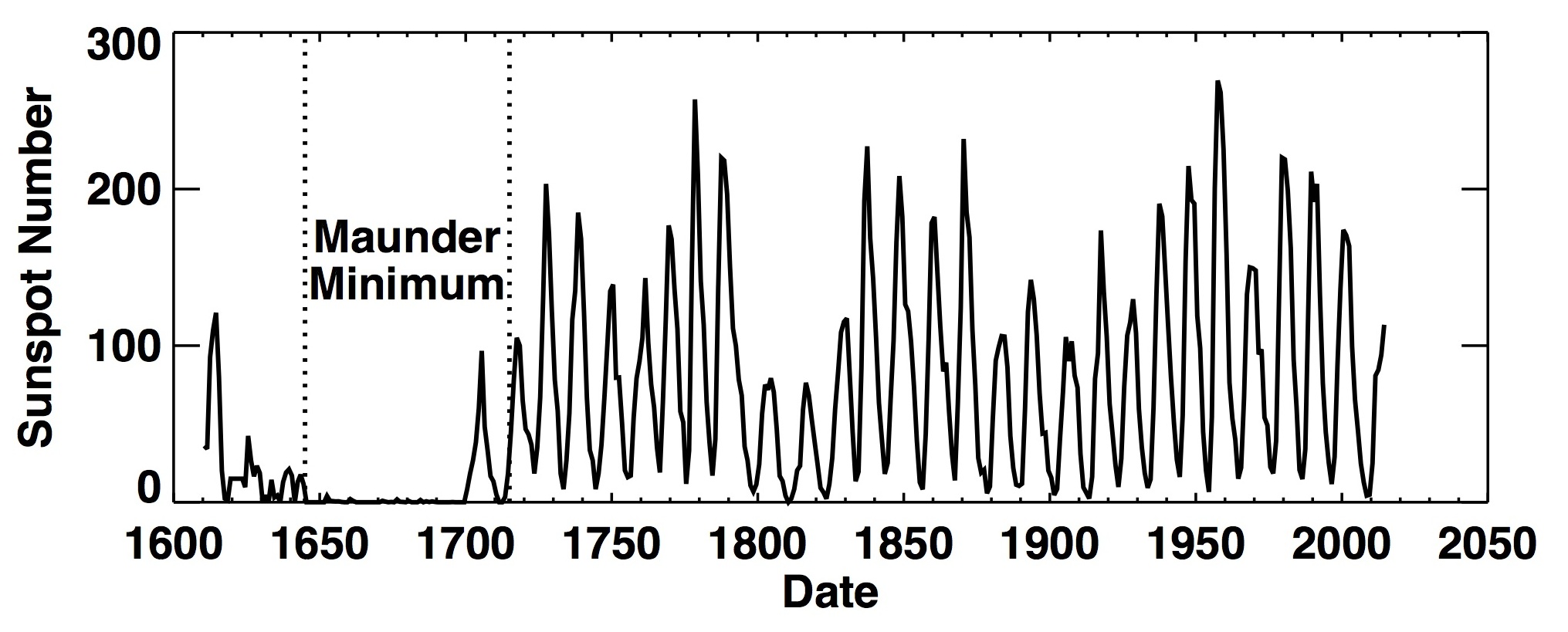
The Dalton minimum spanned Solar Cycles 5 and 6 from 1790 to 1820.  The Maunder Minimum from 1645 to 1715 preceded the numbering of Solar Cycles (Solar Cycle 1 started in 1755). The likelihood that SC 24 and 25 may be similar to SC 5 and 6 is growing and so is the likelihood that we will see 2  – 3 decades of global cooling. It is more likely that for the next 20- 30 years this Landscheidt Minimum will resemble the Dalton Minimum period, but if SC25 is a very small cycle then we may even approach the conditions of the Little Ice Age during the Maunder Minimum. Landscheidt’s prediction was that this minimum would last from 2000 to 2060 and the global temperature stand-still for the last 15 years gives greater credence to his forecasts.

NASA: The Sunspot Cycle —

The Maunder Minimum

Early records of sunspots indicate that the Sun went through a period of inactivity in the late 17th century. Very few sunspots were seen on the Sun from about 1645 to 1715 (38 kb JPEG image). Although the observations were not as extensive as in later years, the Sun was in fact well observed during this time and this lack of sunspots is well documented. This period of solar inactivity also corresponds to a climatic period called the “Little Ice Age” when rivers that are normally ice-free froze and snow fields remained year-round at lower altitudes. There is evidence that the Sun has had similar periods of inactivity in the more distant past. The connection between solar activity and terrestrial climate is an area of on-going research.