Shenanigans at Cardiff University – “There were all those doctor’s papers and they all said just the same”

September 29, 2012

I have the most wonderful memories of my time as a post-doc at University College Cardiff in the mid-70’s. This was where I was educated into the intricacies of the rules of rugby and the tribal rituals surrounding the game. Pubs and real ale and rugby grounds and rugby songs and – of course – Max Boyce.

So I was a little sad to read about the strange goings-on at the laboratory of the Dean of Medicine at what is now Cardiff University.  Lots and lots and lots of papers published by the Dean, Professor B P Morgan, (172 papers and 35 review articles or chapters since 1998 – giving 207 publications in about 180 months!) and now a retraction and a formal investigation into apparent image manipulation and duplication. A case of

 “There were all those doctor’s papers and they all said just the same”

(with apologies to Max Boyce and his great  lyrics to “We all had Doctor’s papers”)

THES:

Cardiff University has confirmed that it is to launch a formal investigation into alleged research misconduct in the laboratory of its dean of medicine.

Read the rest of this entry »

Siemens boycotts Ryanair

September 27, 2012

I have used Ryanair from time to time – but only when I have had no other reasonable options. They are not customer friendly at all and not my airline of choice. Siemens has decided to boycott Ryanair. Clearly Ryanair is not pleased but I think Siemens are perfectly within their rights, are quite justified in their actions and even ought to be commended. Cutting costs  while adventuring safety must – even for Ryanair – be unacceptable.

It occurs to me that since Ryanair seems to thrive on negative publicity perhaps they secretly welcome this?

Strangely this story is not widely reported in the MSM. 

(UPDATE! Airliners.net had something on this story but the page seems to have been deleted. Perhaps legal action is being threatened.

UPDATE 2! Airliners.net has a new forum page where Ryanair is considered in a rather favourable light by commenters. The original page remains deleted. In my suspicious mind I suspect there has been some pressure from Ryanair on the website.)

The Swedish Svenska Dagbladet reports:

The German industrial group Siemens, with 400,000 employees worldwide, has decided for a global boycott of Ryanair. But Ryanair has threatened legal action.
Siemens Group Management took the decision after Ryanair suffered a number of accidents and incidents in recent times and is a signal to the entire aviation industry.

Read the rest of this entry »

Tornadoes and forest fires drastically down – It must be global warming

September 27, 2012

The orthodoxy of the Temple of Climate Science have been busy this summer trying to link every “unusual” weather event to global warming. But every time I see a headline that some weather event has been the worst for 30 or 40 or 100 years, it only serves to  illustrate that the same weather events also occurred 30 or 40 or 100 years ago. And when weather events today are similar to events before 1950 then they can only be further indicators that they are not linked to carbon dioxide emissions.

Even the IPCC realises that weather is not climate.

Read the rest of this entry »

Opposition to shale gas and cheap US coal only leads to greater use of coal in Europe

September 26, 2012

Not that there is anything wrong with using coal when it makes commercial sense. The demonisation of carbon dioxide is a religion built on a hypothesis which in turn is based on “it must be the cause of global warming” and not on any evidence whatever. In consequence the world-wide drive to reduce carbon dioxide emissions is an unnecessary, expensive and ultimately pointless exercise.

The religious and thoughtless opposition of the “greens” to any use of fossil fuels has led them – especially in Europe – to trying to block exploration, production and exploitation of shale gas. But as with so many “environmentally correct” decisions it turns out to be counter-productive to their own misguided objectives. In Europe this together with the availability of cheap US coals has only served to promote the greater use of coal and an increase in carbon dioxide emissions. The blind pursuit of renewable energy in Europe has already given the highest electricity prices in the world. While the increased emissions of carbon dioxide through greater coal use does not itself matter, the consumer will have to pay even higher electricity prices than would prevail if shale gas were exploited.

Reuters reports:

BRUSSELS/LONDON, Sept 25 (Reuters) – Shale gas has jolted traditional roles in the planet’s climate drama, giving cleaner fuel to the United States, whose displaced coal has headed to Europe to pollute the old continent.

It is an ironic twist for the European Union, whose energy policy is largely based on promoting renewables and a target to cut emissions b y 20 percent by 2020. The U.S. did not ratify the Kyoto Protocol to combat global emissions and its national goals are far less ambitious than Europe’s.

Read the rest of this entry »

Why Barron’s Facebook valuation of $15 per share may be too high

September 25, 2012

Facebook shares took a beating yesterday after Barron’s report valued them at $15 per share (compared to the current $20.8 and the IPO valuation of $38 in May). But I suspect that even this valuation is too high. Any share today which trades at more than 20 times earnings is not sustainable. Unless there is a very clear and well grounded prospect of improved earnings, even a 20 times valuation only creates a bubble – which will burst. I use 20 times as my “rule-of-thumb” for the long-term prospects of any technology company and the point at which I can always find a better investment.

The problem with future projections of Facebook earnings is that they have yet to establish a model for mobile earnings and their current pc base for earnings is declining. Not that I have much to invest, but without a clear way of improving earnings I do not think any price of more than $8 dollars per share is worth investing in. An added worry would be the Facebook propensity to hand out large amounts of restricted stock to its employees which only dilutes the value (itself doubtful) for other shareholders.

A personal opinion I have is that as ads get more intrusive they destroy the user-experience and will become counter-productive. Already there are sites that I avoid as a reaction to the ads which are so large, take up so much band-width and slow-down my access. And when a revenue model is dependent on increasing the irritation level with users, the model is flawed. I think the never-ending increase of ad revenues by increasing the number of users while increasing the intrusiveness of the ads can not happen. In fact I suspect that some advertisers are now losing sales because their ads – which may be brilliant in themselves – are now driving visitors away from the sites they are carried on.

So Barron’s valuation of $15 which would be 35 times earnings is certainly no level for me to enter – especially when the future earnings are still so much in doubt. At half that value at around $8 per share (around 18 times earnings) I could be persuaded to enter the Facebook market – though still with the risk that they may not succeed in finding the right earnings model.

Barron’s article ends with :

Stay away from the stock. It could be heading to the mid-teens. 

To that I would add “and I won’t buy until it gets well into single figures”

Barron’s Magazine:

Facebook‘s 40% plunge from its initial-public-offering price of $38 in May has millions of investors asking a single question: Is the stock a buy? The short answer is “No.” After a recent rally, to $23 from a low of $17.55, the stock trades at high multiples of both sales and earnings, even as uncertainty about the outlook for its business grows. 

Read the rest of this entry »

Arrogant and overbearing political correctness censures Tintin from Stockholm library

September 25, 2012

See update below:

I have little patience with the “do-gooders” who always know best what is good for others. But impatience turns to an active dislike when an arrogant young man (a certain Behrang Meri) presumes that his world-view shall prevail and takes it upon himself to be a censor by removing all copies of Tintin from the shelves of the 10-13 year old library of Stockholm’s Culture Centre. Of course he claims he is doing this “for their own good”. Arrogance and coercion are the stock-in-trade of the “do-gooders” and is wide-spread in Sweden. Banning things for the “good of others” is the order of the day. Some of the coercive tactics employed – even if now coming from the left of the political spectrum – are indistinguishable from those employed by the fascists in Europe almost 100 years ago.

Dagens Nyheter reports (my free translation):

Tintin has been ejected from the Culture Centre in Stockholm. DN can report that the beloved cartoon character has been cleaned out from the library shelves. Now the staff have been instructed to look for any more books which have racist or homophobic values.

The 10-13 year old library of Stockholm’s Culture Centre has  removed Tintin books from the shelves. In consultation with their staff, the artistic director with responsibility for children and activities for the young made ​​the decision.

“That’s right. The picture Tintin books give for example of Africans is afrofobisk. Africans are shown to be a bit silly while Arabs are sitting on flying carpets and Turks smoke water pipes. The image of  the “forest Turk” is still there. It’s about exoticism and Orientalism”, says Behrang Miri, who leads efforts to develop Child and Youth Culture activities in the sections for children, “Tiotretton” and “Lava”. ……. 

Behrang Meri, the self-appointed censor in this case, was appointed to his position in February this year.

He was on the radio this morning and tried to babble his way through by insisting that he was removing the books so that children could actually go deeper into the questions of racism!!  He seemed to be avoiding all questions and merely spouting a practised defence. I would have thought that deepening children’s understanding would only be possible by exposure to the books and not by his over-bearing, over-protectiveness denying exposure to the books. In any case the Tintin serials – which I greatly enjoyed through my childhood – were written in a colonial time and had no racist intentions. It depicted the world-view that existed at the time. Censorship will not change history or cause those times to disappear.

He failed to impress and I cannot help feeling that his ego has got the better of him and his objective is mere self-promotion rather than the cultural enrichment of 10-13 year old children.

UPDATE!

Following a storm of media criticism, officials at the Kulturhuset library in Stockholm have reversed their decision to remove Tintin comic books from its shelves, saying the move happened “too fast”.

I note that it was the head of the Culture Centre who reversed the censorship and Bahrang Meri has accepted being overruled. In spite of his vehement defence of his decision on the radio this morning this was clearly not a resigning issue. Some damage control is ongoing but damage there certainly is:

“I wanted to highlight an opinion piece about issues of discrimination, but realize now that it’s wrong to ban books,” Meri said in a statement. However, Kulturhuset head Sjöström applauded Meri for prompting a discussion about discrimination. 
“The issues of discrimination, equality and norms continue to be debated and discussed,” Sjöström said in a statement.
Now Toyota sees sense and backs away from all-electric cars

September 24, 2012

The hype about electric cars is just one more example of environmental alarmism leading to bad decisions. The list of “bad decisions” made to appease environmentalism is long and getting longer. Wind power before its time and solar power before it  was commercially viable have only helped to increase the costs to the consumer but they have been a windfall for those who have managed to “milk” the subsidies. The electric car fiasco is no different. Billions have been wasted in subsidising something that is not commercial and in trying to skew the market in the hope of artificially creating a demand where there is none. But a few have managed to live very well off the subsidies. Some day electric cars may well become commercially viable and when they do it will not be because an environmental lobby group or a government  merely wished for it but because the technology and supply network then will be sufficiently developed to offer the consumer a superior product at a reasonable price.

The simple reality is that:

  • electric car batteries are still too heavy and take too long to charge
  • the range they provide is too short
  • the cars are too expensive

More importantly the ostensible reason for subsidising the technology  – as being for the cutting of carbon dioxide emissions to try and reverse natural climate change –  is both based on a false premise and futile.

“The current capabilities of electric vehicles do not meet society’s needs, whether it may be the distance the cars can run, or the costs, or how it takes a long time to charge,” said, Uchiyamada, who spearheaded Toyota’s development of the Prius hybrid in the 1990s.

Reuters reports:

Read the rest of this entry »

At least 275 water molecules needed to form an ice crystal

September 24, 2012


In idle moments I contemplate on strange things such as the origins of water on earth (which is largely unknown) and the life-span of water molecules (in the order of milliseconds) and the manner  in which water molecules are added to or lost from the apparently constant amount of water on earth. None of these questions are illuminated further but this interesting paper by researchers in Germany and the Czech Republic describes a technique for studying clusters of water molecules and provides some answers on the formation of ice crystals.

A Fully Size-Resolved Perspective on the Crystallization of Water Clusters by Christoph C. Pradzynski, Richard M. Forck, Thomas Zeuch, Petr Slavíček, Udo Buck . Science 21 September 2012:
Vol. 337 no. 6101 pp. 1529-1532 DOI: 10.1126/science.1225468

ABSTRACT

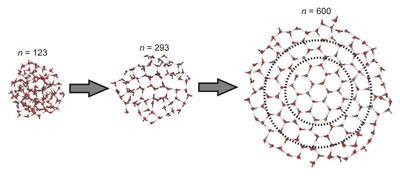
The number of water molecules needed to form the smallest ice crystals has proven challenging to pinpoint experimentally. This information would help to better understand the hydrogen-bonding interactions that account for the macroscopic properties of water. Here, we report infrared (IR) spectra of precisely size-selected (H2O)n clusters, with n ranging from 85 to 475; sodium doping and associated IR excitation–modulated photoionization spectroscopy allowed the study of this previously intractable size domain. Spectral features indicating the onset of crystallization are first observed for n = 275 ± 25; for n = 475 ± 25, the well-known band of crystalline ice around 3200 cm−1 dominates the OH-stretching region. The applied method has the potential to push size-resolved IR spectroscopy of neutral clusters more broadly to the 100- to 1000-molecule range, in which many solvents start to manifest condensed phase properties.

Illustrations of the molecular structure of three water clusters

Illustrations of the molecular structure of three water clusters : from http://physicsworld.com/cws/article/news/2012/sep/21/how-many-water-molecules-does-it-take-to-make-ice


Electric cars in the US: $7.5 billion of taxpayers money for “little or no impact” on gas consumption

September 22, 2012

The fantasy world of subsidies is compounded when the subsidies are for irrational but “politically correct” ends.

Reuters:

U.S. federal policies to promote electric vehicles will cost $7.5 billion through 2019 and have “little to no impact” on overall national gasoline consumption over the next several years, the Congressional Budget Office said in a report issued on Thursday.

Consumer tax credits for buying electric vehicles, which can run as high as $7,500 per vehicle, will account for about 25 percent of the $7.5 billion cost, the CBO said.

The rest of the cost comprises of $2.4 billion in grants to battery makers and projects to promote electric vehicles as well as $3.1 billion in loans to auto companies designed to spur production of fuel-efficient vehicles. …….

Momentum for shale gas builds in Europe

September 22, 2012

The momentum is now growing fast and it is difficult to keep up with the number of parties coming out in favour of the exploitation of shale gas in Europe. However the self-righteousness behind the “environmental correctness” of the European political establishment will not be overcome without a struggle.

France: Bosses demand shale gas rethink:

BUSINESS leaders have signed up to a call to reopen debate on the extraction of shale gas in France. 
The move comes shortly after President Hollande said he will halt exploration during his five-year term and announced refusals of seven oil company applications for drilling permits in the south, because they were thought to be looking for shale gas. …..

UK: IoD: Shale gas could provide 35,000 UK jobs :

The Government is expected to give the green light for more fracking in the UK to access shale reserves within weeks as it publishes a new gas strategy, but energy secretary Ed Davey warned yesterday that it was no “silver bullet”.

The IoD has released a new report on the process this morning which claims there will be an upward revision in the estimate of the size of the UK’s shale gas reserves later this year, up from 5.3 trillion cubic feet. It also suggests there would be “environmental benefits” to using shale gas over coal-fired power plants.

Russia: Gazprom Rethinks Shale as European Gas Prices Sink:

Gazprom has admitted it might yet adjust its attitude towards shale gas, as Russian policy makers assess new dangers to the country’s petro-dollar economy. First, Russia’s Economic Ministry warned that the increasing supply of shale gas on world markets will start hurting Gazprom’s pipeline sales to Europe in 2014. And it seems Gazprom might now be weighing the pros and cons of jumping onto the shale gas bandwagon.