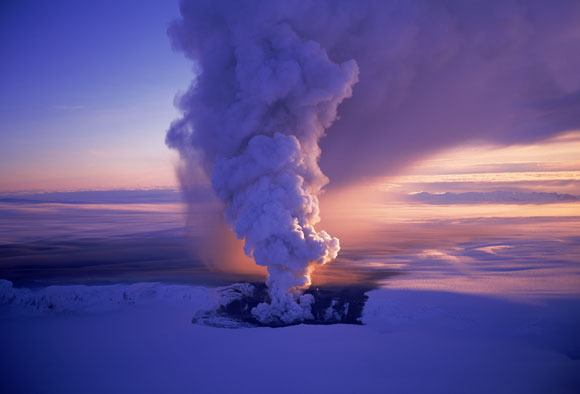
Iceland on watch for new volcano eruption

November 1, 2010

Reuters:

Meltwater is flooding from the Grimsvotn glacial lake in Iceland and could signal the volcano underneath is about to erupt, a spokeswoman at the Icelandic Civil Protection Department told Reuters on Monday.

Water now pouring from Iceland’s biggest glacier, Vatnajokull, which sits on top of a number of volcanic hotspots, could be a sign of fresh geological activity, Civil Protection Department spokeswoman Gudrun Johannesdottir told Reuters.

In April, clouds of ash from an eruption under the Eyjafjallajokull glacier grounded flights across Europe for a week, causing billions of dollars in losses for airlines and other industries. Eyjafjallajokull is about 100 km southeast of Vatnajokull.

“We have to check if there will be an eruption,” Johannesdottir said. “Sometimes it initiates an eruption when a glacial outburst flood starts, but not every the time. So we are monitoring the situation closely.”

The latest eruption at Grimsvotn, in 2004, caused short-term disruptions to airline traffic into Iceland.


Smoke from a subglacial volcanic eruption rises above the Vatnajökull ice cap (file photo by Oddur Sigurdsson)


A special gene for camouflage

November 1, 2010

C. Zhang, Y. Song, D. A. Thompson, M. A. Madonna, G. L. Millhauser, S. Toro, Z. Varga, M. Westerfield, J. Gamse, W. Chen, R. D. Cone. Inaugural Article: Pineal-specific agouti protein regulates teleost background adaptationProceedings of the National Academy of Sciences, 2010; DOI: 10.1073/pnas.1014941107

Science Daily


Like other bony fish, the peacock flounder can change the color and pattern of its skin to blend into the sea floor. (Credit: Photo by Jimmie Mack)


Researchers led by Vanderbilt’s Dr. Roger Cone have discovered a new member of a gene family that has powerful influences on pigmentation and the regulation of body weight.

The gene is the third member of theagouti family. Two agouti genes have been identified previously in humans. One helps determine skin and hair color, and the other may play an important role in obesity and diabetes. The new gene, called agrp2, has been found exclusively in bony fish, including zebrafish, trout and salmon. The protein it encodes enables fish to change color dramatically to match their surroundings, the researchers report this week in the early edition of theProceedings of the National Academy of Sciences (PNAS).

“When my graduate student, Youngsup Song, discovered a third agouti protein in the fish pineal gland, an organ that regulates daily rhythms in response to light, we initially thought we had found the pathway that regulates hunger diurnally,” said Cone, chair of the Department of Molecular Physiology & Biophysics and director of the Vanderbilt Institute for Obesity and Metabolism.

“That is the mechanism that makes you hungry during the day, but not at night,” he continued. “However, Chao Zhang, a graduate student who followed up the study, ultimately discovered that this agouti protein … is involved in the rapid pigment changes that allow fish to adapt to their environment.”

This phenomenon, called background adaptation, also has been observed in mammals. The coat of the arctic hare, for example, turns from brown in summer to white camouflage against the winter snow.

In contrast to mammals that have to grow a new coat to adapt to a changing environment, fish, amphibians and reptiles can change their skin color in a matter of minutes. The first agouti gene, which produces the striped “agouti” pattern in many mammals, was discovered in 1993. The same year, Cone and his colleagues at Oregon Health Sciences University in Portland reported the discovery of the gene that encoded the melanocortin-1 receptor, a key player in the pigmentation story.

In the current paper, Cone’s group reports that the newly discovered protein, AgRP2, regulates expression of the prohormone genes pmch and pmchl, precursors to melanin-concentrating hormone, which has a pigment-lightening effect. “Together, the versatile agouti proteins and melanocortin receptors are responsible for regulation of body weight, the banded patterns of mammalian coats, and even red hair in most people,” Cone said. The current work shows that agouti proteins are also involved in the camouflage mechanisms used in thousands of fish species.

Read the article.

If only the gene could be activated in humans as well!!!

US wind power installations down by 72%

November 1, 2010

The New York Times


broken wind turbine: image thetechherald.com


In July, the American Wind Energy Association reported that it was having a lousy year. It appears the third quarter of 2010 wasn’t much better.

According to an analysis released on Friday, the trade group reports having its slowest quarter since 2007, adding just 395 megawatts of wind power capacity. For the year to date, new installations were down 72 percent.

Natural gas, the chief fossil-fuel competitor to renewable sources of electricity, is also dirt cheap these days, making wind power a tougher sell for cost-conscious utilities and state regulators. Despite lots of talk on Capitol Hill about the hazards of fossil fuels, their contribution to climate change and the need for broad, long-term supports for the renewables industry, legislators have failed to reach agreement on what that might look like.

But then the lobbying  gets going

“If federal policymakers do not act quickly to provide investment certainty through a Renewable Electricity Standard, and longer-term tax policy like our competitors enjoy,” Denise Bode, the chief executive of the wind association, said in a prepared statement, “the U.S. wind industry will continue to stall out.”

Elizabeth Salerno, director of industry data and analysis with the American Wind Energy Association, said in a phone call that state-level policies have helped. Roughly 30 states have mandatory targets for diversifying their energy portfolios with more renewable power. “They’ve been doing a great job leading the effort to get renewables installed over the past decade,” Ms. Salerno said.

The trade group reported some interesting developments — including Oregon’s emergence as the leader in new wind installations for the third quarter, eclipsing Texas, which has long held the top slot. The reason, the group suggests, is that Texas has hit a transmission wall and is trying to sort out how to get its west Texas wind resources to the load centers in the center of the state.

Nuclear renaissance: Vietnam gets nuclear reactors from Russia and Japan, Japan gets access to rare earths

November 1, 2010

Now Vietnam is going nuclear with its first 2 plants coming from Russia and the next 2 from Japan. Unexploited rare earth deposits in Vietnam are receiving a great deal of attention from countries hit by the Chinese monopoly on rare earth supplies.

Chosun Ilbo reports

Russian President Dmitry Medvedev and his Vietnamese counterpart Nguyen Minh Triet have called for increased trade and investment between their two countries. The two leaders met Sunday in Hanoi to seal a nuclear plant construction agreement and other bilateral deals. Under the $5 billion agreement, Russia will build Vietnam’s first nuclear power plant. Construction is expected to start in 2014.

Asahi Shimbun reports on a deal where Japan  gets access to the rare earth resources in Vietnam in exchange for two 1000 MW nuclear reactors worth 14.4 billion $ to the Japanese nuclear construction industry.

The nuclear reactor construction agreement, worth an estimated 1 trillion yen ($14.4 billion), gives the green light for Japanese companies to build nuclear facilities in an emerging nation’s fledgling nuclear industry for the first time.

The two reactors will be built in the southeastern province of Ninh Thuan and are scheduled to start operations in 2021. They will have a combined output of 2 gigawatts. Vietnam plans to build 14 nuclear reactors by 2030. Construction deals for four reactors in Ninh Thuan province have so far been agreed upon, including the two to be awarded to Japan. Russia won the rights to build two reactors in December last year.

Japan, which has been trying to use infrastructure exports as a springboard for its flagging economy, began bidding for the nuclear reactor project earlier this year. In August, a delegation of Japanese business leaders led by Japan’s industry minister visited Vietnam to lobby officials. They offered financial assistance and training for Vietnamese people.

Visiting Prime Minister Naoto Kan and Vietnamese Premier Nguyen Tan Dung also agreed on joint development of deposits in Vietnam of rare earth elements, part of a Japanese drive to reduce its reliance on China for supplies of the vital raw materials, which have been obstructed following a diplomatic dispute with Beijing.

A joint team of Japanese and Vietnamese businesses is currently applying for rare earth mining rights. The Japan Oil, Gas and Metals National Corp. discovered rare earth veins in the northern Lai Chau province about 10 years ago. Toyota Tsusho Corp., Sojitz Corp., and an arm of a Vietnamese public corporation have been preparing plans for joint development.

The underground reserves are believed to be capable of yielding 3,000 tons of rare earths a year, about 10 percent of Japan’s current annual requirement.

The Japanese government has offered to provide expertise and training in surveying, excavation, and processing the rare earth metals to Vietnam. Japan is also likely to dip into official development assistance to help the country build infrastructure such as roads and water supply near the mines. In a separate project, Sumitomo Corp. is looking into mining rare earths in Yen Bai province in the north of Vietnam.

“What the Green Movement got wrong” – Channel 4

October 31, 2010


green = nuclear


Channel 4 in the UK is running a documentary this week called “What the Green Movement got wrong”.

A group of environmentalists are challenging the movement they helped to create. These life-long diehard greens advocate radical solutions to climate change, including GM crops and nuclear energy.

In this film, these life-long diehard greens advocate radical solutions to climate change, which include GM crops and nuclear energy. They argue that by clinging to an ideology formed more than 40 years ago, the traditional green lobby has failed in its aims and is ultimately harming its own environmental cause.

As author and environmentalist Mark Lynas says, ‘Being an environmentalist was part of my identity and most of my friends were environmentalists. We were involved in the whole movement together. It took me years to actually begin to question those core, cherished beliefs. It was so challenging it was almost like going over to the dark side. It was a like a horrible dark secret you couldn’t share with anyone.’

The Telegraph reports on the change of heart:

Mark Lynas, a campaigner who has been a member of action groups on GM foods and climate change, said the environmental lobby was losing the battle for public opinion on climate change because it had made too many apocalyptic prophecies and exaggerated claims.

He said: “We have got to find a more pragmatic and realistic way of engaging with people.”

Stewart Brand, an American activist and former editor of Whole Earth Catalog, said: “I would like to see an environmental movement that says it turns out our fears about genetically engineered food crops were exaggerated and we are glad about that. It is a humble and modest stance to take to the real world. Environmentalists did harm by being ignorant and ideological and unwilling to change their mind based on actual evidence. As a result we have done harm and I regret it.”

What the Green Movement Got Wrong will be broadcast on Thursday 4 November at 9pm and will be followed by a live studio debate hosted by Channel 4 News presenter Krishnan Guru-Murthy.

Ski season starts early with heavy snow

October 31, 2010

After the UK and Sweden experienced early, heavy snow in October, heavy snows in the Alps is providing a boon for ski resorts.

Fast Track Ski reports:

A number of big ski resorts will open for the winter 2010-11 this weekend, many of them weeks and even months earlier than planned.

Heavy snow in the Alps has led to Schladming in Austria being the first non-glacier ski centre to open, it’s due to be followed by Kitzbuhel, tomorrow.
Snow reporting agency skiinfo.co.uk reports that up to a metre of snow has fallen in the past week bringing great conditions to the 20 glacier ski areas that are already open in the Alps. The Tux glacier next to Mayrhofen and close to Innsbruck is already offering more than 40km (20 miles) of piste to enjoy with a 600m lift served vertical. The Kitzsteinhorm glacier above Kaprun has more than three feet of new snow on its slopes.
In Switzerland the resort of Laax, which will stage the Brits festival next Spring, has decided to open early too because of all the snow. It joins Gstaad’s Glacier 300 which is opening tomorrow too. Engelberg, Zermatt and Saas Fee are also open, the latter with World Cup Snowboarding this weekend.
In Italy Cervinia opens this weekend, joining Passo Tonale and two other glacier centres which are already open. Les 2 Alpes and Tignes are both open in France this weekend too. While up in Scandinavia Ruka in Finland is already open and will be joined by Geilo and Hemsedal in Norway next weekend.
Resorts have also begun opening in North America. Loveland and Arapahoe Basin have opened in Colorado and Sunday River in Maine. Keystone and Copper Mountain are due to open on Bonfire Day next week, however Canada’s first opening for 2010-11m Mount Norquay by Banff, is due to happen tomorrow, October 30th, conditions permitting.

The Telegraph reports today that  Heavy snowfall has arrived in ski resorts in the Alps and North America, with some areas reporting 72cm of snowfall this week.


Tignes slopes October 2010 : Images The Telegraph


Joint RAF / IAF exercise Indra Dhanush 2010 enters final phase

October 31, 2010
Eurofighter Typhoon

Eurofighter Typhoon: Image via Wikipedia

The joint UK / India air exercise Indra Dhanush 2010 which began on October 18th at Kalaikunda Airbase in West Bengal’s West Midnapur District has entered its final phase and is due to end on November 3rd.  The RAF is participating with its Euro-fighters, VC-10 mid- air refuellers and E 3 D Sentry Airborne Early Warnings and Control Systems (AWACS) while the IAF is flying the SU 30s, Mirage 2000s, Mig-27s and their newly acquired AWACS.

So far some 120 flying missions have been flown. In the final phase a large number of aircraft in offensive and defensive roles are expected to be launched in ‘Waves’ in a limited airspace to test the skills of the fighter pilots, the AWACS and the ground controllers. High Value Air Asset (HVAA) protection missions which require a large number of aircraft are also to be carried out.

The exercise takes place with the backdrop of the 11 billion $ order for 126 MMRCA fighters that is to be placed soon by the Indian Air Force. The six competing fighters that the IAF has flight-tested over the last year include Boeing’s F/A-18 Super Hornet, Lockheed Martin’s F-16IN Super Viper, Dassault’s Rafale, the Russian MiG-35, the Swedish Saab Gripen NG and the Eurofighter.

Solar power subsidies go wrong even in Australia

October 31, 2010

The evidence that subsidies are inherently unhealthy and can be counter-productive continues to grow :

Now the Sydney Morning Herald reports that in NSW

HOUSEHOLDS will pay an extra $600 on their electricity bill over six years to cover the $2 billion cost of the failure of the state government’s overly generous solar power scheme. If elected in March, the opposition will have the scheme, which runs to the end of 2016, reviewed by the auditor-general so that it can decide on its future.

From midnight last Wednesday, the government slashed from 60¢ to 20¢ per kilowatt hour the tariff paid to households installing solar panel systems because the surging number of applications has blown out the scheme’s cost.

In reports tabled in Parliament last week, the government disclosed that it had been advised that even after slashing the tariff for solar panels, it anticipated 777 megawatts of solar panels would be installed by the time the scheme closed. Already, 200 megawatts of capacity has either been installed or ordered. The reports detailed the total cost to households is forecast to reach $1975 million by 2017, placing a burden on homes at a time when power prices are rising sharply already.

The government refused to indicate when it first became aware that the initial 50-megawatt target had been breached, which triggered an automatic review of the scheme. The government began that review in August. However, Country Energy, one of the largest distributors in NSW, was informing solar industry officials as early as May that the target had already been reached. Even so, the government ”dithered until August” before holding its review, with the report only completed last week, opposition climate change spokeswoman Catherine Cusack said yesterday.

‘Labor’s billion-dollar blowout will be passed on to families who will pay at least an extra $100 per year on their electricity bills every year until 2017,” she said. The total cost to families in some regional areas could be $1000.

The NSW scheme paid existing solar clients 60¢ per kilowatt hour for all energy produced; other states have ”net” schemes that pay for surplus power after domestic use is taken off. NSW had the most generous scheme – now the least. Victoria’s net scheme pays 60¢ per kilowatt hour, Queensland pays 44¢ and Western Australia pays 40¢.

Sweden: Opposition to wind power grows

October 30, 2010

Freely translated from Ny Teknik:

Opposition to wind power is now so extensive that it can be compared with nuclear public opinion as it was more than 30 years ago. Now opponents are kicking-off a campaign with the slogan “Wind power – no thanks.”


Wind Power - No Thanks


With 20 000 registered members and a symbol reminiscent of the 80’s symbol “Nuclear power – no thanks’, the Association for Swedish Landscape Protection is growing steadily as is the opposition to wind power.
“You can definitely compare today’s opinion with the movement against nuclear power, “said Karin Hammarlund, a researcher in landscape analysis at SLU, to the newspaper “Miljörapporten”
But there is one important difference between the protests against nuclear power and the resistance to wind power, says Karen Hammarlund.
“What is causing concern is not wind power technology in itself but how it affects the landscape and social structures”.
According to Elisabeth von Brömsen, chairman of  Swedish Countryside Protection, the resistance movement has this year gained about a thousand new members, both private individuals and associations.

It is beginning to get through, I think, that with the existing nuclear and hydro power available in Sweden, the role for intermittent wind power is marginal and primarily as an exercise in the following of  “fashion”. It has little to contribute to either generation capacity or transmission security. And it is expensive.

But the nuclear renaissance is continuing steadily anyway and history will probably show the “wind story” to be little more than a diversion from common sense for a decade or two.

Nuclear Renaissance continues: Germany extends life of nuclear reactors

October 30, 2010

Der Spiegel:

Opponents of nuclear power suffered a setback in Berlin on Thursday as the federal parliament approved legislation that would effectively repeal Germany’s planned withdrawal from atomic power. Now nuclear plants can stay open an average of 12 years longer than originally planned.

Environment Minister Norbert Röttgen, a member of Merkel’s CDU, countered  criticism by saying: “You are at a dead loss when it comes to energy policy.” He said the Greens, SPD and far-left Left Party were scaremongering and merely seeking to gain votes. “They are placing their party interests before the interests of the country,” he said. Röttgen also stated that his government’s energy plan — which foresees 80 percent of all electricity coming from clean energy sources by 2050 — was the most ambitious renewable energy program in the world.

The Green Party, in particular, sought in vain on Thursday to prevent the vote at the last minute.

Jörg van Essen, a senior party official with the FDP, angered many with his statement that, “it has never done any parliament in history good when a party appeared appeared wearing the same uniform,” a statement he made while staring at the Greens. Members of the party were angered by the statement, which they considered to be a comparison to the uniformed Nazi members of parliament during the Weimar Republic era.

Meanwhile, members of the government accused the Greens of disobeying parliament. “The Greens need to know one thing: The greater the racket they cause, the more damage they do to themselves in terms of how seriously they are taken outside,” said Peter Altmaier, a senior member of the CDU.

The quiet renaissance is continuing in other parts of Europe as well. The Financial Times points out that:

In Italy, which decommissioned its four power stations after the country voted for a moratorium following the 1986 Chernobyl disaster, the government is considering new nuclear power stations. Sweden has embarked on a similar path, voting earlier this summer to overturn a 30-year-old ban on new reactors. Neighbouring Finland has announced plans to build two reactors in addition to one already under construction. In the UK, the coalition government, is also backing new plants.

Several east European countries, many of which are dependent on gas imports from Russia, are also proposing new reactors.

“Globally, there is a nuclear revival,” says Colette Lewiner, head of the Energy and Utilities division at Capgemini, “but it is much bigger and sustained in Asian countries, in particular in China, which has proposals to put eight to nine reactors into operation a year.”

For Europe’s cash-strapped governments, hit by the credit crunch, extending the life of an existing reactor is much cheaper than building a new one. In France, for example, recent estimates suggested it would cost about €500m ($697m) to extend the life of a 1,000MW reactor for 20 years. This compares with a cost of about €3bn for the same capacity from a new one that would have a lifespan of about 60 years, says Ms Lewiner.

On the fuel supply side as well companies are developing strategies and positioning themselves to take advantage of the renaissance. From London South East comes the news that:

Severstal, the largest steelmaker in Russia, has made a bid approach for its first uranium asset in Spain, seeking to diversify its mining business and benefit from an expected rise in European demand for nuclear power.

Severstal has approached Berkeley Resources Ltd about a possible takeover of the uranium exploration company worth about A$304 million ($294.9 million), sending Berkeley shares sharply higher in London.  Severstal is considering a cash bid for Berkeley, also listed in Sydney, at A$2.00 (122 pence) per share, Berkeley said in a statement on Friday.

The big due diligence question will concern the start-up of a uranium concentrate line that is part of the Salamanca project, Renaissance Capital analyst Boris Krasnojenov said. The line operated for 16 years before closing in 2000 due to low uranium prices. ‘Some people believe that nuclear generation is the future for Europe because regulation measures linked to coal generation emissions will increase,’ Krasnojenov said.