Posts Tagged ‘climate’
September 5, 2012
One summer (or one winter) does not a climate make – but ……..
The Swedish Meteorological and Hydrological Institute (SMHI) has posted its summary of the 2102 summer.
In summary, one can say that the summer of 2012 was the year when “hot air avoided Sweden with uncanny precision.”
The summer of 2012 was not one of the wettest and coldest, but was probably still a disappointment for most vacationers. There was not a single extended period of warmth, sunshine and clear blue skies throughout the summer. It is twelve years since it happened last. Previously, this type of summer occurred more frequently. 1987, 1993, 1998 and 2000 are examples.
Otherwise, there was absolutely no shortage of hot air over the Northern Hemisphere. But it avoided Sweden with uncanny precision.
(more…)
Tags:climate, SMHI, summer weather, Sweden
Posted in Climate, Sweden, Weather | Comments Off on The year when “hot air avoided Sweden with uncanny precision.”
September 3, 2012
A new paper again confirming that the theory that carbon dioxide leads global temperature is misconceived.
” Changes in global atmospheric CO2 are lagging 9.5-10 months behind changes in global air surface temperature. CO2 released from use of fossil fuels have little influence on the observed changes in the amount of atmospheric CO2.”
The phase relation between atmospheric carbon dioxide and global temperature
by Ole Humlum, Kjell Stordahl, Jan-Erik Solheim, Global and Planetary Change
Abstract
Using data series on atmospheric carbon dioxide and global temperatures we investigate the phase relation (leads/lags) between these for the period January 1980 to December 2011. Ice cores show atmospheric CO2variations to lag behind atmospheric temperature changes on a century to millennium scale, but modern temperature is expected to lag changes in atmospheric CO2, as the atmospheric temperature increase since about 1975 generally is assumed to be caused by the modern increase in CO2. In our analysis we use eight well-known datasets; 1) globally averaged well-mixed marine boundary layer CO2 data, 2) HadCRUT3 surface air temperature data, 3) GISS surface air temperature data, 4) NCDC surface air temperature data, 5) HadSST2 sea surface data, 6) UAH lower troposphere temperature data series, 7) CDIAC data on release of anthropogene CO2, and 8) GWP data on volcanic eruptions. Annual cycles are present in all datasets except 7) and 8), and to remove the influence of these we analyze 12-month averaged data. We find a high degree of co-variation between all data series except 7) and 8), but with changes in CO2 always lagging changes in temperature. The maximum positive correlation between CO2 and temperature is found for CO2 lagging 11–12 months in relation to global sea surface temperature, 9.5-10 months to global surface air temperature, and about 9 months to global lower troposphere temperature. The correlation between changes in ocean temperatures and atmospheric CO2 is high, but do not explain all observed changes.
Highlights
► The overall global temperature change sequence of events appears to be from 1) the ocean surface to 2) the land surface to 3) the lower troposphere.
►Changes in global atmospheric CO2 are lagging about 11–12 months behind changes in global sea surface temperature.
► Changes in global atmospheric CO2 are lagging 9.5-10 months behind changes in global air surface temperature. Changes in global atmospheric CO2 are lagging about 9 months behind changes in global lower troposphere temperature.
► Changes in ocean temperatures appear to explain a substantial part of the observed changes in atmospheric CO2 since January 1980.
► CO2 released from use of fossil fuels have little influence on the observed changes in the amount of atmospheric CO2, and changes in atmospheric CO2 are not tracking changes in human emissions.
Tags:carbon dioxide, Carbon dioxide in Earth's atmosphere, climate
Posted in Climate, Science | Comments Off on Carbon dioxide lags temperature
July 14, 2012
I am off again on an assignment for a few days and blogging will be light.
It’s summer and where I’m going torrential rain or blistering sunshine with temperatures over 45 °C are quite normal for this time of year. If it is raining the temperature may be down to 25°C. So I’m prepared for a possible variation of some 20 deg C. It’s just weather.
I note the usual summer stories from around the world of heat waves in some places and “coldest” Junes in a 100 years in others. Some farmers are complaining about droughts and others are complaining about floods. Where societies have ignored repairs or have not built up their infrastructure to match the changing concentrations of urban populations – disasters occur. But I also note that when parts of the US declares that they have just had the hottest period for 50 years or 100 years or whatever and that this is “proof” of global warming they conveniently forget that 50 years ago or 100 years ago or whenever, man-made emissions of carbon dioxide were orders of magnitude lower. When weather records from a hundred years ago are broken it only proves that it was hotter/colder/stormier/wetter/drier or whatever long before the modern industrial age and before any significant man man-made carbon dioxide emissions. Breaking an old record only shows cyclic behaviour – not “runaway” behaviour!
It’s summer and people are on vacation and journalists are looking for stories and the silly season has begun!
Tags:climate, climate change, environment, global warming, Silly season, weather
Posted in Climate, Natural Phenomena, Weather | Comments Off on Breaking weather records from a century ago only shows that it was hotter before CO2 emissions began
May 12, 2012
It has been just over two years since I started this blog – my first – and I now feel sufficiently comfortable to move away from the general and to try and focus just on the topics that interest me most. I have changed the sub-heading to reflect this.
My opinions on aspects of energy and power generation and climate and environment will now take centre stage on this blog. I shall have to try to address my interests in technology and materials and behaviour and management and anthropology and politics elsewhere. It has been the advent of accessible electric power which has been the single most liberating force for the human condition – ever. For the foreseeable future humanity will continue to use – and need to use – electric power. And virtually all our sources for electric power – except perhaps some nuclear fuels – derive from the Sun.
Sol Invictus.
The blog image is of sunrise on a very cold day in February last year.
Tags:climate, Electric Power, Energy, environment
Posted in Climate, Energy, Environment | Comments Off on A slight shift of focus
October 12, 2011
It has always struck me as incredibly arrogant and amazingly stupid that the climate “scientists” have ignored the effects of the sun for 2 decades – presumably because:
- they did not understand the sun,
- doomsday scenarios were better for getting funding,
- they had such an overweening conviction about man made effects, and
- they actually believed their computer models were the greatest thing since sliced bread!
This is an exciting time for solar physics, and its role in climate. As one leading climate scientist told me last month, it’s a subject that is now no longer taboo. And about time, too.
Tags:BBC Weather, climate, climate change, global warming, Paul Hudson, solar effects on climate, Sun
Posted in Climate, Science, Solar science | 1 Comment »
September 26, 2011
I am travelling this week.
I had an interesting – if rather depressing – discussion with a fellow traveler (a patent lawyer) at the airport yesterday. The discussion turned to the manner in which science which happened to be “in fashion” became political movements and the manner in which science itself took on politically correct dimensions.
Sometimes – as with eugenics – the political movement came first and the science followed to fit the movement. In fact, his contention was that even where the science had come first, the development of a political movement would always lead to subsequent science being constrained to support the imperatives of the movement.
I brought up the caase of AGW and how an uncertain science – in my opinion – had been hijacked by a political movement such that one particular hypothesis – which has still to be proven – had become the only politically correct or allowable science. I suggested that real observations might change what was considered politically correct. Since global temperature – if such a thing can be defined – has been declining for the last decade even though carbon dioxide has been increasing, I expected that new science would have to take these real observations into account in their mathematical modelling and that the strength of the dogma would eventually decrease.
My companion however disagreed. He suggested that all political movements had to be fundamentally and economically viable to survive. If the movement was lucrative – as AGW had become – then there would be a vested interest in maintaining the science it was based on even if the facts said otherwise. This would be achieved, he argued, by the “Science” allowing or accounting for some deviations – as for example with explanations made up for why a decade or two of cooling could occur without disturbing the central thesis of the “Science”. He cited medical science and examples of purported treatments which were continued for long periods after they were discredited because of the revenues that they were generating. He suggested that the chemical industry was the prime driver for the banning of some refrigerants (based on now outdated ozone depletion science) just so that they could shift production to newer refrigerants having much higher margins. Similarly he felt that the environmental benefits of switching to low energy lamps was minuscule but the lighting industry much preferred the margins and revenues generated by these to those generated by incandescent light bulbs which were suffering from intense competition.
His conclusion was that since the AGW “industry” was generating large revenues whether through carbon trading schemes or by the extraction of subsidies from taxpayer money for so-called “green” energy or “green” fuels, then the vested interest in showing that any conflicting measurements were a temporary aberration would be very strong. Since the timescales of climate change were in the order of hundreds of years, he felt that a mere 20 or 30 years of inconvenient measurements would do little to dent the momentum of a successful revenue generating “science”!!!
He made some good points. I am afraid that even 3 decades of cooling or the start of a mini-ice age will probably not suffice to dampen the ardour of the global warming enthusiast as long as the revenues from growing bio-fuels or getting subsidies for “green” energy keep rolling in. The AGW religion and its corresponding “science” will stop only if the revenues stop.
Tags:AGW, climate, climate change, environment, global warming, Little Ice Age, politically correct science
Posted in Alarmism, Business, Climate, Politics, Science | 2 Comments »
September 21, 2011
During daytime clouds shadow the earth from the sun’s radiation and have a cooling effect while at night they act as a blanket and decrease the radiation away from earth into space. For anybody who has desperately sought the shade on a warm day or has observed the absence of frost after a cloudy night, this might seem a pretty obvious and a rather trivial statement.
The alarmists’ view of global warming assumes that the net effect of clouds is to warm the earth’s climate and that it is one of the “positive feedbacks” for warming. But a new paper in September’s Meteorological Applications severely undermines these assumptions by showing that this feedback is strongly negative. To put the magnitude of this cooling effect into perspective, the net cooling effect of clouds is put at -21W/sq.m while the much-touted effect of a doubling of carbon dioxide concentration in the atmosphere is supposed to be only +1.2W/sq.m.
When this is coupled to the recent support for Svensmark’s hypothesis on solar effects for cloud formation from the CERN cloud experiment, and the lack of warming over the last decade while carbon dioxide has been increasing, it only emphasises that:
- the science of how climate varies is a long way from being settled, and
- the magnitude of carbon dioxide effects on climate are extremely small, and
- the effect of man-made emissions on the atmospheric concentration of carbon dioxide is miniscule
Whether directly by incoming radiation or indirectly by the formation of clouds or through the transport of heat by the oceans and the winds, it is the sun which is the predominant forcing. Climate models which ignore solar effects and do not have the sun at their centre are fatally flawed.
Allan, R. (2011) Combining satellite data and models to estimate cloud radiative effect at the surface and in the atmosphere, Meteorological Applications, 18 (3). pp. 324-333, ISSN 1469-8080, DOI: 10.1002/met.285
Abstract: Satellite measurements and numerical forecast model reanalysis data are used to compute an updated estimate of the cloud radiative effect on the global multi-annual mean radiative energy budget of the atmosphere and surface. The cloud radiative cooling effect through reflection of short wave radiation dominates over the long wave heating effect, resulting in a net cooling of the climate system of − 21 Wm−2. The short wave radiative effect of cloud is primarily manifest as a reduction in the solar radiation absorbed at the surface of − 53 Wm−2. Clouds impact long wave radiation by heating the moist tropical atmosphere (up to around 40 Wm−2 for global annual means) while enhancing the radiative cooling of the atmosphere over other regions, in particular higher latitudes and sub-tropical marine stratocumulus regimes. While clouds act to cool the climate system during the daytime, the cloud greenhouse effect heats the climate system at night. The influence of cloud radiative effect on determining cloud feedbacks and changes in the water cycle are discussed.
Tags:Allan, CERN, climate, climate change, clouds, cooling effect of clouds, global warming, Henrik Svensmark, solar effects on climate
Posted in Climate, Natural Phenomena, Science | Comments Off on Net effect of clouds on climate is strongly cooling and not of warming
August 29, 2011
A welcome paper after last weeks nonsense where a new “scientific field” was created to study the effects of climate on human conflict. This paper claimed – by playing rather silly numbers games – that conflict was linked to the El Niño cycles. “What passes for science: Mindless number games show El Niño correlates with civil war!“ Correlations do not necessarily indicate causality. It is not difficult to find correlations between entirely unrelated parameters. The El Niño – civil war correlation fulfils all the requirements of a pseudoscience.
The “Climate Wars” pseudoscience is clearly shown up by Dr. Bruno Tertrais in a new paper in The Washington Quarterly • 34:3 pp. 17�29, The Climate Wars Myth, DOI: 10.1080/0163660X.2011.587951.
He writes:
The first decade of the 21st century was the hottest since the beginning of the Industrial Revolution….. Think tanks have enthusiastically embraced this new field of research, and militaries around the world are now actively studying the possible impact of a warming planet on global security. Books with titles such as Climate Wars predict a bleak future.
A well-known French consultant claims that a five degree Celsius increase in average global temperature would generate no less than a ‘‘bloodbath.’’ Former World Bank economist Lord Nicholas Stern �the author of the 2006 ‘‘Stern Report’’ on the possible economic impact of climate change� even declares that failing to deal with climate change decisively would lead to ‘‘an extended world war.’’
However, there is every reason to be more than circumspect regarding such dire predictions. History shows that ‘‘warm’’ periods are more peaceful than ‘‘cold’’ ones. In the modern era, the evolution of the climate is not an essential factor to explain collective violence. Nothing indicates that ‘‘water wars’’ or floods of ‘‘climate refugees’’ are on the horizon. And to claim that climate change may have an impact on security is to state the obvious�but it does not make it meaningful for defense planning.
… if there was any significant link between warfare and warming, the number of conflicts should have been rising in the past two decades. It has not� quite the contrary. Since the end of the Cold War, the total number of wars, after having steadily increased since 1945, has diminished. Statistics published by the Stockholm International Peace Research Institute (SIPRI), which come from work done at the Uppsala University, clearly show such a decrease.
Some of the most catastrophic scenarios of climate change-induced conflict just do not stand up to scrutiny. …
He concludes:
There are indeed, it seems, some causal links between climate and warfare. But they are of a seasonal nature: ‘‘nations address seasonal climate change in terms of where they fight, rather than through when or whether disputes occur. . . . Fighting moves to higher latitudes in the summer, and lower latitudes during the cooler months of the year.’’
The stakes of climate change are important �and that is why this area should not be the object of intellectual fantasies or fashions. It is appropriate for defense and security planners to monitor the evolution of the scientific and political debate on its possible consequences. But there is no objective reason today to list climate change as a key issue for defense and security planning.
Read the whole paper
Tags:Bruno Tertrais, climate, climate change, climate change and war, Climate wars myth, El Niño-Southern Oscillation, global warming, pseudoscience, stern report
Posted in Alarmism, Climate, Non-Science | Comments Off on The pseudoscience of climate wars: climate does not control human violence
August 26, 2011
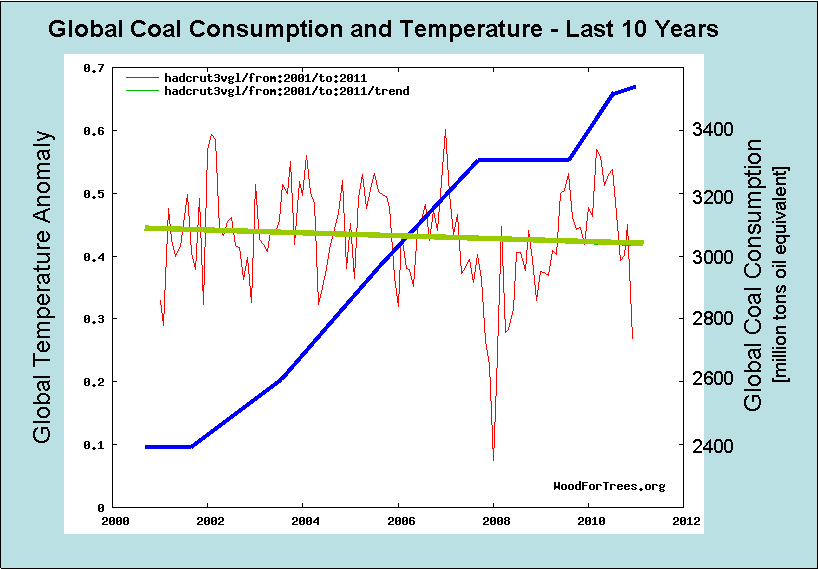
There is a clear disconnect between global coal consumption (and therefore carbon dioxide emissions) and global temperatures.
Of course we must take into account that these are only real data over the last 10 years and are not generated by computer models and have not been validated by the IPCC!!
Quote of the week at WUWT 22nd May 2011
“People underestimate the power of models. Observational evidence is not very useful,” adding, “Our approach is not entirely empirical.” John Mitchell, principal research scientist at the UK Met Office
P Gosselin at NoTricksZone has the “heretical” story:
Global Coal Consumption Jumps Almost 50% – Yet Global Temps Drop!
A recently released BP report here shows that global coal consumption has risen over the last 10 years by almost 50%. So wouldn’t you think that all those millions of tons of emitted CO2 (food for plants) as a result would drive the global temperatures up? Have temperatures risen along with all that extra coal burning?
No they haven’t. In fact they’ve dropped slightly over the same period. So go figure!
In the above chart the blue line shows global coal consumption, data taken here, Review of World Energy. According to the report, India and China alone are responsible for 90% of the world’s coal consumption increase, while renewable energy in the 2 countries plays nary a role. According to BP figures, global CO2 emissions rose 5.8% in the year 2010. ……..
Read source report
Tags:carbon dioxide emissions, climate, Coal, coal consumption, coal consumption disconnected from global temperature, Energy, Fossil fuel, global temperature, IPCC, John Mitchell
Posted in Alarmism, Climate, Energy | Comments Off on Coal consumption increases almost 50% in 10 years and has no impact on global temperature
August 25, 2011
Even making allowance for the fact that it is August when “silly season” stories come to the fore, this nonsense does not bring much credit to the authors, Columbia University, Nature or the sponsors of the “study” who include the U.S. EPA, the brother of George Soros and the Environmental Defense Fund. Gullible journalists who are short of copy and create headlines from this kind of junk science are plentiful.
Civil conflicts are associated with the global climate Solomon M. Hsiang, Kyle C. Meng & Mark A. Cane, Nature 476, 438–441 (25 August 2011) doi:10.1038/nature10311
pdf version here
The Guardian leads –
Climate cycles linked to civil war, analysis shows
Cyclical climatic changes double the risk of civil wars, with analysis showing that 50 of 250 conflicts between 1950 and 2004 were triggered by the El Niño cycle, according to scientists.
Researchers connected the climate phenomenon known as El Niño, which brings hot and dry conditions to tropical nations and cuts food production, to outbreaks of violence in countries from southern Sudan to Indonesia and Peru.
Solomon Hsiang, who led the research at Columbia University, New York, said: “We can speculate that a long-ago Egyptian dynasty was overthrown during a drought. This study shows a systematic pattern of global climate affecting conflict right now. We are still dependent on climate to a very large extent.”
JunkScience gives it short shrift:
Weather causes war, a new study claims. So should we limit CO2 emissions and give peace a chance? Make love not CO2?
The study published in this week’s Nature claims to correlate El Niño Southern Oscillation (ENSO) cycles with wars around the world during 1950-2009. The study’s intended implication, then, is that if only we can stop climate change (i.e., limit CO2 emissions), peace will be at hand.
The study’s major problem, however, is that even if there is a statistical correlation (pardon the redundancy) between ENSO events and wars, the study authors failed to examine any of the actual socio-political circumstances surrounding the wars. To insinuate weather cycles as a cause of or contributor to war simply because they can be correlated is to mindlessly exalt numerology over socio-political reality.
Next ENSO cycles are real and result in actual weather phenomena. Extrapolating the actuality of ENSO to the dubious hypothesis of catastrophic manmade global warming, is yet another leap of faith. The goal of this research is to link CO2 emissions with national security. That is, we don’t just have to wish for world peace anymore; we can stop burning fossil fuels, cooling our homes, driving SUVs, eating meat, etc. It is merely a ploy to tug at the consciences of conservatives who, as a tribe, otherwise generally oppose Al Gore-ism.
Tags:climate, climate and conflict, El Niño-Southern Oscillation, global warming, Junk Science, Nature (journal), non-science
Posted in Climate, Environment, Media, Non-Science, Politics | 1 Comment »

 The k2p blog