Posts Tagged ‘Maunder Minimum’

Droughts on the Tibetan plateau coincide with grand solar minima

May 14, 2012

Yet another paper indicating that climate and solar behaviour are related – at least over the Tibetan plateau and at least over the last 1000 years.

Tree ring based precipitation reconstruction in the south slope of the middle Qilian Mountains, northeastern Tibetan Plateau, over the last millennium

by Junyan Sun and Yu Liu,  Chinese Academy of Sciences, Xi’an, China

JOURNAL OF GEOPHYSICAL RESEARCH, VOL. 117, D08108, 11 PP., 2012
doi:10.1029/2011JD017290

Reconstruction of precipitation amounts for the edge of the Tibet Plateau. The bars on the chart depict prominent weak phases of solar activity, which correspond to Om = Oort Minimum; Wm = Wolf Minimum; Sm = Spörer Minimum; Mm = Maunder Minimum; Dm = Dalton Minimum). Figure from: Sun & Liu (2012).

Geologist Dr. Sebastian Lüning and chemist Prof. Fritz Vahrenholt have written a summary of this paper (in German), and this translation is from P Gosselin at NoTricksZone

New Study of the Tibet Plateau: Whenever Solar Activity is Weak, the Rains Disappear
By Sebastian Lüning and Fritz Vahrenholt

The Tibet Plateau is at 3000 to 5000 meters elevation and is the highest and (most) expansive high plateau on Earth. Therefore it reacts sensitively to climate changes. Junyan Sun and Yu Liu of the Chinese Academy of Sciences studied tree rings in the northwest plateau edge from two living 1000 year old trees. Tree growth in the area of study is particularly sensitive to the amount of precipitation. (more…)

Solar effects on climate – evidence mounts that the Little Ice Age was a global event

May 9, 2012

And another paper showing that the Little Ice Age was a global event.It is highly probable that the LIA was related to the solar effects which gave a dearth of sunspots during the Maunder Minimum.

GEOPHYSICAL RESEARCH LETTERS, VOL. 39, L09710, 7 PP., 2012, doi:10.1029/2012GL051260

Little Ice Age cold interval in West Antarctica: Evidence from borehole temperature at the West Antarctic Ice Sheet (WAIS) Divide

by

Anais J. Orsi , Bruce D. Cornuelle, Jeffrey P. Severinghaus – Scripps Institution of Oceanography, University of California, San Diego, La Jolla, California, USA

(more…)

New study shows solar minimum does cause climate cooling

May 7, 2012

A new paper in Nature Geoscience shows that solar grand minima do indeed cause cooling of the climate in Europe. Around 2800 years ago, one of these Grand Solar Minima, the Homeric Minimum, caused a distinct climatic change in less than a decade in Western Europe. The forcing mechanisms still remain unclear but the evidence that solar effects are significant and cannot be ignored are mounting and persuasive. Now as we enter (or have already entered) a new solar minimum it remains to be seen as to whether this (Landscheidt?) Minimum will be a grand minimum to compare with the Maunder Minimum. In any event a period of global cooling seems likely.

In contrast, the evidence for any anthropogenic effects on climate is still non-existent though political and alarmist theories abound. There is as yet no direct evidence that man-made carbon dioxide emissions has any significant effect on global warming.

Regional atmospheric circulation shifts induced by a grand solar minimum by Celia Martin-Puertas, Katja Matthes, Achim Brauer, Raimund Muscheler, Felicitas Hansen, Christof Petrick, Ala Aldahan, Göran Possnert & Bas van Geel

Nature Geoscience (2012) doi:10.1038/ngeo1460

(more…)

Japanese astronomers also see a Maunder-like solar minimum coming

April 21, 2012

We have been seeing signs that a new solar minimum is probably established and that we are in for a decade or two or three of global cooling. Whether this minimum will be as deep as the Maunder Minimum (1645 – 1715) or more like the Dalton Minimum (1790 – 1830) remains to be seen. Of course we will not know whether we are truly in a Solar Minimum until we are half-way through it. It has been proposed that this new minimum be named after Theodor Landscheidt who predicted this in 1989.

Now Japanese astronomers are also predicting a solar minimum similar to the Dalton Minimum and a period of global cooling. However results from the solar  observation satellite Hinode also suggest that an unusual configuration of the sun’s magnetic poles may also be on its way.

Asahi Shimbun.

(more…)

Solar cycles and the Landscheidt minimum

March 10, 2012

A recent post by John O’Sullivan reminded me that it is time for the next solar minimum that is on its way to be named after the man who predicted it. Theodor Landscheidt (born in 1927 in Bremen, Germany, died on May 20, 2004) was an author and amateur climatologist. In 1989, Landscheidt forecast a period of sunspot minima after 1990, accompanied by increased cold, with a stronger minimum and more intense cold which should peak in 2030 which he described as the “Landscheidt Minimum”.

The sun goes through its cycles as it will and at its own pace and we continue to struggle to try and decipher the various cycles that exist, what causes them and what effects they have on the earth. Some of the cycles known or hypothesised to exist are the:

  • 11 year sunspot cycle
  • 22 year magnetic cycle
  • 87 year Gleissberg cycle
  • 166 year “unnamed” cycle
  • 210 years Suess or de Vries cycle
  • 2,300 years Hallstat cycle
  • 6000 years Xapsos and Burke cycle

Landscheidt’s paper is here: New Little Ice Age instead of Global Warming?

(more…)

Colder winters to come and solar influence on climate beginning to get its due

July 7, 2011

The BBC reports on a new paper in Environmental Research Letters which actually brings solar influence back into the climate picture.

We show that some predictive skill may be obtained by including the solar effect” says this new paper.

Yes Indeed!

But how was the sun’s influence ever discarded in climate models??

Britain is set to face an increase in harsh winters, with up to one-in-seven gripping the UK with prolonged sub-zero temperatures, a study has suggested. The projection was based on research that identified how low solar activity affected winter weather patterns.

“We could get to the point where one-in-seven winters are very cold, such as we had at the start of last winter and all through the winter before,” said co-author Mike Lockwood, professor of space environment physics at the University of Reading.

Using the Central England Temperature (CET) record, the world’s longest instrumental data series that stretches back to 1659, the team said that average temperatures during recent winters had been markedly lower than the longer-term average.

“The mean CET for December, January and February for the recent relatively cold winters of 2008/09 and 2009/10 were 3.50°C and 2.53°C respectively,” they wrote.

“Whereas the mean value for the previous 20 winters had been 5.04°C.

“The cluster of lower winter temperatures in the UK during the last three years had raised questions about the probability of more similar, or even colder, winters occurring in the future.” 

Professor Lockwood was keen to point out that his team’s paper did not suggest that the UK and mainland Europe was about to be plunged into a “little ice age” as a result of low solar activity, as some media reports had suggested.

M Lockwood et al 2011 Environ. Res. Lett. 6 034004 doi: 10.1088/1748-9326/6/3/034004

The solar influence on the probability of relatively cold UK winters in the future

M Lockwood, R G Harrison, M J Owens, L Barnard, T Woollings and F Steinhilber

Abstract: Recent research has suggested that relatively cold UK winters are more common when solar activity is low (Lockwood et  al 2010 Environ Res Lett 5 024001). Solar activity during the current sunspot minimum has fallen to levels unknown since the start of the 20th century (Lockwood 2010 Proc. R. Soc. A 466 303–29) and records of past solar variations inferred from cosmogenic isotopes (Abreu et al 2008 Geophys Res Lett. 35 L20109) and geomagnetic activity data (Lockwood et al 2009 Astrophys. J. 700 937–44) suggest that the current grand solar maximum is coming to an end and hence that solar activity can be expected to continue to decline. Combining cosmogenic isotope data with the long record of temperatures measured in central England, we estimate how solar change could influence the probability in the future of further UK winters that are cold, relative to the hemispheric mean temperature, if all other factors remain constant. Global warming is taken into account only through the detrending using mean hemispheric temperatures. We show that some predictive skill may be obtained by including the solar effect.

The BBC report continues:

Depiction of the 1683 Thames' frost fair (Getty Images)

Depiction of the 1683 Thames' frost fair (Getty Images)

Professor Lockwood said it was a “pejorative name” because what happened during the Maunder Minimum “was actually nothing like an ice age at all”.

“There were colder winters in Europe. That almost certainly means, from what we understand about the blocking mechanisms that cause them, that there were warmer winters in Greenland,” he observed. “So it was a regional redistribution and not a global phenomenon like an ice age. It was nothing like as cold as a real ice age – either in its global extent or in the temperatures reached. “The summers were probably warmer if anything, rather than colder as they would be in an ice age.” He added that the Maunder Minimum period was not an uninterrupted series of cold, harsh winters.

Data from the CET showed that the coldest winter since records began was 1683/84 “yet just two year later, right in the middle of the Maunder Minimum, is the fifth warmest winter in the whole record, so this idea that Maunder Minimum winters were unrelentingly cold is wrong”.

He explained that a similar pattern could be observed in recent events: “Looking at satellite data, we found that when solar activity was low, there was an increase in the number of blocking events of the jetstream over the Atlantic. “That led to us getting colder weather in Europe. The same events brought warm air from the tropics to Greenland, so it was getting warmer. “These blocking events are definitely a regional redistribution, and not like a global ice age.  


Landscheidt Minimum could be a grand solar minimum lasting till 2100

June 20, 2011

It is noticeable that the upsurge of evidence that a solar minimum – and maybe a grand minimum – is upon is causing many of the global warming enthusiasts to try and rationalise the effects of the sun. Suddenly they begin to acknowledge that the sun may have some small effect on climate but rush to point out that the solar influence on climate is not yet understood (indeed!) and in any case it will be much too small to be significant compared to the effects of man.

The belated acknowledgement of the possible influence of the sun is welcome but  the belief that man made effects can overcome the power of the sun is just arrogant.

hockeyschtick

Dr. Cornelis de Jager is a renowned Netherlands solar physicist, past General Secretary of the International Astronomical Union, and author of several peer-reviewed studies examining the solar influence upon climateIn response to the recent press release of three US studies indicating the Sun is entering a period of exceptionally low activity, Dr. de Jager references his publications of 2010 and prior indicating that this Grand Solar Minimum will be similar to the Maunder Minimum which caused the Little Ice Age, and prediction that this “deep minimum” will last until approximately the year 2100. 

“The new episode is a deep minimum. It will look similar to the Maunder Minimum, which lasted from 1620 to 1720…This new Grand Minimum will last until approximately 2100.”


Related: 

  1. http://www.scostep.ucar.edu/archives/scostep11_lectures/de%20Jager.pdf 
  2. Solar activity and its influence on climate  
  3. Major Drop In Solar Activity Predicted: Landscheidt Minimum is upon us and a mini-ice age is imminent

An inconvenient solar minimum..

June 15, 2011

Solar science and the possibility that a Maunder-like Minimum may be approaching seems to have caught the fancy of the MSM — Al Gore notwithstanding.

  1. The Telegraph New Little Ice Age in store? 
  2. Sydney Morning Herald Quiet sun: drop in solar activity may signal second ‘Little Ice Age’ on Earth
  3. Fox News Global Warming Be Damned, We Might Be Headed for a Mini Ice Age
  4. International Business Times The Sun’s inactivity leading to second Little Ice Age, to Offset Global Warming?
  5. MSNBC Solar forecast hints at a big chill
  6. The Christian Science Monitor A sun with no sun spots? What that could mean for Earth and its climate
  7. Discovery News IS THE SUN ABOUT TO FIZZ OUT?
  8. ABC News Goodnight Sun: Sunspots May Disappear for Years
  9. New Scientist Sluggish sun may ‘sit out’ next solar cycle
  10. Arizona Daily Star Fewer sunspots could help offset global warming
Most of these publications are generally fairly uncritical adherents of whatever seems to be in vogue and have usually been very vocal in supporting the AGW creed. But it is nevertheless interesting to see how they have all picked up this news — as if they are bored with and tired of repeating the same old AGW story-line and are just waiting for a new star to follow.
Perhaps the political tide is turning, ……

Solar effects 6 times greater than assumed by IPCC

May 10, 2011

A new paper by A. I. Shapiro, W. Schmutz, E. Rozanov, M. Schoell, M. Haberreiter, A. V. Shapiro, and S. Nyeki in Astronomy & Astrophysics  – Total Solar Irradiance (TSI) Astronomy & Astrophysics 529, A67 (2011)  shows that

a total and spectral solar irradiance was substantially lower during the Maunder minimum than observed today. The difference is remarkably larger than other estimations published in the recent literature. The magnitude of the solar UV variability, which indirectly affects climate is also found to exceed previous estimates. 

We present a new technique to reconstruct total and spectral solar irradiance over the Holocene. We obtained a large historical solar forcing between the Maunder minimum and the present, as well as a significant increase in solar irradiance in the first half of the twentieth-century. Our value of the historical solar forcing is remarkably larger than other estimations published in the recent literature.

Climate Realists reports:

A recent peer-reviewed paper published in Astronomy & Astrophysics finds that solar activity has increased since the Little Ice Age by far more than previously assumed by the IPCC. The paper finds that the Total Solar Irradiance (TSI) has increased since the end of the Little Ice Age (around 1850) by up to 6 times more than assumed by the IPCC. Thus, much of the global warming observed since 1850 may instead be attributable to the Sun (called “solar forcing”), rather than man-made CO2 as assumed by the IPCC. 

article image

NASA reduces forecast for Solar Cycle 24 again

January 19, 2011

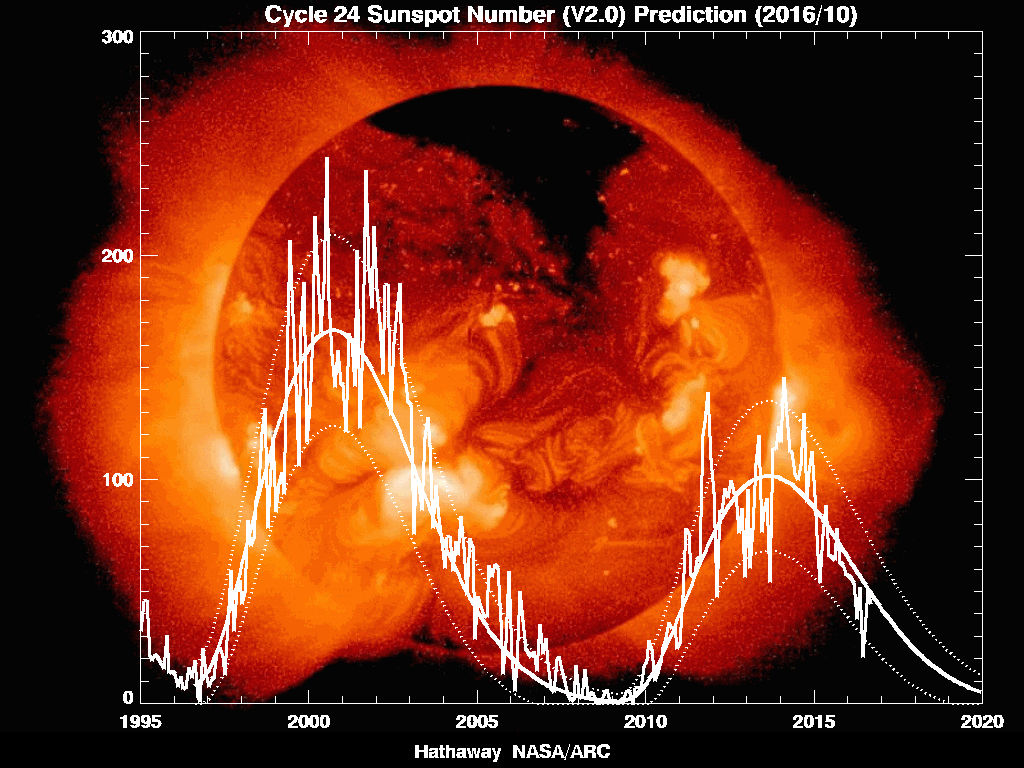
In December NASA had reduced its forecasts for SC24 to a peak sunspot number of 64 being reached in June 2013. Now less than two months later, the latest forecast has been reduced again to a peak sunspot number of 59 to be reached in June / July 2013.

We find a starting time of May 2008 with minimum occurring in December 2008 and maximum of about 59 in June/July of 2013.

NASA SC24 forecast - January 2011: image NASA

At these levels the current Landscheidt minimum is comparable to SC5 and SC6 – the Dalton Minimum of 1790 to 1830 – where peak sunspot numbers were just over 50. (The earlier Maunder Minimum – 1645 to 1715- was before the modern period of sunspot number measurement and nominally was a period with no significant sunspots – presumably at sunspot numbers of less than 20 in today’s measurement values).

From my previous post:

It is not inconceivable that the SC24 will not peak till early 2014 and will only achieve peak sunspot numbers around 55. Solar cycle 24 could well have a length of 150+ months instead of the nominal 132 months.

The development of the NASA predictions are in the table below:

NASA Forecasts for SC24

Date of

forecast

Expected date

of peak

Expected peak

sunspot number

March 2006 June 2010 168
October 2008 March 2012 137
January 2009 June 2012 104
January 2010 June 2013 90
December 2010 June 2013 64
January 2011 June / July 2013 59


Related:

https://ktwop.wordpress.com/2010/12/23/is-the-landscheidt-minimum-a-precursor-for-a-grand-minimum/