Archive for August, 2011

My medicinal chillies

August 26, 2011

Spanish priests in the New World were once a little wary of chillies – considering them an aphrodisiac and something which could inflame passions and therefore possibly a creation of the devil. They preached against indulgence in something “as hot as hell’s brimstone”. The opposition by the priests may have helped chillies gain popularity.

Women drying chillies image: news.bbc.co.uk

Chillies are known to be helpful against hypertension and against pain. They are antimicrobial and aid salivation.  It is thought that capsaicin is an effective defense against a fungus that attacks chili seeds. In fact, experiments have shown that the same species of wild chili plant produces a lot of capsaicin in an environment where the fungus is likely to grow, and very little in drier areas where the fungus is not a danger. Perhaps a liking for chillies is one of the key features distinguishing humans  from other mammals. Family legend has it that my own liking of chillies results from my grandmother coating my thumb in chillie powder as an infant to try and stop me from sucking it!!

But the list of medicinal benefits that chillies can provide is growing.

Now comes evidence in a new paper that chillies are effective against sinus inflammations as well.

Jonathan A. Bernstein, Benjamin P. Davis, Jillian K. Picard, Jennifer P. Cooper, Shu Zheng, Linda S. Levin. A randomized, double-blind, parallel trial comparing capsaicin nasal spray with placebo in subjects with a significant component of nonallergic rhinitisAnnals of Allergy, Asthma & Immunology, 2011; 107 (2): 171 DOI:10.1016/j.anai.2011.05.016

The authors conclude: This is the first controlled trial demonstrating intranasal capsaicin, when used continuously over 2 weeks, rapidly and safely improves symptoms in rhinitis subjects with a significant NAR component.

Science Daily

Hot chili peppers are known to make people “tear up,” but a new study led by University of Cincinnati allergy researcher Jonathan Bernstein, MD, found that a nasal spray containing an ingredient derived from hot chili peppers (Capsicum annum) may help people “clear up” certain types of sinus inflammation. 

The study, which appears in the August 2011 edition of Annals of Allergy, Asthma & Immunology, compares the use of the Capsicum annum nasal spray to a placebo nasal spray in 44 subjects with a significant component of nonallergic rhinitis (i.e., nasal congestion, sinus pain, sinus pressure) for a period of two weeks.

Capsicum annum contains capsaicin, which is the main component of chili peppers and produces a hot sensation. Capsaicin is also the active ingredient in several topical medications used for temporary pain relief. …. This is the first controlled trial where capsaicin was able to be used on a continuous basis to control symptoms. It is considered a significant advance, “because we don’t really have good therapies for non-allergic rhinitis,” says Bernstein, adding that in previous trials the ingredient was too hot to administer without anaesthesia.

Coal consumption increases almost 50% in 10 years and has no impact on global temperature

August 26, 2011

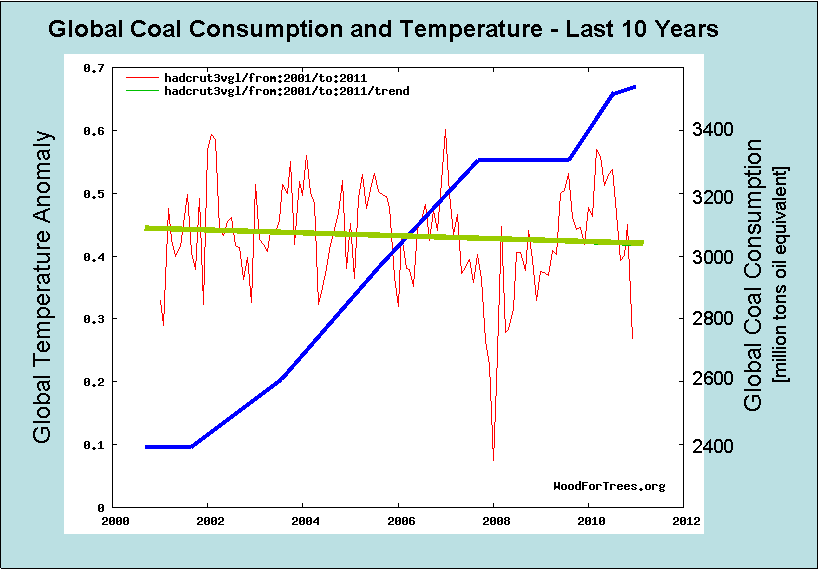
There is a clear disconnect between global coal consumption (and therefore carbon dioxide emissions) and global temperatures.

Of course we must take into account that these are only real data over the last 10 years and are not generated by computer models and have not been validated by the IPCC!!

Quote of the week at WUWT 22nd May 2011

“People underestimate the power of models. Observational evidence is not very useful,” adding, “Our approach is not entirely empirical.” John Mitchell, principal research scientist at the UK Met Office

P Gosselin at NoTricksZone has the “heretical” story:

Global Coal Consumption Jumps Almost 50% – Yet Global Temps Drop! 

recently released BP report here shows that global coal consumption has risen over the last 10 years by almost 50%. So wouldn’t you think that all those millions of tons of emitted CO2 (food for plants) as a result would drive the global temperatures up? Have temperatures risen along with all that extra coal burning?

No they haven’t. In fact they’ve dropped slightly over the same period. So go figure!

Coal consumption and global temperature: http://notrickszone.com

In the above chart the blue line shows global coal consumption, data taken here, Review of World Energy. According to the report, India and China alone are responsible for 90% of the world’s coal consumption increase, while renewable energy in the 2 countries plays nary a role. According to BP figures, global CO2 emissions rose 5.8% in the year 2010. ……..

Read source report

University of Peshawar turns vindictive against plagiarism complainant

August 26, 2011

An earlier post reported that the Vice-Chancellor of the University of Peshawar,  Dr Azmat Hayat Khan had been found guilty of plagiarism by a three-member committee of the Higher Education Commission that was constituted to probe the matter. The complainant, Mohammad Zubair, an assistant professor at the UoP Law College was suspended by the University. Now Noor Aftab at The News reports that the actions against Zubair have turned nasty and the University is trying to cancel his degree in retaliation:

A teacher who raised voice against alleged plagiarism by the Vice Chancellor of University of Peshawar now himself faces hard times , as somewhat controversial internal Fact Finding Inquiry Committee, constituted to probe authenticity of his own LLM degree, has recommended cancelling his degree. ….

….  Assistant Professor Muhammad Zubair said he approached HEC on March 10 and Governor House on March 16 this year to raise issue of plagiarism by the University of Peshawar vice chancellor. “The university administration got infuriated over it and an inquiry was launched on March 17 and I was suspended on March 20 to mute my voice against illegal act of the University of Peshawar vice chancellor”, he said.

Some small hope for Zubair lies in that the Civil Society has started a movement against the plagiarism of the Vice Chancellor Dr Azmat Hayat Khan, reports Pakistan Today.

After the alleged involvement of University of Peshawar (UoP) Vice Chancellor Azmat Hayat Khan in plagiarism, the Joint Action Committee of Civil Society against Plagiarism on Thursday announced to launch ‘Save Peshawar University’ movement to stop any such future incidents. Idrees Kamal, Dr Syed Alam Mehsood and office bearers of other civil societies told a press conference that plagiarism was not only an academic dishonesty but it also challenged the moral norms of the society. …

The committee said that ‘zero tolerance for plagiarism’ was the slogan often raised on various literary platforms. The Supreme Court chief justice termed literary plagiarism as a legally punishable crime, it added. 
Idrees Kamal and Dr Syed Alam Mehsood expressed their disapproval of the relevant authorities’ negligence in the matter. “Azmat Hayat (Khan) is still enjoying the office and the Khyber Pakhtunkhwa governor is a silent spectator”, they said, adding that if the vice chancellor was allowed to continue as head of UoP it would be a disgrace and the university might get blacklisted internationally.

But I am very pessimistic about  Zubair’s prospects. He is fighting a losing battle against a powerful establishment and he will likely have his law degree cancelled. Whether civil society in Pakistan can or will mobilise itself sufficiently to make any difference, either in protecting him or in having any sanctions levied against the plagiarising Vice Chancellor, is is very doubtful. Zubair does seem to have some support in society and at least in one newspaper but the blogosphere is probably not sufficiently developed or influential in Pakistan to have much impact.

The Hamza – a subterranean river to rival the Amazon: 6,000km long, 4,000 m down

August 25, 2011

Subterranean rivers are the stuff of mythology and there is something dark and mysterious and yet wonderful about them. Greek mythology includes the Styx, Phlegethon, Acheron, Cocytus, and Lethe as rivers within the Underworld. The Saraswati River is believed to have drained the north and northwest region of India in ancient times, supporting over 16,000 settlements. Although the river does not have a physical existence today many still believe that it flows underground. The River Fleet is London’s largest subterranean river. Forced underground by the city’s burgeoning populace the river still flows from its source in Hampstead Heath to its mouth where it joins London’s main waterway, the Thames. The longest known subterranean river was the Disu Subterranean river in Du’an, Guangxi Province, China – until now.

Forbes / AP: Sao Paulo

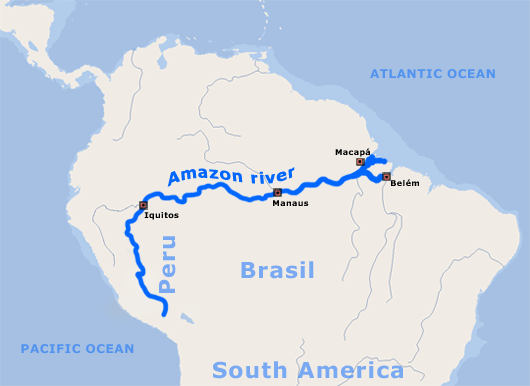
A huge underground river appears to be flowing thousands of feet beneath the Amazon River, Brazilian scientists said Thursday. Valiya Hamza of Brazil’s National Observatory said researchers found indications the subterranean river is 3,700 miles (6,000 kilometers) long, about the same length as the Amazon on the surface. Hamza said the discovery of the possible underground river came from studying temperature variations at 241 inactive oil wells drilled in the 1970s and 1980s by Brazil’s state-run oil company, Petrobras.

He said the “thermal information” provided by Petrobras allowed his team of researchers to identify the movement of water 13,100 feet (4,000 meters) under the Amazon River.

map of the amazon river

map of the amazon river image - 2.bp.blogspot.com

Their findings were presented last week in Rio de Janeiro at a meeting of the Brazilian Geophysical Society. The apparent underground river has been named after Hamza, honoring him as the head of the research team that found the signs of the flowing water. He said the existence of an underground river that also flows west to east would mean that the Amazon rain forest has two drainage systems – the Amazon and Hamza rivers.

There is much about the earth we still don’t know that we don’t know.

And the sense of wonder will remain alive as long as that is so.

UPDATE! Dr. Hamza explains the discovery in an email “interview” with The Hindu. 

“It’s the Sun, stupid” > Svensmark vindicated: CERN shows cosmic rays do influence cloud formation

August 25, 2011

The much awaited results from the CLOUD experiments at CERN have now been published in Nature and show that cosmic rays can influence cloud formation – as Henrik Svensmark has hypothesised. This mechanism – ultimately dependent upon the sun – is far more credible as an explanation of the climate variations seen in recent times than dubious computer models based on implausible forcings due to carbon dioxide in the atmosphere.

Cloud formation may be linked to cosmic rays Kirkby, J. et alNature 476, 429-433 (2011).

Nigel Calder (via GWPF) writes:

Long-anticipated results of the CLOUD experiment at CERN in Geneva appear in tomorrow’s issue of the journal Nature (25 August). The Director General of CERN stirred controversy last month, by saying that the CLOUD team’s report should be politically correct about climate change (see my 17 July post below). The implication was that they should on no account endorse the Danish heresy – Henrik Svensmark’s hypothesis that most of the global warming of the 20th Century can be explained by the reduction in cosmic rays due to livelier solar activity, resulting in less low cloud cover and warmer surface temperatures.

Willy-nilly the results speak for themselves, and it’s no wonder the Director General was fretful.

Henrik Svensmark (born 1958) is a physicist at the Danish National Space Center in Copenhagen who studies the effects of cosmic rays on cloud formation. His work presents hypotheses about solar activity as an indirect cause of global warming; his research has suggested a possible link through the interaction of the solar wind and cosmic rays. His conclusions have been controversial as the prevailing scientific opinion on climate change considers solar activity unlikely to be a major contributor to recent warming, though it is thought to be the primary driver of many earlier changes in climate.

I cannot do any better than reproduce Nigel Calder’s explanation of the CERN experimental results:

Jasper Kirkby of CERN and his 62 co-authors, from 17 institutes in Europe and the USA, announce big effects of pions from an accelerator, which simulate the cosmic rays and ionize the air in the experimental chamber. The pions strongly promote the formation of clusters of sulphuric acid and water molecules – aerosols of the kind that may grow into cloud condensation nuclei on which cloud droplets form. What’s more, there’s a very important clarification of the chemistry involved.

(more…)

Solar Cycle 24: Still on track to be smallest sunspot number cycle in 100 years

August 25, 2011

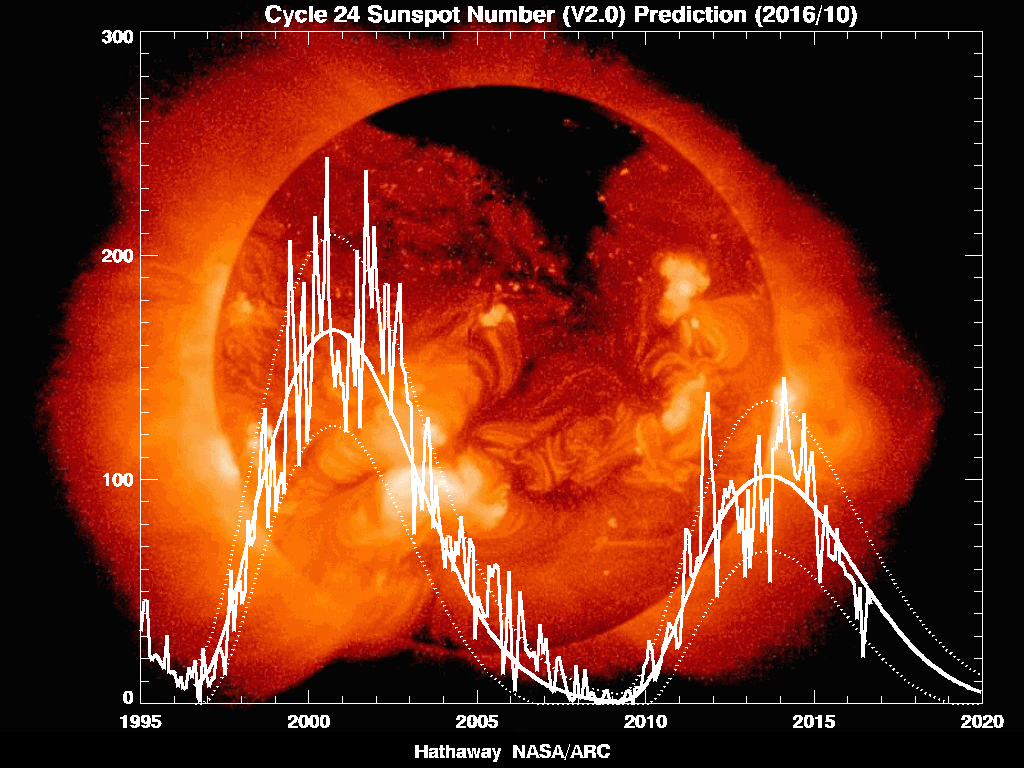
The August solar cycle 24 forecast from NASA is unchanged from the previous month though the maximum has increased to 69 from the 64 forecast about 6 months ago.

The current prediction for Sunspot Cycle 24 gives a smoothed sunspot number maximum of about 69 in June of 2013 (same as last month). We are currently over two and a half years into Cycle 24. Four out of the last five months with average daily sunspot numbers above 40 has raised the predicted maximum above the 64.2 for the Cycle 14 maximum in 1907. This predicted size still make this the smallest sunspot cycle in over 100 years.

NASA - Solar Cycle 24 forecast

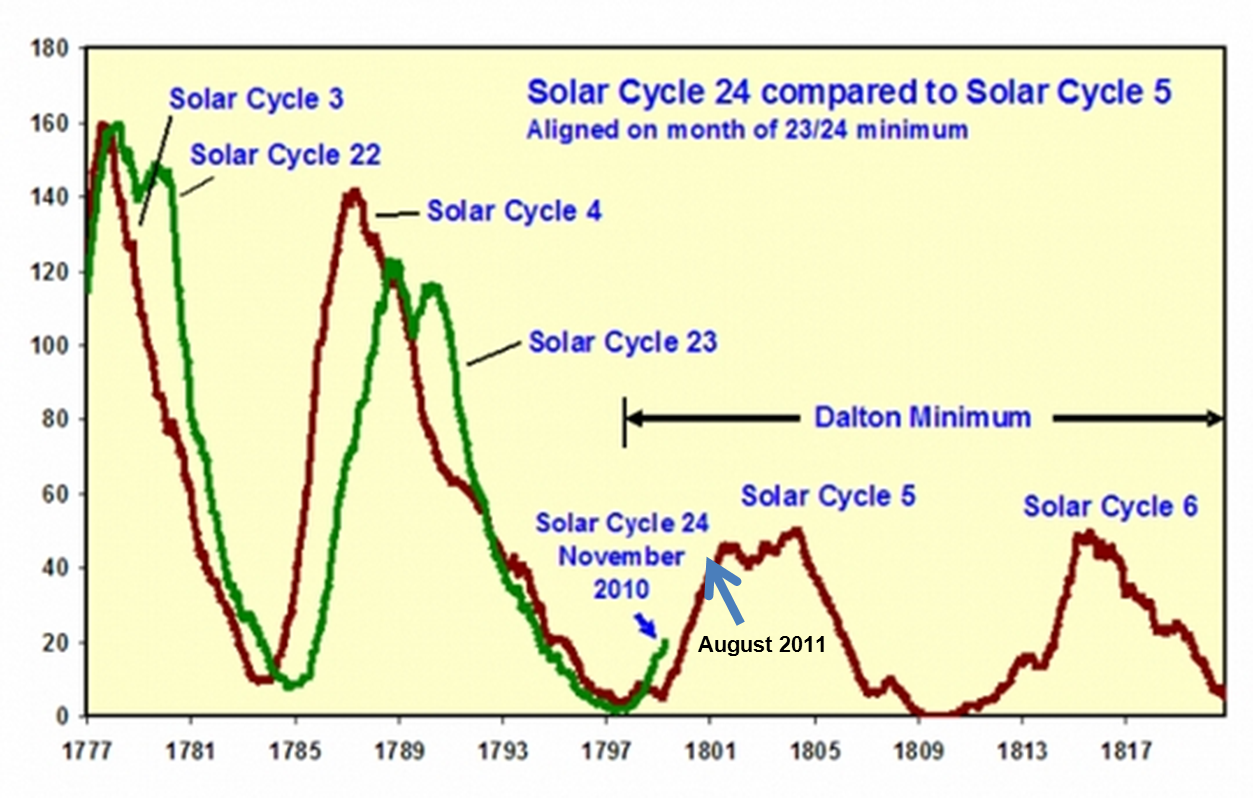
Solar Cycle 24 continues to invite comparisons with Solar Cycle 5.

SC24 versus SC5 - from http://sc25.com

What passes for science: Mindless number games show El Niño correlates with civil war!

August 25, 2011

Even making allowance for the fact that it is August when “silly season” stories come to the fore, this nonsense  does not bring much credit to the authors, Columbia University, Nature or the sponsors of the “study” who include the U.S. EPA, the brother of George Soros and the Environmental Defense Fund. Gullible journalists who are short of copy and create headlines from this kind of junk science are plentiful.

Civil conflicts are associated with the global climate Solomon M. Hsiang, Kyle C. Meng & Mark A. Cane, Nature 476, 438–441 (25 August 2011) doi:10.1038/nature10311 

pdf version here


The Guardian leads –

Climate cycles linked to civil war, analysis shows

Cyclical climatic changes double the risk of civil wars, with analysis showing that 50 of 250 conflicts between 1950 and 2004 were triggered by the El Niño cycle, according to scientists.

Researchers connected the climate phenomenon known as El Niño, which brings hot and dry conditions to tropical nations and cuts food production, to outbreaks of violence in countries from southern Sudan to Indonesia and Peru.

Solomon Hsiang, who led the research at Columbia University, New York, said: “We can speculate that a long-ago Egyptian dynasty was overthrown during a drought. This study shows a systematic pattern of global climate affecting conflict right now. We are still dependent on climate to a very large extent.”

JunkScience gives it short shrift:

Weather causes war, a new study claims. So should we limit CO2 emissions and give peace a chance? Make love not CO2?

The study published in this week’s Nature claims to correlate El Niño Southern Oscillation (ENSO) cycles with wars around the world during 1950-2009. The study’s intended implication, then, is that if only we can stop climate change (i.e., limit CO2 emissions), peace will be at hand.

The study’s major problem, however, is that even if there is a statistical correlation (pardon the redundancy) between ENSO events and wars, the study authors failed to examine any of the actual socio-political circumstances surrounding the wars. To insinuate weather cycles as a cause of or contributor to war simply because they can be correlated is to mindlessly exalt numerology over socio-political reality. 

Next ENSO cycles are real and result in actual weather phenomena. Extrapolating the actuality of ENSO to the dubious hypothesis of catastrophic manmade global warming, is yet another leap of faith. The goal of this research is to link CO2 emissions with national security. That is, we don’t just have to wish for world peace anymore; we can stop burning fossil fuels, cooling our homes, driving SUVs, eating meat, etc. It is merely a ploy to tug at the consciences of conservatives who, as a tribe, otherwise generally oppose Al Gore-ism.


Hydro power plants can release more CO2 emissions than a coal plant

August 24, 2011

Man-made carbon-dioxide emissions are of little significance in the global concentration of carbon dioxide in the atmosphere and the effect of carbon dioxide concentration on global climate is of even less significance. In fact it is much more likely that CO2 concentrations in the atmosphere follow global temperature rather than the other way around.

Nevertheless there are perceptions of fossil fuel fired power plants being terribly polluting and of being the dominant source of man-made emissions while hydro-power plants are perceived as being totally non-polluting. These perceptions are mainly based on pre-determined political positions and not necessarily on measurements or reality.

A new study from Brazil looking at the impact of hydro power plants and the Balbina dam has been published in the Journal of Geophysical Research. One caveat of course with many such studies is that it is not based on measurements but on some measurement followed by hypotheses built into computer models. Nothing wrong with that of course but the weakness with many model results – as with climate models – is that the results can neither be verified or dis-proved by measurements.

Kemenes, A., B. R. Forsberg, and J. M. Melack (2011), CO2 emissions from a tropical hydroelectric reservoir (Balbina, Brazil), J. Geophys. Res., 116, G03004, doi:10.1029/2010JG001465 

Swedish Radio P1:

Electricity from hydropower can lead to several times the emissions of greenhouse gas emissions than produced from fossil fuels. At least from hydro-electric dams in the rain forest areas, according to a new study from Brazil. 

The Balbina dam, which was built fifteen years ago, is located north of Amazonas state capital Manaus. When the rain forest area here was flooded large amounts of organic material ended up at the bottom of the pond. Rotting vegetation then caused large emissions of carbon dioxide and methane. According to this study this corresponded to three tonnes of carbon dioxide per megawatt-hour of energy produced, which is almost ten times that of a coal-fired power plants, and just over half of the emissions from burning fossil fuels in the city ​​of São Paulo.

A recently published study of 85 hydroelectric dams in the world shows that emissions vary between different ponds, depending on size, age and what kind of soil is soaked. How big emissions Swedish hydroelectric dams produce has not yet been studied, but estimates indicate that they are significantly lower than from those in tropical areas in Brazil says Professor Philip Fernside of  Instituto Nacional de Pesquisas da Amazônia (INPA) in Manaus. “It is true that dams in tropical areas such as the Amazon produces more than ponds in temperate climate, but there are emissions in these areas also” says Philip Fernside.

A pdf version of the paper is here.


Number of species on the planet is an unknown unknown – so what is the importance of biodiversity?

August 24, 2011
PLoS Biology_front page_2010-03-01

Image by Bettaman via Flickr

The importance of biodiversity and the loss of species as humans take over their habitats is one of the favourite themes of the environmental movement. But I have yet to see a clear exposition as to why the natural loss of species unable to cope with change is something to be opposed. The diversity of life is certainly one of the most striking aspects of our planet and it is not hard to accept that knowing how many species inhabit Earth is a fundamental question in science. In fact, without knowing this number any comments – let alone conclusions – about the danger of loss of species or the importance of bio-diversity to humanity can only be speculation.

The problem is not only that we have not identified all the eukaryote species in existence (and about 1.3 million have been classified and named) but we have no idea whether the number in existence is to be measured in millions or in hundreds of millions. About 15,000 new species are identified and catalogued each year. If  Bacteria and Archaea are added to eukaryotes, the total number of species could be in the billions.

A new paper in PLoS Biology using a relatively new methodology predicts the total number of species that exist. They claim that “the higher taxonomic classification of species (i.e., the assignment of species to phylum, class, order, family, and genus) follows a consistent and predictable pattern from which the total number of species in a taxonomic group can be estimated”. Using this approach they conclude that “there are ~8.7 million (±1.3 million SE) eukaryotic species globally, of which ~2.2 million (±0.18 million SE) are marine. …. (and) some 86% of existing species on Earth and 91% of species in the ocean still await description”.

Mora C, Tittensor DP, Adl S, Simpson AGB, Worm B (2011) How Many Species Are There on Earth and in the Ocean? PLoS Biol 9(8): e1001127. doi:10.1371/journal.pbio.1001127 

But the paper is already facing objections. The methodology – some claim – actually only estmates human activity in classifying species and not the species themselves. It does seem like an extrapolation from “what has been found” to predict “all that can possibly be found” and the argument is somewhat circular and not fully convincing. It brings to mind the quotation from Donald Rumsfeld which he was castigated for but which I am finding increasingly profound:

There are known knowns; there are things we know we know.
We also know there are known unknowns; that is to say we know there are some things we do not know.
But there are also unknown unknowns – the ones we don’t know we don’t know.

I think we are still in the state of not knowing what we do not know.

NY Times

“It’s astounding that we don’t know the most basic thing about life,” said Boris Worm, a marine biologist at Dalhousie University in Nova Scotia. On Tuesday, Dr. Worm, Dr. Mora and their colleagues presented the latest estimate of how many species there are, based on a new method they have developed. They estimate there are 8.7 million species on the planet, plus or minus 1.3 million.

In 1833, a British entomologist named John Obadiah Westwood made the earliest known estimate of global biodiversity by guessing how many insect species there are. He estimated how many species of insects lived on each plant species in England, and then extrapolated that figure across the whole planet. “If we say 400,000, we shall, perhaps, not be very wide of the truth,” he wrote. Today, scientists know the Westwood figure is far too low. They’ve already found more than a million insect species, and their discovery rate shows no signs of slowing down.

In 1988, Robert May, an evolutionary biologist at the University of Oxford, observed that the diversity of land animals increases as they get smaller. He reasoned that we probably have found most of the species of big animals, like mammals and birds, so he used their diversity to calculate the diversity of smaller animals. He ended up with an estimate 10 to 50 million species of land animals.

For the new estimate, the scientists came up with a method of their own, based on how taxonomists classify species. Each species belongs to a larger group called a genus, which belongs to a larger group called a family, and so on. .. In 2002, researchers at the University of Rome published a paper in which they used these higher groups to estimate the diversity of plants around Italy. There were fewer higher-level groups than lower ones at each site, like the layers of a pyramid. The scientists could estimate how many species there were at each site, much as it’s possible to estimate how big the bottom layer of a pyramid based on the rest of it. . … The scientists built a taxonomic pyramid to estimate the total number of species in well-studied groups, like mammals and birds. (They) then used it on all major groups of species, coming up with estimates of 7.7 million species of animals, for example, and 298,000 species of plants.

Terry Erwin, an entomologist at the Smithsonian Institution, think there’s a big flaw in the study. There’s no reason to assume that the diversity in little-studied groups will follow the rules of well-studied ones. “They’re measuring human activity, not biodiversity,” he said. David Pollock, an evolutionary biologist at the University of Colorado who studies fungi — a particularly understudied group — agrees. “This appears to be an incredibly ill-founded approach,” he said. There are 43,271 cataloged species of fungi, based on which Dr. Mora and his colleagues estimate there are 660,000 species of fungi on Earth. But other studies on fungus diversity suggest the number may be as high as 5.1 million species. ….

Jonathan Eisen, an expert on microbial diversity at the University of California, Davis, said he found the new paper disappointing. “This is akin to saying, ‘Dinosaurs roamed the Earth more than 500 years ago,’ ” he said. “While true, what is the point of saying it?”

At least it could be argued that there are not less than 8.7 million eukaryotic species. This is not likely to be the end of this story. Nevertheless it does at least show the scale of the problem and that the number of all living species (and not just eukaryotes) is still in the realm of the unknown.

And the importance of the disappearance of unsuccessful species and of the resulting bio-diversity on humanity is still an unknown unknown.

Mosquitos increasing in the UK but global warming not blamed – yet

August 23, 2011

This is a very mildly interesting story from the BBC.

I read every word and realised that I continued reading long after it had ceased to be interesting only because I was waiting for the punch line that it “was all due to global warming”.

It never came.

But it will.

Based on a survey of UK local authorities, reports of mosquito bites over the last 10 years are 2.5 times greater than in the 10 years up to 1996. NHS Direct statistics show 9,061 calls in England complaining of bites and stings from early May this year to now – up nearly 15% from last summer. Not all bite complaints are due to mosquitoes – many can be attributed to bedbugs, midges and fleas.

But conditions in the UK, particularly in southeastern England, are increasingly hospitable to mosquitoes.

“The wet weather through May and June this year, along with a warm summer, has affected the population because mosquitoes like the standing breeding water,” says zoologist Michael Bonsall at Oxford University. …. 

But once upon a time, malaria-carrying mosquitoes could be found in the salt marshes of southeastern England. It is believed that malaria – literally “bad air” – dates back at least to Roman times in the UK, and outbreaks occurred as recently as the years just following World War I.

British doctor Ronald Ross, who discovered the malarial parasite living in the gastrointestinal tract of the Anopheles mosquito in the 19th Century, recruited teams to eliminate the larvae from stagnant pools and marshes. … 

Malaria in England had effectively died out by the 1950s, mostly due to the draining of much of the marshland where mosquitoes bred. But because of the growth of global travel, the number of imported cases of the disease in the UK has risen, with nearly 2,000 a year today.

Go to BBC article