Archive for the ‘Climate’ Category

Summer in the Antarctic and expedition is trapped in thick ice

December 25, 2013

“Global sea ice area is second highest on record for the date after 1988, and closing in the #1 spot. Antarctic ice is melting very slowly this summer, due to record cold Antarctic temperatures”.Real Science, 21st December 2013

Certainly no irony would have been intended but irony there undoubtedly is when even The Guardian is forced to report that:

Antarctic expedition stranded as ship gets stuck in ice

Scientists and explorers on Spirit of Mawson voyage will spend Christmas and Boxing Day awaiting rescue. Explorers are stranded near Antarctica after their ship became wedged in by thick sheets of sea ice.

The Spirit of Mawson voyage, which includes scientists, explorers, tourists and the Guardian journalists Alok Jha and Laurence Topham, is trapped in Antarctic ice floes and awaiting rescue.

But with the nearest ship with ice-breaking abilities at least two days away, the crew will spend Christmas and Boxing Day stuck about 1500 nautical miles south of Hobart.

The Australian Maritime Safety Authority received a distress call on Christmas morning, notifying the rescue co-ordination centre that the ship was trapped and would need help. …

Akademik Shokalskiy surrounded by ice

A view of the ice from the boat. Photograph: Laurence Topham

The voyage is part of a research expedition to commemorate the centenary of Douglas Mawson’s exploration.

The Australasian Antarctic Expedition leader, Chris Turney, wrote on Twitter: “Heavy ice. Beautiful; light wind. Only -1degC. All well. Merry Xmas everyone from AAE.”

Global warming – Comments by limerick (1)

December 20, 2013

A mediocre, plump academic named Mann,

Devised a lucrative and cunning plan;

By means of a very Nature trick,

He fabricated a hockey stick;

But global cooling made him an also-ran.

The sun came up, the sun went down,

Global warming could not be found,

Where could it be – the missing heat?

Why in the oceans  – Oh so deep,

But the travesty made Trenberth frown

Ice-ages come and ice-ages go,

And when they come the seas lie low;

“Calamity” cried Hansen in his doom-sayer guise,

“By over 20 feet the seas shall rise”,

But then came the blizzards, ice and snow.

In the hallowed temples of the IPCC,

Carboniferous fuels the devil be,

But for 17 years have temperatures stalled

While coal combustion has not paused,

And the world now sees their idiocy.

The snows of global warming hit the Middle East

December 20, 2013

Of course this snow will be warmer than normal!

Follow the Sun

Beware the IPCC and its false prophets of doom!

Who would addle thy mind in a stew of consensus science,

And entrap thy soul in a web of fear. 

For in their ignorance and in their arrogance,

They presume that they can control the Earth,

And brave the wrath of Sol Invictus.  

The Sun in our heaven heeds not the sticks of Mann,

And waxes and wanes as it is always wont to do,

And the Earth follows.

To the music of the stars in their celestial dance,

By oceans and clouds and winds and rain,

Sol Invictus heats and cools our world.

And as the storms do rage and winds do blow,

As ice-sheets do shrink and then they do grow,

The human mind contrives and Man does follow.  

And there is nothing new under the Sun,

It has happened before and will happen again,

The ice-age will come whether Man will or no!

Winter storm “Alexa” chills the Middle East

Winter storm ‘Alexa' chills the Middle East

People walk in front of the snow- capped Dome of the Rock in the compound known to Muslims as the Noble Sanctuary in Jerusalem’s Old City on Friday. Snow fell in Je rusalem and parts of the occupied West Bank where many schools and offices were closed. (Photo: Reuters)

Kerry trapped in snow

A car covered in snow at the entrance to Jerusalem Friday morning. (photo credit: Israel Hatzolah)

A car covered in snow at the entrance to Jerusalem Friday morning. (photo credit: Israel Hatzolah)

Heavy snow, thunderstorms pummel Turkey

Many schools, roads close as heavy snow continues to hammer Turkey

Cold weather and heavy snow that began on Tuesday afternoon brought İstanbul to a halt. (Photo: DHA)


Man-made global warming is just presumption

December 18, 2013

Presumptions, presumptions everywhere but no evidence to be seen.

  1. There is a presumption among the global warming orthodoxy – but no evidence – that increasing carbon dioxide concentrations in the atmosphere causes significant warming of the Earth’s surface.
  2. There is a presumption that carbon dioxide emissions from human activities (primarily by the increase in fossil fuel combustion since the 1950’s) is the primary cause of the increase of concentration in the atmosphere. This presumption is based on the assumption that the oceans and the forests absorb just as much carbon dioxide as they emit. This balance is an assumption and is based on the argument that pre-industrial concentrations of carbon dioxide in the atmosphere were largely constant. The actual emissions from the forests and the oceans are each an order of magnitude greater than man-made emissions of carbon dioxide. The margin of error in the estimates of amounts of carbon dioxide emitted (and absorbed) by the oceans and the forests is greater than the emissions from fossil fuel combustion. The emissions due to volcanic activity are not well understood just as the rate at which  carbonate sediments are laid down by the oceans is unknown (which in turn affects the concentration of what is dissolved in the oceans and therefore how much gets absorbed by the oceans from the atmosphere). Carbon dioxide released or absorbed by tectonic activity is unknown. There is a presumption based on some limited evidence that approximately 40% of what is released by fossil combustion is accumulating as atmospheric concentration. There is no presumption, however, that increasing carbon dioxide concentration in the atmosphere must lead to an increased absorption rate.
  3. Fossil fuel combustion and man-made carbon dioxide emissions as well as the atmospheric concentration have been increasing at least since about 1950. For the last 17 years this increase has continued but global temperatures have not increased. For the last 10 years the global temperature has shown a slight decline. It is therefore presumed that the original presumption still holds and that the extra heat is presumed to be hidden in a variety of places  (the deep oceans for example) other than at the Earth’s surface. There is no presumption that these observations are fundamentally in conflict with the original presumption.
  4. It is entirely logical that warming of the earth will cause the ice caps to melt and sea levels to rise just as global cooling will cause the ice sheets to expand and the sea levels to fall. It is presumed by the “establishment” that observed short-term reductions of ice extent are not due to natural variation but are proof that man-made global warming prevails. But when ice extent increases – as is happening currently – it is presumed to be due to natural variability and not relevant to the underlying trend due to man-made global warming.
  5. It is postulated by the establishment that extreme weather events are more likely to occur due to man-made global warming (and are not due to natural variability). But when extreme weather events show a decline – as they are doing currently – then any such decline is presumed to be due to natural variability.
  6. A preponderance of “cold records” being broken – rather than “heat records” is presumed to be proof of man-made global warming causing extreme weather events.

Presumptions do not a science make – especially when the evidence available increasingly conflicts with the presumptions.

Solar and ocean cycles – without any CO2 influence – are sufficient to explain climate changes

December 7, 2013
  1. The de Vries solar cycle together with the AMO/PDO are sufficient to explain the main climate variations of the last 1000 years
  2. It is unnecessary to invoke carbon dioxide and its effects to explain the climate cycles
  3. The 21st century will see an underlying cooling due to the de Vries cycle and then modulated by the AMO/PDO. 

The 200-210 year de Vries solar cycle (also known as the Suess cycle)  has been postulated for some time (here and here for example)  as being one of the main natural cycles governing our climate.  The effect of the de Vries cycle can be traced back through the glacial record through many millenia and even through geologic ages. Many solar effects work on climate through ocean cycles. The Atlantic/Pacific Oscillations are well known as  drivers of climate and can be traced back through at least about 1500 years. The Atlantic Multidecadal Oscillation (AMO) has a period of about 66 years while the Pacific Decadal Oscillation (PDO) has a slightly shorter cycle of 60 years.

The entire hypothesis that carbon dioxide concentrations in the atmosphere and therefore human emissions of carbon dioxide are responsible for “global warming” is based on the argument that nothing else can explain the warming witnessed during the 20th century. Yet this is not just conjecture it is a fantasy based on ignoring the effect of the natural cycles that are known to exist. In fact there is no need to invoke carbon dioxide concentration to explain the ups and down of climate. German researchers have now shown that just the de Vries Cycle together with the AMO and the PDO are quite sufficient. The period in the 1970’s and 1980’s often used as the foundation for “global warming” theory can be quite sufficiently explained by the AMO/PDO.

Just as we had about 100 years of an underlying warming due to the de Vries cycle in the 20th century, we are in for an underlying cooling through the 21st century in response to the de Vries solar cycle. This underlying trend will be modulated by the ups and downs of the AMO and the PDO. Carbon dioxide concentrations are largely irrelevant. 

The following is from an article at NoTricksZone:

German Scientists Show Climate Driven By Natural Cycles – Global Temperature To Drop To 1870 Levels By 2100!

by Prof. H. Luedecke and C.O. Weiss (Original German version here).

We reported recently about our spectral analysis work of European temperatures [1] which shows that during the last centuries all climate changes were caused by periodic (i.e. natural) processes. Non-periodic processes like a warming through the monotonic increase of CO2 in the atmosphere could cause at most 0.1° to 0.2° warming for a doubling of the CO2 content, as it is expected for 2100.

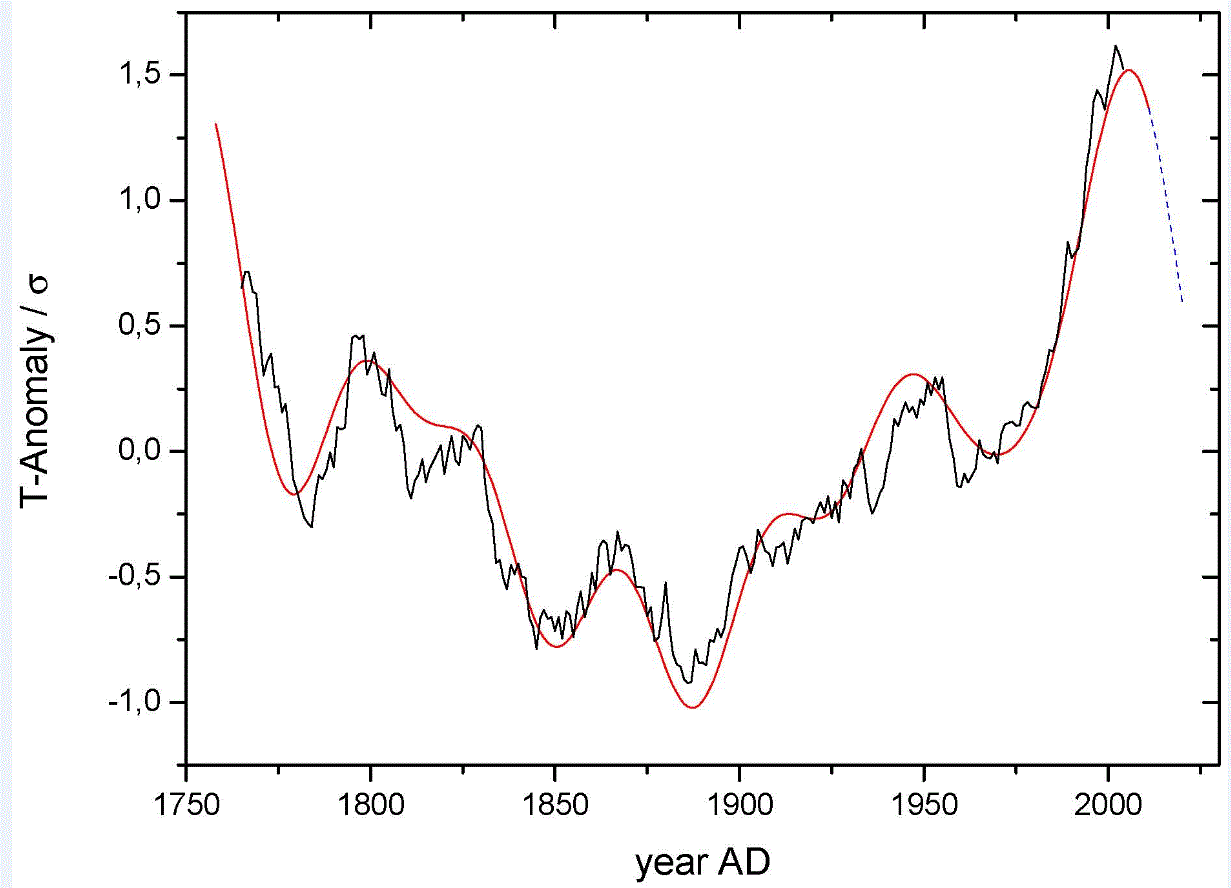
Fig. 1 (Fig. 6 of [1] ) shows the measured temperatures (blue) and the temperatures reconstructed using the 6 strongest frequency components (red) of the Fourier spectrum, indicating that the temperature history is determined by periodic processes only.

On sees from Fig. 1 that two cycles of periods 200+ years and ~65 years dominate the climate changes, the 200+ year cycle causing the largest part of the temperature increase since 1870.

EIKE_2

Fig. 1: Construction of temperatures using the 6 strongest Fourier components (red), European temperatures from instrumental measurements (blue). It is apparent that only a 200+ year cycle and a ~65 year cycle play a significant role.

The ~65 year cycle is the well-known, much studied, and well understood “Atlantic/Pacific oscillation” (AMO/PDO).  It can be traced back for 1400 years. The AMO/PDO has no external forcing it is “intrinsic dynamics”, an “oscillator”.

Although the spectral analysis of the historical instrumental temperature measurements [1] show a strong 200+ year period, it cannot be inferred with certainty from these measurements, since only 240 years of measurement data are available. However, the temperatures obtained from the Spannagel stalagmite show this periodicity as the strongest climate variation by far since about 1100 AD.

……….

Summary

The analysis of solar activity proves the existence and the strength of the 200+ year periodicity which we found from historical temperature measurements, as well as from the Spannagel stalagmite data. This 200+ year cycle is apparently the one known as “de Vries cycle”.

This solar “de Vries cycle together with the AMO/PDO determine practically completely the global climate of the past  (Fig. 1) and the coming time. A significant influence of CO2 on the climate thus has to be excluded. This latter is not surprising in view of the small amount of CO2 in the atmosphere and its weak infrared absorption cross section (also in view of the various proves of NEGATIVE water feedback).

The present “stagnation” of global temperature (Fig. 5) is essentially due to the AMO/PDO: the solar de Vries cycle is presently at its maximum. Around this maximum it changes negligibly. The AMO/PDO is presently beyond its maximum, corresponding to the small decrease of global temperature. Its next minimum will be 2035. The temperature can expected to be then similar to the last AMO/PDO minimum of 1940. Due to the de Vries cycle, the global temperature will drop until 2100 to a value corresponding to the “little ice age” of 1870.

It accounts for the long temperature rise since 1870. One may note, that the stronger temperature increase from the 1970s to the 1990s, which is “officially” argued to prove warming by CO2, is essentially due to the AMO/PDO cycle.

[1] H.Luedecke, A. Hempelmann, C.O. Weiss; Clim. Past.  9  (2013) p 447

[2] F. Steinhilber, J. Beer; Journ. Geophys. Res.: Space Physics  118  (2013) p 1861

The next VEI 5+ volcanic eruption is overdue

November 26, 2013

As Indonesia raised the warning level for the Mount Sinabung eruption it is worth noting that the last volcanic eruptions of  5 or greater on the Volcanic Explosivity Index (VEI) scale were the 1991 eruptions of Mount Pinatubo (VEI of 6) and Mount Hudson (VEI of 5).

The currently ongoing Mount Sinabung eruption (pictures here) gives cause for concern, as all Indonesian volcanoes do, but there is no certainty as to what intensity it may finally reach:

Jakarta Post: The volcanic ash spewed by Mount Sinabung in Karo regency, North Sumatra, disrupted a number of flights from Kuala Namu International Airport in Deli Serdang regency on Sunday.
In Bandung, the Center for Volcanology and Geological Hazard Mitigation (PVMBG) increased the volcano’s status to “awas” (beware), the highest level of the four-level alert system.

During the 19th century VEI eruptions of 5 or greater ocurred every 11 years on average with the Krakatoa eruption being the greatest at VEI 6 in 1883. Through the 20th century, an eruption of intensity 5 or greater came at intervals varying from 1 year upto 23 years with an average interval of just under 7 years. The Novarupta (1912) and Mount Pinatubo (1991) eruptions were the two classified at VEI6. 

  • 1902 Santa Maria
  • 1907 Kudach
  • 1912 Novarupta
  • 1913 Colima
  • 1918 Katla
  • 1932 Cerro Azul
  • 1933 Kharimkotan
  • 1956 Bezymianny
  • 1963 Mount Agung
  • 1980 Mount St. Helens
  • 1982 El Chichón
  • 1991 Mount Pinatubo
  • 1991 Mount Hudson

So far in this century the 2010 Eyjafjallajökull eruption in Iceland “only” reached a VEI intensity of 4. The 2012 Mt. Etna eruption was rated a 3+. 

The last VEI 5 level eruption was in 1991 and a major eruption of intensity 5 or greater is now  overdue. The interval of 22 years is almost as long as the longest interval between major eruptions in the 20th century. Of course even VEI 6 is still a great deal less than the VEI 8 of Toba or Yellowstone.

The VEI is an index taking both the volume of tephra ejected as well as the height to which it is ejected into account. While there is no evidence that the impact of volcanic eruptions is more than a temporary perturbation of the underlying climate cycle, these perturbations may well last a year or two. The effect on climate is usually that of cooling.

The most significant climate impacts from volcanic injections into the stratosphere come from the conversion of sulfur dioxide to sulfuric acid, which condenses rapidly in the stratosphere to form fine sulfate aerosols. The aerosols increase the reflection of radiation from the Sun back into space, cooling the Earth’s lower atmosphere or troposphere. Several eruptions during the past century have caused a decline in the average temperature at the Earth’s surface of up to half a degree (Fahrenheit scale) for periods of one to three years. The climactic eruption of Mount Pinatubo on June 15, 1991, was one of the largest eruptions of the twentieth century and injected a 20-million ton (metric scale) sulfur dioxide cloud into the stratosphere at an altitude of more than 20 miles. The Pinatubo cloud was the largest sulfur dioxide cloud ever observed in the stratosphere since the beginning of such observations by satellites in 1978. It caused what is believed to be the largest aerosol disturbance of the stratosphere in the twentieth century, though probably smaller than the disturbances from eruptions of Krakatau in 1883 and Tambora in 1815. 

But an eruption of VEI 5 or greater within the next year or two could well accelerate the underlying global cooling cycle that may be underway (and caused primarily by solar effects – direct and indirect).

The diagram below comes from a guest post by Dan Pangburn at The Hockey Schtick.

Global temperature anomaly and major volcanic eruptions

UN Climate Conference over – Fortunately nothing was achieved!

November 24, 2013

The UN Climate Conference in Warsaw is over.  We are told that agreement was reached on a compromise. The countries agreed not to make commitments but instead that they would all make “contributions”. To make sure that agreement was reached these contributions are not legally binding. Moreover each nation is only required to specify its “contribution” by the first quarter of 2015 –  if it feels able to. The method of measurement or monitoring the contribution is left to each nation!

The agreement is that each nation may do as it pleases.

Developing countries “believe” in global warming only because they think they can get money from the developed world if they seem to do so. There has been no global warming for 17 years. The supposed link between carbon dioxide and global temperature is well and truly broken. Nobody with any sense believes any longer that any measures taken by any or all countries to cut carbon dioxide emissions can have any impact on our climate. But the UN and political correctness continues with this fiction. Developed countries are no longer prepared to allow the political correctness of global warming and carbon dioxide emissions to lose even more jobs than have already been lost. The vested interests in this fiction and the carbon industry that has sprung up in the last 2 decades are well entrenched – from academia to “green” politicians to lobbyists to “green activists” and to the various industries tied to trying to get rid of fossil fuels. Yet, coal consumption globally has increased by over 80% in the last 10 years and global temperatures have actually declined.

But still some 10,000 bureaucrats and politicians and another 5,000 workers in academia and about twice as many lobbyists and environmentalists travel from one UN conference to the next and achieve nothing but merely plan for the next conference. It seems success is measured by making no commitments whatsoever except to have another conference.

THE UN COP19 conference in Warsaw has ended. Fortunately nothing was achieved. The conferences are now on life-support and being kept alive for nothing other than to keep the conference supporters in jobs. It is time to pull the plug and let these conferences die.

USA Today: 

Avoiding a last-minute breakdown, annual United Nations climate talks limped forward Saturday with a modest set of decisions meant to pave the way for a new pact to fight global warming.

More than 190 countries agreed in Warsaw to start preparing “contributions” for the new deal, which is supposed to be adopted in 2015. That term was adopted after China and India objected to the word “commitments” in a standoff with the U.S. and other developed countries.

The fast-growing economies say they are still developing countries and shouldn’t have to take on as strict commitments to cut carbon emissions as industrialized nations.

The conference also advanced a program to reduce deforestation and established a “loss and damage” mechanism to help island states and other vulnerable countries under threat from rising seas, extreme weather and other climate impacts.

The wording was vague enough to make developed countries feel comfortable that they weren’t going to be held liable for climate catastrophes in the developing world.

U.S. and other rich countries also resisted demands to put down firm commitments on how they plan to fulfill a pledge to scale up climate financing to developing countries to $100 billion by 2020.

It looks like everybody succeeded very well in making no commitments of any substance and they have all agreed to have another conference.

Execution rather than euthanasia is called for.

Good news today: “Green groups walk out of UN climate talks”

November 21, 2013

The UN Climate conferences must count as the most useless, misguided and profligate international cooperation ever.Therefore one hopes that this report in the Guardian is true. The best thing that could happen would be if everybody walked out of these orgies of decadence and the world could forget the last two decades of waste.

I doubt it will happen, since these UN jamborees provide a wonderful and regular forum for the do-gooders and the catastrophe mongers to gather and wallow in their delusions. Mostly financed by taxes. The IPCC is at best a disgrace to both science and to international cooperation. I suspect the green groups think they will get valuable publicity with their walk-out stunt but will all return tomorrow.

They are on to too good a thing and I doubt that they will walk out never to return. But I can always hope:

The Guardian: 

Environment and development groups together with young people, trade unions and social movements walked out of the UN climate talks on Thursday in protest at what they say is the slow speed and lack of ambition of the negotiations in Warsaw. 

Wearing T-shirts reading “Volverermos” (We will return), around 800 people from organisations including Greenpeace, WWF, Oxfam, 350.org, Friends of the Earth, the Confederation and ActionAid, handed back their registration badges to the UN and left Poland’s national stadium, where the talks are being held. 

“Movements representing people from every corner of the Earth have decided that the best use of our time is to voluntarily withdraw from the Warsaw climate talks. This will be the first time ever that there has been a mass withdrawal from a COP,” said a WWF spokesman. 

“Warsaw, which should have been an important step in the just transition to a sustainable future, is on track to deliver virtually nothing. We feel that governments have given up on the process,” he said.

Volcanic CO2 Levels Are Staggering

November 18, 2013

The carbon balance of the earth is far less understood – or quantified – than “climate scientists” would have us believe. The two largest sources and sinks (forests and the oceans) are generally assumed to be largely in balance. Volcanoes are estimated to produce a very small amount of carbon dioxide. Carbon in rocks brought up from the deep mantle by tectonic activities are assumed to be in balance with the return of sediments and rocks into the deep mantle by subduction. These assumed balances of the big numbers means that the relatively small numbers for emissions from fossil fuel combustion and changing land use then become dominant in explaining the observed increase of carbon dioxide concentration in the atmosphere. But these assumptions include many uncertainties:

Carbon dioxide emission sources (GT CO2/year)

  • Transpiration 440
  • Release from oceans 330
  • Fossil fuel combustion 26
  • Changing land use 6
  • Volcanoes and weathering 1

Carbon dioxide is accumulating in the atmosphere by about 15 GT CO2/ year. The accuracy of the amounts of carbon dioxide emitted by transpiration and by the oceans is no better than about 2 – 3% and that error band (+/- 20GT/year)  is itself almost as large as the total amount of emissions from fossil fuels.

But it now appears that even the carbon dioxide emissions from volcanoes have been grossly underestimated. Not only have the emissions from erupting volcanoes been underestimated but it also seems that many volcanoes emit carbon dioxide almost continuously and invisibly (a diffuse degassing).

Volcanic CO2 Levels Are Staggering 

Robin Wylie, University College London   |   October 15, 2013

…. Until the end of the 20th century, the academic consensus was that this volcanic output was tiny — a fiery speck against the colossal anthropogenic footprint. Recently, though, volcanologists have begun to reveal a hidden side to our leaking planet.

Exactly how much CO2 passes through the magmatic vents in our crust might be one of the most important questions that Earth science can answer. Volcanoes may have been overtaken in the carbon stakes, but in order to properly assess the consequences of human pollution, we need the reference point of the natural background. And we’re getting there; the last twenty years have seen huge steps in our understanding of how, and how much COleaves the deep Earth. But at the same time, a disturbing pattern has been emerging.

In 1992, it was thought that volcanic degassing released something like 100 million tons of COeach year. Around the turn of the millennium, this figure was getting closer to 200. The most recent estimate, released this February, comes from a team led by Mike Burton, of the Italian National Institute of Geophysics and Volcanology – and it’s just shy of 600 million tons. It caps a staggering trend: A six-fold increase in just two decades. ……

….. As scientific progress is widening our perspective, the daunting outline of how little we really know about volcanoes is beginning to loom large. ….

…. We now know that the CO2 released during volcanic eruptions is almost insignificant compared with what happens after the camera crews get bored. The emissions that really matter are concealed. The silent, silvery plumes which are currently winding their way skyward above the 150 or so active volcanoes on our planet also carry with them the bulk of its carbon dioxide. Their coughing fits might catch the eye — but in between tantrums, the steady breathing of volcanoes quietly sheds upwards of a quarter of a billion tons of CO2 every year. 

We think. Scientists’ best estimates, however, are based on an assumption. It might surprise you to learn that, well into the new century, of the 150 smokers I mentioned, almost 80 percent are still as mysterious, in terms of the quantity of CO2 they emit, as they were a generation ago: We’ve only actually measured 33.

If the 117 unsampled peaks follow a similar trend, then the research community’s current projection might stand. But looking through such a small window, there’s no way of knowing if what we have seen until now is typical or not. It’s like shining a light on a darkened globe: randomly, you might hit Australia, and think you’d seen it all – while on the edge of your beam, unnoticed, would be Asia. Our planet’s isolated volcanic frontiers could easily be hiding a monster or two; and with a bit of exploration, our estimate of volcanic CO2 output could rise even higher.

You’d think that would be enough. That might be my fault — I tend to save the weird stuff until the end. Recently, an enigmatic source of volcanic carbon has come to light that isn’t involved with lava — or even craters. It now seems that not only is there CO2 we can’t get to, there’s some we can’t even see.

Carbon dioxide is always invisible, but its presence can be inferred in volcanic plumes — betrayed by the billowing clouds of water vapour released alongside it. Without the water, though, it’s a different story. The new poster-child of planetary degassing is diffuse CO2 — invisible emanations which can occur across vast areas surrounding the main vents of a volcano, rising through the bulk of the mountains. This transparent haze is only just beginning to receive proper attention, and as such we have very little idea of how much it might contribute to the global output.

Even more incredibly, it even seems that some volcanoes which are considered inactive, in terms of their potential to ooze new land, can still make some serious additions to the atmosphere through diffuse COrelease. Residual magma beneath dormant craters, though it might never reach the surface, can still ‘erupt’ gases from a distance. Amazingly, from what little scientists have measured, it looks like this process might give off as much as half the CO2 put out by fully active volcanoes.

If these additional ‘carbon-active’ volcanoes are included, the number of degassing peaks skyrockets to more than 500. Of which we’ve measured a grand total of nine percent.
Related: Deep Carbon Emissions from Volcanoes


Broken link between carbon dioxide and global warming could be causing a paradigm shift in climate change theory

November 1, 2013

Dr. David Stockwell writing in Quadrant suggests that a paradigm shift in global warming theory may be underway.

Remember Thomas Kuhn and his paradigm shift?  According to his Structure of Scientific Revolutions, theories change only when anomalous observations stress the ”dominant paradigm” to the point that it becomes untenable. Until then, failure of a result to conform to the prevailing paradigm is not seen as refuting the dominant theory, but explained away as a mistake of the researchers, errors in the data, within the range of uncertainty, and so on. Only at the point of crisis does science become open to a new paradigm.  So, does Kuhn inform the current climate debate, help identify important information or an alternative paradigm?

The link between carbon dioxide concentrations and global warming effects is not based on any direct evidence. It is based on the absorption spectrum of the gas and then on assumptions about the “forcing” caused by the trace amounts of the gas in the atmosphere on other parameters such as clouds. This assumed impact is “confirmed” by correlations between global temperature (or temperature proxies) and carbon dioxide concentration and the assumption that anthropogenic effects (fossil fuel combustion)  dominate the undoubted increase of carbon dioxide concentrations in the atmosphere.  It is said that there is no better correlation but that is not true. Ocean cycles have been shown to have a much stronger correlation. But this assumed link is now looking decidedly shaky as long-ignored parameters (solar effects and the oceans) are also taken into account. Carbon dioxide concentrations have been increasing steadily but global temperatures have remained still for the last 17 – 18 years. In fact over the last 10 years global temperatures have shown a slight decline. Climate models have used the assumed carbon dioxide effect as input. But the predictions they have made about antarctic ice extent, sea level, hurricanes and stormy weather and hot spots in the troposphere have all proved wrong. Real global temperatures are increasingly diverging from these model results. The increase of information is increasing the uncertainty which is very odd.

Climate models can be seen as encapsulating the dominant theory, even though they are composed of many different theories regarding land, the ocean and atmosphere.  Despite their differences they are also similar in many ways, sharing terminology such as the ‘radiative kernel’.  Lets agree, for the purpose of argument, that the dominant AGW paradigm is of global temperature’s high sensitivity to  CO2 doubling, resulting in an increase of around 3°C, which appears to be about the central estimate of the climate models.

Does the 15-year ‘pause’ in global temperatures stress this theory? Certainly to some, the stress has already reached a ‘crisis’; while to others the divergence can be explained away by natural variation, uncertainty, and errors in the data. 

Do failed models and their predictions of increasing extreme events, like hurricanes, droughts and floods, stress the climate models?  Possibly not.  From a physical perspective, these phenomena lie at the boundaries of the theory.  Hurricanes, droughts and floods are ‘higher order’ statistics — extremes not climate averages. Surface temperature is only a part of the greater global climate system. Because anomalous behavior at the margins can be discarded without sacrificing the main theory, their power to confirm or reject the dominant paradigm is somewhat limited. 

Ocean heat content, however, is in a unique position.  The world’s oceans store over 90% of the heat in the climate system.  Arguably, therefore, increases in ocean heat determine overall global warming.  Ocean heat represents the physical bulk of the global heat store, and so should carry the most weight in our assessment of the status of AGW. Observations of ocean heat uptake represent the crucial experiment  — observations capable of decisively dismantling a theory despite its widespread acceptance in the scientific community.  The ARGO project to monitor ocean heat with thousands of drifting buoys is the crucial experiment of the AGW stable. 

A number of climate bloggers have remarked on the very low rate of ocean heat uptake (here, and here, and here), much lower than predicted by the models (herehere, and here).  The last link is about Nic Lewis, a coauthor on Otto et al. 2013, who feels that recent findings of low climate sensitivity, many based on ocean heat content, have led a number of prominent IPCC authors to abandon the higher estimates of climate sensitivity. That may not be a ‘catastrophe’ for the dominant AGW paradigm, but it is certainly a lurch by insiders towards the lower ends of risk and urgency. 

The IPCC panel preparing the AR5 report may not have been devastated when they changed the likely range of climate sensitivity, which had stood at 4.5–2°C since 1990. The lower extimate has now been dropped from 2°C to 1.5°C. What has not been appreciated is that increasing the range of uncertainty is impossible in a period of Kuhnian ‘normal science’, where new information always decreases uncertainty. 

The ‘blow-out’ in the range of likely climate sensitivity can only mean one thing: We are no longer in a period of ‘normal’ science, but entering a period of ‘paradigm shift’. ….

…..

Dr. Stockwell concludes:

Climate skeptics don’t want to say we told you so but, well, we told you so. Even though we do not yet have an accepted theory of solar influence, there are 25 unique models in the AR5-sponsored CIMP5 archive, most with a climate sensitivity untenable on observations from the last decade. 

Take out Occam’s razor and cull them – deep and hard.

Dr David Stockwell, Adjunct Researcher, Central Queensland University