Archive for the ‘Climate’ Category

The IPCC 95% trick: Increase the uncertainty to increase the certainty

October 17, 2013

Increasing the uncertainty in a statement to make the statement more certain to be applicable is an old trick of rhetoric. Every politician knows how to use that in a speech. It is a schoolboy’s natural defense when being hauled up for some wrongdoing. It is especially useful when caught in a lie. It is the technique beloved of defense lawyers in TV dramas. Salesmen are experts at this. It is standard practice in scientific publications when experimental data does not fit the original hypothesis.

Modify the original statement (the lie) to be less certain in the lie, so as to be more certain that the statement could be true. Widen the original hypothesis to encompass the actual data. Increase the spread of the deviating model results to be able to include the real data within the error envelope.

  • “I didn’t say he did it. I said somebody like him could have done it”
  • “Did you start the fight?” >>> “He hit me back first”.
  • “The data do not match your hypothesis” >>> “The data are not inconsistent with the improved hypothesis”
  • “Your market share has reduced” >>> “On the contrary, our market share of those we sell to has increased!” (Note -this is an old one used by salesmen to con “green” managers with reports of a 100% market share!!)

And it is a trick that is not foreign to the IPCC  – “we have a 95% certainty that the less reliable (= improved) models are correct”. Or in the case of the Cook consensus “97% of everybody believes that climate does change”.

A more rigorous treatment of the IPCC trick is carried out by Climate Audit and Roy Spencer among others but this is my simplified explanation for schoolboys and Modern Environ-mentalists.

The IPCC Trick

The IPCC Trick

The real comparison between climate models and global temperatures is below:

Climate Models and Reality

Climate Models and Reality

With the error in climate models increased to infinity, the IPCC could even reach 100% certainty. As it is the IPCC is 95% certain that it is warming – or not!

Phailin came and Phailin went: Alarmists and Warmists disappointed

October 13, 2013

Cyclone Phaelin came and it has now gone.

The Greens around the world are somewhat disappointed that many thousands have not died.

It was a very severe cyclone when it hit (windspeed 200km/h) but it did not reach the classification as a Super Cyclone (>220km/h windspeed).

It was a massive evacuation and that itself was somethiing of an achievement. More than 600,000 (and maybe as many as 1 million) moved or were moved out of harms way. 7 are known to have died in cyclone related events (falling trees in the main). Damage reports have yet to be assessed. Some fishermen are known to be stranded. The military is mobilised and stands ready for rescue and rehabilitation.

The Indian Meteorological community got it about right. But there were those who predicted that it would not only be a Super Cyclone at 220km/h but would be a Super Dooper Cyclone with winds up to 315km/h.

The US Navy’s Joint Typhoon Warning Center (JTWC) in Pearl Harbor, Hawaii, on Friday said Phailin is now expected to break the Indian Ocean intensity record set by the 1999 Cyclone in which at least 9,000 people were killed in Odisha.

Alarmists started criticising the preparations and the evacuations and suggested it would be worse than 1999 where at least 15,000 (unofficially 45,000) died. The Global Warmists at Huffington Post almost seemed to want the loss of life to be as high as possible so that they could blame Global warming (but note that they manage to blame any untoward weather event on Global Warming)

India should rename this meaningless obfuscation and call attention to global warming immediately. .. The anthropogenic global warming caused by accumulation of greenhouse gases is making the oceans warmer, which in turn is causing more frequent and more intense cyclones/hurricanes and floods.

Needless to say the Environ-Mentalists at Greenpeace were also hoping for a major disaster

Intense and destructive storms are likely to occur more frequently as global warming intensifies, Greenpeace said Saturday. “Such intense and destructive storms are likely to become more frequent in the future as global warming intensifies.  India member Biswajit Mohanty. According to the organisation, cyclone Phailin which is expected to hit the coastal areas of Odisha and Andhra Pradesh is likely to be the strongest such to affect India in 14 years, since the 1999 Odisha cyclone.

The Green Brigade conveniently forget that a Super Cyclone is generated in the Bay of Bengal every 10-20 years. It is a natural phenomenon known for at least the last 200 years. The super Cyclone of 1970 killed over 500,000 people. And the lessons learned since 1999, the major evacuation and the other preparations made seem to have achieved their objective and minimised the loss of life.

It was a severe storm and has surely caused some significant damage. But it is something which happens regularly and not anything unprecedented. It was not a Super Cyclone.

And it was nowhere near the major disaster that Alarmists, Greenpeace, Global Warmists and Environ-Mentalists were hoping for.

Oktoberfest is hardly over and snow arrives in Bavaria

October 11, 2013

Oktoberfest only ended last week and 20cm of snow has already fallen in Southern Germany. A few weeks earlier than “normal”. But not to worry. Global Warming is here. Climate models cannot be fooled by little things like local weather and reality.

snow in Bavaria, 11th October 2013 photo DPA

Snow in Bavaria, 11th October 2013 photo DPA

The Local: Winter has arrived in southern Germany with the first heavy snowfall hitting Bavaria on Thursday night and Friday morning. 

The snow caused traffic chaos in the Garmisch-Partenkirchen area – a popular ski resort. Schools and kindergartens were closed, a police spokesman said on Friday, while authorities advised people to stay indoors.

Trees which have collapsed under the weight of the snow are also posing a danger for drivers and pedestrians. On one stretch of road out of Garmisch-Partenkirchen, 15 trees blocked traffic. 

But the early winter weather also brought happier scenes with the first snowmen being built. Snow has also fallen in the southern state of Baden-Württemberg.

NoTricksZone reports:

Meteorologists warned us that snow was on the way and would fall below the 500 m elevation in southern Germany and elsewhere. Moreover, they warned us that this winter could be one of the worst in 100 years for Central Europe. ….. 

Online Die Welt here writes:

‘It began to snow in the Bavarian capital of Munich yesterday evening at about 6 p.m. Many of my meteorologist colleagues had believed this to be improbable,’ said meteorologist Dominik Jung: ‘This year winter has struck early and unusually severely. South of Munich up to 20 centimeters of snow was able to pile up.’”

Die Welt adds that schools have been closed in some localities, 22,000 households in Austria have lost power, trains have come to a standstill, and traffic has been in chaos.

Frost is expected to spread across southern and middle Germany this weekend, reports www.wetter.net,Temperatures down to -4°C are expected under clear skies in some local areas.


2013 was a “good” year for the cryosphere – but could it be the beginning of the end of this interglacial?

October 8, 2013

According to the NSIDC – which is an important part of orthodox officialdom – 2013 was a better year for the cryosphere since:

“This summer, Arctic sea ice loss was held in check by relatively cool and stormy conditions. As a result, 2013 saw substantially more ice at summer’s end, compared to last year’s record low extent. The Greenland Ice Sheet also showed less extensive surface melt than in 2012. Meanwhile, in the Antarctic, sea ice reached the highest extent recorded in the satellite record”.

What makes for “good” or “bad” depends upon what the fears are. If global warming is the fear then – as the NSIDC states – it was a good year. But if a cooling cycle or even a coming ice age is the fear then the increasing ice extent, the short summer, the extended winter last year and the increased snow cover in the Northern Hemisphere are all just early warning signs of what is to come.

We don’t know if we are in:

  1. a run-away global warming period (as the global warming orthodoxy will have us believe), or
  2. a series of global warming and cooling cycles, each about 20 – 30 years long and responding to the decadal ocean cycles, or
  3. the beginning of the end of this interglacial (which is overdue).

The global warming pause of the last 17 – 18 years suggests that “run-away” global warming is unlikely. The slight decrease in global temperatures over the last 7 – 8 years is not conclusive but is also evidence that the effect of increasing carbon dioxide on global temperature is far from certain. Even if it exists it is very small  and is clearly not yet properly understood. Catastrophe scenarios may attract funding but reduce the credibility of the doom-sayers.

If we are just in a regular cooling cycle then the increasing ice level is nothing to be afraid of. Even if 2 or 3 decades of cooling give us another Little Ice Age, it will be followed by a warming cycle. It will not necessarily mean the start of the end of the current interglacial. But it will mean 20 – 30 years of cooling and the increased use of fossil fuels will be required. Fracking and methane hydrate recovery from the deep sea will be needed along with the continued – and increased – mining of coal. Wind and solar energy can play their little part in the niches that they are suitable for. Nuclear energy will have to make a come-back.

But if the Earth is now responding – by mechanisms unknown – to the Milankovitch cycles – and has started its many thousands year journey into glacial conditions, then we would be well served by developing the strategies and technologies for prospering in such times. We will gradually lose habitat in the North to growing ice sheets but we will gain new habitat as the sea level sinks. But these changes will take place over many generations (50 – 100) and we will have time to adapt. One lost generation – as the last 20 years of global warming hysteria will be – will be of little consequence. Humans have lived and prospered through glacial conditions before and will again. One big difference will be the availability of affordable and abundant energy which gives us the ability – not to stop the advance of the ice sheets – but to be able to continue to access resources and minerals under the ice sheets. We may even have colonies living on top of the shallower ice sheets. But there will also be new opportunities. The increase of habitat as the sea levels drop (by upto 150m) will be in exceptionally fertile areas for food production. Mineral and energy resources currently under the sea will become even more accessible. As with the last glacial period it will probably be a period in which human ingenuity is challenged and innovation will flourish.

The coming of a new glacial period will be no catastrophic change. We will have plenty of time to adapt. And in the 1,000 or 2,000 years it will take to establish glacial conditions, humans will probably have found new frontiers and established new colonies in space. And in 50 or 100 generation humans will continue to evolve. The humans coming out of the next glacial will not be quite like us.

Little Ice Age could well have resulted from reduced solar activity

October 4, 2013

This paper is particularly interesting because the senior author, Thomas Stocker, is the Vice-Chair of the IPCC and presented the summary of AR5 at the Press Conference last week!!

It is very strange then that the IPCC is so nonchalant about solar effects. In any event whatever the various climate models say, the Landscheidt Minimum is here and global cooling will continue for the next two decades or so. As The Register puts it.
” There’s been criticism for the Intergovernmental Panel on Climate Change (IPCC) over its latest AR5 report from many quarters for many reasons. But today there’s new research focusing on one particular aspect of that criticism.The particular part of the IPCC’s science in question is its accounting for the effects of changes in the Sun on the climate of planet Earth. Many climatologists have long sought to suggest that the effects of solar variability are minor, certainly when compared to those of human-driven CO2 emissions. Others, however, while admitting that the Sun changes only a very little over human timescales, think that it might be an important factor. This matters because solar physicists think that the Sun is about to enter a “grand minimum”, a prolonged period of low activity. 
The current 11-year peak in solar action is the weakest seen for a long time, and it may presage a lengthy quiet period. Previously, historical records suggest that such periods have been accompanied by chilly conditions on Earth – perhaps to the point where a coming minimum might counteract or even render irrelevant humanity’s carbon emissions. The “Little Ice Age” seen from the 15th to the 19th centuries is often mentioned in this context.
Lehner, Flavio, Andreas Born, Christoph C. Raible, Thomas F. Stocker, 2013: Amplified Inception of European Little Ice Age by Sea Ice–Ocean–Atmosphere Feedbacks.  J. Climate26, 7586–7602.
doi: http://dx.doi.org/10.1175/JCLI-D-12-00690.1
The University of Berne press release writes:
The study that was realized at the OCCR shows that volcanic eruptions and reduced solar radiation caused global cooling between the thirteenth and the fifteenth centuries. The resulting accelerated formation of sea ice in the Northern Seas triggered a positive feedback process that shaped the Little Ice Age. The winter weather in Europe is largely governed by the so-called North Atlantic Oscillation (NAO). ……. Until now, the NAO was believed to be jointly responsible for the cooling in the early fifteenth century along with volcanic eruptions and weakened solar radiation. The subsequent Little Ice Age continued into the nineteenth century. Now, however, Bernese climate researchers Flavio Lehner, Andreas Born, Christoph Raible and Thomas Stocker reveal that the Little Ice Age was also able to take its course without the influence of the NAO, driven purely by the consequences of strong and frequent volcanic eruptions at the time, a reduced solar radiation, or both together.
Using simulations on the CSCS supercomputer “Monte Rosa”, the climate researchers searched for a feedback process that was capable of triggering the Little Ice Age.
….. For the scientists, the fact that all the slightly altered, realistic simulations and the synthetic ice simulation yielded consistent results is solid proof that the Little Ice Age was primarily governed by external triggers. Volcanic activity and less solar radiation initially caused an increase in sea-ice formation independently of atmospheric circulation. Due to the cooling, the mean sea level pressure gradually increased over the Barents Sea, which enabled the cold air to reach Europe. “However, this pressure response is clearly a delayed reaction of the atmosphere to the preceding processes in the ocean,” says Raible.
Abstract: The inception of the Little Ice Age (~1400–1700 AD) is believed to have been driven by an interplay of external forcing and climate system internal variability. While the hemispheric signal seems to have been dominated by solar irradiance and volcanic eruptions, the understanding of mechanisms shaping the climate on a continental scale is less robust. In an ensemble of transient model simulations and a new type of sensitivity experiments with artificial sea ice growth, the authors identify a sea ice–ocean–atmosphere feedback mechanism that amplifies the Little Ice Age cooling in the North Atlantic–European region and produces the temperature pattern suggested by paleoclimatic reconstructions. Initiated by increasing negative forcing, the Arctic sea ice substantially expands at the beginning of the Little Ice Age. The excess of sea ice is exported to the subpolar North Atlantic, where it melts, thereby weakening convection of the ocean. Consequently, northward ocean heat transport is reduced, reinforcing the expansion of the sea ice and the cooling of the Northern Hemisphere. In the Nordic Seas, sea surface height anomalies cause the oceanic recirculation to strengthen at the expense of the warm Barents Sea inflow, thereby further reinforcing sea ice growth. The absent ocean–atmosphere heat flux in the Barents Sea results in an amplified cooling over Northern Europe. The positive nature of this feedback mechanism enables sea ice to remain in an expanded state for decades up to a century, favoring sustained cold periods over Europe such as the Little Ice Age. Support for the feedback mechanism comes from recent proxy reconstructions around the Nordic Seas

Solar Cycle 24 has passed its maximum – 25 years of cooling to be expected in this Landscheidt minimum

October 4, 2013

The September sunspot numbers are now out and it would seem that Solar Cycle 24 has passed its maximum. It looks very much like SC23, SC24 and the coming SC25 will be comparable to SC4, 5 and 6. Solar Cycles 5 and 6 were responsible for the Dalton Minimum. SC 24 and 25 will constitute the Landscheidt Minimum and we can now expect some 25 additional years of global cooling (which has of course already started – about 6 or 7 years ago).

LSC: This month was recorded as the lowest month since Jan 2011 which was the beginning of the rampup for SC24. Cycle max is close or passed with the northern hemisphere changing polarity and the south still somewhat floundering. The southern hemisphere just outweighing the northern hemisphere, showing the south is not meeting expectations by some that a second peak will occur. … SIDC 36.9, NOAA unadjusted at 55.0 (prov). 

NASA has made its latest prediction:

SC24 prediction October 2013

SC24 prediction October 2013

The transition from SC 23 to SC 24 looks very similar to that from SC4 to SC5.

SC4-6 and Dalton

SC4-6 and Dalton

Of course the IPCC makes little of any solar effects and while the variation of direct total irradiance is small, they are rather nonchalant about the very many profound ways in which solar effects manifest themselves in climate (via cloud formation and ocean cycles for example). But the global warmists and the IPCC have now so much invested in their increasingly dubious hypothesis that they are prepared to make the most convoluted contortions to deny the hiatus and that global cooling has started.

Judith Curry: 

Section 8.4.1 of the IPCC AR5 Report provides 2 pages of discussion on observations of solar irradiance.  But they conclude that all this doesn’t matter for the climate.  I agree that the TSI RF variations are much less than projected increased forcing due to the GHG.  But the solar-climate connection is probably a lot more complex than this statement implies. …..

…. Henrik Svensmark has an essay While the Sun Sleeps, …..

Solar activity has always varied. Around the year 1000, we had a period of very high solar activity, which coincided with the Medieval Warm Period. But after about 1300 solar activity declined and the world began to get colder. It was the beginning of the episode we now call the Little Ice Age.

It’s important to realise that the Little Ice Age was a global event. It ended in the late 19th Century and was followed by increasing solar activity. Over the past 50 years solar activity has been at its highest since the medieval warmth of 1000 years ago. But now it appears that the Sun has changed again, and is returning towards what solar scientists call a “grand minimum” such as we saw in the Little Ice Age.

The match between solar activity and climate through the ages is sometimes explained away as coincidence. Yet it turns out that, almost no matter when you look and not just in the last 1000 years, there is a link. Solar activity has repeatedly fluctuated between high and low during the past 10,000 years. In fact the Sun spent about 17 per cent of those 10,000 years in a sleeping mode, with a cooling Earth the result.

You may wonder why the international climate panel IPCC does not believe that the Sun’s changing activity affects the climate. The reason is that it considers only changes in solar radiation. That would be the simplest way for the Sun to change the climate – a bit like turning up and down the brightness of a light bulb.

Satellite measurements have shown that the variations of solar radiation are too small to explain climate change. But the panel has closed its eyes to another, much more powerful way for the Sun to affect Earth’s climate. In 1996 we discovered a surprising influence of the Sun – its impact on Earth’s cloud cover. High-energy accelerated particles coming from exploded stars, the cosmic rays, help to form clouds.

[C]limate scientists try to ignore this possibility.  If the Sun provoked a significant part of warming in the 20th Century, then the contribution by CO2 must necessarily be smaller.

The outcome may be that the Sun itself will demonstrate its importance for climate and so challenge the theories of global warming. No climate model has predicted a cooling of the Earth – quite the contrary. ….


Ancient humans coped with massive climate change (without the IPCC)

October 1, 2013

Many people today seem to like to live in the fear of an impending catastrophe. The fears are all artificial and always include fanciful predictions of doom. Fears of uncontrollable population explosions, food shortages and starvation, of energy crises and depletion of all resources and of course of catastrophic global warming. And they give rise to such utterly useless bodies as the IPCC.

The period from before the last interglacial, the Eemian and through to the current interglacial in the Holocene has seen the rise of Anatomically Modern Humans and, starting from Africa, the peopling of the world. Anatomically modern humans make their appearance in Africa during an even earlier interglacial at around 250,000 years ago. They saw a descent into glacial conditions with global temperatures dropping about 6 °C and sea levels  dropping by some 150m. Then around 130,000 to 135,000 years ago a very rapid (relatively) climate change ocurred as the conditions of the Eemian were established.  Global temperatures increased by some 7 °C and sea levels rose by upto 170m. Temperatures were warmer than today and sea levels were higher.They didn’t just survive this change – they thrived. They made their way through the Sahara (perhaps through ancient green river corridors) and established themselves in the North and North-East of Africa. At this time sea-levels were high and crossing over into Europe or to Arabia would not have been possible. Both these crossings would have been made at earlier periods by the precursors of AMH and such groups would have given rise to the Neanderthals in Europe and the Denisovans in Asia. When sea levels allowed and perhaps driven by desertfication they crossed into Arabia. From Africarabia they moved across the globe – again perhaps driven by desertification of Arabia.

All these predecessors of ours – some ancestors and some distant cousins – not only survived but actually thrived. They had no IPCC to warn them of looming catastrophe if sea levels rose by 20 cm or temperatures rose by 1.5 °C. Not realising their dangers they still coped with changes of 7 °C and sea-levels of 170 m. Of course they were not without their resources. They had fire. They could probably speak but they had not been contaminated by the written word and were not corrupted by IPCC reports. They may have had some primitive form of rafts but they had no boats and the wheel was unknown. They had stone tools and their version of WMD consisted of many spears. They just coped with the weather and whatever it threw at them. They didn’t waste time predicting the climate and living in the fear of their own predictions. They had other more real fears to worry about.

Former interglacials

The period after the Eemian and upto the present day is particularly interesting.  For most of the time the world was in the grip of glacial conditions. Even as the climate changed and the world started warming up, there were sudden spikes of climate in the reverse direction as with the Younger Dryas. It was in this glacial period that AMH left Africa and then peopled the entire globe. It was not a period of stable climate and their expansion and growth took place in an environment of frequent and violent change. Real population increase started some time before the neolithic when we were still hunter-gatherers or semi-nomadic herders.

Age of Human Expansion

Age of Human Expansion

Of course in North Africa and the Middle East and Asia where much of the action took place for AMH there was little danger of advancing ice sheets. But there was the constant risk of sudden desertification, the drying up of fresh water resources and the sudden loss or appearance of new coastal land as sea levels increased or decreased. Rainfall patterns would have changed. Landscapes would have been transformed from forests to savannahs to deserts and back again. The only recourse available to humans of that time was to move to a more viable location whenever their survival was threatened.

And as they did that they populated the world and they prospered.

But they could have been stopped in their tracks if they had had the benefit of an IPCC.

In the Mediterranean temperatures indicate long-term trends which are decreasing

September 30, 2013

Well Now!

Michael Mann’s splicing of temperature records onto tree ring proxies and his trick of hiding the decline to create his hockey stick begins to look decidedly fishy. And the IPCC is beginning to smell.

And this coming at the same time as the release of the IPCC’s AR5 Summary emphasises how far removed the IPCC is from science.

Ingo Heinrich, Ramzi Touchan, Isabel Dorado Liñán, Heinz Vos, Gerhard HelleWinter-to-spring temperature dynamics in Turkey derived from tree rings since AD 1125Climate Dynamics, 2013; 41 (7-8): 1685, DOI:10.1007/s00382-013-1702-3

AbstractIn the eastern Mediterranean in general and in Turkey in particular, temperature reconstructions based on tree rings have not been achieved so far. Furthermore, centennial-long chronologies of stable isotopes are generally also missing. Recent studies have identified the tree species Juniperus excelsa as one of the most promising tree species in Turkey for developing long climate sensitive stable carbon isotope chronologies because this species is long-living and thus has the ability to capture low-frequency climate signals. We were able to develop a statistically robust, precisely dated and annually resolved chronology back to AD 1125. We proved that variability of δ13C in tree rings of J. excelsa is mainly dependent on winter-to-spring temperatures (January–May). Low-frequency trends, which were associated with the medieval warm period and the little ice age, were identified in the winter-to-spring temperature reconstruction, however, the twentieth century warming trend found elsewhere could not be identified in our proxy record, nor was it found in the corresponding meteorological data used for our study. Comparisons with other northern-hemispherical proxy data showed that similar low-frequency signals are present until the beginning of the twentieth century when the other proxies derived from further north indicate a significant warming while the winter-to-spring temperature proxy from SW-Turkey does not. Correlation analyses including our temperature reconstruction and seven well-known climate indices suggest that various atmospheric oscillation patterns are capable of influencing the temperature variations in SW-Turkey.

Alpha Galileo reports: 

For the first time a long temperature reconstruction on the basis of stable carbon isotopes in tree rings has been achieved for the eastern Mediterranean. An exactly dated time series of almost 900 year length was established, exhibiting the medieval warm period, the little ice age between the 16th and 19th century as well as the transition into the modern warm phase. Moreover, Ingo Heinrich from the GFZ German Research Centre for Geosciences and colleagues revealed that the modern warming trend cannot be found in the new chronology. “A comparison with seasonal meteorological data also demonstrates that at several places in the Mediterranean the winter and spring temperatures indicate long-term trends which are decreasing or at least not increasing”, says Ingo Heinrich. “Our results stress the need for further research of the regional climate variations.”

It seems that especially temperature reconstructions derived from extreme sites such as high mountain zones and high latitudes do not always correctly reflect the climate of the different geographical regions. The past temperature variations in the lowlands of central Europe and in the Mediterranean are not well understood yet. The analysis of carbon isotope ratios (13C/12C) in tree rings aims to close this research gap. By focusing on the months January to May the researchers detected the period in which the trees shift from dormancy in late winter to re-activation of growth in early spring. The carbon isotope ratios measured in individual tree rings largely depends on the environmental conditions; thus, the varying tree-ring isotope values are good indicators for changes in the environment. The carbon isotope ratios in the trees from Turkey indicate a temperature sensitivity of the trees during late winter to early spring. In cold winters the cambium and the leaves are damaged more than usual and the following recovery in spring takes longer. Low spring temperatures further delay the photosynthesis or slow down the rate of photosynthesis, with negative effects on the cambial activity.


IPCC: the best headlines

September 28, 2013

I particularly liked the headline in Andrew Orlowski’s article in The Register!

IPCC: Yes, humans are definitely behind all this global warming we aren’t having

Some other winners:

IPCC report: Britain could cool if Gulf Stream slows 

THE DISCLAIMER THAT SHOULD BE ADDED AT THE TOP OF EACH IPCC REPORT

Band-aids Can’t Fix the New IPCC Report

IPCC AR5 Press Release: Oceans Ate “More Than 90% Of The Energy Accumulated Between 1971 And 2010″! 

and of course my own:

IPCC = International Promotion of Global Warming

IPCC = International Promotion of Global Warming

September 28, 2013

It is quite wrong to think of the IPCC as some august body looking objectively at Climate Change and what causes climate to change. They only operate as a PR agent – under the cloak of consensus science – for the Global warming hypothesis. Global cooling hypotheses or – in fact – any hypotheses other than carbon dioxide being the controller of global temperature are given short shrift. Even real observations and all global cooling trends are ignored. Global warming models take precedence over real data. The Sun is ignored. Climate sensitivities is apparently too new a topic to be considered.

They do not just cherry pick data; they just ignore it when they represent inconvenient truths. The last 17 years with no global warming are merely dismissed as being for too short a period. But then the IPCC has only been in operation for 25 years. The IPCC has not looked up from its computer models to realise that for most of its life it has seen no global warming.

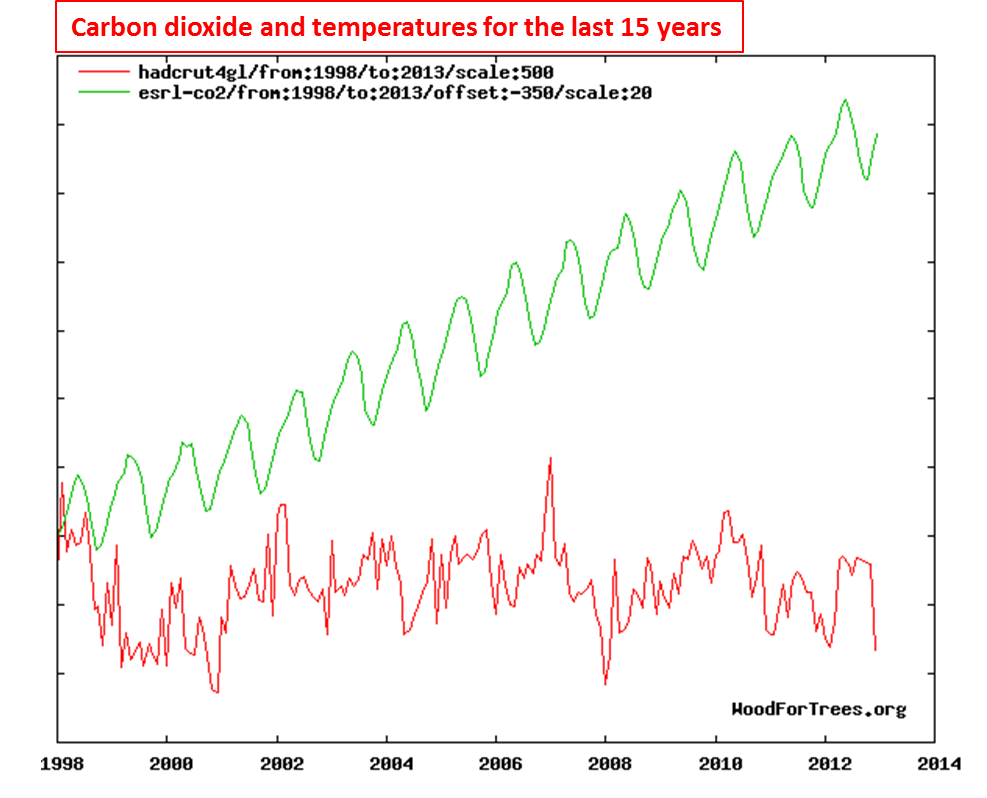
If the IPCC was really looking at climate change and not just promoting the idea of global warming they might have shown some interest in the climate trend-break which seems to have occurred about 15 years ago. But a trend-break would be heretical. Their dismissal yesterday of the last 15 – 18 years was disgraceful. How, after such real observations, they are more certain than ever that global warming continues and that carbon dioxide is the culprit, is not rational and can only be “wishful thinking” (to put the best interpretation on it).

(data below generated using woodfortrees interactive database)

Global temperatures since 1850

Global temperatures since 1850

And how their certainty about carbon dioxide being the prime culprit can be increased with the reality of temperatures declining in the last 15 or so years  boggles rationality. Except of course that their certainty is based on climate models and cannot be bothered by real observations.

CO2 and global temperatures 1998-2013

CO2 and global temperatures 1998-2013