Archive for the ‘Climate’ Category

Snow in Hawaii in July – another omen of the coming ice age?

July 18, 2015

Mauna Kea gets snow in winter but not in July – when Hawaii is supposed to be sweltering.

The omens are gathering. The false prophets of global warming will tell us that cold weather is perfectly consistent with a warming Earth.We ignore these divine omens of a coming ice age at our peril.

Hawaii News Now:

While most of Hawaii experiences sweltering conditions this July, part of the Big Island might seem like winter after Mauna Kea got some snow overnight.

Officials have closed the road to the summit of Mauna Kea Friday after snow fell and caused icy road conditions. A ranger reported mixed rain and snow, fog and 1.5 inches of frozen snow on the summit.

IMAGE TAKEN ON MAUNA KEA – JULY 17, 2015 Hawaii News Now

Image: Mauna Kea Weather Center

Image: Mauna Kea Weather Center 17 July 2015

With another ice age on its way, thank goodness for fossil fuels.

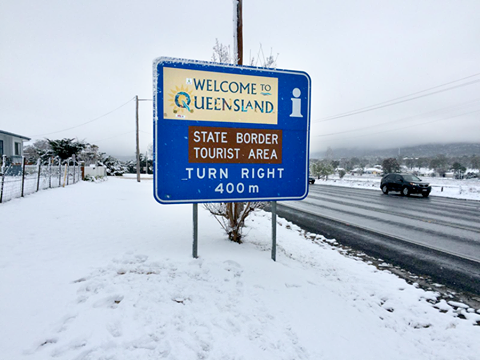
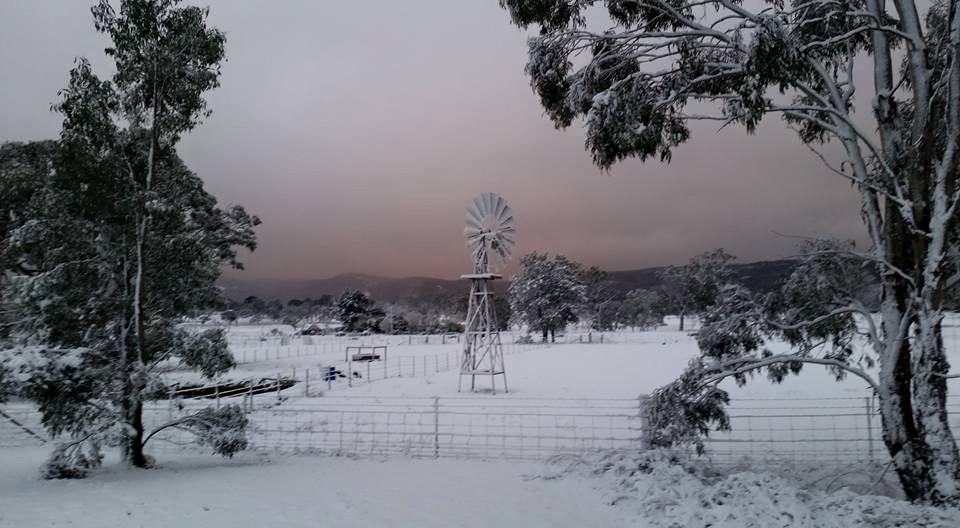
More snow in Queensland and NSW than for a decade – harbinger of the coming ice age?

July 17, 2015

Carbon dioxide concentration in the atmosphere is the highest in modern times and has been increasing for well over a decade. But global temperatures – however that is defined – has shown no sign of warming and a slight decrease in that period. The Sun’s activity is down and reducing to levels similar to that of the Maunder Minimum in this Landscheidt Minimum. A new Little Ice Age is likely by 2030.

The small little signs of weather that are harbingers of the coming Little Ice Age are accumulating – even in the southern hemisphere. Australia is experiencing a “cold” wave (though +12ºC does not seem particularly cold). The cold wave is also giving “unprecedented” (for a decade) levels of snow.

It is inevitable that since the global warming priesthood have been preparing for the icecaps melting that we will now enter a new ice age.

Maybe this time the glaciers are going to spread in the southern hemisphere across Australia and South America?

SMH: Snow creates winter wonderland … in Queensland, as well as NSW


It has always been the Sun as new model predicts another ice age

July 12, 2015

I can see the evidence that the earth goes through warming and cooling cycles. But I have seen no evidence that man-made carbon dioxide emissions have had any significant impact on global climate in general or on global warming in particular. I am more inclined to the view that our climate is overwhelmingly dominated by the Sun – both directly with insolation variations and indirectly through the clouds and the oceans. Solar activity indicates we are approaching – or have arrived at – a new minimum, the Landscheidt Minimum – which will be similar to the Maunder Minimum. Another Little Ice Age in the next decade or two has always been on the cards.

(On a longer timescale, I believe a large volcanic eruption could be one of the possible triggers which tips the earth from interglacial to glacial conditions and our current interglacial cannot last more than another millennium or so.)

Now another model of the suns activity level also suggests that a Maunder-like Minimum and another Little Ice Age is just around the corner.

PhysOrg:

A new model of the Sun’s solar cycle is producing unprecedentedly accurate predictions of irregularities within the Sun’s 11-year heartbeat. The model draws on dynamo effects in two layers of the Sun, one close to the surface and one deep within its convection zone. Predictions from the model suggest that solar activity will fall by 60 per cent during the 2030s to conditions last seen during the ‘mini ice age’ that began in 1645. Results will be presented today by Prof Valentina Zharkova at the National Astronomy Meeting in Llandudno.

It is 172 years since a scientist first spotted that the Sun’s activity varies over a cycle lasting around 10 to 12 years. But every cycle is a little different and none of the models of causes to date have fully explained fluctuations. Many solar physicists have put the cause of the solar cycle down to a dynamo caused by convecting fluid deep within the Sun. Now, Zharkova and her colleagues have found that adding a second dynamo, close to the surface, completes the picture with surprising accuracy.

“We found magnetic wave components appearing in pairs, originating in two different layers in the Sun’s interior. They both have a frequency of approximately 11 years, although this frequency is slightly different, and they are offset in time. Over the cycle, the waves fluctuate between the northern and southern hemispheres of the Sun. Combining both waves together and comparing to real data for the current solar cycle, we found that our predictions showed an accuracy of 97%,” said Zharkova.

Zharkova and her colleagues derived their model using a technique called ‘principal component analysis’ of the magnetic field observations from the Wilcox Solar Observatory in California. They examined three solar cycles-worth of magnetic field activity, covering the period from 1976-2008. In addition, they compared their predictions to average sunspot numbers, another strong marker of solar activity. All the predictions and observations were closely matched.

Looking ahead to the next solar cycles, the model predicts that the pair of waves become increasingly offset during Cycle 25, which peaks in 2022. During Cycle 26, which covers the decade from 2030-2040, the two waves will become exactly out of synch and this will cause a significant reduction in solar activity. 

“In cycle 26, the two waves exactly mirror each other – peaking at the same time but in opposite hemispheres of the Sun. Their interaction will be disruptive, or they will nearly cancel each other. We predict that this will lead to the properties of a ‘Maunder minimum’,” said Zharkova. “Effectively, when the waves are approximately in phase, they can show strong interaction, or resonance, and we have strong solar activity. When they are out of phase, we have solar minimums. When there is full phase separation, we have the conditions last seen during the Maunder minimum, 370 years ago.”

It really is time to acknowledge the Landscheidt Minimum:

Landscheidt also predicted that after the next solar minimum in 2030 the following minimum would occur in 2200.

It is perhaps time to officially name this minimum that is coming as the “Landscheidt Minimum”.


“Global warming” on vacation as July temperatures rival last November

July 10, 2015

Reality seems quite different to the fanciful computer models of the alarmists. Where has the imagined global warming gone? Of course “global warming” is not something that can be experienced or observed. Global temperature is an artefact. It can only be calculated from “adjusted” and “homogenised” data where the past has been cooled and continues to be cooled with every year that passes. The algorithms used to adjust and homogenise real data seem to be designed to produce pre-determined results. From raw temperature data, there is no evidence of man-made global warming.

We had 3 days here in Sweden over 30ºC last week. The fantasists began talking about a “heat wave”. Since then it has felt like March or November. The maximum today will not exceed 13ºC.

(Note that in the UK, on one day last week – and based on one temperature reading at an airport – it was claimed that it was the hottest day for 200 years. Even if the sensational conclusion was correct – which it was not since it was hotter in 1976 – it would only demonstrate that it was hotter 200 years ago and long before man made emissions were of any significance).

DagensNyheter:

November Chill – in the middle of July
The summer warmth is conspicuous by its absence. And the mercury can hardly get to more than 12 degrees in Stockholm. It is as cold as last November.

The summer warmth will have to wait a good long while. Low pressures are relentless in Sweden – and today it is colder than in a long time. The temperature in Stockholm just before midday is about 12 degrees. It is as cold as the beginning of November last year.

“This is unusually cold and far below the normal temperature”, says Eva Strandberg, meteorologist at SMHI.

It does not appear that it will be much warmer anytime soon. “During the next 10 days or so it does not look like there will be any high pressure. The unstable weather will dominate and perhaps with a few days up to 20 degrees. There is a continued risk of showers”, says Eva Strandberg.

No evidence of any global warming in robust Arctic and Antarctic ice extents

July 8, 2015

After 40+ years of an imagined, man-made, global warming, the ice extent at the poles and in the Greenland Ice Sheet seem pretty robust – individually and collectively.

No further commentary is necessary.

Arctic Ice Extent – 6th July 2015

Arctic Ice Extent 6 July 2015

Arctic Ice Extent 6 July 2015

Antarctic Ice Extent – 6th July 2015

Antarctic Ice Extent 6 July 2015

Antarctic Ice Extent 6 July 2015

Mass of Greenland Ice Sheet 

Greenland Icesheet mass 2015

Greenland Icesheet mass 2015

Bill Gates punctures the renewables fantasy balloon

June 29, 2015

I know that renewables provide a useful but limited resource for our energy needs. I know that they are economic only in some specialised niches in the energy sector. I dislike the distortion in the market caused by subsidies generally and power generation subsidies in particular. I “know” because I have worked within the energy sector including the renewables sector for some 40 years. I have made the calculations myself and I don’t rely on advocacy reports or alarmist scenarios. I have made the calculations of the various benefits accruing to the developers, the equipment manufacturers, the power plant owner/operators and the consumers. Grant subsidies allow the developers to make money at the cost of the consumer. Feed-in tariffs and tax breaks allow the owner/operator to make money at the cost of the consumer. Subsidies attract the “cowboy” developers and manufacturers who take their money and arrange a suitable bankruptcy at the appropriate time. If subsidies are reduced or removed, it is all too easy for the owner/operator to walk away without losses and without liability. It is consumers and the duped small investors who pay the cost.

I pay little attention to publicity hungry “personalities” who jump on the nearest fashionable, image enhancing band-wagon. I am highly suspicious of the rich and famous supporting “causes”, without any exercise of mind and primarily for the sake of publicity and image. I admire but don’t much care for Microsoft’s autocratic ways (and  I do use Windows) and see Bill Gates as extraordinary in his field but not as any kind of expert on energy matters. But he is a “personality” with a very valid claim to fame – in his area. So it is gratifying to read this report, even if it has no real impact on my views, at least as one example of a rich and famous “personality” who bothered to think.

The A-Register:

Retired software kingpin and richest man in the world Bill Gates has given his opinion that today’s renewable-energy technologies aren’t a viable solution for reducing CO2 levels, and governments should divert their green subsidies into R&D aimed at better answers.

Gates expressed his views in an interview given to the Financial Times yesterday, saying that the cost of using current renewables such as solar panels and windfarms to produce all or most power would be “beyond astronomical”. At present very little power comes from renewables: in the UK just 5.2 per cent, the majority of which is dubiously-green biofuel burning1 rather than renewable ‘leccy – and even so, energy bills have surged and will surge further as a result.

In Bill Gates’ view, the answer is for governments to divert the massive sums of money which are currently funnelled to renewables owners to R&D instead. This would offer a chance of developing low-carbon technologies which actually can keep the lights on in the real world.

“The only way you can get to the very positive scenario is by great innovation,” he told the pink ‘un. “Innovation really does bend the curve.”

Gates says he’ll personally put his money where his mouth is. He’s apparently invested $1bn of his own cash in low-carbon energy R&D already, and “over the next five years, there’s a good chance that will double,” he said.

The ex-software overlord stated that the Guardian‘s scheme of everyone refusing to invest in oil and gas companies would have “little impact”. He also poured scorn on another notion oft-touted as a way of making renewable energy more feasible, that of using batteries to store intermittent supplies from solar or wind. 

“There’s no battery technology that’s even close to allowing us to take all of our energy from renewables,” he said, pointing out – as we’ve noted on these pages before – that it’s necessary “to deal not only with the 24-hour cycle but also with long periods of time where it’s cloudy and you don’t have sun or you don’t have wind.” ……

I would go further of course. A low-carbon economy itself is nothing to aspire to unless it makes commercial sense. It does not now and will not for many years to come. It achieves nothing for climate but does increase costs, everywhere and particularly in the developing world where fossil fuels are needed most. In Europe, the obsession with renewables has delayed the financial recovery and has cost almost 20 million jobs.

Though Bill Gates does not qualify as an energy expert, he certainly does qualify as an influential investor. He even qualifies as an informed investor in the energy sector. So some little common sense from one of the very rich and famous to balance the irrational, do-gooding and sanctimonious mouthings of others is always welcome.

Monsoon recovers from slow start – rainfall running 20% higher than “normal”

June 29, 2015

The SW Monsoon has, after a late, slow start, spread across all of India and is just crossing the NW frontier into Pakistan. This normally only happens around the 15th of July. Just 5 weeks ago the IMD’s updated long range forecast (Forecast 2) warned that the monsoon would be later than predicted and that total rainfall could be deficient.

  1. Rainfall over the country as a whole for the 2015 southwest monsoon season (June to September) is likely to be deficient (<90% of LPA).
  2. Quantitatively, monsoon season rainfall for the country as a whole is likely to be 88% of the long period average with a model error of ±4%.
  3. Region wise, the season rainfall is likely to be 85% of LPA over North-West India, 90% of LPA over Central India, 92% of LPA over South Peninsula and 90% of LPA over North-East India all with a model error of ± 8 %.
  4. The monthly rainfall over the country as whole is likely to be 92% of its LPA during July and 90% of LPA during August both with a model error of ± 9 %.

Moreover the risk of this being a La Nina year could further depress rainfall, we were warned by IMD. The fear of drought led to government updating emergency plans and for state governments to prepare emergency budgets. A private forecaster, Skymet,  however suggested that Indian farmers need not worry too much.

Economic Times Skymet is a young weather forecasting agency that has, with gradually amplifying audacity, been challenging the monopoly of the India Meteorological Department (IMD), the hoary state-led colonial-era institution, on matters related to climate and weather in India. ….. The IMD has usually been the final word on droughts but this time Skymet has asserted that the IMD is grievously mistaken. The IMD expects India to get ‘below normal’ rains during the coming monsoon months between June and September whereas Skymet says farmers and citizens needn’t be worried: India is going to have ‘normal’ rains.

(The IMD scientists – based on my small experience with them – are very sober and very rigorous, doing good science. But the organisation’s presentation skills are conspicuous by their absence and their public relations skills are sadly lacking. The IMD website is particularly poor. They have little clue as to how to present their forecasts for the media or the general public.)

In the event, the monsoon has surged over the last 10 days and the all-India-spread has been reached almost 2 weeks earlier than “normal”. Last year this was achieved on 17th July.

Monsoon spread till 28 June 2015 - Skymet graphic from IMD data

Monsoon spread till 28 June 2015 – Skymet graphic from IMD data

It is still early days and the monsoon is only one month into its 4 month season, but currently the rainfall (weighted average) is running some 23% above “normal”. So far it would seem that Skymet’s optimism may be closer to the mark than IMD’s dour pessimism. A weak La Nina year is still possible but 2015 will not go down as a peak La Nina year.

Rainfall during June 2015

Rainfall during June 2015

In the wettest East/North East region, rainfall is close to normal. In all other regions rainfall has been “in excess”. So far the cumulative rainfall would be classified as being “plentiful”.


Monsoon slow to reach North West but rainfall running 11% above average

June 22, 2015

In spite of a forecast of a deficient monsoon, a late start and a possible El Nino year, so far, so good.

The advance of the monsoon front is a little slow across central India and into the North West. Pakistan is experiencing a heat wave.

monsoon advance June 21st 2015 - IMD

monsoon advance June 21st 2015 – IMD

Rainfall has been holding up quite well. Accumulated rainfall across the entire country (weighted average) in the 3 weeks of the 16 week long monsoon season is running about 11% higher than the long-term average. Rainfall is deficient (from a low expected value) only in the North West region and is above average elsewhere. Even rainfall in the Southern region which often starts deficient is running some 20% above average. In this period the heaviest rainfall is usually in the North East and even here it is running 5% above normal.

rainfall till 20th june 2015 - IMD

rainfall till 20th june 2015 – IMD

The start, at least, is better than was feared and the government will be relieved that the emergency plans for “drought” conditions will not, yet, need to be activated.

Indian monsoon sets in, risk for deficiency remains but so far, so good

June 8, 2015

The long range forecast was revised a few weeks ago and there is a risk that this year’s monsoon may be somewhat deficient. But the onset has not been much delayed and the first week’s rainfall is slightly above “normal. The second LRF cast a shadow over the markets when it was announced. But the pessimism may have been overdone.

2nd stage Long Range Forecast:

  • Rainfall over the country as a whole for the 2015 southwest monsoon season (June to September) is likely to be deficient (<90% of LPA).
  • Quantitatively, monsoon season rainfall for the country as a whole is likely to be 88% of the long period average with a model error of ±4%.
  • Region wise, the season rainfall is likely to be 85% of LPA over North-West India, 90% of LPA over Central India, 92% of LPA over South Peninsula and 90% of LPA over North-East India all with a model error of ± 8 %.
  • The monthly rainfall over the country as whole is likely to be 92% of its LPA during July and 90% of LPA during August both with a model error of ± 9 %.

The monsoon onset was just a couple of days “late” compared to the forecast date (which is in itself always a warning sign). Furthermore, this year could be an El Nino (albeit weak El Nino) year which could depress rainfall levels. One week into the 13 week monsoon season, however, rainfall is running at 4% above the long term average.

monsoon advance June 6th 2015

monsoon advance June 6th 2015

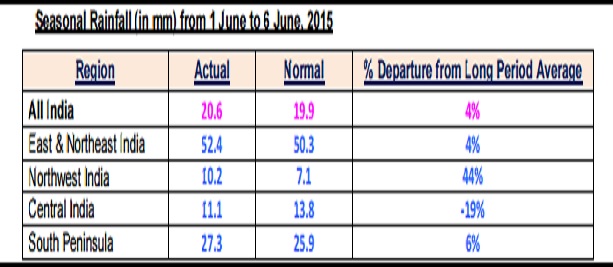
The northern and western ends of the front are progressing well but the central section is well behind its “normal” advance. In terms of rainfall distribution the north-east and the south which usually receive the highest rainfall by this time are running slightly ahead of normal. The central and north-west region receive low levels of rainfall in  this period but the north-west is running 44% above normal while the central regions are deficient and running at -20%.

rainfall till 6th June 2015

The warnings about potential deficiency has led to the government planning measures for those farmers who are not “covered” by irrigation networks and are solely dependent upon rainfall.

But, so far, so good.

Cold – not heat – is the real killer

May 24, 2015

Climate will change as it always has. While there is a religious belief among the radicalised of the true faith that man-made global warming is real, the reality is that there is no signature of man-made global warming that can be distinguished from the natural variations of climate. I have no doubt that whatever change occurs, humans will cope as well as they are able to, and history shows that even glacial conditions have not held back human development. When (not if) the current inter-glacial ends, humans will have access to energy levels and energy intensities magnitudes greater than what was available during the last glacial maximum (20 – 25,000 years ago). And we will have fossil fuels and nuclear energy to thank for that. Hydro Power will virtually vanish during glacial conditions. The more time we have to prepare, and the preparations we make, will determine how well we cope and how many deaths may occur while we do adjust.

It is cold which is by far the more dangerous and which requires the greater preparation. It is far, far better we prepare for the ice age that will undoubtedly come than for any imaginary man-made global warming.

A new paper in the Lancet reports on an analysis of over 74 million (74,225,200) deaths between 1985 and 2012 in 13 countries with a wide range of climates, from cold to subtropical. The results show that moderate cold or heat cause more deaths than extreme weather and that cold kills 20 times more people than heat.

Antonio Gasparrini et alMortality risk attributable to high and low ambient temperature: a multicountry observational study. The Lancet, May 2015 DOI: 10.1016/S0140-6736(14)62114-0

The Lancet (press release):

Cold weather kills 20 times as many people as hot weather, according to an international study analysing over 74 million deaths in 384 locations across 13 countries. The findings, published in The Lancet, also reveal that deaths due to moderately hot or cold weather substantially exceed those resulting from extreme heat waves or cold spells.

“It’s often assumed that extreme weather causes the majority of deaths, with most previous research focusing on the effects of extreme heat waves,” says lead author Dr Antonio Gasparrini from the London School of Hygiene & Tropical Medicine in the UK. “Our findings, from an analysis of the largest dataset of temperature-related deaths ever collected, show that the majority of these deaths actually happen on moderately hot and cold days, with most deaths caused by moderately cold temperatures.” 

…… Around 7.71% of all deaths were caused by non-optimal temperatures, with substantial differences between countries, ranging from around 3% in Thailand, Brazil, and Sweden to about 11% in China, Italy, and Japan. Cold was responsible for the majority of these deaths (7.29% of all deaths), while just 0.42% of all deaths were attributable to heat. The study also found that extreme temperatures were responsible for less than 1% of all deaths, while mildly sub-optimal temperatures accounted for around 7% of all deaths—with most (6.66% of all deaths) related to moderate cold. …

The study also shows that cold has greater impact in Japan and Italy than in Sweden but that is only to be expected. Warm countries will be more unprepared for cold and vice versa.