Archive for the ‘Science’ Category

The climate is a-changin

April 20, 2013

The winds of climate are changing direction – again.

Forty years ago “climate scientists” were sure we were entering a new ice age and even that we could have triggered the end of the current inter-glacial.

For forty years we have seen the growth of the global warming meme and the demonisation of carbon dioxide and of all things “fossil”.

A new economy based on the expensive and premature cessation of the use of fossil fuels took shape. All alternatives to fossil fuel – no matter how expensive or impractical – were worthy of subsidy. By invoking a connection to global warming any science project could attract funds. A fascist and authoritarian “environmental” politics gained ground.  The politicians had a new “label” for introducing taxation in the name of controlling climate (!). Vast new revenue streams of taxes and subsidies and carbon credits were created in the name of protecting the planet. In fact the penalty for not being “politically correct” on climate was seen as being so disadvantageous that every product – from toothpaste to children’s toys to aircraft and weapons – had to show that it was “climate-smart”. Meaningless new parameters like “carbon footprint” entered the vocabulary. No self-respecting newspaper or scientist or politician or business could afford to be heretical with respect to the new religion of the day.

But the Earth and the Sun and the resulting climate pay little attention to the puny efforts of man and dance to their own music. When an ice age is to come it will come and when the ice sheets are to retreat the earth will warm and humanity’s best option is to adapt to the changes as they come. If we understand anything about the Sun and its cycles, an ice age will surely come – whether in 10 or 10,000 years.  And we should concentrate on having the wherewithal to cope when it does. To attempt to control the climate has more than a hint of arrogance. We might as well try to ask the Sun to shine a little less brightly or for a little longer!

But for the last 17 years (or 12 or 18 depending upon how religious one is) global warming has stalled. Now vast amounts of a “new” fossil fuel – shale gas –  have been discovered and its utilisation is changing the economic landscape. “Global warming” was renamed to be “climate change”. The money making (for some) revenue schemes and subsidy-milking for unnecessary and expensive renewable energy have been revealed for the scams they are. Heretical views are being expressed again.

The climate winds are changing:

  1. The Great Green Con no. 1: The hard proof that finally shows global warming forecasts that are costing you billions were WRONG all along   
  2. A sensitive matter
  3. Spiegel Stops Believing…”Hot Debate Over Climate: How Reliable Are The Prognoses?” Growing Doubts Over Models! 

  4. Global warming: time to rein back on doom and gloom?
  5. Climate scientists struggle to explain warming slowdown 

  6. Mother Of German Green Weeklies, Die Zeit, Shocks Readers…Now Casts Doubt On Global Warming!

Climate forcing: Missing water must be hiding in the deep ocean

April 19, 2013

Clive Best points out that NASA data shows quite clearly that water vapour in the atmosphere has been decreasing quite significantly especially since about 1998 while carbon dioxide has continued rising. All the wonderful climate models (settled science after all) take it for granted that increased water vapour in the atmosphere is a key forcing caused by increasing carbon dioxode.

I wonder where the water went?

Presumably hiding along with all the missing heat in the deep oceans!

And causing the sea level to increase no doubt.

The fact is that we can’t account for the lack of water in the atmosphere and it is a travesty that we can’t.

H2O decreasing while CO2 rises !

Posted on April 18, 2013 by Clive Best

Dire predictions of global warming all  rely on positive feedback from  water vapor. The argument goes that as surface temperatures rise so  more water will evaporate from the oceans thereby amplifying temperatures because H2O itself is a strong GHG.  Climate models all assume net amplification factors of between 1.5 and 6. But in the real world has the water content of the atmosphere actually been increasing as predicted?

NASA have just released their latest NVAP-M  survey of global  water content derived from satellite data and radio-sondes over the period from 1988 to 2009. This new data is explicitly intended for climate studies . So lets take a look at the comparison between actual NVAP-M atmospheric H2O levels and those of CO2 as measured at Mauna Loa. I have extracted all the daily measurement NVAP-M data and then calculated the global average. Figure 1 shows the running 30 day average of all the daily data recorde between 1988 and 2009 inclusive. The 365 day (yearly) running average is also shown. Plotted on the right hand scale are the Mauna Loa CO2 concentration data in red over the same period.

Fig1: Total precipitative H2O (running 30 day average) compared to Mauna Loa CO2 data in red. The central black curve is a running 365 day average.

Fig1: Total precipitative H2O (running 30 day average) compared to Mauna Loa CO2 data in red. The central black curve is a running 365 day average.

There is indeed some correlation in the data from 1988 until 1998, but thereafter the two trends diverge dramatically. Total atmospheric water content actually falls despite a relentless slow rise in CO2. This fall in atmospheric H2O also coincides with the observed and now widely accepted stalling of global temperatures over the last 16 years. All climate models (that I am aware of) predict exactly the opposite, so something is clearly amiss with theory. Is it not now time for “consensus” climate scientists perhaps to have a rethink ?

more to follow…

  1. My thanks to Ken Gregory for help with the  data. The conversion from NetCDF was a bit of a nightmare !
  2. NASA NVAP-M data is available here. Thanks to NASA Water Vapor Project-Measures (NVAP-M) team.

Anthony Watts in a comment does point out that sensor degradation or failure would need to be eliminated. (But I wonder why sensor integrity would not have been checked by NASA before the data was published as data)

Chaos of climate models only shows that “we don’t know what we don’t know”

April 17, 2013

I spent a large part of my early career in mathematical modelling (of combustion systems and of heat flow) and have a very clear idea of what models can do and what they can’t. Models after all are used primarily to simplify complex systems which are otherwise intractable. They are – always – severely limited by the assumptions and simplifying approximations that have to be introduced. Models are a powerful tool for investigation but are only as good as their most inaccurate assumption. But they are a tool primarily for investigation — and can be dangerous when used for decision making based on their imperfect predictions. The spectacular failures of mathematical models of the global economy are a case in point. It is worth noting that in spite of the great strides made in weather forecasting  for example – much of which is empirical – the simple statement that “tomorrows weather will be like today’s”  is as correct – statistically – as the most complex model running on some super-computer somewhere.

It has therefore always amazed me that so-called “scientists” would be so certain about their approximate models of climate systems – which are perhaps as complex, chaotic and “unknown” systems as any one could study. It has been a boon for politicians looking for new ways of raising revenue. It has been exploited by the alarmists since the alarmist predictions cannot be tested. The wide spread of results from climate models is rarely mentioned.

When reality does not match model forecasts it is time to back off and rethink the models and hopefully they will be better next time. And it is time to back track from all the political decisions made on the basis of patently incomplete and inaccurate models.

The simple reality about climate is that rather than being a “settled science”

  • we don’t know the impact of solar effects on climate
  • we don’t know the impact of clouds or even if they are net “warmers” or net “coolers”
  • we don’t know how much of the earth’s radiative energy balance is dependent upon carbon dioxide
  • we don’t know how much carbon dioxide is absorbed  by the oceans and living things
  • we don’t know the impact of aerosols and particles in the atmosphere
  • we don’t know the role of the oceans in transporting heat around the globe
  • we don’t know how much heat is stored in the oceans and how it varies
  • we don’t know the impact of solar effects on cloud formation
  • we don’t know what triggers ice ages, and
  • we don’t know what we don’t know.

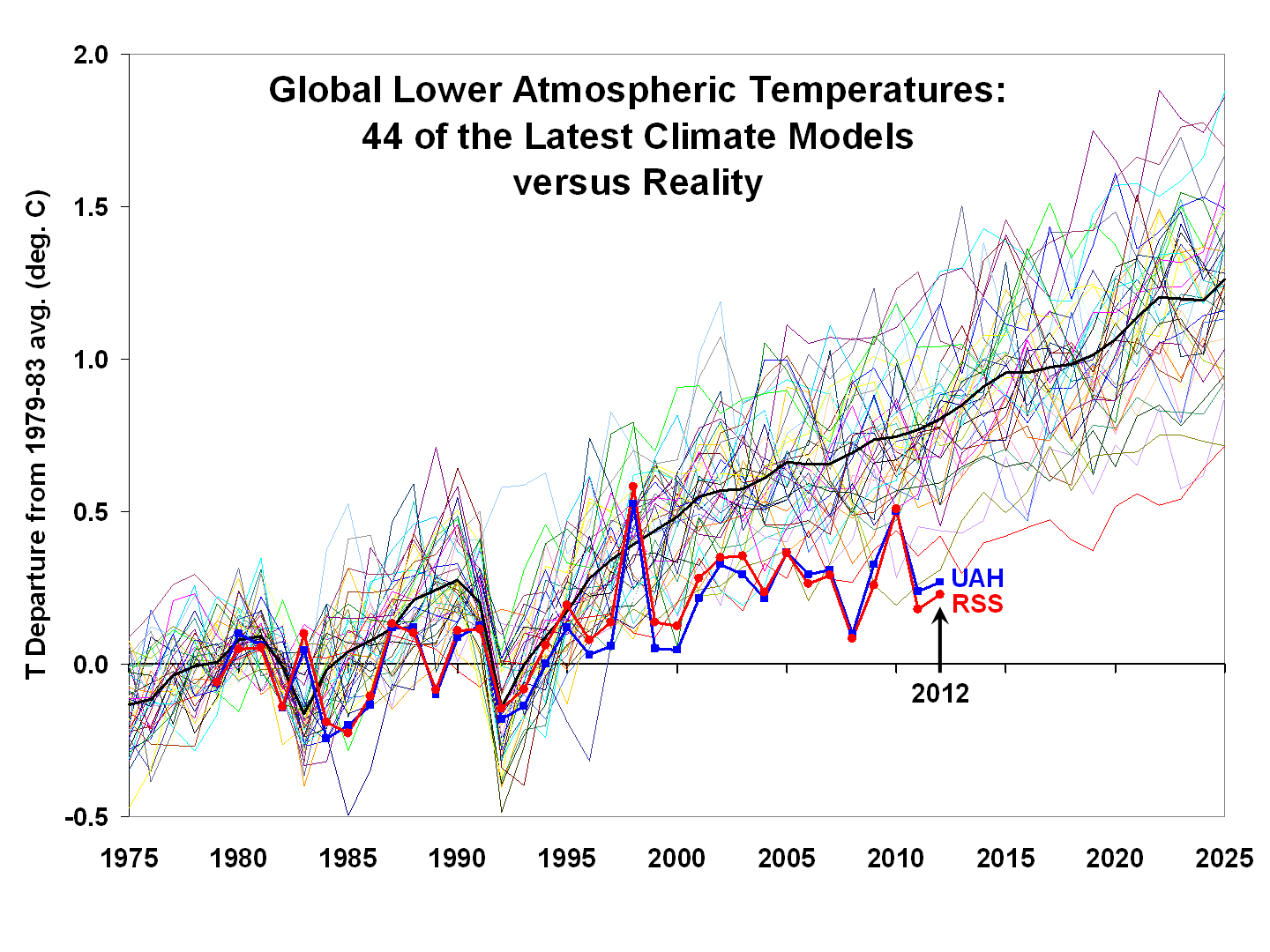
This from Dr. Roy Spencer and the ridiculously wide spread of the model results and the obvious deviation of reality from model results are particularly striking:

Global Warming Slowdown: The View from Space

Since the slowdown in surface warming over the last 15 years has been a popular topic recently, I thought I would show results for the lower tropospheric temperature (LT) compared to climate models calculated over the same atmospheric layers the satellites sense.

Courtesy of John Christy, and based upon data from the KNMI Climate Explorer, below is a comparison of 44 climate models versus the UAH and RSS satellite observations for global lower tropospheric temperature variations, for the period 1979-2012 from the satellites, and for 1975 – 2025 for the models:

CMIP5-global-LT-vs-UAH-and-RSS

CMIP5-global-LT-vs-UAH-and-RSS

Clearly, there is increasing divergence over the years between the satellite observations (UAH, RSS) and the models. The reasons for the disagreement are not obvious, since there are at least a few possibilities:

……… 

The dark line in the above plot is the 44-model average, and it approximately represents what the IPCC uses for its official best estimate of projected warming. Obviously, there is a substantial disconnect between the models and observations for this statistic.

I find it disingenuous for those who claim that, because not ALL of individual the models disagree with the observations, the models are somehow vindicated. What those pundits fail to mention is that the few models which support weaker warming through 2012 are usually those with lower climate sensitivity.

So, if you are going to claim that the observations support some of the models, and least be honest and admit they support the models that are NOT consistent with the IPCC best estimates of warming.

Revisiting Heyerdahl’s Kon-Tiki 50 years on

April 6, 2013

Last night we saw the new Kon-Tiki movie at our local cinema. A full-fledged action/adventure film it relates the story of Thor Heyerdahl and his 1947 Kon-Tiki expedition. It is the most expensive film ever to have been made in Norway and was a nominee for Best Foreign Film at this year’s Oscars (which it did not win). The film is directed by Joachim Rønning and Espen Sandberg and the role of Thor Heyerdahl is played by Pål Sverre Valheim Hagen.

English: Kon-Tiki raft

Kon-Tiki raft (Photo credit: Wikipedia)

I enjoyed every minute of this 2 hour movie. Stunning visuals and a clear demonstration, I think , that understatement is far more effective than “sound and fury” in sustaining excitement. It took me back some 50 years to 1962 when I first saw Heyerdahl’s own documentary movie about his expedition (which did win an Oscar in 1951). Ever since then I have eagerly followed Heyerdahl’s various expeditions and theories of the migrations of ancient peoples (Ra and Tigris and The Search for Odin among others). And my current fascination with anthropology is in no small measure due to Heyerdahl’s injection of adventure and wonder and a kind of “romance” into the long-dead past of our ancestors. It does not matter that his theories were heavily criticised and may not have been correct. It does not matter either that our theories about the past may no longer be capable  of being “proven” conclusively. Imagining how our ancestors – just 100 or so generations ago – could have behaved and acted is what I find absolutely compelling. And Heyerdahl’s adherence to the materials and tools of the past adds credibility at least to imagining what our fore-fathers could have accomplished – if not necessarily to his own theories.

Back in 1962 when I first saw Heyerdahl’s documentary I had not fully appreciated the enormity of what Heyerdahl and his “glad amateurs” were trying to do. While he had an absolute belief in the migration of people from South America to Polynesia, his companions were only there either because he was or because they were seeking some intense adventure after the war. While the success of the Kon-Tiki could not prove that this migration had actually taken place it certainly proved that it could have. Heyerdahl’s theory received much criticism from the establishment view that Polynesia had been populated solely from Asia. But what all this “establishment criticism” sometimes forgets is their sense of wonder and that Heyerdahl does actually prove that it could have happened. This criticism continued well into the 1990’s but the latest genetic studies now show that Heyerdahl was in fact partly correct.

Heyerdahl’s theory of Polynesian origins never gained acceptance among anthropologists. Physical and cultural evidence had long suggested that Polynesia was settled from west to east, migration having begun from the Asian mainland, not South America. In the late 1990s, genetic testing found that the mitochondrial DNA of the Polynesians is more similar to people from southeast Asia than to people from South America, showing that their ancestors most likely came from Asia. Easter Islanders are of Polynesian descent. Anthropologist Robert Carl Suggs included a chapter titled “The Kon-Tiki Myth” in his book on Polynesia, concluding that “The Kon-Tiki theory is about as plausible as the tales of Atlantis, Mu, and ‘Children of the Sun.’ Like most such theories it makes exciting light reading, but as an example of scientific method it fares quite poorly.” Anthropologist and National Geographic Explorer-in-Residence Wade Davis also criticised Heyerdahl’s theory in his book The Wayfinders, which explores the history of Polynesia. Davis says that Heyerdahl “ignored the overwhelming body of linguistic, ethnographic, and ethnobotanical evidence, augmented today by genetic and archaeological data, indicating that he was patently wrong.”

But that is changing as advanced genetic studies show that there is some clear admixture from South America.

Now – 64 years later- new research has finally proved the adventurer was at least partly right after all. A team of scientists have tested the genetic make up of descendants of the original islanders and found it includes DNA that could have only come from native Americans.

That means that some time before the remote islands – including Easter Island – were colonised by Europeans the locals had interbred with people from South America. …. 

The established theory has always been that Polynesia was colonised via Asia around 5,500 years ago. This has been backed up by archaeology, linguistics and some genetic studies. But in 1947, Heyerdahl controversially claimed that Easter Island’s famous statues were similar to those at Lake Titicaca in Bolivia, and sailed a raft from Peru to French Polynesia to prove it could have been colonised from America.

Now Professor Erik Thorsby of the University of Oslo in Norway has found clear evidence to support elements of Heyerdahl’s hypothesis.

The Polynesian gene pool: an early contribution by Amerindians to Easter Island, Erik Thorsby, Published 6 February 2012, doi:10.1098/rstb.2011.0319, Phil. Trans. R. Soc. B 19 March 2012 vol. 367 no. 1590 812-819 (full text pdf)

AbstractIt is now generally accepted that Polynesia was first settled by peoples from southeast Asia. An alternative that eastern parts of Polynesia were first inhabited by Amerindians has found little support. There are, however, many indications of a ‘prehistoric’ (i.e. before Polynesia was discovered by Europeans) contact between Polynesia and the Americas, but genetic evidence of a prehistoric Amerindian contribution to the Polynesian gene pool has been lacking. We recently carried out genomic HLA (human leucocyte antigen) typing as well as typing for mitochondrial DNA (mtDNA) and Y chromosome markers of blood samples collected in 1971 and 2008 from reputedly non-admixed Easter Islanders. All individuals carried HLA alleles and mtDNA types previously found in Polynesia, and most of the males carried Y chromosome markers of Polynesian origin (a few had European Y chromosome markers), further supporting an initial Polynesian population on Easter Island. The HLA investigations revealed, however, that some individuals also carried HLA alleles which have previously almost only been found in Amerindians. We could trace the introduction of these Amerindian alleles to before the Peruvian slave trades, i.e. before the 1860s, and provide suggestive evidence that they were introduced already in prehistoric time. Our results demonstrate an early Amerindian contribution to the Polynesian gene pool on Easter Island, and illustrate the usefulness of typing for immunogenetic markers such as HLA to complement mtDNA and Y chromosome analyses in anthropological investigations.


Climate sensitivity – 10 years on and Pat Michaels et al get their due

April 5, 2013

Back in 2002 a paper in Climate Research by Pat Michaels and his colleagues seriously questioned the sensitivities assumed in the exaggerated IPCC projections for global temperature but the paper was considered heretical and its authors were castigated by the global warming orthodoxy. So Pat Michaels and his colleagues would be more than entitled to an “I told you so” and even some more derisory nose-thumbing at the IPCC.

As Michaels and Knappenberger write at Cato:

Getting Our Due

In the Diary feature of this week’s The Spectatorrational optimist Matt Ridley has a collection of rather random observations from his daily life that have him thinking about (or maybe wishing for since Old Man Winter has been slow to loose his grip in the U.K. and Western Europe, much like he has across the Eastern U.S.) anthropogenic global warming.

What has his attention is that global warming just doesn’t seem to be going according to plan. And for those who have bought into that plan, their plan-driven actions are starting to make them look foolish.

But it’s not as if we haven’t “told you so”—a fact that Ridley draws attention to in the closing segment of his article. ……. 

What we determined in our 2002 study was that the amount of global warming projected by the end of this century was most likely being overestimated.  When we adjusted the climate model projections to take into account and better match the actual observations, our best estimate of the amount of warming we expected from 1990 to 2100 was about 1.8°C (3.2°F), which was in the lower end of the IPCC projected range, and which Ridley correctly noted, we termed as “modest.”

Further, we anticipated the slowdown in the warming rate. ….. 

…… Now, more than 10 years later, more and more evidence is piling in that we were right, including several recent papers that apply a technique not all that dissimilar in theory than our own (e.g. Gillett et al., 2012; Stott et al., 2013).

So even though we still are largely ostracized, at least we rest assured that we were pretty much on target—and some people are starting to take notice.

Revised 21st century temperature projectionsPatrick J. Michaels, Paul C. Knappenberger, Oliver W. Frauenfeld and Robert E. Davis, Climate Research, Vol. 23: 1–9, 2002

Abstract: Temperature projections for the 21st century made in the Third Assessment Report (TAR) of the United Nations Intergovernmental Panel on Climate Change (IPCC) indicate a rise of 1.4 to 5.8°C for 1990–2100. However, several independent lines of evidence suggest that the projections at the upper end of this range are not well supported. Since the publication of the TAR, several findings have appeared in the scientific literature that challenge many of the assumptions that generated the TAR temperature range. Incorporating new findings on the radiative forcing of black carbon (BC) aerosols, the magnitude of the climate sensitivity, and the strength of the climate/carbon cycle feedbacks into a simple upwelling diffusion/energy balance model similar to the one that was used in the TAR, we find that the range of projected warming for the 1990–2100 period is reduced to 1.1–2.8°C. When we adjust the TAR emissions scenarios to include an atmospheric CO2 pathway that is based upon observed CO2 increases during the past 25 yr, we find a warming range of 1.5–2.6°C prior to the adjustments for the new findings. Factoring in these findings along with the adjusted CO2 pathway reduces the range to 1.0–1.6°C. And thirdly, a simple empirical adjustment to the average of a large family of models, based upon observed changes in temperature, yields a warming range of 1.3–3.0°C, with a central value of 1.9°C. The constancy of these somewhat independent results encourages us to conclude that 21st century warming will be modest and near the low and of the IPCC TAR projections.

Climate studies a “science” is not

April 4, 2013

That climate is a subject for study is obvious. That it can be called a “discipline” is questionable but allowable. But any claim that it is settled and understood, let alone fanciful claims that we can control it, are just arrogant nonsense. When the study of climate might  get to be a “science” lies some few centuries in the future – if ever. Climate studies may be a discipline but a “science” it is not.

As with many articles in RealClearPolitics this by Robert Tracinski is trenchant, concise, precise and extremely well written. But RCP has not often been known to break with the global warming orthodoxy and I was surprised to find this there.

Very well worth reading.

The End of an Illusion

Many years ago, I remember thinking that it would take many years to refute the panicked claims about global warming. Unlike most political movements, which content themselves with making promises about, say, what the unemployment rate will be in two years if we pass a giant stimulus bill—claims that are proven wrong (and how!) relatively quickly—the environmentalists had successfully managed to put their claims so far off into the future that it would take decades to test them against reality.

But guess what? The decades are finally here.

…….. So basically, all that the global warming advocates really have, as the evidentiary basis for their theory, is that global temperatures were a little higher than usual in the late 1990s. That’s it. Which proves nothing. The climate varies, just as weather varies, and as far as we can tell, this is all well within the normal range. …..

……

So here’s the state of play of climate science a third of a century into the global warming hysteria. They don’t have a reliable baseline of global temperature measurements that would allow them to say what is normal and natural and what isn’t. Their projections about future warming are demonstrably failing to predict the actual data. And now they have been caught, yet again, fudging the numbers and manipulating the graphs to show a rapid 20th-century warming that they want to be true but which they can’t back up with actual evidence.

A theory with this many holes in it would be have been thrown out long ago, if not for the fact that it conveniently serves the political function of indicting fossil fuels as a planet-destroying evil and allowing radical environmentalists to put a modern, scientific face on their primitivist crusade to shut down industrial civilization.

But can’t we all just stop calling this “science” now? 

Full article here

Climate science on “negative watch”

March 30, 2013

Graphic: The Economist

The almost 20 year pause in global warming while emissions of carbon dioxide have continued to increase can no longer be ignored. Following The Economist’s article earlier this week, more of the main steam media are beginning to question if climate science is as “settled” as some would like us to believe. I would go a little further than The Australian and say that “climate science” and not just “climate sensitivity”  is now on “negative watch” if not as yet “downgraded”. While it is encouraging that some sanity may be returning to the debate as evidenced by the greater interest from the main stream media to question global warming orthodoxy (Die Welt, Jyllands Posten, Der Spiegel, The Telegraph, Daily Mail), they are already a little late. “Climate Science” has actually been at “junk” levels since Copenhagen and Climategate and is only just beginning to creep up from there!

The Australian:

DEBATE about the reality of a two-decade pause in global warming and what it means has made its way from the sceptical fringe to the mainstream.

In a lengthy article this week, The Economist magazine said if climate scientists were credit-rating agencies, then climate sensitivity – the way climate reacts to changes in carbon-dioxide levels – would be on negative watch but not yet downgraded.

Another paper published by leading climate scientist James Hansen, the head of NASA’s Goddard Institute for Space Studies, says the lower than expected temperature rise between 2000 and the present could be explained by increased emissions from burning coal.

For Hansen the pause is a fact, but it’s good news that probably won’t last.

International Panel on Climate Change chairman Rajendra Pachauri recently told The Weekend Australian the hiatus would have to last 30 to 40 years “at least” to break the long-term warming trend. 

But the fact that global surface temperatures have not followed the expected global warming pattern is now widely accepted.

Research by Ed Hawkins of University of Reading shows surface temperatures since 2005 are already at the low end of the range projections derived from 20 climate models and if they remain flat, they will fall outside the models’ range within a few years.

“The global temperature standstill shows that climate models are diverging from observations,” says David Whitehouse of the Global Warming Policy Foundation.

“If we have not passed it already, we are on the threshold of global observations becoming incompatible with the consensus theory of climate change,” he says.

Whitehouse argues that whatever has happened to make temperatures remain constant requires an explanation because the pause in temperature rise has occurred despite a sharp increase in global carbon emissions. ….. 


We learn about climate only when the models are wrong!

March 29, 2013

When a forecast based on a mathematical model is correct, we learn nothing.

A mathematical model is merely a theory, a simplification of reality or an approximation to the real world. By definition a mathematical model is a hypothesis.  When forecasts are incorrect, we can return to our model and improve it and make a new hypothesis. A forecast is then a test of the model but in just one particular set of circumstances. Being correct does not prove the theory behind the model. It does of course add to the body of evidence that the model may be a satisfactory representation of reality and it does allow further forecasts to be made without tweaking the model. For learning to take place the mathematical model must be the falsifiable hypothesis of the scientific method.

It seems to me that Solar Science has a much healthier (scientifically) attitude to models and forecasts than “Climate Science”. When observations don’t match a climate forecast, the observations are impugned rather than the models being improved. This is, I think, because the forecast climate results have been used to establish huge revenue flows in the political arena (whether as taxes or carbon credits or just as research funding). There has been a vested interest in denying the observations and calling the science “settled”. Once the science is “settled”  the climate forecast and its underlying model become sacrosanct and take on the certainty of prophecy. Instead of being falsifiable hypotheses, climate model forecasts have taken on the character of unfalsifiable prophecies!

No scientist would presume to claim that we know or understand all solar effects. Or that we know and understand the role of the oceans or of the water vapour and dust and aerosols in the atmosphere. “Climate” is contained in the thin, chaotic layer of atmosphere which surrounds us. Yet “Climate Science” makes the arrogant assumption that the effect of trace amounts of carbon dioxide on climate is known definitively. Filling a real greenhouse with higher concentrations of carbon dioxide does not make that greenhouse any warmer than one filled with normal air – but the plants do grow faster with access to the additional CO2!! But – claim the climate priesthood –  in the real atmosphere, carbon dioxide causes other forcings (clouds? aerosols? precipitation effects?) which maximise warming which means that our model is still valid. Why not just admit that we don’t know what we don’t know?

The behavioural issue of course is whether it is worth trying to control something as poorly understood as climate rather than ensuring that we have the wherewithal to adapt to whatever changes may come. Another ice age will surely come whether in 10 years or a 100 years or 2,000. It will then be our ability to harness all available energy sources around us which will determine our capacity to adapt.

Learning from forecasts when they are wrong – not just in science but also in business and project management and technology development – has long been a hobby-horse of mine and is why forecasts need to be wrong.

When there is no difference there is no learning.

  • I take prophecies to be a promise about the future  based primarily on faith and made by prophets , witchdoctors, soothsayers and politicians such as ”You will be doomed to eternal damnation if you don’t do as I say”,
  • I take “forecasts” to be an estimate of future conditions based on known data with the use of calculations, logic, judgement, some intuition and even some faith. They are extrapolations of historical conditions to anticipate – and thereby plan for -future conditions.

……. Over the last 30 years I have spent of a lot of time conducting and participating in reviews. Reviews of research projects, of construction projects, of organisations and processes, of designs, of strategies and action plans, of businesses and of companies. The common features  in all these different reviews, that I have found the most penetrating, have been the comparisons not only between forecast values  and actual values, (which may be any values indicating performance and capable of being extrapolated), but also between past forecasts and current forecasts.

Whether considering construction progress or costs or sales figures or cash flow or profit or number of patents applied for, it is the differences between forecast and actual values, or values forecast before and values forecast later which have led to learning. In all these fields we are in the area of the behaviour of complex systems; and where people and their behaviour is involved any system is inevitably a complex system.

When a forecast is fulfilled there is usually an air of congratulation, satisfaction and self-adulation and this leads to a deadly complacency that everything is “settled science” and well understood. In any enterprise of any kind, that kind of complacency is the kiss of death. It is the differences which lead to questioning, to proper scientific scepticism, to further investigation and ultimately to an increase of understanding and – perhaps – a better forecast. (Of course, ignoring all such differences  and to merely “continue as before” can be equally fatal).

Which brings me to climate (which is not a science by any stretch of the imagination) and solar cycles. They are both in the realm not only of where “what we know is a great deal less than what we don’t know” but they are also both in the region where “we don’t even know what we don’t know”. We do not even know all the questions to be asked. They are both complex systems where – by definition – the complexity lies in the multitude of the processes involved and their interactions.

When climate – which is contained in the 100 m of ocean and 20 or so km thick, turbulent and chaotic atmospheric layer (and which is dimensionally miniscule in relation to the 140 million km of the earth-to-sun system) – is so complacently considered to be “settled science” then we have shifted into the area of faith and soothsaying and prophecies. When climate modellers are smug enough to believe they have understood the climate system and believe that their models are complete, then the models produce outputs which are not forecasts but prophecies. (No doubt soothsayers and shamans have sometimes made accurate prophecies but I still would not buy a used car from one of them)! Weather is in the realm of forecast (though you could argue that the most accurate forecast is still that “the weather tomorrow will be like today”) but climate is not yet there.

This kind of “arrogance” which pervades some of the climate “scientists” is not so prevalent when it comes to the study of Solar Cycles. There is a clear understanding that “we don’t know what we don’t know”. In addition to the 11 year and 22 year cycles, other cycles are hypothesised for 87 years, 210 years, 2300 years (or maybe 2241 or 2500 years) and 6000 years. We have no idea what causes these cycles. Even the 11 year cycle which has been most studied produces  surprises every day but is properly in the area of “forecast” (and hopefully never again will be in the area of prophecy). ….

…… We seem to be in a solar minimum. We may be seeing a 210 year cycle – or maybe not. There are changes to the forecasts not only regarding the maximum level of sunspot activity but also about when it will occur and what the length of cycle 24 might be. There is speculation as to what effect the length of the solar cycle may have on climate – but we haven’t a clue as to what mechanisms may be involved.  This is not to say that there isn’t much speculation and hypothesising. There is a great deal of comment about the effect these changing forecasts may have on global warming or cooling or climate disruption.  In some quarters there is much glee that the forecasts have been “wrong”. Some comments question the intelligence of the forecasters.

But of course the forecasts themselves say nothing about how the behaviour of the sun may impact our climate. They do not pretend to be prophecies or to be statements of inevitable outcomes. All they do say is that we don’t know very much – yet – about the sun. But we do know enough to make some tentative forecasts.

But I am very glad that people continue to be brave enough to make forecasts and I am quite relieved that the forecasts are not spot on. That at least ensures we will continue learning.

Are global warmists preparing exit strategies?

March 28, 2013

Are global warmists preparing their arguments so that they can have exit strategies ready for when they have to abandon the global warming religion?

The purpose of an exit strategy is – as a minimum – to save face and minimise losses. In the best case it ends an engagement while realising potential benefits and protecting past gains. This is common enough in – and a necessary part of  – business and military planning. Politicians – at least the skilled ones – always have exit strategies in place when they choose to follow a particular “path of principle”. It is less likely that ideologues or religious leaders have prepared exits from dogmatic positions. However even they do have to change their colours from time to time. (Fanatics of course are not permitted exit strategies. They are expected to fall on their swords and die for their cause).

To escape from a discredited or outdated or bankrupt “faith-based” dogma usually requires some strong, visible reason for leaving a dogmatic position. A divine “revelation” is best though “new data” or  just “seeing the light” are also acceptable. This provides both a new faith as a destination and a reason for leaving the current position. A good exit strategy will also include a high profile “conversion” from one faith to another such that much credit can accrue, first for an”honourable” mea culpa for having followed the wrong path and then for the “principled and difficult” shift to the new path! Damage control may also require that the new converts repudiate their former “brothers of the faith”. In fact it is often “converts” who become the most fanatical about their new “religion”. The success of an exit strategy can be judged by how much baggage or stigma the ideologue or politician can avoid after the conversion.

James Hansen has been one of the most vocal and active proponents of the global warming hypothesis that it is caused by man-made emissions of carbon dioxide. He has been seen as one of the high priests of the global warming religion and qualifies as an ideologue:

Hansen is best known for his research in the field of climatology, his testimony on climate change to congressional committees in 1988 that helped raise broad awareness of global warming, and his advocacy of action to avoid dangerous climate change. In recent years, Hansen has become an activist for action to mitigate the effects of climate change, which on a few occasions has led to his arrest.

But he has a new (open access)  paper which makes me wonder whether he is preparing a position for the execution of an exit strategy when it becomes necessary.  He now admits that less of human made CO2 is entering the atmosphere than it should but that it is due to the increased use of coal which has increased aerosol particulates. He argues that this short term masking by aerosols of global warming will eventually have to appear and his doomsday messages have not changed. But he is adjusting his arguments quite fundamentally to account for the real life observations which he can no longer ignore. The “fertlisation of the biosphere” to account for man-made carbon dioxide not entering the atmosphere sounds a lot like back-pedalling to me. That the biosphere feeds on and relishes carbon dioxide is obvious. It does not much care  where it comes from.

James Hansen et al 2013 Environ. Res. Lett. 8 011006 doi:10.1088/1748-9326/8/1/011006

Climate forcing growth rates: doubling down on our Faustian bargain

As The Hockey Schtick reports some of the contents are startling – coming from Hansen:

  • the effect [forcing] of man-made greenhouse gas emissions has fallen below IPCC projections, despite an increase in man-made CO2 emissions exceeding IPCC projections
  • the growth rate of the greenhouse gas forcing has “remained below the peak values reached in the 1970s and early 1980s, has been relatively stable for about 20 years, and is falling below IPCC (2001) scenarios (figure 5).”
  • the airborne fraction of CO2 [the ratio of observed atmospheric CO2 increase to fossil fuel CO2 emissions] has decreased over the past 50 years [figure 3], especially after the year 2000
  • Hansen believes the explanation for this conundrum is CO2 fertilization of the biosphere from “the surge of fossil fuel use, mainly coal.”
  • “the surge of fossil fuel emissions, especially from coal burning, along with the increasing atmospheric CO2 level is ‘fertilizing’ the biosphere, and thus limiting the growth of atmospheric CO2.”
  • “the rate of global warming seems to be less this decade than it has been during the prior quarter century”

From the paper:

The simple Keeling airborne fraction, clearly, is not increasing (figure 3). Thus the net ocean plus terrestrial sink for carbon emissions has increased by a factor of 3–4 since 1958, accommodating the emissions increase by that factor.

Figure 3.

Figure 3. Fossil fuel CO2 emissions (left scale) and airborne fraction, i.e., the ratio of observed atmospheric CO2 increase to fossil fuel CO2 emissions. Final three points are 5-, 3- and 1-year means.

Remarkably, and we will argue importantly, the airborne fraction has declined since 2000 (figure 3) during a period without any large volcanic eruptions. The 7-year running mean of the airborne fraction had remained close to 60% up to 2000, except for the period affected by Pinatubo. The airborne fraction is affected by factors other than the efficiency of carbon sinks, most notably by changes in the rate of fossil fuel emissions (Gloor et al 2010). However, it is the dependence of the airborne fraction on fossil fuel emission rate that makes the post-2000 downturn of the airborne fraction particularly striking. The change of emission rate in 2000 from 1.5% yr-1 to 3.1% yr-1 (figure 1), other things being equal, would have caused a sharp increase of the airborne fraction (the simple reason being that a rapid source increase provides less time for carbon to be moved downward out of the ocean’s upper layers). ……

…… We suggest that the surge of fossil fuel use, mainly coal, since 2000 is a basic cause of the large increase of carbon uptake by the combined terrestrial and ocean carbon sinks. One mechanism by which fossil fuel emissions increase carbon uptake is by fertilizing the biosphere via provision of nutrients essential for tissue building, especially nitrogen, which plays a critical role in controlling net primary productivity and is limited in many ecosystems (Gruber and Galloway 2008). Modeling (e.g., Thornton et al 2009) and field studies (Magnani et al 2007) confirm a major role of nitrogen deposition, working in concert with CO2 fertilization, in causing a large increase in net primary productivity of temperate and boreal forests. Sulfate aerosols from coal burning also might increase carbon uptake by increasing the proportion of diffuse insolation, as noted above for Pinatubo aerosols, even though the total solar radiation reaching the surface is reduced.

The paper concludes

The principal implication of our present analysis probably relates to the Faustian bargain. Increased short-term masking of greenhouse gas warming by fossil fuel particulate and nitrogen pollution represents a ‘doubling down’ of the Faustian bargain, an increase in the stakes. The more we allow the Faustian debt to build, the more unmanageable the eventual consequences will be. Yet globally there are plans to build more than 1000 coal-fired power plants (Yang and Cui 2012) and plans to develop some of the dirtiest oil sources on the planet (EIA 2011). These plans should be vigorously resisted. We are already in a deep hole—it is time to stop digging.

Climate sensitivities are not what they have been made out to be

March 27, 2013

A far from settled science! In fact – Climate Science may well be a discipline but it is a long, long way from being a science.

But the bottom line is that when “the observed trends are pushing down, whereas the models are pushing up” and “the mismatch between rising greenhouse-gas emissions and not-rising temperatures is among the biggest puzzles in climate science just now. it is time to stop fudging the models and to start examining the assumptions in the models again.

An important article and a “Must Read” even if I would take exception to their uncritical and naive acceptance of the effect of  carbon dioxide in the atmosphere.

The Economist:

OVER the past 15 years air temperatures at the Earth’s surface have been flat while greenhouse-gas emissions have continued to soar. The world added roughly 100 billion tonnes of carbon to the atmosphere between 2000 and 2010. That is about a quarter of all the CO₂ put there by humanity since 1750. And yet, as James Hansen, the head of NASA’s Goddard Institute for Space Studies, observes, “the five-year mean global temperature has been flat for a decade.”

Temperatures fluctuate over short periods, but this lack of new warming is a surprise. Ed Hawkins, of the University of Reading, in Britain, points out that surface temperatures since 2005 are already at the low end of the range of projections derived from 20 climate models (see chart 1). If they remain flat, they will fall outside the models’ range within a few years.

The mismatch between rising greenhouse-gas emissions and not-rising temperatures is among the biggest puzzles in climate science just now. It does not mean global warming is a delusion. Flat though they are, temperatures in the first decade of the 21st century remain almost 1°C above their level in the first decade of the 20th. But the puzzle does need explaining.

The mismatch might mean that—for some unexplained reason—there has been a temporary lag between more carbon dioxide and higher temperatures in 2000-10. Or it might be that the 1990s, when temperatures were rising fast, was the anomalous period. Or, as an increasing body of research is suggesting, it may be that the climate is responding to higher concentrations of carbon dioxide in ways that had not been properly understood before. This possibility, if true, could have profound significance both for climate science and for environmental and social policy. ……..

………… So what does all this amount to? The scientists are cautious about interpreting their findings. As Dr Knutti puts it, “the bottom line is that there are several lines of evidence, where the observed trends are pushing down, whereas the models are pushing up, so my personal view is that the overall assessment hasn’t changed much.”

Economist article