Archive for the ‘Science’ Category

An inconvenient solar minimum..

June 15, 2011

Solar science and the possibility that a Maunder-like Minimum may be approaching seems to have caught the fancy of the MSM — Al Gore notwithstanding.

  1. The Telegraph New Little Ice Age in store? 
  2. Sydney Morning Herald Quiet sun: drop in solar activity may signal second ‘Little Ice Age’ on Earth
  3. Fox News Global Warming Be Damned, We Might Be Headed for a Mini Ice Age
  4. International Business Times The Sun’s inactivity leading to second Little Ice Age, to Offset Global Warming?
  5. MSNBC Solar forecast hints at a big chill
  6. The Christian Science Monitor A sun with no sun spots? What that could mean for Earth and its climate
  7. Discovery News IS THE SUN ABOUT TO FIZZ OUT?
  8. ABC News Goodnight Sun: Sunspots May Disappear for Years
  9. New Scientist Sluggish sun may ‘sit out’ next solar cycle
  10. Arizona Daily Star Fewer sunspots could help offset global warming
Most of these publications are generally fairly uncritical adherents of whatever seems to be in vogue and have usually been very vocal in supporting the AGW creed. But it is nevertheless interesting to see how they have all picked up this news — as if they are bored with and tired of repeating the same old AGW story-line and are just waiting for a new star to follow.
Perhaps the political tide is turning, ……

Major Drop In Solar Activity Predicted: Landscheidt Minimum is upon us and a mini-ice age is imminent

June 15, 2011

The stunning announcement made at the annual meeting of the American Astronomical Society exceeded the expectations from the advance publicity!

The results of new studies were announced today (June 14) at the annual meeting of the solar physics division of the American Astronomical Society, which is being held this week at New Mexico State University in Las Cruces. 

The results of three separate studies seem to show that even as the current sunspot cycle (SC24) moves toward the solar maximum, the sun could be heading into a more-dormant period, with activity during the next 11-year sunspot cycle (SC25) greatly reduced or even eliminated.

The indicators have been  growing for some time that we are in for a a new solar minimum – the Landscheidt minimum – which could be similar to the Dalton Minimum and may even approach the Maunder Minimum. This could mean a cooling period for the earth of 20 – 30 years or for as long as 60 – 70 years. In any event the signs will be unambiguous and inescapable within a decade.

It is reasonable to assume that climatic conditions over the next 20 – 30 years will resemble those prevailing between 1790 and 1820. But SC24 has a way to go yet and it could be that solar activity for SC24 and 25 will be even lower than during the Dalton minimum and perhaps closer to the Spörer minimum but perhaps not as deep as the Maunder minimum.

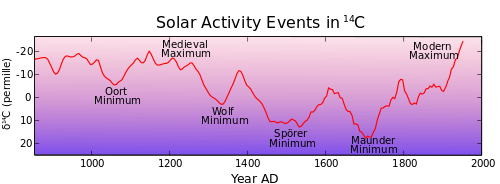
But in either case the solar activity to come following the Modern maximum may well resemble the 500 years of decline in solar activity which followed the Medieval maximum.

Solar activity events recorded in radiocarbon. Present period is on left. Values since 1950 not shown: Wikipedia

The three papers are: 

  1. “Large-Scale Zonal Flows During the Solar Minimum — Where Is Cycle 25?” by Frank Hill, R. Howe, R. Komm, J. Christensen-Dalsgaard, T.P. Larson, J. Schou & M. J. Thompson.
  2. “A Decade of Diminishing Sunspot Vigor” by W. C. Livingston, M. Penn & L. Svalgard.
  3. “Whither Goes Cycle 24? A View from the Fe XIV Corona” by R. C. Altrock.

 Spacedaily reports:

Major Drop In Solar Activity Predicted

As the current sunspot cycle, Cycle 24, begins to ramp up toward maximum, independent studies of the solar interior, visible surface, and the corona indicate that the next 11-year solar sunspot cycle, Cycle 25, will be greatly reduced or may not happen at all.

“This is highly unusual and unexpected,” Dr. Frank Hill, associate director of the NSO’s Solar Synoptic Network, said of the results. “But the fact that three completely different views of the Sun point in the same direction is a powerful indicator that the sunspot cycle may be going into hibernation.”

Hill is the lead author on one of three papers on these results being presented this week. Using data from the Global Oscillation Network Group (GONG) of six observing stations around the world, the team translates surface pulsations caused by sound reverberating through the Sun into models of the internal structure.

One of their discoveries is an east-west zonal wind flow inside the Sun, called the torsional oscillation, which starts at mid-latitudes and migrates towards the equator. The latitude of this wind stream matches the new spot formation in each cycle, and successfully predicted the late onset of the current Cycle 24.

“We expected to see the start of the zonal flow for Cycle 25 by now,” Hill explained, “but we see no sign of it. This indicates that the start of Cycle 25 may be delayed to 2021 or 2022, or may not happen at all.”

In the second paper, Matt Penn and William Livingston see a long-term weakening trend in the strength of sunspots, and predict that by Cycle 25 magnetic fields erupting on the Sun will be so weak that few if any sunspots will be formed. Spots are formed when intense magnetic flux tubes erupt from the interior and keep cooled gas from circulating back to the interior.

For typical sunspots this magnetism has a strength of 2,500 to 3,500 gauss (Earth’s magnetic field is less than 1 gauss at the surface); the field must reach at least 1,500 gauss to form a dark spot.

Using more than 13 years of sunspot data collected at the McMath-Pierce Telescope at Kitt Peak in Arizona, Penn and Livingston observed that the average field strength declined about 50 gauss per year during Cycle 23 and now in Cycle 24.

They also observed that spot temperatures have risen exactly as expected for such changes in the magnetic field. If the trend continues, the field strength will drop below the 1,500 gauss threshold and spots will largely disappear as the magnetic field is no longer strong enough to overcome convective forces on the solar surface.

Moving outward, Richard Altrock, manager of the Air Force’s coronal research program at NSO’s Sunspot, NM, facilities has observed a slowing of the “rush to the poles,” the rapid poleward march of magnetic activity observed in the Sun’s faint corona. Altrock used four decades of observations with NSO’s 40-cm (16-inch) coronagraphic telescope at Sunspot.

“A key thing to understand is that those wonderful, delicate coronal features are actually powerful, robust magnetic structures rooted in the interior of the Sun,” Altrock explained. “Changes we see in the corona reflect changes deep inside the Sun.”

Altrock used a photometer to map iron heated to 2 million degrees C (3.6 million F). Stripped of half of its electrons, it is easily concentrated by magnetism rising from the Sun. In a well-known pattern, new solar activity emerges first at about 70 degrees latitude at the start of a cycle, then towards the equator as the cycle ages. At the same time, the new magnetic fields push remnants of the older cycle as far as 85 degrees poleward.

“In cycles 21 through 23, solar maximum occurred when this rush appeared at an average latitude of 76 degrees,” Altrock said.

“Cycle 24 started out late and slow and may not be strong enough to create a rush to the poles, indicating we’ll see a very weak solar maximum in 2013, if at all. If the rush to the poles fails to complete, this creates a tremendous dilemma for the theorists, as it would mean that Cycle 23’s magnetic field will not completely disappear from the polar regions (the rush to the poles accomplishes this feat). No one knows what the Sun will do in that case.”

All three of these lines of research to point to the familiar sunspot cycle shutting down for a while. “If we are right,” Hill concluded, “this could be the last solar maximum we’ll see for a few decades. That would affect everything from space exploration to Earth’s climate.”
That last may be the understatement of the century!!!

A photo of a sunspot taken in May 2010, with Earth shown to scale. The image has been colorized for  aesthetic reasons. This image with 0.1 arcsecond resolution from the Swedish 1-m Solar  Telescope represents the limit of what is currently possible in te

A photo of a sunspot taken in May 2010, with Earth shown to scale.This image with 0.1 arcsecond resolution from the Swedish 1-m Solar Telescope represents the limit of what is currently possible in terms of spatial resolution. CREDIT: The Royal Swedish Academy of Sciences, V.M.J. Henriques (sunspot), NASA Apollo 17 (Earth)

Climate change teaching to get back to science but High Priest Bob Ward wants the brainwashing to continue

June 13, 2011

The phenomenon of climate change will someday get back to science and leave the alarmist dogma behind. But we can expect that any moves in this direction will be resisted bitterly by the high priests of global warming and the carbon trading cabal.

The Guardian reports:

Climate change should be excluded from curriculum

Climate change should not be included in the national curriculum, the government adviser in charge of overhauling the school syllabus in England has said. 

Tim Oates, whose wide-ranging review of the curriculum for five- to 16-year-olds will be published later this year, said it should be up to schoolsto decide whether – and how – to teach climate change, and other topics about the effect scientific processes have on our lives. 

In an interview with the Guardian, Oates called for the national curriculum “to get back to the science in science”. “We have believed that we need to keep the national curriculum up to date with topical issues, but oxidation and gravity don’t date,” he said. “We are not taking it back 100 years; we are taking it back to the core stuff. The curriculum has become narrowly instrumentalist.”

But this is The Guardian and it must have been painful to report such a radical step!! Needless to say they provide ample space for global warming High Priest Bob Ward to voice his objections:

But Bob Ward, policy and communications director of the Grantham Research Institute on Climate Change and the Environment at the London School of Economics, warned that Oates’ ideas might not be in pupils’ best interests and could make science less interesting for children.

“An emphasis on climate change in the curriculum connects the core scientific concepts to topical issues,” he said. “Certain politicians feel that they don’t like the concept of climate change. I hope this isn’t a sign of a political agenda being exercised.”

He said leaving climate change out of the national curriculum might encourage a teacher who was a climate change sceptic to abandon teaching the subject to their pupils. “This would not be in the best interests of pupils. It would be like a creationist teacher not teaching about evolution. Climate change is about science. If you remove the context of scientific concepts, you make it less interesting to children.”

But perhaps Bob Ward needs to be reminded that climate change has been happening for ever and will continue without caring very much about what our science purports to understand – or fails to understand. There is little science left in present day “climate science” – which has degenerated to be a dogma with the “consensus scientists” being little more than an advocacy group – and any return to science regarding the climate is welcome and long overdue.

Ununquadium = Flerovium and Ununhexium = Moscovium?

June 9, 2011

In June last year it was reported that element 114 – with the temporary name ununquadium – had been manufactured in the lab.

Periodic table gets bigger: Element 114 Ununquadium

Now a a joint working party of the International Union of Pure and Applied Chemistry (IUPAC) and the International Union of Pure and Applied Physics (IUPAP) have concluded that elements 114 and 116 have fulfilled criteria for official inclusion in the periodic table.

Discovery of the elements with atomic numbers greater than or equal to 113

doi:10.1351/PAC-REP-10-05-01

Abstract: The IUPAC/IUPAP Joint Working Party (JWP) on the priority of claims to the discovery of new elements 113–116 and 118 has reviewed the relevant literature pertaining to several claims. In accordance with the criteria for the discovery of elements previously established by the 1992 IUPAC/IUPAP Transfermium Working Group (TWG), and reinforced in subsequent IUPAC/IUPAP JWP discussions, it was determined that the Dubna-Livermore collaborations share in the fulfillment of those criteria both for elements Z = 114 and 116. A synopsis of experiments and related efforts is presented.

The discovery of both elements has been credited to a collaborative team based at the Joint Institute for Nuclear Research in Dubna, Russia, and Lawrence Livermore National Laboratory in California, US. The collaborative parties have proposed the name flerovium for 114, after Soviet scientist Georgy Flyorov, and moscovium for 116, after the region in Russia.

In recent years, there have been several claims by laboratories for the discovery of elements at 113, 114, 115, 116 and 118 in the periodic table. The working party concluded that elements 114 and 116 now fulfilled criteria for official inclusion in the table.

Periodic Table

Periodic Table with the Unun series: image BBC

The two new elements are radioactive and only exist for less than a second before decaying into lighter atoms. Element 116 will quickly decay into 114, and 114 transforms into the slightly lighter copernicium as it sheds its alpha particles.

Skin cells made to behave like nerve cells without the use of stem cells

June 7, 2011

A new paper by researchers at Lund University in the Proceedings of the National Academy of Sciences of the United States of America describes how they have managed to develop nerve cells from human skin cells without using stem cells – a development described as an ethical and medical breakthrough.

Direct conversion of human fibroblasts to dopaminergic neurons

by Ulrich Pfisterer, Agnete Kirkeby, Olof Torper, James Wood, Jenny Nelander, Audrey Dufour, Anders Björklund, Olle Lindvall,Johan Jakobsson, and Malin Parmar

doi:10.1073/pnas.1105135108 PNAS June 6, 2011

Abstract: Recent reports demonstrate that somatic mouse cells can be directly converted to other mature cell types by using combined expression of defined factors. Here we show that the same strategy can be applied to human embryonic and postnatal fibroblasts. By overexpression of the transcription factors Ascl1, Brn2, and Myt1l, human fibroblasts were efficiently converted to functional neurons. We also demonstrate that the converted neurons can be directed toward distinct functional neurotransmitter phenotypes when the appropriate transcriptional cues are provided together with the three conversion factors. By combining expression of the three conversion factors with expression of two genes involved in dopamine neuron generation, Lmx1a and FoxA2, we could direct the phenotype of the converted cells toward dopaminergic neurons. Such subtype-specific induced neurons derived from human somatic cells could be valuable for disease modeling and cell replacement therapy.

The Local reports:


Swedish team turns skin into nerve cells

Swedish team turns skin into nerve cells

A team of researchers at Lund University in southern Sweden have managed to develop nerve cells from human skin cells without using stem cells – a development described as an ethical and medical breakthrough.

“This fundamentally changes how we look at mature cells and their capacity. Previously a skin cell was thought to always remain a skin cell, but we have shown that it can be any cell,” said Malin Parmar, the Lund University researcher leading the study, to The Local on Tuesday.

The new technique works by reprogramming connective tissue cells, so-called human fibroblasts, directly into nerve cells, opening up a new field with the potential to “take research around cell transplantation to the next level”.

Parmar explained that members of the research team were surprised at how receptive the fibroblasts were for new instructions.

“From the beginning this was mostly an experiment that was fun to try out. But fairly quickly it was shown that the cells were unexpectedly receptive to instructions,” she said.


Deforestation? Carbon sequestered in forests is increasing

June 7, 2011

A new paper studying forest area and the density of forests by researchers from the University of Helsinki, the US Forestry Department and Rockefeller University:

A National and International Analysis of Changing Forest Density

by Aapo Rautiainen, Iddo Wernick, Paul E. Waggoner,Jesse H. Ausubel, Pekka E. Kauppi

doi:10.1371/journal.pone.0019577  pdf

Carbon mass by region 1990–2010.

Annual change in forest area a, carbon density d′, and carbon mass q by region (a) 1990–2000 (b) 2000–2010.

The density of forests and woodland across much of the world is actually increasing

In countries from Finland to Malaysia, the thickening has taken place so quickly that it has reversed the carbon losses caused by deforestation between 1990 and 2010. In Britain, forest density has increased by 10.8 per cent from 2000 to 2010 and by 6.6 per cent across the whole of Europe. Even South America and Africa, which have suffered deforestation because of logging and farming, have recorded increases in forest density of 0.8 per cent and 1.1 per cent respectively. The research, carried out by teams from the University of Helsinki and New York’s Rockefeller University, shows that forests are thickening in 45 of 68 countries, which together account for 72 per cent of global forests. Traditionally, environmentalists have focused their concern solely on the dwindling extent of forested areas, but the authors believe evidence of denser forests could be crucial in reducing the world’s carbon footprint. Professor Pekka Kauppi of Helsinki University, a co-author of the study, said: ‘People worry about forest area, and that’s quite correct. But if you want to know the carbon budget, it cannot be monitored observing only the changes in area. It is more important to observe this change in forest density.’  Aapo Rautiainen, lead author of the report, also based at Helsinki University, said: ‘The reversal occurred in Europe much earlier, then a little bit later in North America, and it has now spread to certain parts of Asia. So that is a positive sign.’  In China, an ambitious reforestation programme has added three million hectares to the country’s forests every year over the past decade, but green campaigners believe this is predominantly composed of one species – eucalyptus. 

Nothing new under the sun: Global warming in the 80’s followed by global cooling after 2000 was predicted back in 1979

June 1, 2011

From JoNova

St Petersburg Times, Jan 1, 1979

Drs Leona Libby and Louise Pandolfi projected world temperatures in 1979 for the next 70 years and got results that, 30 years later, appear to have been broadly correct if out by 5 – 7 years. Ironically, they used, of all things, … tree ring data (going back 1,800 years). The critical difference was they assumed that the climate changes in natural cycles.

Visit Steven Goddard’s blog to read the full news story.

Climate Predictions 1979

St Petersburg times news 1979

http://joannenova.com.au/2009/04/global-warming-a-classic-case-of-alarmism/

Nasa Glory mission fails again after launch

March 4, 2011
Top down view of Taurus XL carrying OCO

Top down view of Taurus XL carrying OCO: Image via Wikipedia

The US space agency’s (Nasa) attempt to launch its latest Earth observation mission has ended in failure. This is the second straight failure for the Taurus XL rocket, which appears to be connected to the rocket failing to release its payload. The Glory satellite lifted off from California at 0209 local time (1009 GMT), but officials became aware of a problem five minutes into the mission.

The Glory spacecraft was scheduled for launch today  Friday, March 4 after technical issues with ground support equipment for the Taurus XL launch vehicle led to the scrub of the original Feb. 23 launch attempt. Those issues were thought to have been resolved. Data from the Glory mission is expected to allow scientists to better understand how the sun and tiny atmospheric particles called aerosols affect Earth’s climate. The Taurus XL also carries the first of NASA’s Educational Launch of Nanosatellite missions. This auxiliary payload contains three small satellites called CubeSats, which were designed and created by university and college students.

From Nasa’s blog:

After Liftoff of Taurus XL Rocket, Fairing Fails to Separate

The Glory spacecraft and Taurus XL rocket lifted off this morning on time at 2:09:43 a.m. PST/5:09:43 a.m. EST.

About six minutes into the launch, a spacecraft contingency was declared by Launch Director Omar Baez. Data indicates the rocket fairing did not separate. More information will be provided at a news briefing later on NASA TV.

Project management for Glory is the responsibility of NASA’s Goddard Space Flight Center in Greenbelt, Md. The launch management for the mission is the responsibility of NASA’s Launch Services Program at the Kennedy Space Center in Florida. Orbital Sciences Corp. of Dulles, Va., is the launch service provider to Kennedy of the four-stage Taurus XL rocket and is also builder of the Glory satellite for Goddard.

Humans stink more than other animals

February 27, 2011
A female mosquito of the Culicidae family (Cul...

Image via Wikipedia

A new paper in Trends in Parasitology, 20 January 2011, 10.1016/j.pt.2010.12.009

Sweaty skin: an invitation to bite? by Renate C. Smallegange, Niels O. Verhulst, Willem Takkenby

Out pet cats and dogs with their enhanced sense of smell probably have to put up with much greater olefactory trauma due to smelly humans than their owners ever have to due to smelly pets.

Discovery News writes:

Pungent body odor from sweaty adult human skin is unique in the animal kingdom. Humans turn out to be particularly smelly because odors are released from nearly every part of the body while other species living on us are simultaneously emitting odors too.

Lead author Renate Smallegange explained to Discovery News that “the microorganisms on our skin use the materials present on our skin and in our sweat for their own metabolism. The microorganisms convert non-volatile compounds into volatile compounds.”

Smallegange, a Wageningen University entomologist, and colleagues Niels Verhulst and Willem Takken, analyzed data on the chemical structure of human sweat. They conclude that “sweat-associated human volatiles are probably the primary determinant factor in the host preference of anthropophilic mosquitoes.” These insects can carry life-threatening diseases, such as dengue, yellow fever and malaria.

So far, the “recipe” for synthetic human sweat appears to contain a complex blend of carbon dioxide, ammonia, lactic acid, and seven other carboxylic acids. The latter “have a sweaty smell,” Smallegange said. Mosquitoes are very attracted to this odorous concoction when scientists whip it up in the lab. ……

Adult humans instead frequently emit water, proteins, amino acids, urea, ammonia, lactic acids and certain salts — much of which can stink. During puberty, the glands that release these components mature and are colonized by bacteria.

“So even though parents can recognize their preadolescent children by olfaction, children have a less ‘pungent’ body odor compared with adults,” the researchers explained, adding that children also produce sweat at a lower rate than adults do.

The mosquitoes studied by the scientists bite sweeter smelling infants and children less frequently. Having a strong body odor can be useful at times, however. Smallegange mentioned that the odors that emerge during and after puberty are likely tied to “sexual maturity and mate choice.” Prior research determined that we can even distinguish ourselves based on hand smell alone.

The scientists further report that men sweat more than women do during exercise. Nevertheless, the concentrations of smelly, volatile carboxylic acids are basically the same for men and women.

Baltic sea ice highest in 25 years

February 26, 2011

From The Local:

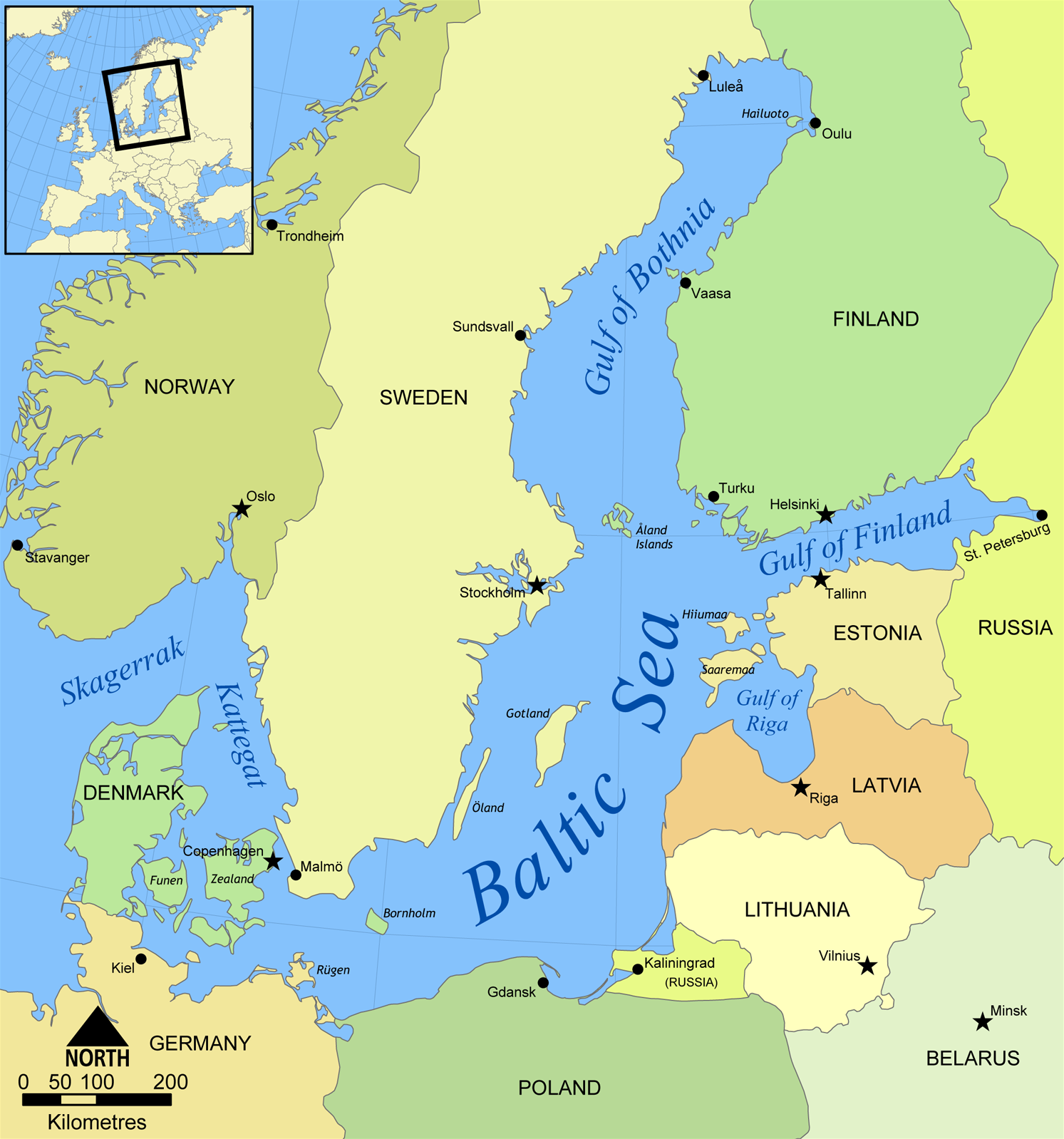
Baltic Sea: image Wikipedia

Deep freeze puts Baltic on track for record ice

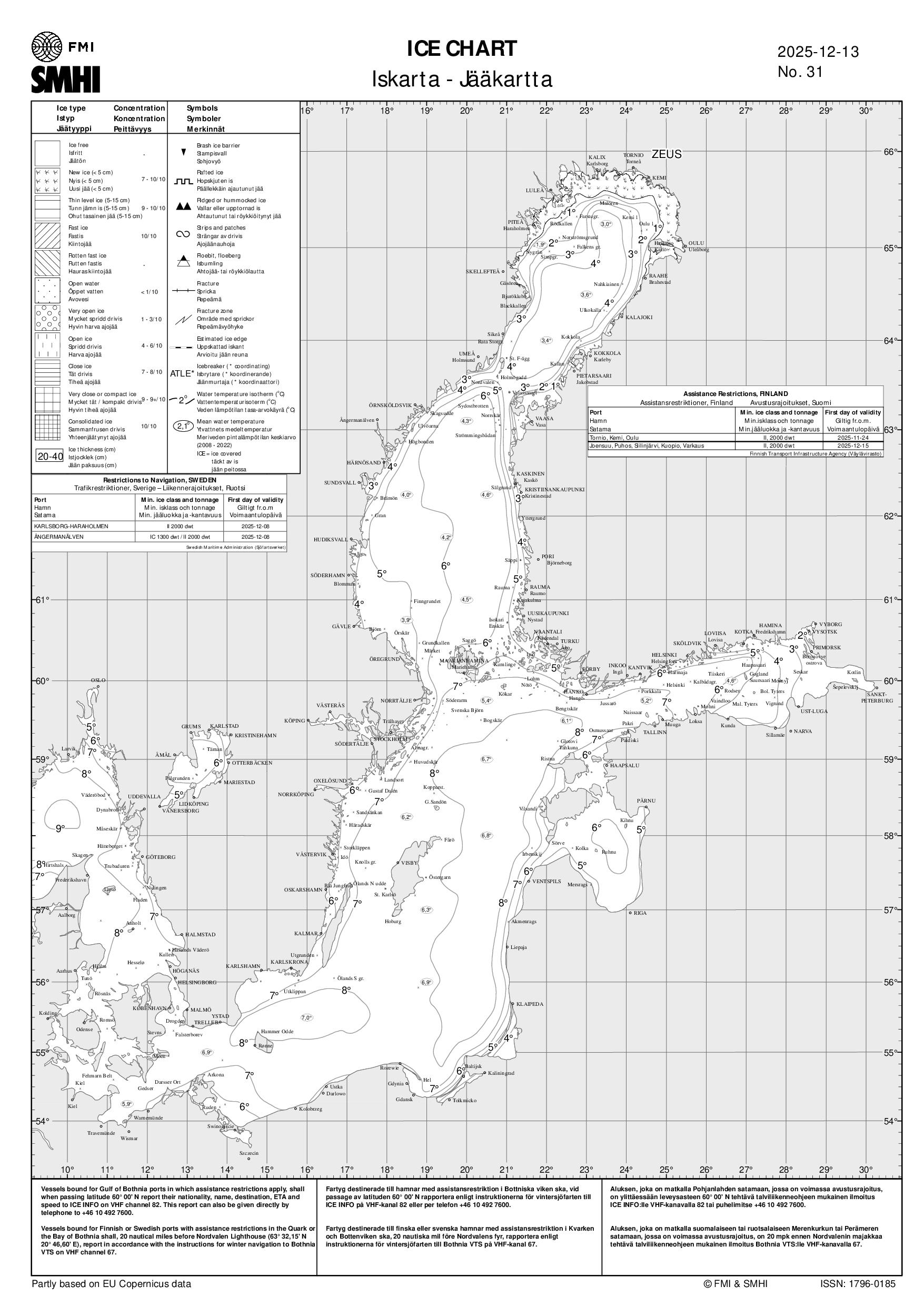
Following another extended stretch of sub-zero temperatures, ice coverage on the Baltic Sea is greater than it’s been in nearly a quarter century, Sweden’s meteorological agency reports. About 250,000 square kilometres of the Baltic Sea are now covered in ice according to the Swedish Meteorological and Hydrological Institute (SMHI).

The last time so much of the Baltic was frozen was the winter of 1986-87, when ice covered nearly 400,000 square kilometres of the sea’s surface.

SMHI warns that ice coverage on the Baltic could expand further in the coming days, possibly setting a new record. “The surface water is cold and if winter-like temperatures continue in the region a few more weeks, we’ll probably get an icy winter on par with 1984-85, one of the toughest winters in the 1980s,” SMHI oceanographer Amund E. B. Lindberg said in a statement.

According to SMHI’s estimates, ice may eventually connect the Swedish mainland all the way out to the Baltic island of Gotland, which lies about 90 kilometres off of Sweden’s eastern coast.

Baltic ice cover is not only unusually wide this winter, but also unusually thick, especially in Gulf of Bothnia off Sweden’s northeastern coast, where air temperatures have consistently hovered around -30 degrees Celsius in recent months.

In some areas far out at sea, ice is more than 60 centimetres thick in the northern parts of the gulf. Recent cold temperatures near the southern areas of the Gulf of Bothnia have resulted in ice thickness growing by 30 centimetres in just two weeks.

Icebreakers from the Swedish Maritime Administration (Sjöfartsverket) have been working round the clock to ensure that sea routes on the Baltic remain open, but strong winds expected at the weekend may complicate their work.

SMHI’s daily ice report says:

During the next two days  heavy ice drifting and ridge forming is expected in all waters of the Baltic Sea north of N58 °.

A detailed sea ice map is available here:

Baltic Sea ice levels 20110225: image smhi