Archive for the ‘Solar science’ Category

Major Drop In Solar Activity Predicted: Landscheidt Minimum is upon us and a mini-ice age is imminent

June 15, 2011

The stunning announcement made at the annual meeting of the American Astronomical Society exceeded the expectations from the advance publicity!

The results of new studies were announced today (June 14) at the annual meeting of the solar physics division of the American Astronomical Society, which is being held this week at New Mexico State University in Las Cruces. 

The results of three separate studies seem to show that even as the current sunspot cycle (SC24) moves toward the solar maximum, the sun could be heading into a more-dormant period, with activity during the next 11-year sunspot cycle (SC25) greatly reduced or even eliminated.

The indicators have been  growing for some time that we are in for a a new solar minimum – the Landscheidt minimum – which could be similar to the Dalton Minimum and may even approach the Maunder Minimum. This could mean a cooling period for the earth of 20 – 30 years or for as long as 60 – 70 years. In any event the signs will be unambiguous and inescapable within a decade.

It is reasonable to assume that climatic conditions over the next 20 – 30 years will resemble those prevailing between 1790 and 1820. But SC24 has a way to go yet and it could be that solar activity for SC24 and 25 will be even lower than during the Dalton minimum and perhaps closer to the Spörer minimum but perhaps not as deep as the Maunder minimum.

But in either case the solar activity to come following the Modern maximum may well resemble the 500 years of decline in solar activity which followed the Medieval maximum.

Solar activity events recorded in radiocarbon. Present period is on left. Values since 1950 not shown: Wikipedia
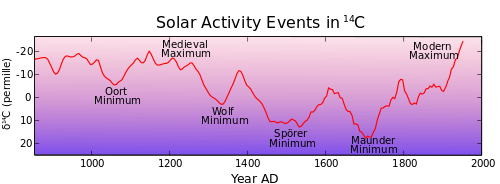
The three papers are: 

  1. “Large-Scale Zonal Flows During the Solar Minimum — Where Is Cycle 25?” by Frank Hill, R. Howe, R. Komm, J. Christensen-Dalsgaard, T.P. Larson, J. Schou & M. J. Thompson.
  2. “A Decade of Diminishing Sunspot Vigor” by W. C. Livingston, M. Penn & L. Svalgard.
  3. “Whither Goes Cycle 24? A View from the Fe XIV Corona” by R. C. Altrock.

 Spacedaily reports:

Major Drop In Solar Activity Predicted

As the current sunspot cycle, Cycle 24, begins to ramp up toward maximum, independent studies of the solar interior, visible surface, and the corona indicate that the next 11-year solar sunspot cycle, Cycle 25, will be greatly reduced or may not happen at all.

“This is highly unusual and unexpected,” Dr. Frank Hill, associate director of the NSO’s Solar Synoptic Network, said of the results. “But the fact that three completely different views of the Sun point in the same direction is a powerful indicator that the sunspot cycle may be going into hibernation.”

Hill is the lead author on one of three papers on these results being presented this week. Using data from the Global Oscillation Network Group (GONG) of six observing stations around the world, the team translates surface pulsations caused by sound reverberating through the Sun into models of the internal structure.

One of their discoveries is an east-west zonal wind flow inside the Sun, called the torsional oscillation, which starts at mid-latitudes and migrates towards the equator. The latitude of this wind stream matches the new spot formation in each cycle, and successfully predicted the late onset of the current Cycle 24.

“We expected to see the start of the zonal flow for Cycle 25 by now,” Hill explained, “but we see no sign of it. This indicates that the start of Cycle 25 may be delayed to 2021 or 2022, or may not happen at all.”

In the second paper, Matt Penn and William Livingston see a long-term weakening trend in the strength of sunspots, and predict that by Cycle 25 magnetic fields erupting on the Sun will be so weak that few if any sunspots will be formed. Spots are formed when intense magnetic flux tubes erupt from the interior and keep cooled gas from circulating back to the interior.

For typical sunspots this magnetism has a strength of 2,500 to 3,500 gauss (Earth’s magnetic field is less than 1 gauss at the surface); the field must reach at least 1,500 gauss to form a dark spot.

Using more than 13 years of sunspot data collected at the McMath-Pierce Telescope at Kitt Peak in Arizona, Penn and Livingston observed that the average field strength declined about 50 gauss per year during Cycle 23 and now in Cycle 24.

They also observed that spot temperatures have risen exactly as expected for such changes in the magnetic field. If the trend continues, the field strength will drop below the 1,500 gauss threshold and spots will largely disappear as the magnetic field is no longer strong enough to overcome convective forces on the solar surface.

Moving outward, Richard Altrock, manager of the Air Force’s coronal research program at NSO’s Sunspot, NM, facilities has observed a slowing of the “rush to the poles,” the rapid poleward march of magnetic activity observed in the Sun’s faint corona. Altrock used four decades of observations with NSO’s 40-cm (16-inch) coronagraphic telescope at Sunspot.

“A key thing to understand is that those wonderful, delicate coronal features are actually powerful, robust magnetic structures rooted in the interior of the Sun,” Altrock explained. “Changes we see in the corona reflect changes deep inside the Sun.”

Altrock used a photometer to map iron heated to 2 million degrees C (3.6 million F). Stripped of half of its electrons, it is easily concentrated by magnetism rising from the Sun. In a well-known pattern, new solar activity emerges first at about 70 degrees latitude at the start of a cycle, then towards the equator as the cycle ages. At the same time, the new magnetic fields push remnants of the older cycle as far as 85 degrees poleward.

“In cycles 21 through 23, solar maximum occurred when this rush appeared at an average latitude of 76 degrees,” Altrock said.

“Cycle 24 started out late and slow and may not be strong enough to create a rush to the poles, indicating we’ll see a very weak solar maximum in 2013, if at all. If the rush to the poles fails to complete, this creates a tremendous dilemma for the theorists, as it would mean that Cycle 23’s magnetic field will not completely disappear from the polar regions (the rush to the poles accomplishes this feat). No one knows what the Sun will do in that case.”

All three of these lines of research to point to the familiar sunspot cycle shutting down for a while. “If we are right,” Hill concluded, “this could be the last solar maximum we’ll see for a few decades. That would affect everything from space exploration to Earth’s climate.”

That last may be the understatement of the century!!!

A photo of a sunspot taken in May 2010, with Earth shown to scale. The image has been colorized for  aesthetic reasons. This image with 0.1 arcsecond resolution from the Swedish 1-m Solar  Telescope represents the limit of what is currently possible in te

A photo of a sunspot taken in May 2010, with Earth shown to scale.This image with 0.1 arcsecond resolution from the Swedish 1-m Solar Telescope represents the limit of what is currently possible in terms of spatial resolution. CREDIT: The Royal Swedish Academy of Sciences, V.M.J. Henriques (sunspot), NASA Apollo 17 (Earth)

Sun goes quiet again but proton events and heightened risk of earthquake and volcanic activity continues

June 14, 2011

After picking up somewhat in April, the sun has quietened again in May.

Sunspots:

Sunspot numbers

 Radio Flux:

10.7 Radio flux

And,

Astronomers will unveil a “major result” on Tuesday (June 14) regarding the sun’s 11-year sunspot cycle.

The announcement will be made at a solar physics conference in New Mexico, according to an alert released today (June 10) by the American Astronomical Society. The discussion will begin at 1 p.m. EDT (1700 GMT).

In the meantime, 

solar flares and proton events continue signifying a period of heightened volcanic and earthquake activity ——

Piers Corbyn predicts,

 M6+ Earthquakes Indonesia and New Zealand confirm WeatherAction 13-15th June quake risk trial warning.

Two major Earthquakes 13 June M6.0 New Zealand (precede by an M5.5) andM6.4 Molucca Sea Indonesia confirm WeatherAction’s warning issued 22 May for 13-15 June as a period of increased earthquake risk. SEE:

http://www.mauritiushot.com/christchurch-earthquake-13-june/ Two quakes hit Christchurch NZ. http://earthquake.usgs.gov/earthquakes/recenteqsww/Quakes/quakes_big.php

“This 13-15th period”, said Piers Corbyn of WeatherAction.com, “is at the ‘q’ (lesser) level of our now two level forecasts of increased Earthquake risk (trial) around the world compared with other times before and after.  In the upper, ‘Q’, level we expect the biggest increases in seismic activity which also includes notable volcanic eruptions. The last Q period May 31- Jun5th was dramatically marked by the new eruption of the Chile earthquake chain on June 4th as well as associated very extreme weather events”. See http://bit.ly/lFXtsu

The next increased Quake risk period 16-19 June – at the larger, Q, level – follows straight after this one.


Solar effects 6 times greater than assumed by IPCC

May 10, 2011

A new paper by A. I. Shapiro, W. Schmutz, E. Rozanov, M. Schoell, M. Haberreiter, A. V. Shapiro, and S. Nyeki in Astronomy & Astrophysics  – Total Solar Irradiance (TSI) Astronomy & Astrophysics 529, A67 (2011)  shows that

a total and spectral solar irradiance was substantially lower during the Maunder minimum than observed today. The difference is remarkably larger than other estimations published in the recent literature. The magnitude of the solar UV variability, which indirectly affects climate is also found to exceed previous estimates. 

We present a new technique to reconstruct total and spectral solar irradiance over the Holocene. We obtained a large historical solar forcing between the Maunder minimum and the present, as well as a significant increase in solar irradiance in the first half of the twentieth-century. Our value of the historical solar forcing is remarkably larger than other estimations published in the recent literature.

Climate Realists reports:

A recent peer-reviewed paper published in Astronomy & Astrophysics finds that solar activity has increased since the Little Ice Age by far more than previously assumed by the IPCC. The paper finds that the Total Solar Irradiance (TSI) has increased since the end of the Little Ice Age (around 1850) by up to 6 times more than assumed by the IPCC. Thus, much of the global warming observed since 1850 may instead be attributable to the Sun (called “solar forcing”), rather than man-made CO2 as assumed by the IPCC. 

article image

Massive 7.4 quake again in Japan – as predicted on 5th April

April 7, 2011

On 5th April there was a large coronal mass ejection on the sun:

article image

The sun on April 5th 2011

In consequence:
– solar wind speed went up
– a 5MeV proton burst and
– proton flux went up.

Piers Corbyn then predicted that heightened earthquake activity was likely between the 6th and 9th of April.

article image

Prediction on 5th April

And lo and behold, a 7.4 magnitude quake has struck off the north east coast of Japan again – strong enough for the Fukushima nuclear plant to be evacuated and for a tsunami warning to be issued. Fortunately no significant damage has been reported and the tsunami warning has now been withdrawn.

Earlier in the day there was  a 6.5 magnitude quake near Vera Cruz Mexico. There are some reports also of increased seismic activity in the western US.

One more piece of evidence linking heightened earthquake and volcanic activity on earth with what happens on the sun.

Related:

Solar effects will give increased volcanic and earthquake activity in the next 2 years

Two 7.0 quakes hit Burma — as predicted?


A voice of sanity in “climate science”

April 6, 2011

Prof. Dr. Vincent Courtillot Präsentation

This needs no comment but should be required watching for anybody who claims to be a “climate scientist” or wants to pontificate about global warming.

Dr. Vincent Courtillot is a professor of geophysics at the University Paris-Diderot and Chair of paleomagnetism and geodynamics of the Institut Universitaire de France.

In the recent lecture below he explains how solar cycles control the climate by influence on cloud formation (the cosmic ray theory of Svensmark et al) and via influence on ocean oscillations and length of day. Dr. Courtillot notes that IPCC climate computer models do not correlate with observations and that temperature trends vary substantially between North America and Europe (which is contrary to IPCC computer model predictions).

He also notes that while the total solar irradiance (TSI) only varies by about .1% over a solar cycle, the solar UV varies by about 10% and that secondary effects on cloud formation may vary up to 30% over solar cycles. The IPCC computer models dismiss the role of the sun by only considering the small variations of the TSI and ignore the large changes in the most energetic and influential part of the solar spectrum – the ultraviolet.


h/t wuwt

Two 7.0 quakes hit Burma — as predicted?

March 24, 2011

Update 25th March! Reports are now beginning to come in of over 50 70 killed.

In the light of  the recent predictions of increased earthquake activity especially in the period 22nd – 27th March, two large 7.0 quakes – as if on cue – have rocked north east Burma (Myanmar) close to the borders with Laos and Thailand.

The prediction was made by Jim Berkland and Piers Corbyn and points to solar effects as the trigger.

The are hit by the two quakes are remote  and even if large numbers of people and heavy infrastructure are not involved,  at magnitude 7.0 they are very powerful quakes and they may have been devastating for the people in this very poor region. One of the quakes was very shallow and may have caused much destruction.

One more major quake in the Pacific Rim region in the next 3 to 4 days will, I think, be a very strong indicator that we should be looking mainly at the sun in efforts to anticipate what triggers earthquakes. Tectonic plate movement clearly describes the build up of forces in the earth’s crust but what triggers particular quakes at particular times is largely unknown.

BBC reports:

map

Burma earthquake 24th March 2011

North-east Burma has been rocked by two 7.0 magnitude earthquakes, close to the borders with Laos and Thailand, the US Geological Survey has reported.

They struck seconds apart at 1355 GMT and were centred about 70 miles (110 km) from the northern Thai city of Chiang Rai, the agency said.

The first quake was shallow, at a depth of 6.2 miles (10km), while the second was much deeper at 142.5 miles (230km).

Tremors could be felt as far away as Bangkok and Hanoi. The area where the quakes struck is sparsely populated and remote. The BBC’s Rachel Harvey in Bangkok said it could be a while before the extent of the damage is known.

Seismic monitor

article image

chart from iris.edu

ABOVE chart from iris.edu

Another major earthquake within the next 6 days?

March 22, 2011

According to Piers Corbyn of Weather action:

According to Corbyn it was the ‘X Class’ solar flare of March 10, 2011 that caused a significant hit on the Earth by a Coronal Mass Ejection, which was reported by NASA. He says this, in turn, triggered the massive Japan super quake (M=9.0) the following day.

Former USGS geologist Jim Berkland warns of a ‘high risk’ seismic window and potential for a massive quake poised to strike somewhere in North America in between the dates of March 19th and 26th.

Three massive earthquakes have struck the Ring of Fire in the past year, says Berkland. If this clockwise trend continues, that places the Pacific NW next in line. The top seismic window in years is developing between the 19th of March and the 26th. There has been a massive fish kill off the coast of California, which indicates changes in the magnetic field.

The Indonesian tsunami struck on the day of a full moon, says Berkland. So did the Alaska earthquake of 1964. Though many scientists disagree with him, Berkland correctly predicted the 1989 “World Series” earthquake four days in advance.

EXTREME WEATHER AND EARTHQUAKE DANGER IMMINENT around 23rd-27th March warns Piers Corbyn

The very active solar region which emerged from the SE limb of the sun on the morning of 21st March is crackling with dangerous activity including extreme UV radiation and up to 50Mev proton bursts and its appearance along with other active regions on the sun fits our WeatherAction.com long-range WARNING for significant weather extremes and earthquakes in the period around 23rd-27th March, issued during February.

The weather events are expected in two waves ~23/24th and ~26/27th and extreme earthquake events risk is significantly enhanced all through this period 23-27th but probably more enhanced later with high risk continuing a day or so after 27th.

John O’Sullivan writes

Berkland suggests that in this top seismic window in years, the west coast of the united States as a high risk area. Piers Corbyn is less specific on the location but believes the time of highest risk is in the five day period of 23th to the 27th March.

Related:

The Great Sendai quake of 2011 is part of the Sun’s Dance

Solar effects will give increased volcanic and earthquake activity in the next 2 years


The Great Sendai quake of 2011 is part of the Sun’s Dance

March 11, 2011

I was woken up in Tokyo in 1995 when the Great Hanshin Earthquake hit Kobe (having left Kobe 6 hours earlier on the last Shinkansen to Tokyo the night before) where the epicentre was just off Awaji Island but there was no tsunami then. The destruction was massive and Kobe burned and over 6,000 people perished.

All day today I have been watching the riveting pictures of the tsunami hitting the Sendai coast. The sheer power of the water sweeping irresistibly across the landscape picking up houses, ships, buses and cars like little cardboard models was terrible and awe-inspiring. The memories of 1995 came flooding back and it once again reminded me of the puny impact mankind has in the face of such forces.

And all the energy that is released by these great movements of the continents on Earth have their origin in the energy stored at the time of Earth’s creation and the energy it has received from the Sun since then. And all the energy of all these earthquakes and volcanoes and tsunamis and cyclones are as nothing to the energy released continuously by the Sun. To the Earth this Great Sendai quake of 2011 is just a very small adjustment of stresses and strains and is of little significance. The Great Dance orchestrated and choreographed by the  Sun will go on and the continents will keep drifting and moving under each other  and volcanoes will keep erupting. And our Science will continue to try and understand and predict when catastrophic events will occur. But we will have to tame the Sun if we are ever to be able to control these events.

The death toll in Sendai is rising and and as morning comes in a few hours to Japan the full extent of the destruction will begin to be revealed. Whole villages could well have been wiped out, entire trains have been carried away by the force of the waters and some ships are missing.  Fires are breaking out and the Fukushima nuclear plant was swamped.

Science and technology are our best defence against loss of life and loss of property by “natural” disasters. The preparedness of Japan is a tribute to this when comparing today’s tsunami with that after the Aceh quake of 2004. Science and technology will help us to cope with the consequences of these events and maybe – some day – will help us predict some of them. But they will not prevent such disasters.

The Sun is going through an unusual – but not unprecedented – minimum. There is no proof and there is no evidence of any causal relationship but there are correlations between increased earthquake and volcanic activity with solar minima and solar proton events. We have a further 2 or 3 years of increased earthquake and volcanic activity if this correlation holds true.

It seems not only plausible but also fitting that such great and terrible events can only be a part of the Great Dance of the Sun.

Nasa Glory mission fails again after launch

March 4, 2011
Top down view of Taurus XL carrying OCO

Top down view of Taurus XL carrying OCO: Image via Wikipedia

The US space agency’s (Nasa) attempt to launch its latest Earth observation mission has ended in failure. This is the second straight failure for the Taurus XL rocket, which appears to be connected to the rocket failing to release its payload. The Glory satellite lifted off from California at 0209 local time (1009 GMT), but officials became aware of a problem five minutes into the mission.

The Glory spacecraft was scheduled for launch today  Friday, March 4 after technical issues with ground support equipment for the Taurus XL launch vehicle led to the scrub of the original Feb. 23 launch attempt. Those issues were thought to have been resolved. Data from the Glory mission is expected to allow scientists to better understand how the sun and tiny atmospheric particles called aerosols affect Earth’s climate. The Taurus XL also carries the first of NASA’s Educational Launch of Nanosatellite missions. This auxiliary payload contains three small satellites called CubeSats, which were designed and created by university and college students.

From Nasa’s blog:

After Liftoff of Taurus XL Rocket, Fairing Fails to Separate

The Glory spacecraft and Taurus XL rocket lifted off this morning on time at 2:09:43 a.m. PST/5:09:43 a.m. EST.

About six minutes into the launch, a spacecraft contingency was declared by Launch Director Omar Baez. Data indicates the rocket fairing did not separate. More information will be provided at a news briefing later on NASA TV.

Project management for Glory is the responsibility of NASA’s Goddard Space Flight Center in Greenbelt, Md. The launch management for the mission is the responsibility of NASA’s Launch Services Program at the Kennedy Space Center in Florida. Orbital Sciences Corp. of Dulles, Va., is the launch service provider to Kennedy of the four-stage Taurus XL rocket and is also builder of the Glory satellite for Goddard.

Solar effects will give increased volcanic and earthquake activity in the next 2 years

February 22, 2011

Solar effects are much more profound than many so-called climate scientists like to admit. It seems entirely plausible to me that earthquakes and volcanism are connected to solar events. This paper by Zhang from 1998 also associates increased Earthquakes with general increases in solar proton events.

http://www.springerlink.com/content/buvw2tq081013210/fulltext.pdf?page=1

Relationship between global seismicity and solar activities

Gui-Qing ZHANG

Vol. 11 No.4 (495~500)  ACTA SEISMOLOGICA SINICA  July, 1998

Beijing Astronomical Observatory, Chinese Academy of  Sciences, Beijing 100101, China

Abstract :

The  relations  between  sunspot  numbers and earthquakes  (M>6), solar 10.7cm  radio flux  and  earthquakes,  solar  proton events and earthquakes have been  analyzed in this  paper. It has been found that:

  1. Earthquakes occur frequently around the minimum years  of  solar activity. Generally, the  earthquake  activities are  relatively less during the peak value years of  solar activity, some  say, a round the period when magnetic polarity  in the  solar polar regions  is reversed.
  2. The earthquake frequency in the minimum period of  solar activity is closely related to the  maximum annual means of sunspot numbers, the maximum annual means of solar 10.7 cm radio flux and solar proton events of a whole solar cycle, and the relation between earthquake and solar proton events is closer than others.
  3. As judged by above interrelationship, the period from 1995 to 1997 will be the years while earthquake activities are frequent. In the paper, the simple physical discussion has been carried out.

Piers Corbyn at WeatherAction comments:

“We now think that it is not just general solar proton event levels which point towards more earthquakes but that individual solar proton events exacerbate immediate earthquake (and associated volcanism) risk either directly or due to consequent storm activity and related surface pressure changes such as caused by our solar triggered and predicted Tropical Cyclone Atu which is currently centred North of New Zealand and heading closer.

There are also additional lunar effects on storm development and earthquakes & volcanism and for solar drivers it appears that the odd-even minima, particularly the later part i.e. the rising phase of even solar cycles – WHICH IS WHERE WE ARE NOW (early Solar Cycle 24) – are the most dangerous.

Prediction of individual Earthquakes is very hard but we are very confident of a continuing period of significantly enhanced earthquake and volcanic activity as well as extreme weather events for the coming one or two years, probably exceeding the levels of the most active extended periods in at least the last 100 years.”