Archive for the ‘Weather’ Category

La Niña is back and will persist till 2012

August 22, 2011

In February Klaus Wolter came to the conclusion that there was an even chance that La Niña conditions could extend into 2012. He wrote then:

While La Niña conditions are guaranteed well into 2011, it remains to be seen whether it can rally once more to cross the -2 sigma barrier, and/or whether it will indeed last into 2012, as discussed six months ago on this page. I believe the odds for a two-year event remain well above 50%, made even more likely by the continued unabated strength in various ENSO indices.

Bob Tisdale points out at WUWT that

NINO3.4 SST anomalies (a commonly used El Niño-Southern Oscillation Index) have dropped significantly below the -0.5 deg C threshold of a La Niña Event. They are presently at approximately -0.74 deg C.

NINO3.4 SST anomalies

NOAA has yet to update its El Niño / La Niña forecasts but has called a “La Niña watch” but Bob Tisdale is ahead of them in calling the return of La Niña which is not too far away from Wolter’s forecast.

Update!! 8th September: NOAA now calls it:  La Niña is back

But Agriculture.com reports that the money is already betting on La Niña conditions for this winter and into 2012:

Sentiment towards commodities lying in the traditional path of conditions known as La Nina is starting to turn more bullish, exacerbated by supply shortages in a number of products like iron ore and coal.

Forecasting models by the U.S. National Weather Service’s Climate Prediction Center predict La Nina will redevelop this autumn. “Atmospheric patterns continue to reflect La Nina-like conditions,” the weather body said.

La Nina is a periodic climatic phenomenon that brings more rain to the western Pacific, and to a lesser extent, to the eastern Pacific. Climatologists blamed La Nina for last year’s floods that gripped Australia, resulting in major losses to coal and iron ore stockpiles. 

But while it isn’t clear what impact La Nina might have on the production and shipment of commodities, its return isn’t expected to cause the same serious problems as in 2010. That’s because historically the La Nina weather phenomenon occurs in bursts of three consecutive years, with the first one being the worst and the next two much milder. ……

Joe Vaclavik, grains broker at Chicago-based MF global, said from an agricultural commodity markets perspective, the biggest fear of a second La Nina would be the continuation of the current drought in the U.S. southern plains, causing further damage to the winter wheat crop. ….. Matt Rogers, President of Maryland-based Commodity Weather Group, warned that possible effects from the second round of La Nina could bring above-normal precipitation in eastern Australia, but would actually benefit the wheat and barley crops in terms of moisture. Yet, dryness concerns could be an issue for Argentina and southern Brazil, which would experience lower amounts of rainfall, causing damage to wheat, corn and soybean yields.

And Indian and Japanese forecasters have already called La Niña conditions.

The Indian Meteorological Department (IMD) has forecast an active wet spell for northwest India during the next five days and over east and adjoining central India during the next three days. This came about on a day when Japanese scientists assessed that the predicted return of La Nina conditions may already be happening.

Dr Jing-Jia Luo, Senior Scientist with the Climate Variation Predictability and Applicability Research Programme Research at RIGC, wrote to Business Lineon Friday that the La Nina condition is currently on the way back. This condition is forecast to persist until early next year, Dr Jing-Jia says, adding that a weak positive Indian Ocean Dipole (IOD), which mimics EL Nino-La Nina in the Indian Ocean, also may occur during the next few months.

Positive IOD refers to the warming of seas-surface temperatures in the western part of the Indian Ocean, and vice versa. Positive IOD has been found to favour a concurrent monsoon. Regional forecast from the RIGC said that the La Nina would bring cool to wet conditions over southern Africa, Australia, and Brazil during the southern hemisphere summer.

The confirming indicators for a La Niña event are accumulating – from the Indian monsoon to greater evaporation leading to increased rains expected in the Western Pacific in Australia, less rain in the Eastern Pacific on the western coast of S. America (coastal Chile and Peru) but increased rain on the east coast in southern Brazil and  northern Argentina.

Snow in Auckland gives conditions not seen since the 1930’s

August 15, 2011

It’s only weather but it is also only a matter of time before some climate “scientist” claims that it is all perfectly consistent with global warming.

Auckland had snow for the first time in 30 years and Wellington was enjoying “once in a life time” snow. The storm was a ‘once in a lifetime’ event and similar conditions had not been seen in Auckland since the 1930s.

A cyclist is seen riding after heavy snowfalls have blanketed large parts of New Zealand

New Zealand is experiencing its heaviest snow in decades, with meteorologoists describing the flurry in Wellington as a once in a lifetime event. Photograph: EPA

New Zealand Herald

Snow has fallen in downtown Auckland for the first time in 80 years as a ‘once in a lifetime’ polar blast spreads across New Zealand, forecasters say. Widespread reports of snow emerged this afternoon as bitterly cold and stormy conditions set in around Auckland. Weatherwatch.co.nz this afternoon confirmed snowflakes had fallen in Auckland city centre for the first time since the 1930s. 

Its head forecaster Philip Duncan said snow flurries could hit amid expected bitterly cold conditions this evening. “If Auckland is getting reports of snow flurries now at the warmest point of the day that makes you wonder about what might be coming tonight.

Earlier

The country may be blanketed in snow, but there is plenty more to come, with the cold conditions expected to continue until Thursday, and significant snowfalls expected for many areas during that time. Further snowfalls are expected in the southern and eastern parts of the South Island, and southern and central parts of the North Island.

The snowfalls should ease on Wednesday and were unlikely to continue down to sea level. Snow fell in Auckland for the first time in more than 30 years as the country shuddered from a polar blast that brought joy to children and angst for motorists.

The snow that has covered New Zealand today will freeze overnight creating treacherous driving conditions, police warn. Many state highways around New Zealand were closed, including the Desert Road and Rimutaka Hill road in the North Island and the Lewis Pass and Arthurs Pass in the South Island. …. 

MetService head forecaster Peter Kreft told NZPA the polar blast was “of the order of a 50 year” event and warned it could last for several more days. “It’s a once in many decades event. We are probably looking at something like – in terms of extent and severity – maybe 50 years,” he said.

Residents of Wellington were also revelling in the snow:

Residents of Wellington, New Zealand’s capital city, are taking delight in the unusual sight of snowflakes falling in what forecasters are describing as a once in a lifetime event.

Services across the country on Monday were disrupted by the snowfall, which were accompanied by heavy rain and high winds. Mail delivery in many areas was cancelled, as were several flights. Some roads were closed and recreational facilities such as libraries and swimming pools were shut.

Wellington rarely gets snow – the few inches it got on Sunday and Monday is the most in at least 30 years – and people have been taking to the streets to photograph the event.


Spring is here and so is the snow!

March 18, 2011

The official definition of Spring in Sweden is when the average daily temperature exceeds 0°C for 7 days in a row. This was the picture on 14th March (blue indicating temperatures below zero, yellow for temperatures currently above zero and green for regions where spring had arrived with 7 consecutive days with average temperatures above zero). The headlines were celebrating the arrival of spring.

Arrival of Spring in Sweden

Årstidskarta, 2011

Arrival of Spring in Sweden 2011-03-14: map by SMHI

Yesterday it felt almost spring like with bright sunshine through the temperature was only 3 C°. The snow and ice from the winter were melting away and it was time to sweep away the gravel and sand laid down at various places through the very cold winter.

But the view from my window this morning has brought us crashing back to reality >>>>>>>


Finspång, 0800 18th March 2011: image k2p


2010 was coldest year in Sweden in 23 years and coldest in Norway since 1941

March 8, 2011

The 2010 winter cold can be coupled to the NAO and to large blocking high pressure areas: image smhi

My actual experiences during 2010 (in Asia and in Northern Europe) and my very real electricity bills are far more compelling than fudged statistics and Hockey Stick Illusions from the global warming alarmists. The reality is that we are in for 2 or 3 decades of cooling courtesy of the sun and man-made carbon dioxide is of little consequence. The sun drives the ocean currents and the North Atlantic Oscillation was negative as it was for the 2009/10 winter.

The global warming / carbon dioxide scare is driven not only by carbon trading scams and catastrophe promoting insurance companies but also by so-called climate scientists who have lost the scepticism that is at the heart of science and developed a Nostradamus complex.

From Stockholm News:

Most people who live in Sweden most certainly remember some really cold months last year, particularly the winter months of January, February and December. There was for certain a serious heat wave in July. But that did not help out: 2010 was the coldest year in Sweden in 23 years.

The Swedish Weather Agency’s preliminary estimations show that Sweden as a whole had around one degree Celsius below normal temperatures last year.

Since 1987, all years have been warmer than normal, except in 1996, which had a small temperature deficit. “Normal” in this context is the average for the years 1961-1990.

The coldest part of the country was in the west, and consequently the western neighbouring country of Norway also had a cold last year. Their general temperature was likewise one degree Celsius below normal. This made last year the coldest in Norway since 1941 and the tenth coldest year since 1900, writes the Norwegian Meteorological Institute.


Australia – A country “of droughts and flooding rains”

March 5, 2011
Page 1 of My Country (Core of my Heart) by Dor...

page 1 of Core of my Heart (My Country): Image via Wikipedia

A lovely little essay by Clive James in Standpoint gently chiding the pretension of the alarmists who see global warming in every weather event and bringing some much needed perspective into weather and climate after the decade of Murray-Darling droughts and the recent Queensland floods:

The Drumming of an Army

…….. Before the floods, proponents of the CAGW view had argued that there would never be enough rain again, because of Climate Change. When it became clear that there might be more than enough rain, the view was adapted: the floods, too, were the result of Climate Change. In other words, they were something unprecedented. Those opposing this view — those who believed that in Australia nothing could be less unprecedented than a flood unless it was a drought — took to quoting Dorothea Mackellar’s poem “My Country”, which until recently every Australian youngster was obliged to hear recited in school. In my day we sometimes had to recite it ourselves, and weren’t allowed to go home until we had given evidence that we could remember at least the first four lines of the second stanza, which runs like this.

I love a sunburnt country,
A land of sweeping plains,
Of ragged mountain ranges,
Of droughts and flooding rains……

…. It was Green pressure that stymied the construction of dams. Probably, from now on, dams will come back into favour, in recognition of the fact that the climate of the sunburnt country, in all her beauty and her terror, is still the way it always was. After the First World War, the desirability of up-river flood control was already well understood. Indeed Australia pioneered such engineering, and the Tennessee Valley Authority borrowed the idea from Australia, not the other way about.

If, from now on, dams are built instead of desalination plants — which in recent years have been proved to yield a fraction of the water at a multiple of the cost — then we will be able to tell that sanity has returned to at least one section of the vast area covered by the pretensions of the climatologists.

Dorothea Mackellar’s poem “My Country” was published in 1908 and her description of the Australia “of droughts and flooding rains” remains just as accurate a century later and is quite indifferent to global warming. .

“My Country” is an iconic patriotic poem about Australia, written by Dorothea Mackellar (1885-1968) at the age of 19 while homesick in England. After travelling through Europe extensively with her father during her teenage years she started writing the poem in London in 1904 and re-wrote it several times before her return to Sydney. The poem was first published in the London Spectator in 1908 under the title “Core of My Heart”. It was reprinted in many Australian newspapers, quickly becoming well known and establishing Mackellar as a poet.


60 ships trapped in Baltic Sea Ice on Sunday: 5 icebreakers at work

February 28, 2011

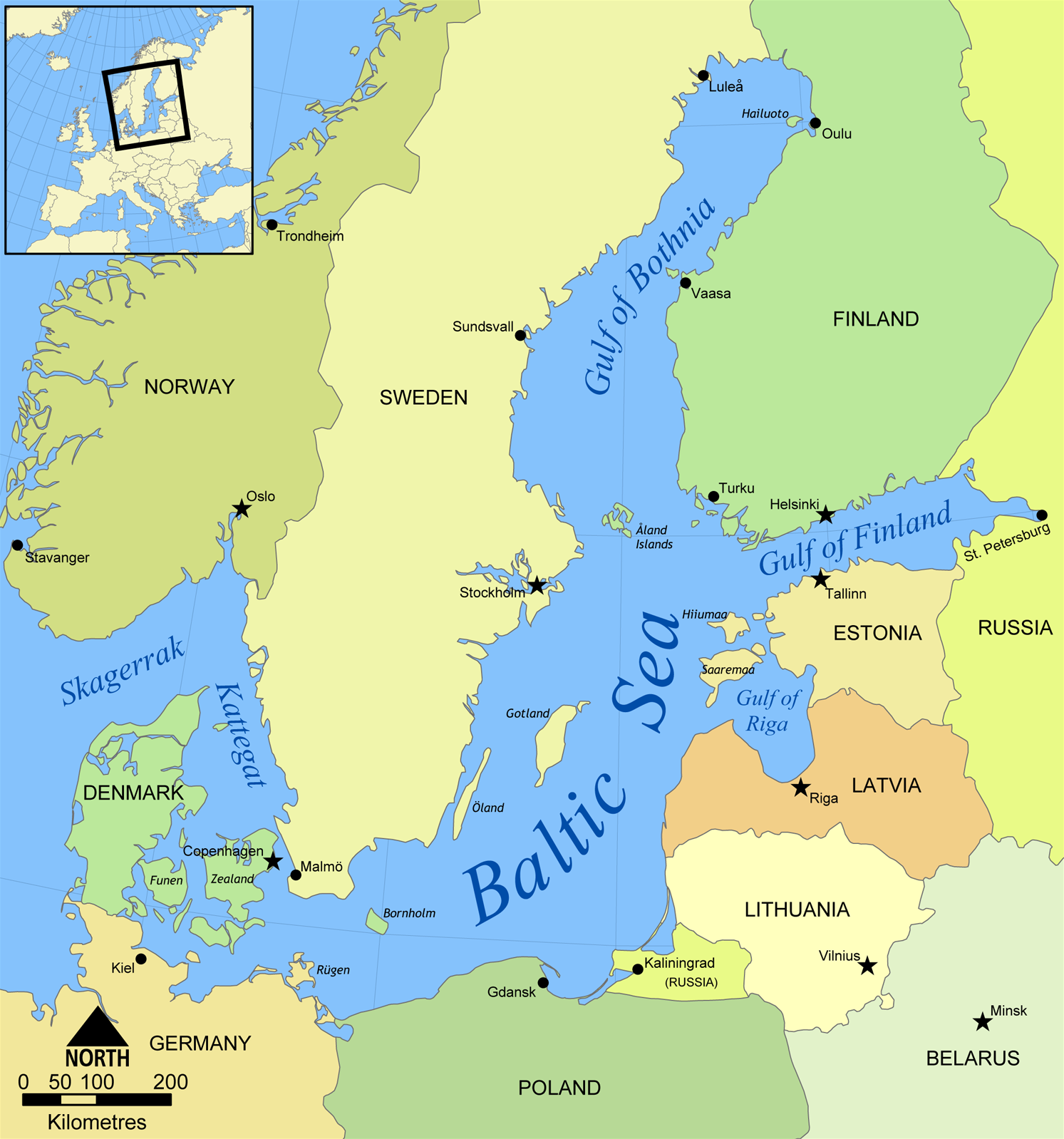
The area of the Bothnian Sea.

Image via Wikipedia

Swedish Radio reports that some 60 vessels were trapped in the Baltic sea ice yesterday and that 5 icebreakers are working feverishly to clear their paths. The ships are trapped in the southern section of the Gulf of Bothnia known as “Bottenhavet”.

This problematic situation was not helped by the strong southerly winds which compressed the ice sheet. To the north of Sundsvall, ships cannot proceed without icebreaker assistance.
Most ships trapped on Sunday are now free but some yet have problems and are waiting for assistance from icebreakers.
“At all ports north of Sundsvall, it remains very difficult ” says
Johny Lindvall at FMA Icebreaking.
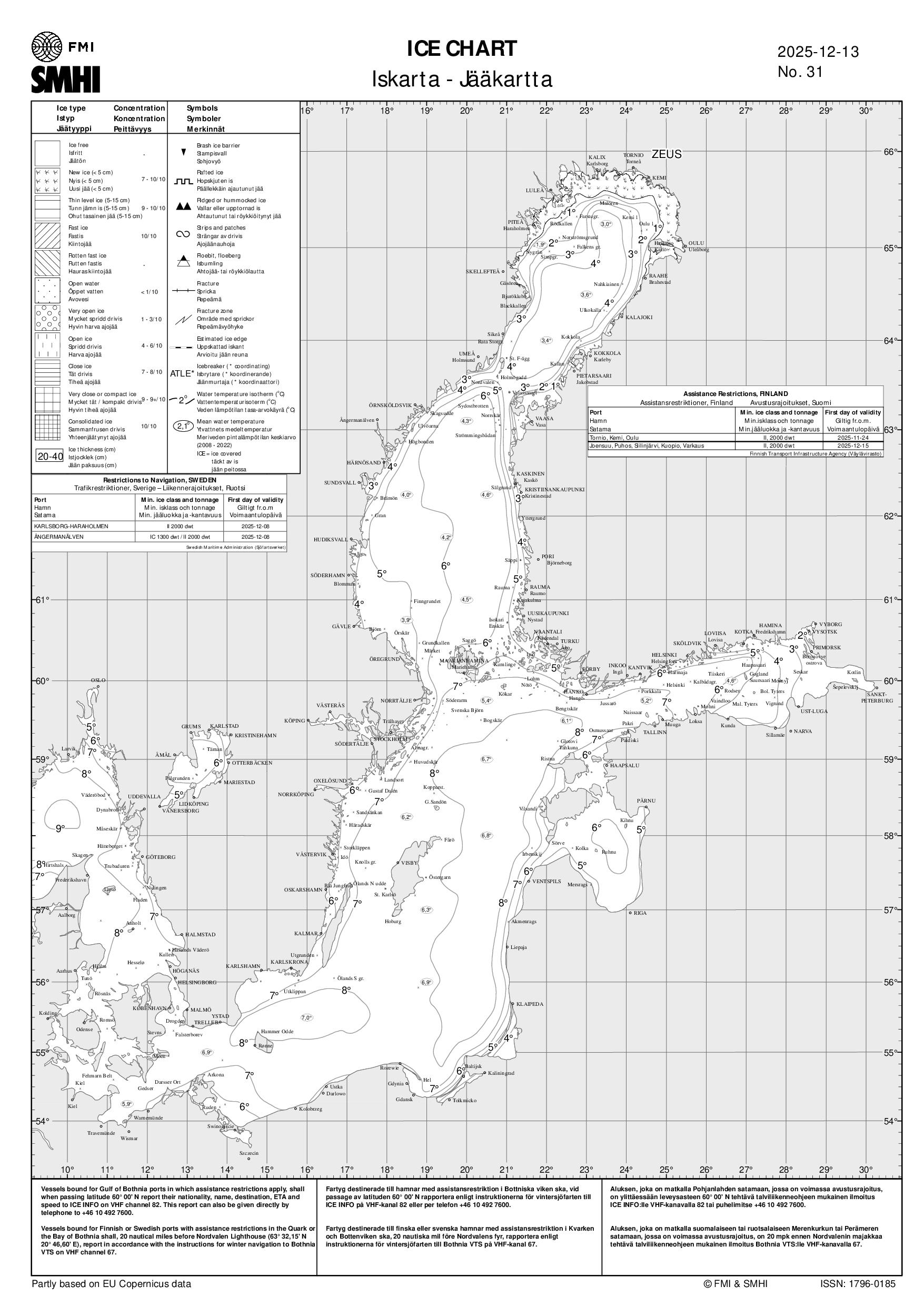
Last weekend 250 000 square kilometers of the Baltic Sea was  covered with ice, which according to SMHI was the largest area covered by ice since the winter of 1986-87.

The Swedish Maritime Administration warns:

The strong winds that we have had the last couple of days has resulted in a severe ice situation, mainly in the northern part of the Sea of Bothnia. This makes it hard to predict how long time each individual assistance will take.

Ice breaking vessels and their activities:

Ale: Assisting/supervising the traffic on Lake Vänern.
Atle: During the evening/night assisting Red Spirit from Karlsborg to Haraholmen and then Salsa out from Haraholmen.
Frej: Now assisting a convoy of four southbound ships , that were stuck on the finnish side, over to the channel that has opened up on the swedish side.
Ymer: Assisting/supervising the traffic in Ålands Sea
Baltica: Visit in shipyard
Scandica: Assisting and supervising the traffic in Kalmar Sound.
Fyrbyggaren: Assisting/supervising in Bay of Havringe.
Balder Viking: On her way with a convoy to Ornskoldsvik and Holmsund.
Tor Viking: Breaking loose Merwborg and then assist her to Holmsund.
Vidar Viking: Assisting/supervising on the northern Baltic Proper,  Bay of Havringe and Landsort.
STOCKHOLM 110223 Isläggningen i Bottenhavet och Östersjön är den mest omfattande sedan 1987, och det kalla vädret gör att isen fortsätter att breda ut sig, rapporterar SMHI. Foto: Kustbevakningen.

Ice levels in Bottenhavet are the most widespread since 1987. Photo Swedish Coast Guard

Baltic sea ice highest in 25 years

February 26, 2011

From The Local:

Baltic Sea: image Wikipedia

Deep freeze puts Baltic on track for record ice

Following another extended stretch of sub-zero temperatures, ice coverage on the Baltic Sea is greater than it’s been in nearly a quarter century, Sweden’s meteorological agency reports. About 250,000 square kilometres of the Baltic Sea are now covered in ice according to the Swedish Meteorological and Hydrological Institute (SMHI).

The last time so much of the Baltic was frozen was the winter of 1986-87, when ice covered nearly 400,000 square kilometres of the sea’s surface.

SMHI warns that ice coverage on the Baltic could expand further in the coming days, possibly setting a new record. “The surface water is cold and if winter-like temperatures continue in the region a few more weeks, we’ll probably get an icy winter on par with 1984-85, one of the toughest winters in the 1980s,” SMHI oceanographer Amund E. B. Lindberg said in a statement.

According to SMHI’s estimates, ice may eventually connect the Swedish mainland all the way out to the Baltic island of Gotland, which lies about 90 kilometres off of Sweden’s eastern coast.

Baltic ice cover is not only unusually wide this winter, but also unusually thick, especially in Gulf of Bothnia off Sweden’s northeastern coast, where air temperatures have consistently hovered around -30 degrees Celsius in recent months.

In some areas far out at sea, ice is more than 60 centimetres thick in the northern parts of the gulf. Recent cold temperatures near the southern areas of the Gulf of Bothnia have resulted in ice thickness growing by 30 centimetres in just two weeks.

Icebreakers from the Swedish Maritime Administration (Sjöfartsverket) have been working round the clock to ensure that sea routes on the Baltic remain open, but strong winds expected at the weekend may complicate their work.

SMHI’s daily ice report says:

During the next two days  heavy ice drifting and ridge forming is expected in all waters of the Baltic Sea north of N58 °.

A detailed sea ice map is available here:

Baltic Sea ice levels 20110225: image smhi

Solar effects will give increased volcanic and earthquake activity in the next 2 years

February 22, 2011

Solar effects are much more profound than many so-called climate scientists like to admit. It seems entirely plausible to me that earthquakes and volcanism are connected to solar events. This paper by Zhang from 1998 also associates increased Earthquakes with general increases in solar proton events.

http://www.springerlink.com/content/buvw2tq081013210/fulltext.pdf?page=1

Relationship between global seismicity and solar activities

Gui-Qing ZHANG

Vol. 11 No.4 (495~500)  ACTA SEISMOLOGICA SINICA  July, 1998

Beijing Astronomical Observatory, Chinese Academy of  Sciences, Beijing 100101, China

Abstract :

The  relations  between  sunspot  numbers and earthquakes  (M>6), solar 10.7cm  radio flux  and  earthquakes,  solar  proton events and earthquakes have been  analyzed in this  paper. It has been found that:

  1. Earthquakes occur frequently around the minimum years  of  solar activity. Generally, the  earthquake  activities are  relatively less during the peak value years of  solar activity, some  say, a round the period when magnetic polarity  in the  solar polar regions  is reversed.
  2. The earthquake frequency in the minimum period of  solar activity is closely related to the  maximum annual means of sunspot numbers, the maximum annual means of solar 10.7 cm radio flux and solar proton events of a whole solar cycle, and the relation between earthquake and solar proton events is closer than others.
  3. As judged by above interrelationship, the period from 1995 to 1997 will be the years while earthquake activities are frequent. In the paper, the simple physical discussion has been carried out.

Piers Corbyn at WeatherAction comments:

“We now think that it is not just general solar proton event levels which point towards more earthquakes but that individual solar proton events exacerbate immediate earthquake (and associated volcanism) risk either directly or due to consequent storm activity and related surface pressure changes such as caused by our solar triggered and predicted Tropical Cyclone Atu which is currently centred North of New Zealand and heading closer.

There are also additional lunar effects on storm development and earthquakes & volcanism and for solar drivers it appears that the odd-even minima, particularly the later part i.e. the rising phase of even solar cycles – WHICH IS WHERE WE ARE NOW (early Solar Cycle 24) – are the most dangerous.

Prediction of individual Earthquakes is very hard but we are very confident of a continuing period of significantly enhanced earthquake and volcanic activity as well as extreme weather events for the coming one or two years, probably exceeding the levels of the most active extended periods in at least the last 100 years.”

The wind-blown snow-ice balls on Öland

February 21, 2011

Freely translated from KvällsPosten

The unusual phenomenon of snow-ice balls has once again appeared on the island’s southern tip. “They varied in size. Some were as big as tennis balls and others like volleyballs” said  Göran Andersson, ornithologist and guide at the Ottenby Bird Observatory. It is not often this phenomenon is spotted in Sweden. It was last observed was on 18th December 2009.

These snow-ice balls probably formed in connection with the weather on 11th February. After a period with mild temperatures a low pressure system set in and temperatures dropped. In addition, the wind increased considerably.

“This is a natural process where the wind formed and rolled the snowballs into the shore zone in the shallow water which then built up layers of ice” says George Anderson.

When the water receded snow-ice balls froze solid froze solid at Kapellvilken on Ölands southern tip.

Snow-ice balls rolled naturally by the wind on Öland Photo: Göran Andersson

The current set of snow-ice balls were not as large and as well-formed as in 2009.

Isbollarna dök upp första gången 2009.

Snow-ice balls in 2009: image Ottenby Bird Station


Floods and Global Warming is fashion not science

February 18, 2011

There is the attempt to link current weather to long term climate, to use computer models to achieve the evidence, and to alarm the public and policy makers that climate change is real and here.

Roger Pielke Jr. points out:

Nature published two papers yesterday that discuss increasing precipitation trends and a 2000 flood in the UK.  I have been asked by many people whether these papers mean that we can now attribute some fraction of the global trend in disaster losses to greenhouse gas emissions, or even recent disasters such as in Pakistan and Australia. I hate to pour cold water on a really good media frenzy, but the answer is “no.”  Neither paper actually discusses global trends in disasters (one doesn’t even discuss floods) or even individual events beyond a single flood event in the UK in 2000.  But still, can’t we just connect the dots?  Isn’t it just obvious?  And only deniers deny the obvious, right? ….

In short, the new studies are interesting and add to our knowledge.  But they do not change the state of knowledge related to trends in global disasters and how they might be related to greenhouse gases.  But even so, I expect that many will still want to connect the dots between greenhouse gas emissions and recent floods.  Connecting the dots is fun, but it is not science.

And Andrew Revkin goes to town in his New York Times blog about how uncertainties and caveats disappear when a political corner is being fought:

….. In scientific literature you rarely see statements so streamlined and definitive. For climate science, this is the equivalent of a smoking gun. News indeed. Add in the extreme floods last year (a period not included in the study) and you have more relevance, although Roger Pielke Jr. this morning notes the importance of distinguishing between analysis of certain kinds of extreme precipitation events and disastrous flooding.

The problem is that the Nature paper is not definitive at all, as you’ll see below.

None of this detracts from the importance of this work, or the overall picture of an increasingly human-influenced climate, with impacts on the frequency of gullywashers.

But this does raise big questions about the standards scientists and journals use in summarizing complex work and the justifiable need for journalists — and readers — to explore such work as if it has a “handle with care” sign attached.

This is not about “ false balance.” This is about responsible reporting.

A previous instance occurred in 2006, when a paper in Science on frog die-offs in Costa Rica included this firm and sobering statement:

Here we show that a recent mass extinction associated with pathogen outbreaks is tied to global warming.

Things were far more complicated, of course, as you can read in my 2008 piece on Vanishing Frogs, Climate and the Front Page.