The end of the Universe is nigh and getting closer

December 16, 2013

This is beyond Rapture.

Not just the end of our world, but the end of the entire Universe.

It could happen tomorrow or many billion years later. It may not be the classic Big Crunch which will negate the Big Bang but it could be a phase transition which will cause the entire Universe and all its galaxies and all their suns and all their planets to collapse in on themselves.

Collapse of the universe is closer than ever before

Collapse of the universe is closer than ever before

Journal of High Energy Physics: Standard Model Vacuum Stability and Weyl Consistency Conditions, Authors: Oleg Antipin, Marc Gillioz, Jens Grund, Esben Mølgaard, Francesco Sannino (CP3 – Origins and DIAS). arXiv:1306.3234 arxiv.org/abs/1306.3234

PhysOrg: Physicists have long predicted that the universe may one day collapse, and that everything in it will be compressed to a small hard ball. New calculations from physicists at the University of Southern Denmark now confirm this prediction – and they also conclude that the risk of a collapse is even greater than previously thought.

Sooner or later a radical shift in the forces of the universe will cause every little particle in it to become extremely heavy. Everything – every grain of sand on Earth, every planet in the solar system and every galaxy – will become millions of billions times heavier than it is now, and this will have disastrous consequences: The new weight will squeeze all material into a small, super hot and super heavy ball, and the universe as we know it will cease to exist.

This violent process is called a phase transition and is very similar to what happens when, for example water turns to steam or a magnet heats up and loses its magnetization. The phase transition in the universe will happen if a bubble is created where the Higgs-field associated with the Higgs-particle reaches a different value than the rest of the universe. If this new value results in lower energy and if the bubble is large enough, the bubble will expand at the speed of light in all directions. All elementary particles inside the bubble will reach a mass, that is much heavier than if they were outside the bubble, and thus they will be pulled together and form supermassive centers.

“Many theories and calculations predict such a phase transition– but there have been some uncertainties in the previous calculations. Now we have performed more precise calculations, and we see two things: Yes, the universe will probably collapse, and: A collapse is even more likely than the old calculations predicted”, says Jens Frederik Colding Krog ……. 

The theory of phase transition is not the only theory predicting a collapse of the universe. Also the so-called Big Crunch theory is in play. This theory is based on the Big Bang; the formation of the universe. After the Big Bang all material was ejected into the universe from one small area, and this expansion is still happening. At some point, however, the expansion will stop and all the material will again begin to attract each other and eventually merge into a small area again. This is called the Big Crunch.

“The latest research shows that the universe’s expansion is accelerating, so there is no reason to expect a collapse from cosmological observations. Thus it will probably not be Big Crunch that causes the universe to collapse”, says Jens Frederik Colding Krog.

Although the new calculations predict that a collapse is now more likely than ever before, it is actually also possible, that it will not happen at all ….

Oh Well! No need to stock up anything just yet. No real possibility of some Universal-Engineering to put off the evil day.

I’ll just get more warm clothes for the global cooling that is happening!!

Waves of aging

December 15, 2013

The aging of the world is not news, but visualising the change is done very well here:

Population By Age, Japan

Population By Age, Japan

Population By Age, U.S.

Population By Age, U.S.

Not all countries are getting older. Many developing countries still have high fertility rates, and children account for a huge share of the people in those countries. (Typically, fertility rates don’t start falling until countries hit a certain stage of economic development.)

When you look at the whole world, you see a blend of these two trends — the population of the globe is aging, on average, but there are still far more children than old people.

World Population Breakdown By Age

World Population Breakdown By Age


Chang’e 3’s Jade Bunny begins gambolling on the moon

December 15, 2013

Chang’e 3 landed on the moon on Saturday and her Jade Bunny has now started gambolling on the moon.

China’s first lunar rover separates from Chang’e-3 moon lander early Dec. 15, 2013. Picture was taken from the screen of the Beijing Aerospace Control Center in Beijing, capital of China. (Xinhua/Li Xin)

Xinhua:China’s first moon rover, Yutu, or Jade Rabbit, separated from the lander early on Sunday, several hours after the Chang’e-3 probe soft-landed on the lunar surface.

The 140 kg six-wheeled rover touched the lunar surface at 4:35 a.m., leaving deep trace on the loose lunar soil. The process was recorded by the camera on the lander and the images were sent to the earth, according to the Beijing Aerospace Control Center.

After the separation, the rover and lander will take photos of each other and start their own scientific explorations.

Engineers made final checks of the environment of the landing site, the situation of the probe and the solar incidence angle late night on Saturday and sent signals of separation to Chang’e-3.

Yutu, atop the probe, extended its solar panel and started to drive slowly to the transfer mechanism at 3:10.

The transfer mechanism unlocked at 4:06 with one side reaching the moon’s surface, allowing the rover to descend to the surface following a ladder mechanism.

Chang’e-3 landed on the moon’s Sinus Iridum, or the Bay of Rainbows, at 9:11 p.m. Saturday, making China the third country in the world to carry out such a rover mission after the United States and former Soviet Union. 

In ancient Chinese mythology, Yutu was the white pet rabbit of the lunar goddess Chang’e. The name for the rover was selected following an online poll that collected several million votes from people around the world. 

The rover, 1.5 meters long with its two wings folded, 1 m in width and 1.1 m in height, is a highly efficient robot controlled by the command center from the earth. It will face challenges including temperature differences of more than 300 degrees Celsius on the moon. 

Yutu will survey the moon’s geological structure and surface substances and look for natural resources for three months, while the lander will conduct in-situ exploration at the landing site for one year.


You are not just your genes, you are how they are expressed

December 8, 2013

As genetics advance it is becoming clear that an individual’s genes are only a part of the story. The same genes may be expressed in many different ways. And how a gene or a group of genes are expressed depends upon environmental and other triggers which are yet to be fully understood. Your genes may be your blueprint but you are what the manufacturer then produces depending upon the materials and resources available to him. In fact “blueprint” may not be the best analogy since a “blueprint” today may well even define the method of manufacture to be followed and the materials to be used. A set of genes being a “pattern” to follow may be a better representation. How the pattern is read and put into effect then determines the final product.

David Dobbs has an interesting article about how the simplistic view of the all-determining gene is changing.

… The grasshopper, he noted, sports long legs and wings, walks low and slow, and dines discreetly in solitude. The locust scurries hurriedly and hoggishly on short, crooked legs and joins hungrily with others to form swarms that darken the sky and descend to chew the farmer’s fields bare.

Related, yes, just as grasshoppers and crickets are. But even someone as insect-ignorant as I could see that the hopper and the locust were wildly different animals — different species, doubtless, possibly different genera. So I was quite amazed when Rogers told us that grasshopper and locust are in fact the same species, even the same animal, and that, as Jekyll is Hyde, one can morph into the other at alarmingly short notice. 

Not all grasshopper species, he explained (there are some 11,000), possess this morphing power; some always remain grasshoppers. But every locust was, and technically still is, a grasshopper — not a different species or subspecies, but a sort of hopper gone mad. If faced with clues that food might be scarce, such as hunger or crowding, certain grasshopper species can transform within days or even hours from their solitudinous hopper states to become part of a maniacally social locust scourge. They can also return quickly to their original form.

In the most infamous species, Schistocerca gregaria, the desert locust of Africa, the Middle East and Asia, these phase changes (as this morphing process is called) occur when crowding spurs a temporary spike in serotonin levels, which causes changes in gene expression so widespread and powerful they alter not just the hopper’s behaviour but its appearance and form. Legs and wings shrink. Subtle camo colouring turns conspicuously garish. The brain grows to manage the animal’s newly complicated social world, which includes the fact that, if a locust moves too slowly amid its million cousins, the cousins directly behind might eat it.

How does this happen? Does something happen to their genes? Yes, but — and here was the point of Rogers’s talk — their genes don’t actually change. That is, they don’t mutate or in any way alter the genetic sequence or DNA. Nothing gets rewritten. Instead, this bug’s DNA — the genetic book with millions of letters that form the instructions for building and operating a grasshopper — gets reread so that the very same book becomes the instructions for operating a locust. Even as one animal becomes the other, as Jekyll becomes Hyde, its genome stays unchanged. Same genome, same individual, but, I think we can all agree, quite a different beast. ….

…. Gene expression is what makes a gene meaningful, and it’s vital for distinguishing one species from another. We humans, for instance, share more than half our genomes with flatworms; about 60 per cent with fruit flies and chickens; 80 per cent with cows; and 99 per cent with chimps. Those genetic distinctions aren’t enough to create all our differences from those animals — what biologists call our particular phenotype, which is essentially the recognisable thing a genotype builds. This means that we are human, rather than wormlike, flylike, chickenlike, feline, bovine, or excessively simian, less because we carry different genes from those other species than because our cells read differently our remarkably similar genomes as we develop from zygote to adult. The writing varies — but hardly as much as the reading.

This raises a question: if merely reading a genome differently can change organisms so wildly, why bother rewriting the genome to evolve? How vital, really, are actual changes in the genetic code? Do we even need DNA changes to adapt to new environments? Is the importance of the gene as the driver of evolution being overplayed?

I think the idea that anything drives evolution is the wrong end of the stick. Evolution is a result of response to change. The resultant evolution is by deselection of those individuals who cannot survive the change – it is not a pro-active selection of desirable traits for some change yet to come.

So it seems to me that it is perfectly logical that a set of genes only describe and define an envelope of possibilities. It is gene expression which then – reacting to environmental or other triggers – determines the particular model from within the envelope that will materialise. But the set of genes are still critical in that they set the constraints – they define the envelope of possibilities. And no matter how creatively they are expressed, the constraints and the envelope still apply. I suspect that we have only just begun to understand the incredibly wide variation that gene expression permits with any given set of genes and how such expression can be triggered.

This variability is sufficiently wide that one twin can be a saint and the other can be a sinner but this variability is not so great that we can suddenly morph into chimpanzees.

Solar and ocean cycles – without any CO2 influence – are sufficient to explain climate changes

December 7, 2013
  1. The de Vries solar cycle together with the AMO/PDO are sufficient to explain the main climate variations of the last 1000 years
  2. It is unnecessary to invoke carbon dioxide and its effects to explain the climate cycles
  3. The 21st century will see an underlying cooling due to the de Vries cycle and then modulated by the AMO/PDO. 

The 200-210 year de Vries solar cycle (also known as the Suess cycle)  has been postulated for some time (here and here for example)  as being one of the main natural cycles governing our climate.  The effect of the de Vries cycle can be traced back through the glacial record through many millenia and even through geologic ages. Many solar effects work on climate through ocean cycles. The Atlantic/Pacific Oscillations are well known as  drivers of climate and can be traced back through at least about 1500 years. The Atlantic Multidecadal Oscillation (AMO) has a period of about 66 years while the Pacific Decadal Oscillation (PDO) has a slightly shorter cycle of 60 years.

The entire hypothesis that carbon dioxide concentrations in the atmosphere and therefore human emissions of carbon dioxide are responsible for “global warming” is based on the argument that nothing else can explain the warming witnessed during the 20th century. Yet this is not just conjecture it is a fantasy based on ignoring the effect of the natural cycles that are known to exist. In fact there is no need to invoke carbon dioxide concentration to explain the ups and down of climate. German researchers have now shown that just the de Vries Cycle together with the AMO and the PDO are quite sufficient. The period in the 1970’s and 1980’s often used as the foundation for “global warming” theory can be quite sufficiently explained by the AMO/PDO.

Just as we had about 100 years of an underlying warming due to the de Vries cycle in the 20th century, we are in for an underlying cooling through the 21st century in response to the de Vries solar cycle. This underlying trend will be modulated by the ups and downs of the AMO and the PDO. Carbon dioxide concentrations are largely irrelevant. 

The following is from an article at NoTricksZone:

German Scientists Show Climate Driven By Natural Cycles – Global Temperature To Drop To 1870 Levels By 2100!

by Prof. H. Luedecke and C.O. Weiss (Original German version here).

We reported recently about our spectral analysis work of European temperatures [1] which shows that during the last centuries all climate changes were caused by periodic (i.e. natural) processes. Non-periodic processes like a warming through the monotonic increase of CO2 in the atmosphere could cause at most 0.1° to 0.2° warming for a doubling of the CO2 content, as it is expected for 2100.

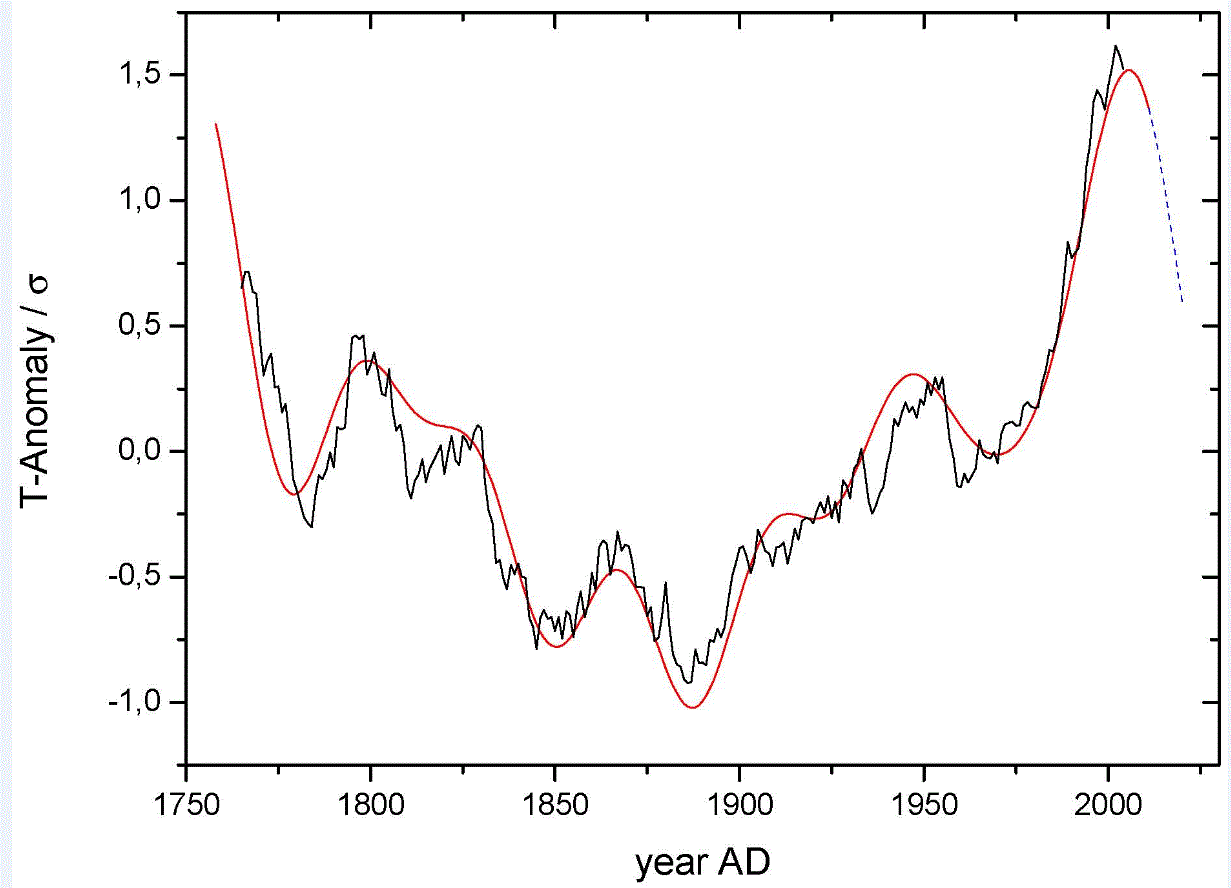
Fig. 1 (Fig. 6 of [1] ) shows the measured temperatures (blue) and the temperatures reconstructed using the 6 strongest frequency components (red) of the Fourier spectrum, indicating that the temperature history is determined by periodic processes only.

On sees from Fig. 1 that two cycles of periods 200+ years and ~65 years dominate the climate changes, the 200+ year cycle causing the largest part of the temperature increase since 1870.

EIKE_2

Fig. 1: Construction of temperatures using the 6 strongest Fourier components (red), European temperatures from instrumental measurements (blue). It is apparent that only a 200+ year cycle and a ~65 year cycle play a significant role.

The ~65 year cycle is the well-known, much studied, and well understood “Atlantic/Pacific oscillation” (AMO/PDO).  It can be traced back for 1400 years. The AMO/PDO has no external forcing it is “intrinsic dynamics”, an “oscillator”.

Although the spectral analysis of the historical instrumental temperature measurements [1] show a strong 200+ year period, it cannot be inferred with certainty from these measurements, since only 240 years of measurement data are available. However, the temperatures obtained from the Spannagel stalagmite show this periodicity as the strongest climate variation by far since about 1100 AD.

……….

Summary

The analysis of solar activity proves the existence and the strength of the 200+ year periodicity which we found from historical temperature measurements, as well as from the Spannagel stalagmite data. This 200+ year cycle is apparently the one known as “de Vries cycle”.

This solar “de Vries cycle together with the AMO/PDO determine practically completely the global climate of the past  (Fig. 1) and the coming time. A significant influence of CO2 on the climate thus has to be excluded. This latter is not surprising in view of the small amount of CO2 in the atmosphere and its weak infrared absorption cross section (also in view of the various proves of NEGATIVE water feedback).

The present “stagnation” of global temperature (Fig. 5) is essentially due to the AMO/PDO: the solar de Vries cycle is presently at its maximum. Around this maximum it changes negligibly. The AMO/PDO is presently beyond its maximum, corresponding to the small decrease of global temperature. Its next minimum will be 2035. The temperature can expected to be then similar to the last AMO/PDO minimum of 1940. Due to the de Vries cycle, the global temperature will drop until 2100 to a value corresponding to the “little ice age” of 1870.

It accounts for the long temperature rise since 1870. One may note, that the stronger temperature increase from the 1970s to the 1990s, which is “officially” argued to prove warming by CO2, is essentially due to the AMO/PDO cycle.

[1] H.Luedecke, A. Hempelmann, C.O. Weiss; Clim. Past.  9  (2013) p 447

[2] F. Steinhilber, J. Beer; Journ. Geophys. Res.: Space Physics  118  (2013) p 1861

Obama and the “birthers”

December 6, 2013

Hearing Obama speak today about Nelson Mandela, I was wondering what Obama’s legacy would be.

I am not convinced that the US requirement that only those born in the US can become President makes any sense in today’s world. It may have had a purpose once upon a time but it seems to me to be particularly inappropriate to “The American Dream”.

In any event the requirement is on the books and if it could have been shown that Barack Obama had not been born in the US before he was elected President, he could have been ineligible and his candidature would have ended. The convolutions of the “birthers“ who have tried to make their case with strange and exotic conspiracy stories about his birth in Kenya or of not having been born in Hawaii or of being an Indonesian citizen or of being a dual citizen, have been very entertaining but have not developed much traction. Their strident and often racist tone has not helped them much.

In two years Barack Obama will complete his two terms and go down in the record as the 44th President of the US. Probably he will be remembered most for having promised much but for not having been able to deliver. He will be remembered more for his risk aversion and not so much for Osama Bin Laden having been killed on his watch. I have a feeling that he may not wish to be remembered for how Obamacare finally turns out. He will not be remembered as we remember Nelson Mandela today.

Where he was actually born – one would think – is a little irrelevant now.

But a little story in the Washington Post makes me think that he has not been completely transparent about his early life.

After denial, White House now says Obama lived with uncle

The White House acknowledged Thursday that President Obama lived with his uncle for a brief period in the 1980s while he was a student at Harvard Law School — despite previously saying there was no record of the two having met.

“The president did stay with him for a brief period of time until his apartment was ready,” White House spokesman Eric Schultz said in a statement. “After that, they saw each other once every few months, but after law school they fell out of touch. The president has not seen him in 20 years, has not spoken with him in 10. “

Onyango “Omar” Obama faced a deportation hearing earlier this week following a drunk-driving arrest. During the hearing, he said that the president had lived with him while he was a student at Harvard. 

The Boston Globe reported in 2012, after Omar Obama’s arrest, that the White House said he had “never met his famous nephew.” The White House now says it only told the Globe that there was no record of the two having met — not definitively that they hadn’t met.

In its report Thursday, the Globe confirmed that the White House initially said that there was no record that they had met. It said the White House never asked for a correction. ….

Omar Obama comes from his father’s side of the family and is a Kenyan national. Obama was not close to his father, who left the family when the president was very young.

Obama’s relationship with his uncle is also news to scholars of the president, who also found no evidence that the two had met, according to a 2011 Washington Post report.

Omar Obama, 69, was allowed to stay in the United States following his hearing. The White House emphasized that it did nothing to assist him in his deportation case. He had said following his arrest that the president would help him out.

It all strikes me as a little odd. Why would Obama/the White House deny knowing or meeting his uncle? Was he so scared of being accused of interfering in his Uncle’s case that he was prepared to lie? Or was he/is he afraid that the Omar connection could lead elsewhere? And the current explanation that nobody had asked Barack Obama before making the previous denial does not seem very credible. If that denial, about such a personal event, had been issued without Obama’s knowledge, then somebody at the White House was pretty incompetent.

But it makes me wonder as to what would happen if, after Obama has completed his two terms, it comes to light that he was – in fact – ineligible to have been elected President under Article Two of the U.S. Constitution? After all Pope Joan is now legend!

Would the record of his Presidency be expunged? Would all legislation signed by him fall? Would the next President then become the 44th President? Would he lose his pension? Could he be prosecuted? for what?

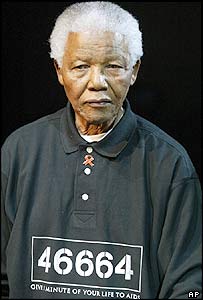
Nelson Mandela 1918 – 2013

December 6, 2013

The Power of forgiveness


Nelson Madela image BBC

Nelson Madela image BBC

NSA covers less than 10% of the world’s mobile communications!

December 5, 2013

It’s only arithmetic!

The NSA has much room for improvement and probably needs to increase its budget by a factor of 10.

  1. The National Security Agency is gathering nearly 5 billion records a day on the whereabouts of cellphones around the world.
  2. The ITU expects the number of cell phone accounts to rise from 6 billion now to 7.3 billion in 2014, compared with a global population of 7 billion.
  3. (NSA) records feed a vast database that stores information about the locations of at least hundreds of millions of devices.
  4. People make, receive or avoid 22 phone calls every day.
  5. The NSA has a budget (secret) of about $52 billion (estimate).

Number of records available to be spied on = 6 billion x 22 /2 = 66 billion.

Five billion records may seem like a big number but it is not as comprehensive as one would expect to see from anybody aspiring to be “Big Brother”. The NSA records only 7.58% of the world’s mobile communications.

If the NSA (and Obama)  truly aspire to being the “Big Brother” of this Brave New World, they are going to have to step up their game. They need to increase their surveillance of mobile communications by at least a factor of 10. Moreover they need to start recording more of the content and not just the location of these devices.

Clearly the NSA needs a budget of about $500 billion per year just to come close to this goal!

DNA sequenced from a 400,000 year old hominin from Spain

December 4, 2013

After developing techniques for extracting and analysing DNA from ancient (c. 40,000 years ago) Neanderthal and Denisovan specimens the Max Planck team have now taken a giant leap backwards in time in extracting and analysing an almost complete mitochondrial genome sequence of a 400,000-year-hominin. The specimen is from  Sima de los Huesos, a unique cave site in Northern Spain. The results show that it is related to the mitochondrial genome of Denisovans, extinct relatives of Neandertals in Asia. DNA this old has until recently been retrieved only from the permafrost.

standard

The Sima de los Huesos hominins lived approximately 400,000 years ago during the Middle Pleistocene. © Kennis & Kennis, Madrid Scientific Films

The result itself is of great interest but it is the development of the techniques for extracting and analysing – without any contamination – and with sufficient confidence, the entire MtDNA sequence in such old specimens that is quite revolutionary. Archaeological evidence – and particularly of of such age – is subject to a great deal of subjective interpretation. But dating techniques and now DNA extraction techniques are removing much of this subjectivity and they are now providing the anchor points around which the evolutionary narrative must be built. And this narrative is now of a much more complex story of hominin expansions and admixture than has generally been thought. Ancient and presumed extinct hominin species are now showing themselves within us.

“Our results show that we can now study DNA from human ancestors that are hundreds of thousands of years old. This opens prospects to study the genes of the ancestors of Neandertals and Denisovans. It is tremendously exciting” says Svante Pääbo, director at the Max Planck Institute for Evolutionary Anthropology.

Matthias Meyer, Qiaomei Fu, Ayinuer Aximu-Petri, Isabelle Glocke, Birgit Nickel, Juan-Luis Arsuaga, Ignacio Martínez, Ana Gracia, José María Bermúdez de Castro, Eudald Carbonell, Svante Pääbo. A mitochondrial genome sequence of a hominin from Sima de los Huesos. Nature, 2013; DOI: 10.1038/nature12788

Read the whole post in 6,000 Generations


The inexorable numbers – 10:10:10:100 is inevitable around 2100

December 4, 2013

10:10:10:100 by 2100

The “success” of a species is generally taken to be indicated by its population though it is of course possible to have quantity without much quality of life. In general however, an increasing population of any species does indicate the sufficiency of food, the ability of the species to withstand competition from other species and the ability to breed successfully in the prevailing conditions. And so it is for humans. Based on population, modern humans have never been as successful as they currently are. And in spite of all the doom-sayers and the alarmists, the fact remains that more humans are being fed and housed and are achieving some large part of their aspirations than ever before. They are living longer than ever before  and their life expectancy is still increasing – currently by about 2 -3 months every year.

However  just looking at the crude birth rate (number of births per 1000 of population) might lead one to a conclusion that there was a catastrophic decline in the human species.

Crude Birth Rate / 1000 of population

Crude Birth Rate / 1000 of population

Birth rates have declined from about 37/1000 in 1950 to less than 15/1000 now and are projected to be around 10/1000 by 2100. For any other species that would be a catastrophic decline. But of course that conclusion would be quite wrong when applied to humans. The mortality rate of humans has also declined drastically as medical and public health advances have been made. And human ingenuity has maintained food and material supplies such that life expectancy has increased in spite of a booming population.

Birth and mortality rates

Birth and mortality rates

The fact that population and life expectancy have increased simultaneously is a clear indicator that the quality of life has not deteriorated. There may be problems of equitable distribution but there is no shortage of food or other resources – and no prospect of any catastrophic shortages occurring. All other indicators tell the same story. Infant mortality, poverty and malnourishment are all at all-time lows and declining even if these can be lower still. The real GDP per capita is increasing. Leisure time (time not spent on the requirements for survival) is increasing and for more people than ever before. The age of space exploration and the potential for access to new sources of raw materials and even real estate has already begun.

There are many who rail against the consumer society and materialism but generally do so from a position of some comfort. There are others who moan the loss of spirituality and yearn for a return to a simpler life but they too are not quite ready to return to the trees. There is no shortage of doom-mongers and alarmists who merely keep pushing their doomsdays into the future where they cannot be disproved.

It is a question of attitude. There are those who would prefer to be governed by fear (the precautionary principle) and there are others who would move forward in spite of their fears.

But the reality is that the human species – with all its warts and threats and self-inflicted problems – is thriving.

Population and life expectancy WPP2012

Population and life expectancy WPP2012

It is not a forecast or an objective but merely the inexorable arithmetic of demographics which leads to the inevitability of 10:10:10:100 around the year 2100.

10 billion population, 10 births per 1000 of population, 10 deaths per 1000 of population and a life expectancy at birth of 100 years.

I prefer to see the glass half-full rather than the glass half-empty.