Medicine Nobel to Robert Edwards for IVF

October 4, 2010
SvD: Thirteen minutes before midnight on July 25, 1978 Louise Joy Brown delivered a baby girl by Caesarean section at Oldham General Hospital outside Manchester UK.
The girl weighed 2610 grams and the responsible physician Patrick Steptoe was soon able to reassure the hundreds of journalists gathered that “all studies have shown that the child is completely normal. ” The news of the birth was a medical sensation. Louise Brown was the first child in the world born with the aid of in vitro fertilisation (IVF).

BBC: Robert Edwards, the man who devised the fertility treatment IVF, has been awarded this year’s Nobel prize for medicine. His efforts in the 1950s, 60s and 70s led to the birth of the world’s first “test tube baby” in July 1978. Since then more than four million babies have been born following IVF.

The prize committee said his achievements had made it possible to treat infertility, a medical condition affecting 10% of all couples worldwide.

(That’s one prediction I got wrong)

Biodiversity 100 – another 10.10 crisis?

October 4, 2010

The Guardian today (and they have yet to distance themselves from their support for their 10: 10 partners):

Talk has not halted biodiversity loss – now it’s time for action

Guillaume Chapron and George Monbiot: “Help us compile a list of 100 tasks (that’s 10.10 to the rest of us) that G20 governments should undertake to prove their commitment to tackling the biodiversity crisis”.

Lurching from one crisis to the next

This comes a day after such headlines  as:

Oceans could contain 750,000 undiscovered species

The world’s oceans are teeming with far greater diversity of life than was previously thought, according to the first Census of Marine Life.

This plethora of manufactured crises is becoming farcical.

Mr. Monbiot has been silent regarding the 10:10 fiasco.

The Guardian is busy positioning itself for the next crisis when biodiversity becomes less fashionable.

The water footprint


Onwards and upwards.

Three Gorges Dam to reach full water level this month

October 4, 2010

The Three Gorges Dam is a hydroelectric dam that spans the Yangtze River by the town ofSandouping, located in the Yiling District of Yichang, in Hubei province, China.

Map of the location of the Three Gorges Dam, Sandouping, Yichang, Hubei Province, China and major cities along the Yangtze River

Three Gorges Dam location: Wikipedia image

The dam body was completed in 2006. Except for a ship lift, the originally planned components of theproject were completed on October 30, 2008, when the 26th generator in the shore plant began commercial operation. Each generator has a capacity of 700 MW. Six additional generators in the underground power plant are not expected to become fully operational until 2011. Coupling the dam’s 32 main generators with 2 smaller generators (50 MW each) to power the plant itself, the total electric generating capacity of the dam will eventually reach 22,500 MW.

Xinhua reports  from Yichang, Hubei that the water level at the Three Gorges Dam, the world’s largest water control project, reached 164.59 meters on Sunday, only 10 meters short of its full capacity of 175-meters. The dam in central China started to hold back water this September by discharging less to the lower reaches of the Yangtze River, the country’s longest river.

When the water level is at its maximum of 175 metres over sea level (110 metres above the river level downstream), the dam reservoir is about 660 kilometres  in length and 1.12 kilometres  in width on average, and contains 39.3 km3 of water. The total surface area of the reservoir is 1,045 km². The reservoir flooded a total area of 632 km² of land, compared to the 1,350 km² of reservoir created by the Itaipu Dam on the border of Brazil and Paraguay (which has a  generating capacity of 14,000 MW).

File:Yangtze longitudinal profile upstream.JPG

Yangtze longitudinal profile: Wikipedia image

Reaching the 175-meter water level would enable the Three Gorges Dam to fulfill its functions of flood control and generating electricity to the fullest extent, symbolizing the total success of the massive water project. This is the reservoir’s third attempt to reach full capacity since 2008. However, water levels stopped at 172.8 meters in 2008 and 171.43 meters in 2009 due to droughts on the lower reaches.

However, this time officials believe the dam will reach full capacity by the end of October.

Changed Landscape of the Three Gorges Dam region. (NASA/Goddard Space Flight Center Scientific Visualization Studio).

The 10:10 No Pressure video

October 3, 2010

Hopefully my last post about this vulgar piece of film.

The 10:10 campaign site seems to have been abandoned. The comments are entirely unmoderated and overwhelmingly critical – and some quite abusive.

After the initial mealy-mouthed apology posted on their web-site, there is utter silence from the perpetrators of this fiasco (Richard Curtis and Franny, Lizzie, Eugenie and the whole 10:10 team)

The only damage control that would now work is for the campaign to shut down.

New – and much cleverer variations of the original video – are now multiplying and being posted on YouTube.

Remarkably the original video is still available at The Guardian.

The Guardian’s initial endorsement of the video by its 10:10 partners and its subsequent silence about the reaction is deafening.

Commonwealth Games open in spectacular fashion!

October 3, 2010

So far, so good!!

Reuters: The 19th Commonwealth Games were declared open on Sunday in a spectacular opening ceremony which might repair some of the damage to India’s image after a calamitous buildup to the sporting festival.

Opening Ceremony for the Delhi 2010 Commonwealth Games

But my fingers are still crossed.

According to the Sydney Morning Herald: But the Australian swimmers were too scared to take part (or they just wanted to make sure of their medals on Monday)

commonwealth games opening ceremony

CWG 2010 Opening Ceremony

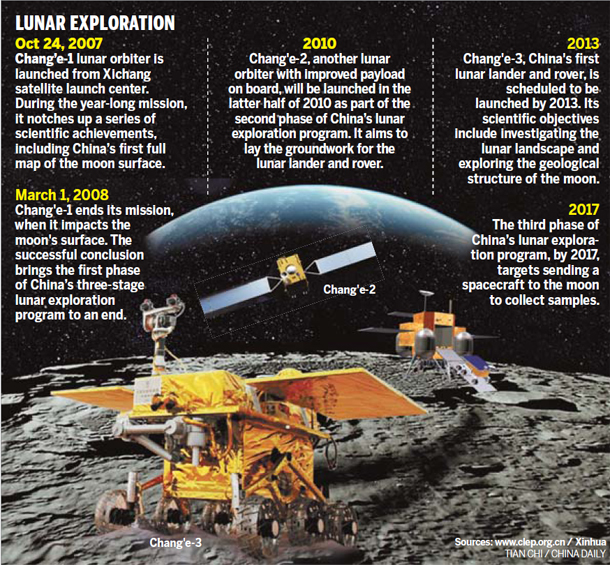
Chang’e-2 mission on track

October 3, 2010

Chang'e programme: Xinhua

On Saturday scientists successfully activated the attitude control engines on Chang’e-2 and trimmed the satellite for the first time on its journey, according to a flight control official in Beijing. “During Chang’e-2’s 380,000-km journey to the moon, we will conduct more orbit corrections if necessary to ensure that it enters a lunar orbit,” said Ma Yongping, vice director of the flight control center. Chang’e-2 blasted off on a Long-March-3C carrier rocket from the Xichang Satellite Launch Center, in southwest China’s Sichuan Province, at about 7 p.m. Friday. It is China’s first unmanned spacecraft to be boosted from the launch site directly to the earth-moon transfer orbit, greatly reducing the journey time from that of its predecessor Chang’e-1.

Chang’e-1 took about 13 days to travel to a lunar orbit after orbiting the earth in a geosynchronous orbit and then transferring to the earth-moon transfer orbit. Chang’e-2 is expected to travel for about 112 hours, or almost five days, to arrive in a lunar orbit. To acquire more detailed moon data, Chang’e-2 will enter a lower lunar orbit about 100 km above the surface, compared with the 200-km altitude of Chang’e-1, according to the control center.

Sinus Iridum - Bay of Rainbows

The satellite will eventually be maneuvered into an orbit just 15 kilometer above the moon. At that point, Chang’e-2 will take pictures of moon’s Bay of Rainbows (Sinus Iridum)  area, the proposed landing ground for Chang’e-3, with a resolution of 1.5 meters. The resolution on Chang’e-1’s camera was 120 meters, said Wu Weiren, chief designer of China’s lunar orbiter project.

China steps in to support Greece (and the EU)

October 3, 2010
Wen Jiabao (温家宝), Chinese Premier

Image via Wikipedia

China is now too big a player to take lightly and I see the Euro strengthening.

Dagens Industri:

(My translation)

On Saturday China entered into an EU- country’s economy by promising strong financial support to crisis-hit Greece. “When Greece has problems, China is prepared to offer all the help it can” said the Chinese Prime Minister Wen Jiabao at a press conference in Athens together with his Greek counterpart, Giorgos Papandreou sfter they had held bilateral discussions.

China, according to Wen Jiabao, will help finance the purchase of
Chinese ships to the Greek shipping industry by creating  a
Fund worth five billion U.S. dollars (about 34 billion SEK). “China is willing to join together with the EU – as a passenger in the same boat – to strengthen cooperation to meet the financial crisis, said the Chinese Prime Minister. Crisis-hit Greece also had the promise of Chinese investment, including for the port of Piraeus and for import of Greek
goods. The Chinese also promised purchases of Greek government bonds.
“Greece has been effective in its handling of the debt crisis”, continued Wen Jiabao, who spoke through an interpreter at a press conference.

He also stressed that the EU and the IMF aid package to Greece had
yielded positive results and that he sees the Greek economy recovering in line with the global economy. Papandreou, for his part said that China’s plans to support Greece is an expression of confidence in Greece.

Wen Jiabao will speak to the Greek Parliament on Sunday before moving on to Brussels to attend a meeting between EU and Asian leaders. Then he goes on to Germany, Italy and Turkey.

Airbus engineering to grow in India

October 3, 2010
Airbus A320 (9M-AFA) der Air Asia

Airbus A 320: Wikipedia

The Telegraph:

Airbus expects India to need around 1,000 new planes over the next 20 years, compared with 3,000 in China. Air traffic has expanded by 16pc in India this year.

Airbus, which has 68 per cent Indian market share, as measured by orders, believes it can build on its current success by selling more aircraft. The European plane maker is also building relationships on the ground. It has 25 partners in India, eight of them top-tier suppliers. Airbus is also leaning more and more on Indian engineers.

The company will decide this week whether to go ahead with its next development programme, a new engine for the single-aisle A320 plane that generates much of Airbus’s profit. “Airbus has never made a secret that our engineering resources are stretched thin,” Mr Enders said during a two-day visit to Airbus’s Indian operations in Bangalore last week. “We’re taking this decision very seriously because we cannot afford that other programmes, especially the 350, should suffer.”

At its base in Bangalore, Airbus has 160 engineers working on the A350 and A380 programmes in conjunction with staff in France, Germany and Britain. The company plans to have 200 staff at the engineering centre by the end of the year and 400 by 2013. India produces around 350,000 engineering graduates a year, about 25pc of which Airbus describes as “employable”. “I don’t think 400 is going to be the final number, there is a huge pool of talent we can tap into,” said Mr Enders. “In terms of the work we sub-contract, there’s a lot more to come.”

In the past, most of the work done for Airbus by external suppliers has been making parts of the airframe, and while some manufacturing work is now being done in India, it is the engineering and technology base that is more attractive, Mr Enders said. “IT, simulations, technical publication – all these are things which India is particularly good at,” he said.

It makes sense and is inevitable that more will shift to India and China – where the market is.

The 10:10 video and ecofascism

October 2, 2010

I find the entire 10.10 campaign infantile but still feel I have to address their (at best) stupid video.

That this puerile video was castigated soundly (as for example at WUWT) is only right and proper. That infantile humour – when indulged in by infants – has a place in comedy is not in doubt. But what is much more disturbing in my opinion is that in this case – and in these times – it is being used to cloak the message that terror and mayhem and execution are acceptable to eliminate dissent.

The apology by the 10.10 campaign is not much of an apology and is more in the way of an attack on those who did not find it funny Many people found the resulting film extremely funny, but unfortunately some didn’t …”. They continue that “We won’t be making any attempt to censor or remove other versions currently in circulation on the internet”.

No? Presumably because they feel their message is fundamentally sound — it is just that the “some” who didn’t find it funny are reacting disproportionately !

The campaign denied that the withdrawal was planned from the beginning as a publicity stunt. I also found Monty Python and Blackadder extremely funny but this is something entirely different. This video is insidious in that it supports the creation of an atmosphere in which the ecofascism creed can flourish under the cloak of “humour”:

An ecocatastrophe is taking place on earth and therefore discipline, prohibition, enforcement and oppression must be used on dissenters. They must be sent to the mountains for “re-education” in eco-gulags or eliminated. The sole glimmer of hope lies in a centralised government and the tireless control of citizens.

The video is puerile — but so is the entire juvenile, misguided and meaningless 10:10 campaign which seems to be little more than an easy, painless way for “privileged brats” to salve their consciences.

Low carbon meals

Magna Germania: Ptolemy’s map deciphered

October 2, 2010

Der Spiegel reports: Berlin Researchers Crack the Ptolemy Code

A 2nd century map of Germania by the scholar Ptolemy has always stumped scholars, who were unable to relate the places depicted to known settlements. Now a team of researchers have cracked the code, revealing that half of Germany’s cities are 1,000 years older than previously thought.

Magna Germania

Link to larger map.

A group of classical philologists, mathematical historians and surveying experts at Berlin Technical University‘s Department for Geodesy and Geoinformation Science has produced an astonishing map of central Europe as it was 2,000 years ago.

Ptolemy: Bildarchiv Hansmann/Interfoto

The map shows that both the North and Baltic Seas were known as the “Germanic Ocean” and the Franconian Forest in northern Bavaria was “Sudeti Montes.” The map indicates three “Saxons’ islands” off the Frisian coast in northwestern Germany — known today as Amrum, Föhr and Sylt.

It also shows a large number of cities. The eastern German city that is now called Jena, for example, was called “Bicurgium,” while Essen was “Navalia.” Even the town of Fürstenwalde in eastern Germany appears to have existed 2,000 years ago. Its name then was “Susudata,” a word derived from the Germanic term “susutin,” or “sow’s wallow” — suggesting that the city’s skyline was perhaps less than imposing.

This unusual map draws on information from the mathematician and astronomer Ptolemy, who, in 150 AD, embarked on a project to depict the entire known world. Living in Alexandria, in the shadow of its monumental lighthouse, the ancient scholar drew 26 maps in colored ink on dried animal skins — a Google Earth of the ancient world, if you will.

Read the full article

The Roman Empire in 116 AD and Germania Magna,...

Image via Wikipedia. Roman Empire in 116 AD