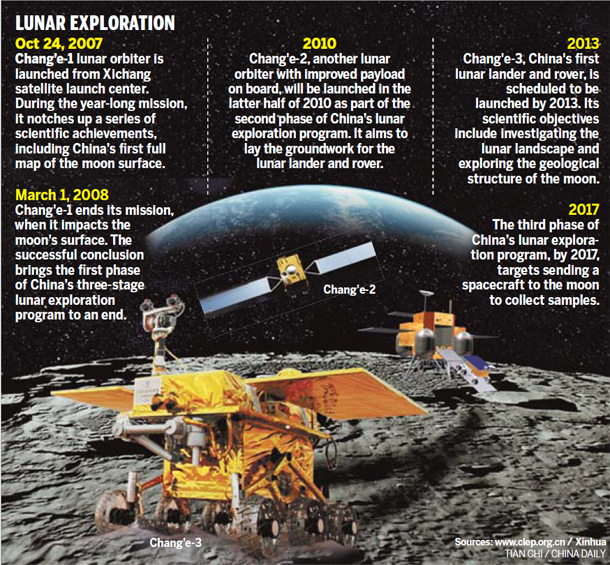
Chang’e-2 mission on track

October 3, 2010

Chang'e programme: Xinhua

On Saturday scientists successfully activated the attitude control engines on Chang’e-2 and trimmed the satellite for the first time on its journey, according to a flight control official in Beijing. “During Chang’e-2’s 380,000-km journey to the moon, we will conduct more orbit corrections if necessary to ensure that it enters a lunar orbit,” said Ma Yongping, vice director of the flight control center. Chang’e-2 blasted off on a Long-March-3C carrier rocket from the Xichang Satellite Launch Center, in southwest China’s Sichuan Province, at about 7 p.m. Friday. It is China’s first unmanned spacecraft to be boosted from the launch site directly to the earth-moon transfer orbit, greatly reducing the journey time from that of its predecessor Chang’e-1.

Chang’e-1 took about 13 days to travel to a lunar orbit after orbiting the earth in a geosynchronous orbit and then transferring to the earth-moon transfer orbit. Chang’e-2 is expected to travel for about 112 hours, or almost five days, to arrive in a lunar orbit. To acquire more detailed moon data, Chang’e-2 will enter a lower lunar orbit about 100 km above the surface, compared with the 200-km altitude of Chang’e-1, according to the control center.

Sinus Iridum - Bay of Rainbows

The satellite will eventually be maneuvered into an orbit just 15 kilometer above the moon. At that point, Chang’e-2 will take pictures of moon’s Bay of Rainbows (Sinus Iridum)  area, the proposed landing ground for Chang’e-3, with a resolution of 1.5 meters. The resolution on Chang’e-1’s camera was 120 meters, said Wu Weiren, chief designer of China’s lunar orbiter project.

China steps in to support Greece (and the EU)

October 3, 2010
Wen Jiabao (温家宝), Chinese Premier

Image via Wikipedia

China is now too big a player to take lightly and I see the Euro strengthening.

Dagens Industri:

(My translation)

On Saturday China entered into an EU- country’s economy by promising strong financial support to crisis-hit Greece. “When Greece has problems, China is prepared to offer all the help it can” said the Chinese Prime Minister Wen Jiabao at a press conference in Athens together with his Greek counterpart, Giorgos Papandreou sfter they had held bilateral discussions.

China, according to Wen Jiabao, will help finance the purchase of
Chinese ships to the Greek shipping industry by creating  a
Fund worth five billion U.S. dollars (about 34 billion SEK). “China is willing to join together with the EU – as a passenger in the same boat – to strengthen cooperation to meet the financial crisis, said the Chinese Prime Minister. Crisis-hit Greece also had the promise of Chinese investment, including for the port of Piraeus and for import of Greek
goods. The Chinese also promised purchases of Greek government bonds.
“Greece has been effective in its handling of the debt crisis”, continued Wen Jiabao, who spoke through an interpreter at a press conference.

He also stressed that the EU and the IMF aid package to Greece had
yielded positive results and that he sees the Greek economy recovering in line with the global economy. Papandreou, for his part said that China’s plans to support Greece is an expression of confidence in Greece.

Wen Jiabao will speak to the Greek Parliament on Sunday before moving on to Brussels to attend a meeting between EU and Asian leaders. Then he goes on to Germany, Italy and Turkey.

Airbus engineering to grow in India

October 3, 2010
Airbus A320 (9M-AFA) der Air Asia

Airbus A 320: Wikipedia

The Telegraph:

Airbus expects India to need around 1,000 new planes over the next 20 years, compared with 3,000 in China. Air traffic has expanded by 16pc in India this year.

Airbus, which has 68 per cent Indian market share, as measured by orders, believes it can build on its current success by selling more aircraft. The European plane maker is also building relationships on the ground. It has 25 partners in India, eight of them top-tier suppliers. Airbus is also leaning more and more on Indian engineers.

The company will decide this week whether to go ahead with its next development programme, a new engine for the single-aisle A320 plane that generates much of Airbus’s profit. “Airbus has never made a secret that our engineering resources are stretched thin,” Mr Enders said during a two-day visit to Airbus’s Indian operations in Bangalore last week. “We’re taking this decision very seriously because we cannot afford that other programmes, especially the 350, should suffer.”

At its base in Bangalore, Airbus has 160 engineers working on the A350 and A380 programmes in conjunction with staff in France, Germany and Britain. The company plans to have 200 staff at the engineering centre by the end of the year and 400 by 2013. India produces around 350,000 engineering graduates a year, about 25pc of which Airbus describes as “employable”. “I don’t think 400 is going to be the final number, there is a huge pool of talent we can tap into,” said Mr Enders. “In terms of the work we sub-contract, there’s a lot more to come.”

In the past, most of the work done for Airbus by external suppliers has been making parts of the airframe, and while some manufacturing work is now being done in India, it is the engineering and technology base that is more attractive, Mr Enders said. “IT, simulations, technical publication – all these are things which India is particularly good at,” he said.

It makes sense and is inevitable that more will shift to India and China – where the market is.

The 10:10 video and ecofascism

October 2, 2010

I find the entire 10.10 campaign infantile but still feel I have to address their (at best) stupid video.

That this puerile video was castigated soundly (as for example at WUWT) is only right and proper. That infantile humour – when indulged in by infants – has a place in comedy is not in doubt. But what is much more disturbing in my opinion is that in this case – and in these times – it is being used to cloak the message that terror and mayhem and execution are acceptable to eliminate dissent.

The apology by the 10.10 campaign is not much of an apology and is more in the way of an attack on those who did not find it funny ” Many people found the resulting film extremely funny, but unfortunately some didn’t …”. They continue that “We won’t be making any attempt to censor or remove other versions currently in circulation on the internet”.

No? Presumably because they feel their message is fundamentally sound — it is just that the “some” who didn’t find it funny are reacting disproportionately !

The campaign denied that the withdrawal was planned from the beginning as a publicity stunt. I also found Monty Python and Blackadder extremely funny but this is something entirely different. This video is insidious in that it supports the creation of an atmosphere in which the ecofascism creed can flourish under the cloak of “humour”:

An ecocatastrophe is taking place on earth and therefore discipline, prohibition, enforcement and oppression must be used on dissenters. They must be sent to the mountains for “re-education” in eco-gulags or eliminated. The sole glimmer of hope lies in a centralised government and the tireless control of citizens.

The video is puerile — but so is the entire juvenile, misguided and meaningless 10:10 campaign which seems to be little more than an easy, painless way for “privileged brats” to salve their consciences.

Low carbon meals

Magna Germania: Ptolemy’s map deciphered

October 2, 2010

Der Spiegel reports: Berlin Researchers Crack the Ptolemy Code

A 2nd century map of Germania by the scholar Ptolemy has always stumped scholars, who were unable to relate the places depicted to known settlements. Now a team of researchers have cracked the code, revealing that half of Germany’s cities are 1,000 years older than previously thought.

Magna Germania

Link to larger map.

A group of classical philologists, mathematical historians and surveying experts at Berlin Technical University‘s Department for Geodesy and Geoinformation Science has produced an astonishing map of central Europe as it was 2,000 years ago.

Ptolemy: Bildarchiv Hansmann/Interfoto

The map shows that both the North and Baltic Seas were known as the “Germanic Ocean” and the Franconian Forest in northern Bavaria was “Sudeti Montes.” The map indicates three “Saxons’ islands” off the Frisian coast in northwestern Germany — known today as Amrum, Föhr and Sylt.

It also shows a large number of cities. The eastern German city that is now called Jena, for example, was called “Bicurgium,” while Essen was “Navalia.” Even the town of Fürstenwalde in eastern Germany appears to have existed 2,000 years ago. Its name then was “Susudata,” a word derived from the Germanic term “susutin,” or “sow’s wallow” — suggesting that the city’s skyline was perhaps less than imposing.

This unusual map draws on information from the mathematician and astronomer Ptolemy, who, in 150 AD, embarked on a project to depict the entire known world. Living in Alexandria, in the shadow of its monumental lighthouse, the ancient scholar drew 26 maps in colored ink on dried animal skins — a Google Earth of the ancient world, if you will.

Read the full article

The Roman Empire in 116 AD and Germania Magna,...

Image via Wikipedia. Roman Empire in 116 AD

Commonwealth Games and the “last minute fix”

October 2, 2010

CWG 2010 New Delhi

The adjectives being used a week ago were a public relations disaster for India:

“filthy, unlivable, uninhabitable, unhygenic, rampant corruption, chaotic, unfinished, disease-prone, dengue, terrorism risk …”

Even allowing for the fact that all projects in India believe implicitly in the “last minute fix”, the situation was desperate. Athletes were pulling out, some countries were considering pulling out of the games entirely, politicians and administrators were busy positioning themselves, pointing fingers at others and all denying any personal involvement in the corruption. The Australian  national pastime of India-bashing was having a field day.

The view today – just one day away from the opening of the Games – is slightly more optimistic. Athletes are living in the Games village and are finding it quite good if not salubrious- Australian athletes included (though many of the “softer” and less adventurous athletes from the UK have opted for 5-star hotels).

Sydney Morning Herald: Australian athletes have hit the Twittersphere to give the thumbs up to their accommodation and security in New Delhi ahead of the Commonwealth Games.

Toronto Star: New Delhi ready for Commonwealth Games, athletes say

A major fiasco is less likely than a week ago but this is India where everything is possible and anything can be impossible.

IG Stadium

More than 5,800 athletes and officials have already arrived in Delhi. With more arrivals scheduled in the coming days, to reach 6,700, Delhi 2010 is well on the way to becoming the biggest in history. The 2006 Melbourne Commonwealth Games saw the participation of 5,766 athletes and officials. The adjectives being used have changed to be “comfortable, satisfactory, acceptable…..”

My fingers are crossed and hope it is a great games  for all.

Life flows back into the Murray-Darling Basin

October 1, 2010

From the Sydney Morning Herald:

An aerial view of the Choke (north and south lagoon) of the Coorong. Photo: David Mariuz

The long wait is almost over at the mouth of Australia’s greatest river. A decade after it last spilt into the sea, the Murray River will reconnect with the Southern Ocean in a matter of days.

The Murray-Darling Basin is having its fourth wettest year (to date) on record, the Bureau of Meteorology said yesterday. The Murray’s famous Lower Lakes – surviving on environmental ”death row” last year – have swollen close to 150 centimetres higher than the nadir of 2009, thanks mostly to summer downpours in northern Australia and the September floods in Victoria.

Chief executive of South Australia’s environment and water department Allan Holmes is bullish about the future, saying the region was already ”an entirely different environment” to the one he was managing six months ago. ”These systems, provided you don’t tip them over the edge, are enormously resilient and they come back with a vengeance,” he said.

Just a month ago The plight of Australia’s Murray-Darling Basin was being attributed to climate change:

“Australian climate scientists see the country as ‘extremely vulnerable’ to climate change and the Murray-Darling Basin as a ground zero for global warming. Climate change advisors to Australia’s government have warned that agricultural production in the basin could fall by up to 92% by 2100”.

“Global warming will trigger more frequent and severe droughts, as well as more devastating bushfires, cyclones and floods”–Kathy Marks.

Next week is Nobel week: My layman forecasts

October 1, 2010

This week I won a $10 prize in a lottery and my belief in my crystal ball is high (but I ignore the fact that the lottery tickets cost me $30).

Nobel Prize® medal - registered trademark of the Nobel Foundation

Nobel prize medal

Next week is Nobel week and the winners for Medicine will be announced on Monday 4th, for Physics on Tuesday 5th and for Chemistry on Wednesday 6th. I pass over the Literature, Economics and Peace prizes in silence but address my crystal ball as to the areas of research that will be honoured.

Medicine: The 2 areas that spring to mind are stem cells and genetic cancer research. To choose one I go for stem cells with Dr. Yamanaka included in there somewhere.

Physics: The 2 areas I see as most likely are either quantum physics or the expanding universe. To choose one I plump for the universe and Prof. Perlmutter among the recipients.

Chemistry: I am fascinated by new materials and with graphene being the flavour of the decade I choose work related to graphene as being the winner. To name a name it would be just if the first person to discover graphene received recognition and so I hope that Hanns-Peter Boehm is on the list.

In spite of my lottery win, I put the probability of being right on one count at no more than 1%, on two counts at 0.1% and being right on all 3 at 0.01%.

Add your favourites if you have any.

Rain and lack of wind hit UK renewable generation

October 1, 2010

The Guardian reports that

The UK has suffered a second fall in renewable energy production this year, raising concern about the more than £1bn support the industry receives each year from taxpayers.

Wind turbine accident

Lower than expected wind speeds and rainfall led to a 12% fall in renewable electricity generated between April and June, compared to the same period in 2009. This setback follows a smaller but still notable decline between January and March, again compared to last year.

The DECC admits that “The intermittent nature of wind means that we do need alternative back-up generation, for when wind speeds drop” but should have added that alternative capacity is also necessary when it blows too hard and when it is too cold and when the foundations are cracking and …

Seasonal power generation can contribute marginally to energy needs but cannot provide base-load power generation.

Wind is not always as benign as it is made out. The “Summary of Wind Turbine Accident Data to 31 December 2008” reports 41 worker fatalities.

BBC balance: 1 PR = 2 x FRS

October 1, 2010

The BBC carries a short article about the Royal Society’s rewritten “Short guide to the science of climate change”.

Professor Anthony Kelly, one of the 43 Fellows who called for the change, says he is reasonably satisfied with the new guidance. “It’s gone a long way to meeting our concerns,” he said. “The previous guidance was discouraging debate rather than encouraging it among knowledgeable people. The new guidance is clearer and a very much better document.”

Professor Kelly is one of two Fellows who are advisers to Lord Lawson’s Global Warming Policy Foundation, which says it wants to bring balance to a “seriously unbalanced, irrationally alarmist” debate about the impact of human activities on the Earth’s climate system.

Having named the GWPF the BBC feels it incumbent for the sake of balance to also mention the Grantham Research Institute on Climate Change and the Environment, But to do this they are forced to quote a certain Bob Ward who is the PR hack of the Grantham Institute.

But the BBC which is far from neutral in the climate disruption / change debate, reveals its governing mathematics when it implies that one public relations hack is sufficient to balance two Fellows of the Royal Society:

1 x PR = 2 x FRS