200 new species found in Papua New Guinea

October 6, 2010

With the rate at which new species are being found and extinct species are being rediscovered and with unknown marine species being estimated to be between 1 and 10 million and  micro-organism species thought to be in excess of one billion, I am beginning to wonder if humans are not soon going to be crowded off the planet.

From Reuters today: Some 200 news species of animals and plants, including an orange spider, a jabbing spiny-legged katydid (bush cricket) and a minute long-nosed frog, have been discovered in Papua New Guinea‘s remote jungle-clad mountains. A team of international scientists made the discoveries during a two-month expedition in the remote Nakanai and Muller mountains in 2009, Conservation International said on Wednesday. In the Nakanai mountains on New Britain island, the team found 24 new species of frogs, two new mammals, nine new species of plants, nearly 100 new insects including damselflies, katydids and ants, and approximately 100 new spiders.

new mouse genus discovered in new guinea

new mouse genus discovered in new guinea : Stephen Richards

Several of the katydids and at least one ant and one mammal are so different from any known species that they represent entirely new genera, said the scientists.

Scientific American: One of the new genera is represented by a mouse that was found in the Nakanai range at about 1,590 meters above sea level in April 2009. The rare rodent has narrow feet and looks somewhat like known prehensile-tailed species in New Guinea. But its long, half-white tail is one of the striking features that distinguishes it from others in the region.

One “new” language found, another has died out

October 6, 2010

BBC: http://www.bbc.co.uk/news/science-environment-11479563

Researchers have identified a language new to science in a remote region of India. Known as Koro, it appears to be distinct from other languages in the family to which it belongs; but it is also under threat.

Koro was discovered by a team of linguists on an expedition to Arunachal Pradesh, in north-eastern India. The team was part of National Geographic’s “Enduring Voices” project onthreatened indigenous languages. The researchers were searching for two other little-known languages spoken only in one small area. As they heard and recorded these, they found a third which was completely new to them and had never before been listed. “We didn’t have to get far on our word list to realise it was extremely different in every possible way,” said Dr David Harrison, one of the expedition leaders.

The linguists recorded thousands of words- and found Koro was distinct from other languages in the area.

But in February this year, the language “Bo” died out on the Andaman Islands.

Map

Andaman Islands

The last speaker of an ancient language in India’s Andaman Islands has died at the age of about 85, a leading linguist has told the BBC. The death of the woman, Boa Senior, was highly significant because one of the world’s oldest languages, Bo, had come to an end, Professor Anvita Abbi said. Languages in the Andamans are thought to originate from Africa. Some may be up to 70,000 years old. The islands are often called an “anthropologist’s dream” and are one of the most linguistically diverse areas of the world. Professor Abbi – who runs the Vanishing Voices of the Great Andamanese (Voga) website – explained: “After the death of her parents, Boa was the last Bo speaker for 30 to 40 years.

The Sun moves to its own music

October 6, 2010

Totally impervious to vulgar 10:10 videos, biodiversity 10.10 campaigns, 0% interest rates and other goings-on on Earth, the Sun moves to its own music.

It was spotless again.

Spotless Sun 5th October 2010: NASA image

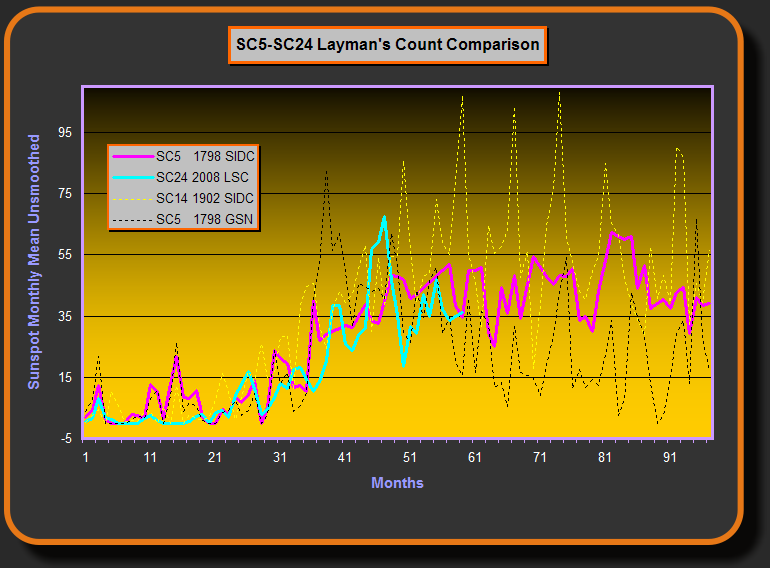
Sunspot numbers and 10.7 flux continue to be significantly lower than forecast (and the forecast for Cycle 24 were pretty low to begin with).

2010/10/05 08:00 Today was spotless although Locarno managed to see two groups. The specks were tiny and would be on the fringe of visibility on the original Wolf 64x telescope on a perfect day. What could be old area 1106 may be returning in the next two days.

Yesterday’s adjusted F10.7 flux figures recorded a high of 76.6 (81.4) and a low of 74.7 (78.8), unbelievably low.

F10.7 Radio Flux (including September 2010)

That we are in a solar minimum (the Landscheidt minimum) seems clear but whether it will be a grand minimum remains to be seen.

sc5 sc24 comparison

sc5,sc14 comparison with sc24

And the sun will surely impact our climate — but how?

And in any case the sun gets no feedback and it does not much care.


Biotechnology Advances retracts 3 papers from India for plagiarism

October 5, 2010

Biotechnology Advances


Update 3: 7th August 2011 Kalasalingam University sacks Sangiliyandi Gurunathan

Update 2: 27th June 2011: Yet another

Sangiliyandi retraction  h/t JV Prasath


Update:

Links to the retraction notices have been added – 31st January 2011 and the links have been updated 22nd February 2011.

Biotechnology Advances has retracted 3 papers from India (2 from IIT Kanpur and1 from Kalasalingam University), all at the request of the editors and all for plagiarism.

A matter of some shame for Indian science and especially for the Indian Institute of Technology Kanpur. It remains to be seen if the Institutions take any action. The plagiarism seems to have been particularly inept since it included blatant copying even from Wikipedia and Encyclopedias.

The 3 retraction notices are given below:

1. Retraction notice to “Microbial production of dihydroxyacetone” [Biotech Adv. 26 (2008) 293–303] by Ruchi Mishra, Seema Rani Jain and Ashok Kumar

Department of Biological Sciences and Bioengineering, Indian Institute of Technology Kanpur, 208016-Kanpur, India

Available online 22 August 2010.

Retraction Notice

Reason: This article has been retracted at the request of the editor as the authors have plagiarised part of several papers that had already appeared in several journals. One of the conditions of submission of a paper for publication is that authors declare explicitly that their work is original and has not appeared in a publication elsewhere. Re-use of any data should be appropriately cited. As such this article represents a severe abuse of the scientific publishing system. The scientific community takes a very strong view on this matter and we apologise to the readers of the journal that this was not detected during the submission process.

From a limited, non-exhaustive check of the text, several elements of the text had been plagiarised from the following list of sources:

Read the rest of this entry »

Physics Nobel for graphene

October 5, 2010

What I thought might be the subject area of the Chemistry Nobel was in fact rewarded with the Physics Nobel prize today.

The Nobel Prize in Physics 2010 was awarded jointly to Andre Geim and Konstantin Novoselov “for groundbreaking experiments regarding the two-dimensional material graphene”

BBC: Andrei Geim and Konstantin Novoselov, both at Manchester University, UK, took the prize for research on graphene. Geim, 51, is a Dutch national while Novoselov, 36, holds British and Russian citizenship. Both are natives of Russia and started their careers in physics there.

Andre Geim

Andre Geim: Wikipedia

Graphene is a flat sheet of carbon just one atom thick; it is almost completely transparent, but also extremely strong and a good conductor of electricity. It consists of a hexagonal array of sp2-bonded carbon atoms, just like those found in bulk graphite. 2D materials display very interesting properties, and are fundamentally different from the 3D materials we encounter everyday. The discovery of 2D materials means that scientists now have access to materials of all dimensionalities, including 0D (quantum dots, atoms) and 1D (nanowires, carbon nanotubes).

Geim and Novoselov first isolated the fine sheets of graphene from graphite. A layer of graphite one millimetre thick actually consists of three million layers of graphene stacked on top of one another. The layers are weakly held together and are therefore fairly simple to tear off and separate. The researchers used ordinary sticky tape to rip off thin flakes from a piece of graphite. Then they attached the flakes to a silicon plate and used a microscope to identify the thin layers of graphene among larger fragments of graphite and carbon scraps.

Graphene can be used for many different purposes including transistors, gas sensors, support membranes for TEM and inert transparent coatings.

Konstantin Novoselov

Konstantin Novoselov : Photo: University of Manchester, UK

It provides the possibility for further research in quantum physics, relativity and has allowed the Klein paradox to be observed for the first time.

Some scientists have precicted that graphene could one day replace silicon – which is the current material of choice for transistors. It could also yield incredibly strong, flexible and stable materials and find uses in transparent touch screens or solar cells.

Ten years ago, Professor Geim and Professor Sir Michael Berry from the University of Bristol were jointly awarded an Ig Nobel prize for their experiments using magnetic fields to levitate live frogs.

And Kim Jong Un may actually be Kim Jong 2 or maybe 3….?

October 5, 2010

German Expert Casts Doubt on Identity of Kim Jong Un

Kim the student in Switzerland

So-called “Kimologists” based in Seoul, Tokyo and Beijing are busy analyzing the impenetrable machinations of North Korea’s power structure. There is broad agreement that Kim Jong Il, referred to in North Korea as the “Dear Leader,” who succeeded his father Kim Il Sung (known as “Great Leader”) in 1994, suffered a stroke in 2008 and was forced to take time off governing for months.

At least one Japanese expert believes that Kim Jong Il died a long time ago and that doppelgangers are being used.

Was the fat-cheeked young man shown alongside North Korean dictator Kim Jong Il in an official photo really his son and chosen successor, Kim Jong Un?

The last few days have highlighted once again how little the world knows about the regime in Pyongyang. North Korean dictator Kim Jong Il, 68, summoned an extremely rare meeting of his Workers Party and presented his son Kim Jong Un, who is aged 26 or perhaps 27, as his successor.

Kim, the heir apparent

A German expert on face research claims he is not identical with the pupil shown in a widely published photo taken during his school days in Switzerland.

A Hamburg-based expert on facial research who was asked by SPIEGEL to compare several photos supposedly portraying Kim in his youth with the latest official one has come to an astonishing conclusion. There is a “high probablility that they are not one and the same person,” he said.

Many Kimologists say it doesn’t really matter who the young man is because he will be firmly embedded in a power apparatus made up of older relatives.

Read the Der Spiegel article: http://www.spiegel.de/international/world/0,1518,721076,00.html

He is supposed to have attended the International School of Berne incognito but even that is disputed, and Kim the heir -apparent may well not be Kim the schoolboy and maybe just the Kim who never was ……….

How exactly is biodiversity a problem?

October 5, 2010

Yesterday The Guardian reported that

While some 230,000 marine species have been recorded there are thought to be at least 1 million species in the sea. Ian Poiner, chair of the Census of Marine Life (COML) steering committee, said: “All surface life depends on life inside and beneath the oceans. Sea life provides half of our oxygen and a lot of our food and regulates climate. We are all citizens of the sea”. To mark the end of the COML project, scientists at the British Antarctic Survey (BAS) showed off the results of the Census of Antarctic Marine Life, an inventory of more than 16,000 marine species and the culmination of more than 19 trips into Antarctic waters.

In fact the total is unknown and may be as many as 10 million. The New Scientist points out:

A newly discovered copepod (Image: Jan Michels)

A newly discovered copepod (Image: Jan Michels)

“There are three to four unknown species for every known,” says Paul Snelgrove of Memorial University of Newfoundland in St John’s, Canada.

The Census has so far added 1200 new species to the tally, though that is likely to rise as over 5000 more organisms that were collected have yet to be studied or named. The new species include several that were thought to have disappeared, such as the “Jurassic shrimp”, which was believed to have died out 50 million years ago.

The Census was also able to identify those regions that are richest in diversity, which include the Gulf of Mexico and the Australian coastline. The Galapagos Islands, meanwhile, turned out to have less biodiversity than the chilly South Orkney Islands, in the Southern Ocean near Antarctica.

However, plant and animal diversity looks insignificant compared to the sea’s micro-organisms, which may number 1 billion. Their diversity is “spectacular”, Snelgrove says.

Just a few days ago Science reported that

Diana Fisher and Simon Blomberg of the University of Queensland in Australia carried out a comprehensive analysis of missing and extinct mammalian species. They created a database of all 187 mammal species that have been identified as extinct or possibly extinct, then combed through the literature to find out which ones had been rediscovered. They also included what threats the species had been facing, such as habitat destruction or hunting.

Read the rest of this entry »

Sony disassociate themselves from 10:10

October 4, 2010

I just received the following email from Nick Sharples, Sony Europe’s Director of Communications:

Dear Mr. Pillai,

Thank you for your email concerning the video released by the 10:10 climate change campaign group. Sony has supported the 10:10 climate change campaign because we share its objective to reduce carbon emissions. However, we strongly condemn the “No Pressure” video which was conceived, produced and released by 10:10 entirely without the knowledge or involvement of Sony. The company considers the video to be ill-conceived and in extremely bad taste. We also believe the video risks undermining the work of the many thousands of members of the public, schools and universities, local authorities and many businesses, of which Sony is one, who support the long-term aims of the 10:10 movement and who are actively working towards the reduction of carbon emissions.

As a result we have taken the decision to disassociate ourselves from 10:10 at this time.

In our press statement we will be posting tomorrow morning we reaffirm our ongoing commitment to the reduction of global carbon emissions as part of our ‘Road to Zero’ environmental plan.

Yours sincerely,

Nick

Nick Sharples

Director of Corporate Communications

Sony Europe

The Heights, Weybridge

Surrey, KT13 0XW

nick.sharples@eu.sony.com

+44 (0)7786 114 870 (Mobile)

+44(0)1932 816 828 (Office)

Getting a silkworm to behave like a spider

October 4, 2010

http://www.eurekalert.org/pub_releases/2010-09/uond-nda092910.php

A research and development effort by the University of Notre Dame, the University of Wyoming, and Kraig Biocraft Laboratories, Inc. has succeeded in producing transgenic silkworms capable of spinning artificial spider silks. “This research represents a significant breakthrough in the development of superior silk fibers for both medical and non-medical applications,” said Malcolm J. Fraser Jr., a Notre Dame professor of biological sciences. “The generation of silk fibers having the properties of spider silks has been one of the important goals in materials science.”

Silkworms and cocoon:University of Cambridge, Department of Materials Science

Natural spider silks have a number of unusual physical properties, including significantly higher tensile strength and elasticity than naturally spun silkworm fibers. The artificial spider silks produced in these transgenic silkworms have similar properties of strength and flexibility to native spider silk.

Until this breakthrough, only very small quantities of artificial spider silk had ever been produced in laboratories, but there was no commercially viable way to produce and spin these artificial silk proteins. Kraig Biocraft believed these limitations could be overcome by using recombinant DNA to develop a bio-technological approach for the production of silk fibers with a much broader range of physical properties or with pre-determined properties, optimized for specific biomedical or other applications.

The wonders of spider silk

Read the rest of this entry »

La Niña chills out the Pacific – could cause drought

October 4, 2010

“The tropical Pacific Ocean has transitioned from last winter’s El Niño conditions to a cool La Niña, as shown by new data about sea surface heights, collected by the U.S-French Ocean Surface Topography Mission (OSTM)/Jason-2 oceanography satellite” writes Science Daily.

La Niña continues to strengthen in the Pacific Ocean, as shown in the latest satellite data of sea surface heights from the NASA/European Ocean Surface Topography Mission/Jason-2 satellite. The image is based on the average of 10 days of data centered on Sept. 3, 2010. Higher (warmer) than normal sea surface heights are indicated by yellows and reds, while lower (cooler) than normal sea surface heights are depicted in blues and purples. Green indicates near-normal conditions. (Credit: NASA/JPL Ocean Surface Topography Team)

“This La Niña has strengthened for the past four months, is strong now and is still building,” said Climatologist Bill Patzert of NASA’s Jet Propulsion Laboratory, Pasadena, Calif. “It will surely impact this coming winter’s weather and climate.

“After more than a decade of mostly dry years on the Colorado River watershed and in the American Southwest, and only one normal rain year in the past five years in Southern California, water supplies are dangerously low,” Patzert added. “This La Niña could deepen the drought in the already parched Southwest and could also worsen conditions that have fueled Southern California’s recent deadly wildfires.” NASA will continue to track this change in Pacific climate.