Posts Tagged ‘NASA’

The sun at solstice 12.12 CET on 21.12.2012

December 22, 2012

The shortest day of the year has come and gone and the countdown to summer (in the Northern Hemisphere) has begun. From a day length of 6 hours 15 minutes yesterday the next 183 days will see the length of the day – at this latitude – increasing by an average of over 3 minutes every day reaching a day length of almost 17 hours at the summer solstice.

From Discovery News:

At 11:12 UT (6:12 a.m. EST), the world didn’t end (as far as I can tell), but it was a significant time none-the-less. That was the exact minute of the Winter Solstice in the Northern Hemisphere (or the Summer Solstice in the Southern Hemisphere) — when the daylight hours are shortest and the sun reaches its most southern position in the sky at noon.

Sun-solstice

The sun at solstice 12:12 CET on 21.12.2012: image NASA

NASA Solar Dynamics Observatory (SDO) captured the time of solstice from orbit. Although the SDO is always imaging the sun through a multitude of filters, this is a great excuse to showcase the fantastic beauty of our nearest star, while putting all the doomsday nonsense behind us.

The sun didn’t unleash a killer solar flare or devastating coronal mass ejection, but it is undergoing a fascinating period in its solar cycle.

As can be seen from the SDO image above, the solar magnetic field is twisted and warped, channeling million-degree plasma high into the sun’s atmosphere in the form of beautiful coronal loops. This is all because the sun is fast approaching “solar maximum” — an exciting time when the sun’s magnetic field is most stressed.

Diwali lights are not visible from space

December 6, 2012

I have posted earlier about the composite image from 2003 but taken over many years and which has purported to be an image of India during Diwali but which was not.

Now a real image actually taken of South Asia on Diwali night (November 12th/13th) this year has been released by NASA and they write: In reality, any extra light produced during Diwali is so subtle that it is likely imperceptible when observed from space”.

India 20121112 Diwali NASA

NASA reports: 

Every fall, Hindus around the world light lamps, candles, and firecrackers as part of a five-day festival known as Diwali. The celebration, which has roots as a harvest festival, usually falls between mid-October and mid-November. In 2012, it began on November 11.

On November 12, 2012, the Visible Infrared Imaging Radiometer Suite (VIIRS) on the Suomi NPP satellite captured this nighttime view of southern Asia. The image is based on data collected by the VIIRS “day-night band,” which detects light in a range of wavelengths from green to near-infrared. The image has been brightened to make the city lights easier to distinguish.

Most of the bright areas are cities and towns in India, the country with the world’s largest Hindu population. India is home to more than 1.2 billion people and has 30 cities with populations over 1 million. (For comparison, China has 62 cities with more than 1 million residents and the United States has 9). Cities in Bangladesh, Nepal, and Pakistan are also visible near the edges of the image.

An image that claims to show the region lit for Diwali has been circulating on social media websites and the Internet in recent years. In fact, it does not show what it claims. That image, based on data from the Operational Linescan System flown on U.S. Defense Meteorological Satellite Program (DMSP) satellites, is a color-composite created in 2003 by NOAA scientist Chris Elvidge to highlight population growth over time. In that image, white areas show city lights that were visible prior to 1992, while blue, green, and red shades indicate city lights that became visible in 1992, 1998, and 2003 respectively.

In reality, any extra light produced during Diwali is so subtle that it is likely imperceptible when observed from space.

Solar Cycle 24 prediction: On track to be smallest in 100 years

June 12, 2012

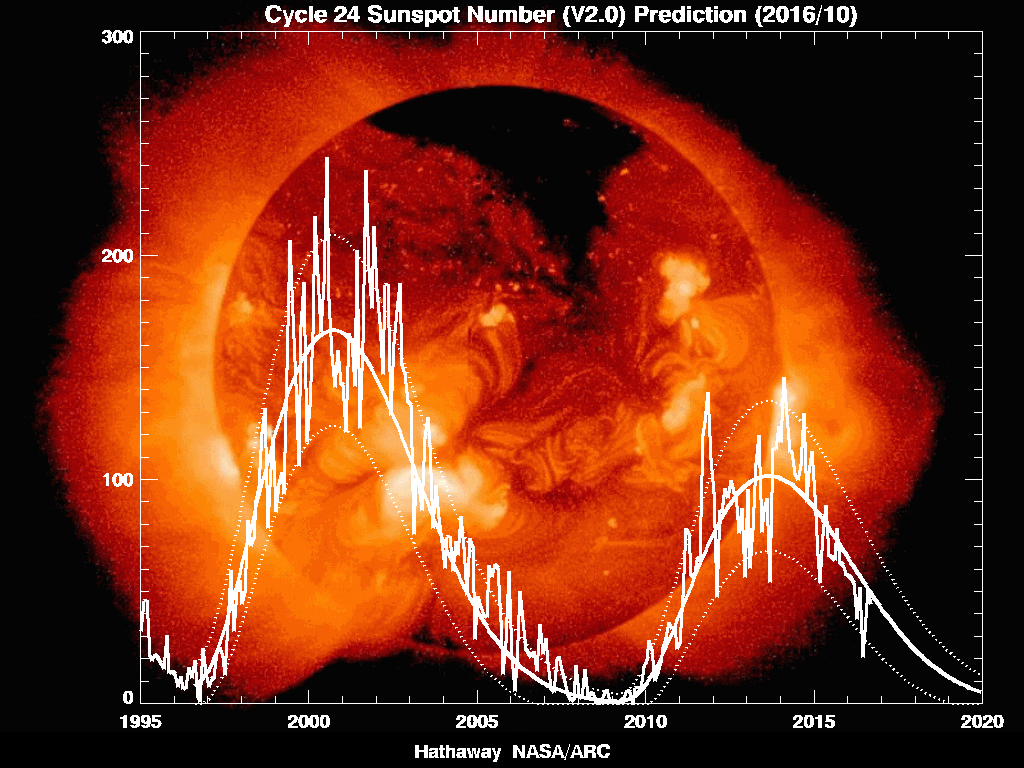
NASA has updated its forecast for Solar Cycle 24.

Maximum is expected to be reached in Spring 2013 with a sunspot number of 60 and this prediction is for the lowest sunspot number in  100 years. This only confirms that we are currently in a solar minimum – the Landscheidt Minimum – though it remains to be seen whether this will be a Grand Minimum in the style of the Maunder Minimum or the Dalton Minimum. In any event a period of several decades of global cooling is to be expected and is already probably upon us (starting some 10 years ago).

(more…)

The Dragon docks

May 26, 2012

Space Exploration Technologies (SpaceX) made history when its Dragon spacecraft became the first commercial vehicle in history to successfully attach to the International Space Station.  Previously only four governments – the United States, Russia, Japan and the European Space Agency – had achieved this challenging technical feat.

  • May 22/Launch Day: SpaceX’s Falcon 9 rocket launched the Dragon spacecraft into orbit from the Cape Canaveral Air Force Station.
  • May 23: Dragon orbited Earth as it traveled toward the International Space Station.
  • May 24: Dragon’s sensors and flight systems were subjected to a series of complicated tests to determine if the vehicle was ready to berth with the space station; these tests included maneuvers and systems checks in which the vehicle came within 1.5 miles of the station.
  • May 25: NASA gave Dragon the GO to attempt berthing with the station.  Dragon approached. It was captured by station’s robotic arm and attached to the station

The next steps:

  • May 25 – 31: Astronauts open Dragon’s hatch, unload supplies and fill Dragon with return cargo.
  • May 31: Dragon is detached from the station and returns to Earth, landing in the Pacific, hundreds of miles west of Southern California.

Live coverage of the hatch opening, including some of the first video from inside Dragon, will begin Saturday at approximately 3:00 AM PT/ 6:00 AM ET on www.spacex.com .

The scale of the Universe: from yoctometres to Gigaparsecs

March 16, 2012

I like this flash animation from NASA which is a modern version of the classic video Powers of Ten and travels from billionths of a yoctometre (10 -24 metres) up to tens of Gigaparsecs (about 3.1 x 10 25 metres). A journey of 60 powers of 10 from the Planck length of 1.616199(97)×10 -35  metres to the size of the observable universe at 10 27 metres.

“From where neutrinos are like suns to where galaxies are like dust”

It takes a few seconds to load.

http://apod.nasa.gov/apod/ap120312.html

Asteroid 2005 YU 55 will fly-by closer than the moon on Tuesday

November 6, 2011

A very close encounter coming up on Tuesday at 6:28 pm US Eastern time.

(Reuters) – A huge asteroid will pass closer to Earth than the moon Tuesday, giving scientists a rare chance for study without having to go through the time and expense of launching a probe, officials said.

Earth’s close encounter with Asteroid 2005 YU 55 will occur at 6:28 p.m. EST (2328 GMT) Tuesday, as the space rock sails about 201,000 miles from the planet.

(more…)

Solar Cycle 24: Still on track to be smallest sunspot number cycle in 100 years

August 25, 2011

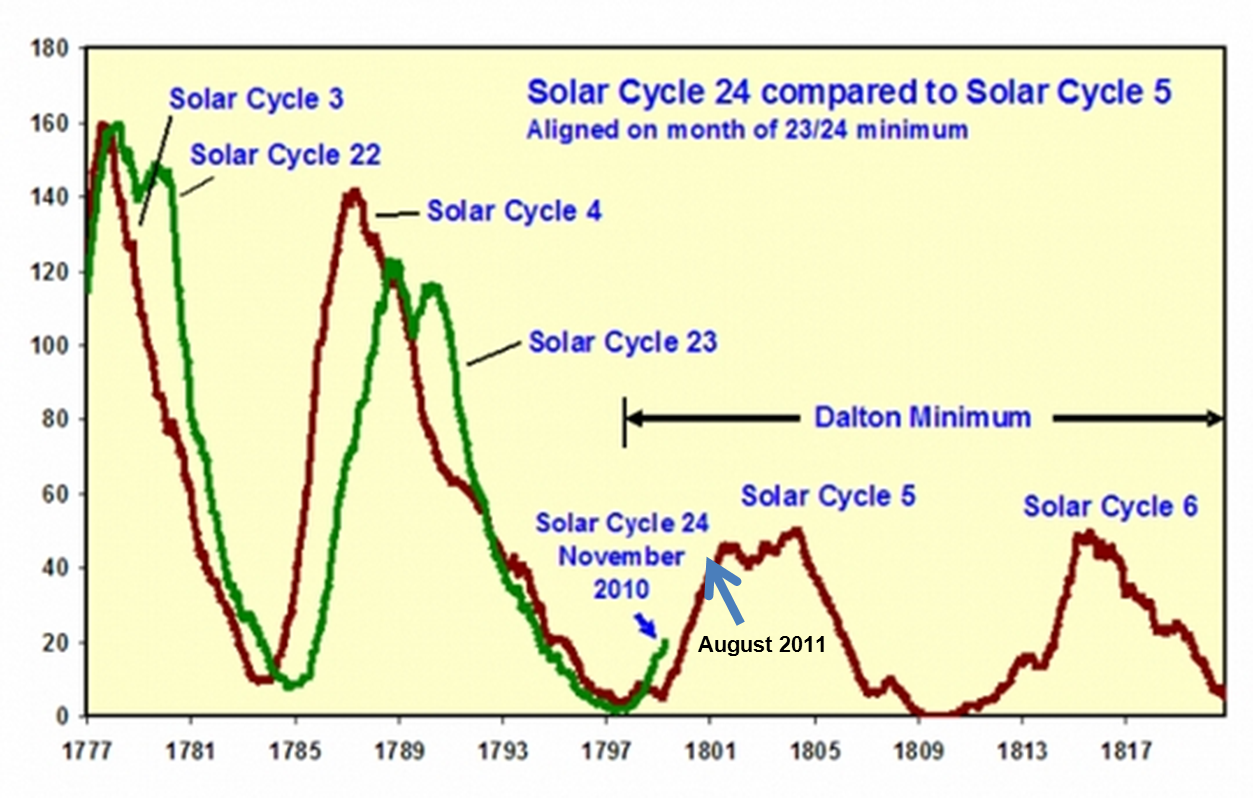
The August solar cycle 24 forecast from NASA is unchanged from the previous month though the maximum has increased to 69 from the 64 forecast about 6 months ago.

The current prediction for Sunspot Cycle 24 gives a smoothed sunspot number maximum of about 69 in June of 2013 (same as last month). We are currently over two and a half years into Cycle 24. Four out of the last five months with average daily sunspot numbers above 40 has raised the predicted maximum above the 64.2 for the Cycle 14 maximum in 1907. This predicted size still make this the smallest sunspot cycle in over 100 years.

NASA - Solar Cycle 24 forecast

Solar Cycle 24 continues to invite comparisons with Solar Cycle 5.

SC24 versus SC5 - from http://sc25.com

First private space flight to the ISS in November?

August 16, 2011

California-based rocket maker SpaceX said that it will make a test flight in late November to the International Space Station, now that NASA has retired its space shuttle program.The Dragon space capsule to be launched by a Falcon Heavy rocket has been given a November 30th launch date by NASA.

The Space X news release is here.

Space X Dragon capsule: image spacetourismnow.com

PhysOrg

“SpaceX has been hard at work preparing for our next flight — a mission designed to demonstrate that a privately-developed space transportation system can deliver cargo to and from the International Space Station (ISS),” the company, also called Space Exploration Technologies, said in a statement.

The mission is the second to be carried out by SpaceX, one of a handful of firms competing to make a spaceship to replace the now-defunct US shuttle, which had been used to carry supplies and equipment to the orbiting outpost.

“NASA has given us a November 30, 2011 launch date, which should be followed nine days later by Dragon berthing at the ISS,” the company said.

It said the arrival of the vessel at the space station would herald “the beginning of a new era in space travel.”

“Together, government and the private sector can simultaneously increase the reliability, safety and frequency of space travel, while greatly reducing the costs,” SpaceX said.

The company won $75 million in new seed money earlier this year, after it became the first to successfully send its own space capsule, the gumdrop-shaped Dragon, into orbit and back in December 2010.

Nasa Glory mission fails again after launch

March 4, 2011
Top down view of Taurus XL carrying OCO

Top down view of Taurus XL carrying OCO: Image via Wikipedia

The US space agency’s (Nasa) attempt to launch its latest Earth observation mission has ended in failure. This is the second straight failure for the Taurus XL rocket, which appears to be connected to the rocket failing to release its payload. The Glory satellite lifted off from California at 0209 local time (1009 GMT), but officials became aware of a problem five minutes into the mission.

The Glory spacecraft was scheduled for launch today  Friday, March 4 after technical issues with ground support equipment for the Taurus XL launch vehicle led to the scrub of the original Feb. 23 launch attempt. Those issues were thought to have been resolved. Data from the Glory mission is expected to allow scientists to better understand how the sun and tiny atmospheric particles called aerosols affect Earth’s climate. The Taurus XL also carries the first of NASA’s Educational Launch of Nanosatellite missions. This auxiliary payload contains three small satellites called CubeSats, which were designed and created by university and college students.

From Nasa’s blog:

After Liftoff of Taurus XL Rocket, Fairing Fails to Separate

The Glory spacecraft and Taurus XL rocket lifted off this morning on time at 2:09:43 a.m. PST/5:09:43 a.m. EST.

About six minutes into the launch, a spacecraft contingency was declared by Launch Director Omar Baez. Data indicates the rocket fairing did not separate. More information will be provided at a news briefing later on NASA TV.

Project management for Glory is the responsibility of NASA’s Goddard Space Flight Center in Greenbelt, Md. The launch management for the mission is the responsibility of NASA’s Launch Services Program at the Kennedy Space Center in Florida. Orbital Sciences Corp. of Dulles, Va., is the launch service provider to Kennedy of the four-stage Taurus XL rocket and is also builder of the Glory satellite for Goddard.

Kepler telescope finds two planets sharing the same orbit

February 25, 2011

Architecture and Dynamics of Kepler’s Candidate Multiple Transiting Planet Systems

by Jack J. Lissauer, Darin Ragozzine, Daniel C. Fabrycky, Jason H. Steffen, Eric B. Ford, Jon M. Jenkins, Avi Shporer, Matthew J. Holman, Jason F. Rowe, Elisa V. Quintana, Natalie M. Batalha, William J. Borucki, Stephen T. Bryson, Douglas A. Caldwell, David Ciardi, Edward W. Dunham, Jonathan J. Fortney, Thomas N. Gautier III, Steve Howell, David G. Koch, David W. Latham, Geoffrey W. Marcy, Robert C. Morehead, Dimitar Sasselov

Astrophysical Journal (arxiv.org/abs/1102.0543).

From the New Scientist:

Room for two (Image: NASA/Ames/JPL-Caltech)

Room for two (Image: NASA/Ames/JPL-Caltech)

Buried in the flood of data from the Kepler telescope is a planetary system unlike any seen before. Two of its apparent planets share the same orbit around their star. If the discovery is confirmed, it would bolster a theory that Earth once shared its orbit with a Mars-sized body that later crashed into it, resulting in the moon’s formation.

The two planets are part of a four-planet system dubbed KOI-730. They circle their sun-like parent star every 9.8 days at exactly the same orbital distance, one permanently about 60 degrees ahead of the other. In the night sky of one planet, the other world must appear as a constant, blazing light, never fading or brightening.

Gravitational “sweet spots” make this possible. When one body (such as a planet) orbits a much more massive body (a star), there are two Lagrange points along the planet’s orbit where a third body can orbit stably. These lie 60 degrees ahead of and 60 degrees behind the smaller object. For example, groups of asteroids called Trojans lie at these points along Jupiter’s orbit.

In theory, matter in a disc of material around a newborn star could coalesce into so-called “co-orbiting” planets, but no one had spotted evidence of this before. “Systems like this are not common, as this is the only one we have seen,” says Jack Lissauer of NASA’s Ames Research Center in Mountain View, California. Lissauer and colleagues describe the KOI-730 system in a paper submitted to the Astrophysical Journal (arxiv.org/abs/1102.0543).

File:Lagrange points2.svg

Lagrange Points: image Wikipedia