Posts Tagged ‘solar cycle’

Solar cycles and the Landscheidt minimum

March 10, 2012

A recent post by John O’Sullivan reminded me that it is time for the next solar minimum that is on its way to be named after the man who predicted it. Theodor Landscheidt (born in 1927 in Bremen, Germany, died on May 20, 2004) was an author and amateur climatologist. In 1989, Landscheidt forecast a period of sunspot minima after 1990, accompanied by increased cold, with a stronger minimum and more intense cold which should peak in 2030 which he described as the “Landscheidt Minimum”.

The sun goes through its cycles as it will and at its own pace and we continue to struggle to try and decipher the various cycles that exist, what causes them and what effects they have on the earth. Some of the cycles known or hypothesised to exist are the:

  • 11 year sunspot cycle
  • 22 year magnetic cycle
  • 87 year Gleissberg cycle
  • 166 year “unnamed” cycle
  • 210 years Suess or de Vries cycle
  • 2,300 years Hallstat cycle
  • 6000 years Xapsos and Burke cycle

Landscheidt’s paper is here: New Little Ice Age instead of Global Warming?

(more…)

Norway: “25–56% of the temperature increase the last 150 years may be attributed to the Sun”

March 8, 2012

The evidence for the obvious mounts. The sun comes first and dominates and then come the oceans which provide the vehicle for distributing solar effects around the globe. The mythical effect of anthropogenic carbon dioxide on climate has yet to be supported by any direct evidence. Instead, the direct evidence observations of the last 12 years is that increasing carbon dioxide concentration in the atmosphere has been accompanied by a decline of “global” temperature.

A new paper by Jan-Erik Solheim (Department of Physics and Technology, University of Tromsø), Kjell Stordahl (Telenor Norway, Fornebu), Ole Humlum (Department of Geosciences, University of Oslo; Department of Geology, University Centre in Svalbard).

The long sunspot cycle 23 predicts a significant temperature decrease in cycle 24

Preprint: Accepted for publication in Journal of Atmospheric and Solar-Terrestrial Physics February 9, 2012

Abstract. Relations between the length of a sunspot cycle and the average temperature in the same and the next cycle are calculated for a number of meteorological stations in Norway and in the North Atlantic region. No significant trend is found between the length of a cycle and the average temperature in the same cycle, but a significant negative trend is found between the length of a cycle and the temperature in the next cycle. This provides a tool to predict an average temperature decrease of at least 1.0 “C from solar cycle 23 to 24 for the stations and areas analyzed. We find for the Norwegian local stations investigated that 25-56% of the temperature increase the last 150 years may be attributed to the Sun. For 3 North Atlantic stations we get 63-72% solar contribution. This points to the Atlantic currents as reinforcing a solar signal.

Solar Cycle 24: Still on track to be smallest sunspot number cycle in 100 years

August 25, 2011

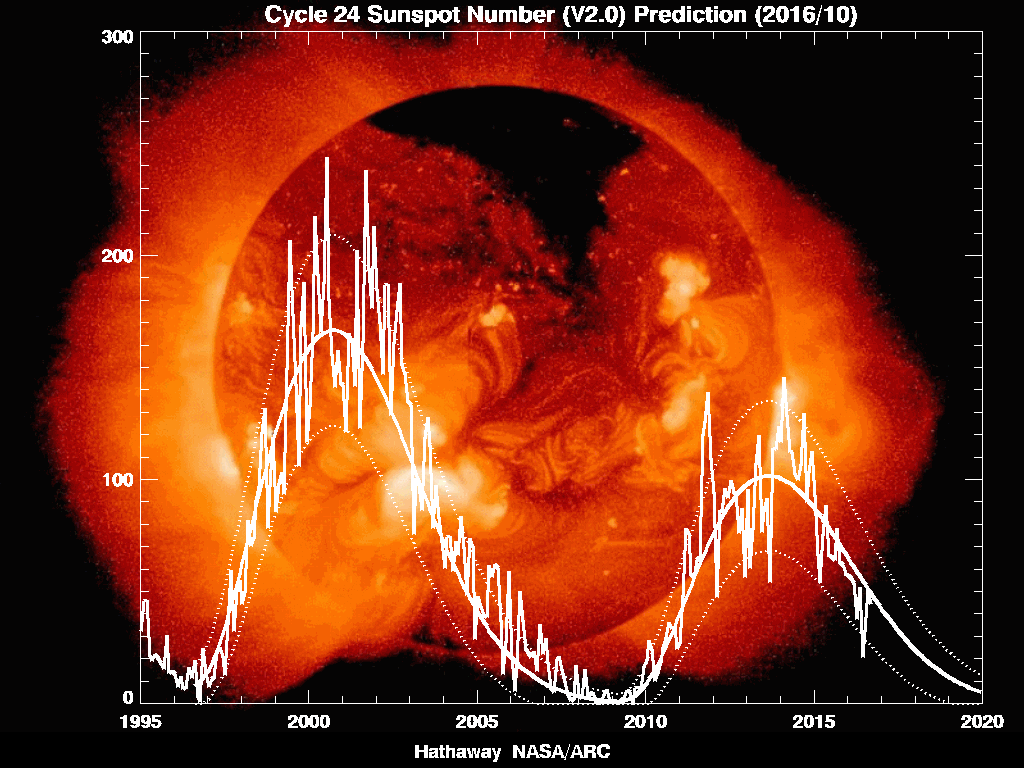
The August solar cycle 24 forecast from NASA is unchanged from the previous month though the maximum has increased to 69 from the 64 forecast about 6 months ago.

The current prediction for Sunspot Cycle 24 gives a smoothed sunspot number maximum of about 69 in June of 2013 (same as last month). We are currently over two and a half years into Cycle 24. Four out of the last five months with average daily sunspot numbers above 40 has raised the predicted maximum above the 64.2 for the Cycle 14 maximum in 1907. This predicted size still make this the smallest sunspot cycle in over 100 years.

NASA - Solar Cycle 24 forecast

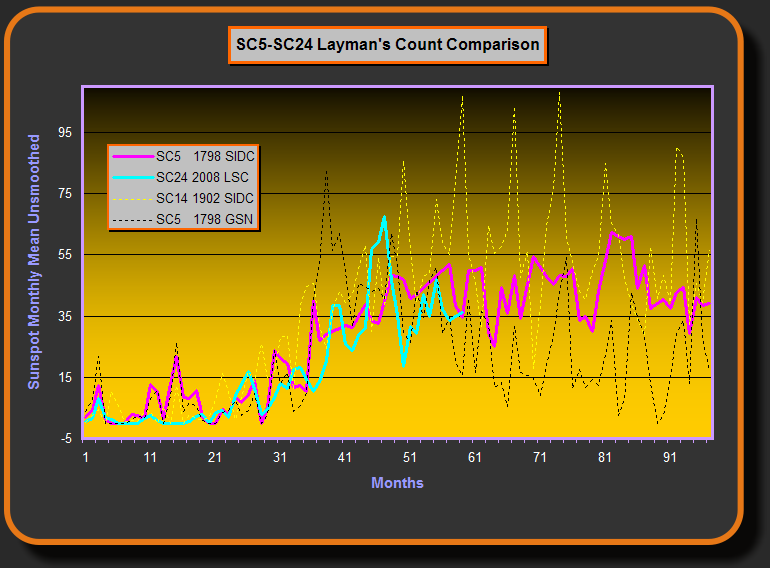
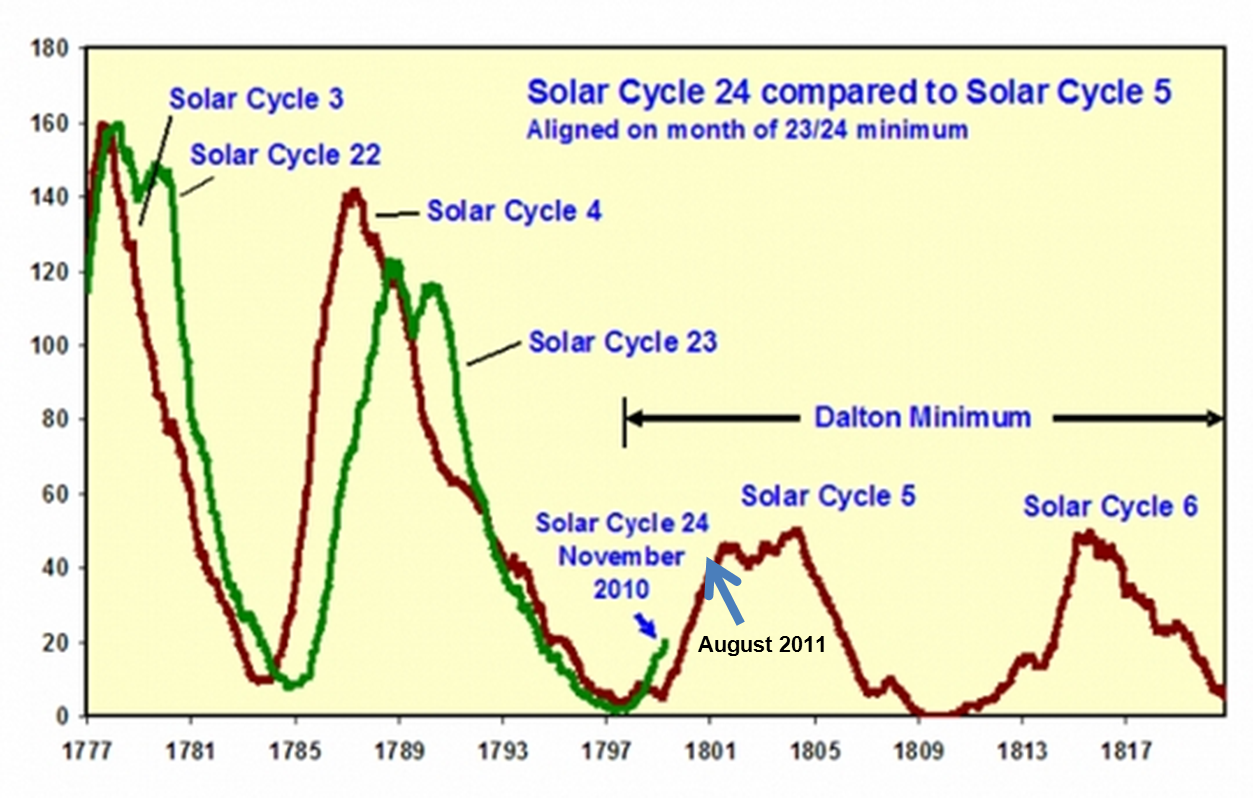
Solar Cycle 24 continues to invite comparisons with Solar Cycle 5.

SC24 versus SC5 - from http://sc25.com

Major Drop In Solar Activity Predicted: Landscheidt Minimum is upon us and a mini-ice age is imminent

June 15, 2011

The stunning announcement made at the annual meeting of the American Astronomical Society exceeded the expectations from the advance publicity!

The results of new studies were announced today (June 14) at the annual meeting of the solar physics division of the American Astronomical Society, which is being held this week at New Mexico State University in Las Cruces. 

The results of three separate studies seem to show that even as the current sunspot cycle (SC24) moves toward the solar maximum, the sun could be heading into a more-dormant period, with activity during the next 11-year sunspot cycle (SC25) greatly reduced or even eliminated.

The indicators have been  growing for some time that we are in for a a new solar minimum – the Landscheidt minimum – which could be similar to the Dalton Minimum and may even approach the Maunder Minimum. This could mean a cooling period for the earth of 20 – 30 years or for as long as 60 – 70 years. In any event the signs will be unambiguous and inescapable within a decade.

It is reasonable to assume that climatic conditions over the next 20 – 30 years will resemble those prevailing between 1790 and 1820. But SC24 has a way to go yet and it could be that solar activity for SC24 and 25 will be even lower than during the Dalton minimum and perhaps closer to the Spörer minimum but perhaps not as deep as the Maunder minimum.

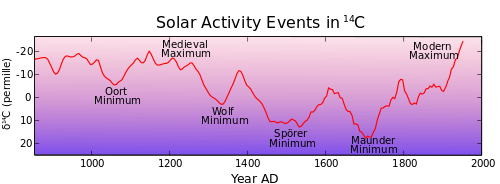
But in either case the solar activity to come following the Modern maximum may well resemble the 500 years of decline in solar activity which followed the Medieval maximum.

Solar activity events recorded in radiocarbon. Present period is on left. Values since 1950 not shown: Wikipedia

The three papers are: 

  1. “Large-Scale Zonal Flows During the Solar Minimum — Where Is Cycle 25?” by Frank Hill, R. Howe, R. Komm, J. Christensen-Dalsgaard, T.P. Larson, J. Schou & M. J. Thompson.
  2. “A Decade of Diminishing Sunspot Vigor” by W. C. Livingston, M. Penn & L. Svalgard.
  3. “Whither Goes Cycle 24? A View from the Fe XIV Corona” by R. C. Altrock.

 Spacedaily reports:

Major Drop In Solar Activity Predicted

As the current sunspot cycle, Cycle 24, begins to ramp up toward maximum, independent studies of the solar interior, visible surface, and the corona indicate that the next 11-year solar sunspot cycle, Cycle 25, will be greatly reduced or may not happen at all.

“This is highly unusual and unexpected,” Dr. Frank Hill, associate director of the NSO’s Solar Synoptic Network, said of the results. “But the fact that three completely different views of the Sun point in the same direction is a powerful indicator that the sunspot cycle may be going into hibernation.”

Hill is the lead author on one of three papers on these results being presented this week. Using data from the Global Oscillation Network Group (GONG) of six observing stations around the world, the team translates surface pulsations caused by sound reverberating through the Sun into models of the internal structure.

One of their discoveries is an east-west zonal wind flow inside the Sun, called the torsional oscillation, which starts at mid-latitudes and migrates towards the equator. The latitude of this wind stream matches the new spot formation in each cycle, and successfully predicted the late onset of the current Cycle 24.

“We expected to see the start of the zonal flow for Cycle 25 by now,” Hill explained, “but we see no sign of it. This indicates that the start of Cycle 25 may be delayed to 2021 or 2022, or may not happen at all.”

In the second paper, Matt Penn and William Livingston see a long-term weakening trend in the strength of sunspots, and predict that by Cycle 25 magnetic fields erupting on the Sun will be so weak that few if any sunspots will be formed. Spots are formed when intense magnetic flux tubes erupt from the interior and keep cooled gas from circulating back to the interior.

For typical sunspots this magnetism has a strength of 2,500 to 3,500 gauss (Earth’s magnetic field is less than 1 gauss at the surface); the field must reach at least 1,500 gauss to form a dark spot.

Using more than 13 years of sunspot data collected at the McMath-Pierce Telescope at Kitt Peak in Arizona, Penn and Livingston observed that the average field strength declined about 50 gauss per year during Cycle 23 and now in Cycle 24.

They also observed that spot temperatures have risen exactly as expected for such changes in the magnetic field. If the trend continues, the field strength will drop below the 1,500 gauss threshold and spots will largely disappear as the magnetic field is no longer strong enough to overcome convective forces on the solar surface.

Moving outward, Richard Altrock, manager of the Air Force’s coronal research program at NSO’s Sunspot, NM, facilities has observed a slowing of the “rush to the poles,” the rapid poleward march of magnetic activity observed in the Sun’s faint corona. Altrock used four decades of observations with NSO’s 40-cm (16-inch) coronagraphic telescope at Sunspot.

“A key thing to understand is that those wonderful, delicate coronal features are actually powerful, robust magnetic structures rooted in the interior of the Sun,” Altrock explained. “Changes we see in the corona reflect changes deep inside the Sun.”

Altrock used a photometer to map iron heated to 2 million degrees C (3.6 million F). Stripped of half of its electrons, it is easily concentrated by magnetism rising from the Sun. In a well-known pattern, new solar activity emerges first at about 70 degrees latitude at the start of a cycle, then towards the equator as the cycle ages. At the same time, the new magnetic fields push remnants of the older cycle as far as 85 degrees poleward.

“In cycles 21 through 23, solar maximum occurred when this rush appeared at an average latitude of 76 degrees,” Altrock said.

“Cycle 24 started out late and slow and may not be strong enough to create a rush to the poles, indicating we’ll see a very weak solar maximum in 2013, if at all. If the rush to the poles fails to complete, this creates a tremendous dilemma for the theorists, as it would mean that Cycle 23’s magnetic field will not completely disappear from the polar regions (the rush to the poles accomplishes this feat). No one knows what the Sun will do in that case.”

All three of these lines of research to point to the familiar sunspot cycle shutting down for a while. “If we are right,” Hill concluded, “this could be the last solar maximum we’ll see for a few decades. That would affect everything from space exploration to Earth’s climate.”
That last may be the understatement of the century!!!

A photo of a sunspot taken in May 2010, with Earth shown to scale. The image has been colorized for  aesthetic reasons. This image with 0.1 arcsecond resolution from the Swedish 1-m Solar  Telescope represents the limit of what is currently possible in te

A photo of a sunspot taken in May 2010, with Earth shown to scale.This image with 0.1 arcsecond resolution from the Swedish 1-m Solar Telescope represents the limit of what is currently possible in terms of spatial resolution. CREDIT: The Royal Swedish Academy of Sciences, V.M.J. Henriques (sunspot), NASA Apollo 17 (Earth)

Solar effects will give increased volcanic and earthquake activity in the next 2 years

February 22, 2011

Solar effects are much more profound than many so-called climate scientists like to admit. It seems entirely plausible to me that earthquakes and volcanism are connected to solar events. This paper by Zhang from 1998 also associates increased Earthquakes with general increases in solar proton events.

http://www.springerlink.com/content/buvw2tq081013210/fulltext.pdf?page=1

Relationship between global seismicity and solar activities

Gui-Qing ZHANG

Vol. 11 No.4 (495~500)  ACTA SEISMOLOGICA SINICA  July, 1998

Beijing Astronomical Observatory, Chinese Academy of  Sciences, Beijing 100101, China

Abstract :

The  relations  between  sunspot  numbers and earthquakes  (M>6), solar 10.7cm  radio flux  and  earthquakes,  solar  proton events and earthquakes have been  analyzed in this  paper. It has been found that:

  1. Earthquakes occur frequently around the minimum years  of  solar activity. Generally, the  earthquake  activities are  relatively less during the peak value years of  solar activity, some  say, a round the period when magnetic polarity  in the  solar polar regions  is reversed.
  2. The earthquake frequency in the minimum period of  solar activity is closely related to the  maximum annual means of sunspot numbers, the maximum annual means of solar 10.7 cm radio flux and solar proton events of a whole solar cycle, and the relation between earthquake and solar proton events is closer than others.
  3. As judged by above interrelationship, the period from 1995 to 1997 will be the years while earthquake activities are frequent. In the paper, the simple physical discussion has been carried out.

Piers Corbyn at WeatherAction comments:

“We now think that it is not just general solar proton event levels which point towards more earthquakes but that individual solar proton events exacerbate immediate earthquake (and associated volcanism) risk either directly or due to consequent storm activity and related surface pressure changes such as caused by our solar triggered and predicted Tropical Cyclone Atu which is currently centred North of New Zealand and heading closer.

There are also additional lunar effects on storm development and earthquakes & volcanism and for solar drivers it appears that the odd-even minima, particularly the later part i.e. the rising phase of even solar cycles – WHICH IS WHERE WE ARE NOW (early Solar Cycle 24) – are the most dangerous.

Prediction of individual Earthquakes is very hard but we are very confident of a continuing period of significantly enhanced earthquake and volcanic activity as well as extreme weather events for the coming one or two years, probably exceeding the levels of the most active extended periods in at least the last 100 years.”

Landscheidt minimum is here — a new Dalton is indicated

December 21, 2010
SDO Sunspot

Spotless Sun

All the indicators are that the Landscheidt minimum is here and that this is going to be close to a Dalton minimum.

2010/12/20 8:00  Five Days in a row spotless is achieved 12 months after solar cycle 24 began it’s ramp up.

A Dalton Minimum Repeat is Shaping Up

The Dalton Minimum was a period of low solar activity, named after the English meteorologist John Dalton, lasting from about 1790 to 1830. Like the Maunder Minimum and Spörer Minimum, the Dalton Minimum coincided with a period of lower-than-average global temperatures. The Oberlach Station in Germany, for example, experienced a 2.0°C decline over 20 years. The Year Without a Summer, in 1816, also occurred during the Dalton Minimum. Solar cycles 5 and 6, as shown below, were greatly reduced in amplitude.

http://solarcycle24.com/sunspots.htm

Sunspot number till December 7th


http://www.landscheidt.info/images/sc5_sc24.png

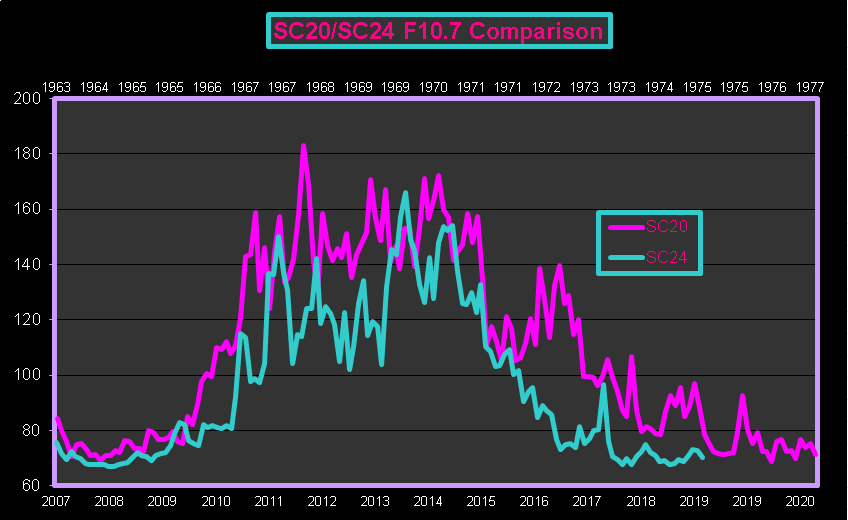
To compare solar cycles we can also use the F10.7 radio flux values that have been recorded since 1947 in Canada. Solar cycle 20 was a weak cycle which is currently looking strong against solar cycle 24. Data is taken from the AU adjusted monthly average values.

Why Forecasts need to be wrong

October 7, 2010


The Lorenz attractor is an example of a non-li...

Image via Wikipedia


This started yesterday as a short comment on the changing forecasts by Hathaway on solar activity in Solar Cycle 24 but has now become something else.

As clarification, I  distinguish here between prophecies and forecasts  where:

  • I take prophecies to be a promise about the future  based primarily on faith and made by prophets , witchdoctors, soothsayers and politicians such as “You will be doomed to eternal damnation if you don’t do as I say”,
  • I take “forecasts” to be an estimate of future conditions based on known data with the use of calculations, logic, judgement, some intuition and even some faith. They are extrapolations of historical conditions to anticipate – and thereby plan for -future conditions.

(more…)

New Scientist permits the sun to join the climate club

September 23, 2010

It does seem as if the AGW establishment are preparing the ground for admitting that the sun is perhaps critical for climate.

The New Scientist runs an editorial today grudgingly admitting that “The sun’s activity has a place in climate science”.

FOR many years, any mention of the sun’s influence on climate has been greeted with suspicion.

People who believe human activity has no effect on the climate staked a claim on the sun’s role, declaring it responsible for the long-term warming trend in global temperatures. Climate scientists were often uneasy about discussing it, fearful that any concession would be misunderstood by the public and seen as an admission that climate sceptics are right.

No one has ever denied that the sun has an effect on climate. But the consensus view has always been that variations in the sun’s activity, such as the 11-year sunspot cycle, have insignificant effects. While this remains true, the latest findings show that the sun might be significant on a more regional scale. It seems changes in solar activity can have consequences ranging from higher rainfall in the tropics to extreme weather events in the north.

Mighty sun

But then they go out of their way in this article (see “The sun joins the climate club”) to denigrate the sun.

THE idea that changes in the sun’s activity can influence the climate is making a comeback, after years of scientific vilification, thanks to major advances in our understanding of the atmosphere.

The findings do not suggest – as climate sceptics frequently do – that we can blame the rise of global temperatures since the early 20th century on the sun. “There are extravagant claims for the effects of the sun on global climate,” says Giles Harrison, an atmospheric physicist at the University of Reading, UK. “They are not supported.”

Where solar effects may play a role is in influencing regional weather patterns over the coming decades. Predictions on these scales of time and space are crucial for nations seeking to prepare for the future.

Over the famous 11-year solar cycle, the sun’s brightness varies by just 0.1 per cent. This was seen as too small a change to impinge on the global climate system, so solar effects have generally been left out of climate models. However, the latest research has changed this view, and the next report by the Intergovernmental Panel on Climate Change (IPCC), due in 2013, will include solar effects in its models.

But the sun does not much care (Beware the Icarus Syndrome) I think for the scientific establishment and will continue to do its own thing.

Defence lobbies enlist the sun

September 18, 2010

“Solar flares could paralyse Britain’s power and communications”.

The UK Defence Secretary will next week attend a summit of scientists and security advisers who believe the infrastructure that underpins modern life in Western economies is potentially vulnerable to electromagnetic disruption. Dr Liam Fox will tell the conference he believes there is a growing threat, and he wants to address the “vulnerabilities” in Britain’s high-tech infrastructure. “As the nature of our technology becomes more complex, so the threat becomes more widespread,” he will say.

Brahmos Missiles

The meeting will be addressed by Avi Schnurr, a former US government adviser who said that “super-flares” occur about once every hundred years, meaning the next is overdue. The electrical grid, computers, telephones, transportation, water supply, food production are all vulnerable to a major flare, said Mr Schnurr, who also works for the Israel Missile Defence Association, a lobby group.

David Williams, acting head of the UK Space Agency, told a Commons committee that any negative impacts on technology, particularly satellites, would have “severe problems both short-term and long-term” for Britain.

A few weeks ago the talk was of a Solar Tsunami which turned out to be little more than a pretty ripple. https://ktwop.wordpress.com/2010/08/04/alarmism-exaggerations-aplenty/.

The Telegraph contributed to the alarmism http://www.telegraph.co.uk/science/space/7923069/Nasa-scientists-braced-for-solar-tsunami-to-hit-earth.html

That lobbyists will use whatever scare scenario they can find to increase budgets and sales of totally unnecessary equipment (Y2K for example) is understandable. But Ministers are expected to be a little more discerning. Applying the nonsensical precautionary principle for an event that may occur once in a hundred years and which will affect the “enemy” as much as anyone else seems a feeble argument to increase defence budgets.

Beware the Icarus syndrome

September 16, 2010

Like Icarus the global warming believers pay little attention to the sun and its moods. But like the wings of Icarus the demonisation of carbon dioxide is likely to be demolished by the sun. We are now in Solar Cycle  24 and magnetic flux and sunspots continue to be lower than the already low forecasts for this cycle. The Landscheidt minimum approaches and the sun is entirely oblivious of fanciful theories about coming ice ages or the melting of the polar ice caps. The sun will not be denied. The earth will merely adapt to whatever the sun deigns to produce and it might be best if we focused on adapting to whatever the sun does and waste less time on trying to control the climate.

Say Goodbye to Sunspots?

Science reports a new paper submitted to the International Astronomical Union Symposium No. 273, an online colloquium showing that the dearth of sunspots is at an unprecedented low level.

The sun goes through an 11-year cycle, in which the number of sunspots spikes during a period called the solar maximum and drops—sometimes to zero—during a time of inactivity called the solar minimum.The last solar minimum should have ended last year, but something peculiar has been happening. Although solar minimums normally last about 16 months, the current one has stretched over 26 months—the longest in a century. One reason, according to the paper is that the magnetic field strength of sunspots appears to be waning.

After studying sunspots for the past 2 decades the authors have concluded that the magnetic field that triggers their formation has been steadily declining. If the current trend continues, by 2016 the sun’s face may become spotless and remain that way for decades—a phenomenon that in the 17th century coincided with a prolonged period of cooling on Earth. Sunspots disappeared almost entirely between 1645 and 1715 during a period called the Maunder Minimum, which coincided with decades of lower-than-normal temperatures in Europe nicknamed the Little Ice Age. But Livingston cautions that the zero-sunspot prediction could be premature. “It may not happen,” he says. “Only the passage of time will tell whether the solar cycle will pick up.” Still, he adds, there’s no doubt that sunspots “are not very healthy right now.” Instead of the robust spots surrounded by halolike zones called penumbrae, as seen during the last solar maximum (photo), most of the current crop looks “rather peaked,” with few or no penumbrae.

Over a year ago Henrik Svensmark, Professor, Technical University of Denmark, Copenhagen warned “In fact global warming has stopped and a cooling is beginning. No climate model has predicted a cooling of the Earth – quite the contrary. And this means that the projections of future climate are unreliable.”

It’s important to realise that the Little Ice Age was a global event. It ended in the late 19th Century and was followed by increasing solar activity. Over the past 50 years solar activity has been at its highest since the medieval warmth of 1000 years ago. But now it appears that the Sun has changed again, and is returning towards what solar scientists call a “grand minimum” such as we saw in the Little Ice Age.

The match between solar activity and climate through the ages is sometimes explained away as coincidence. Yet it turns out that, almost no matter when you look and not just in the last 1000 years, there is a link. Solar activity has repeatedly fluctuated between high and low during the past 10,000 years. In fact the Sun spent about 17 per cent of those 10,000 years in a sleeping mode, with a cooling Earth the result.

image: http://solarcycle24.com/sunspots.htm