Archive for the ‘Solar science’ Category

Idiot science? Urban vegetation decreases violent crime but not theft!

April 6, 2013

Correlation and causation again! Correlation does not necessarily mean causation and even real causation may not give any correlation.

The authors are from the Department of Geography and Urban Studies, Temple University, United States. And they get paid for this?

Does vegetation encourage or suppress urban crime? Evidence from Philadelphia, PA, Mary K. Wolfe and Jeremy Mennis, Landscape and Urban Planning, Volume 108, Issues 2–4, November–December 2012, Pages 112–122, http://dx.doi.org/10.1016/j.landurbplan.2012.08.006

(emphasis added)

AbstractThere is longstanding belief that vegetation encourages crime as it can conceal criminal activity. Other studies, however, have shown that urban residential areas with well-maintained vegetation experience lower rates of certain crime types due to increased surveillance in vegetated spaces as well as the therapeutic effects ascribed to vegetated landscapes. The present research analyzes the association of vegetation with crime in a case study of Philadelphia, Pennsylvania. We examine rates of assaults, robberies, burglaries, and thefts in relation to remotely sensed vegetation abundance at the Census tract level. We employ choropleth mapping, correlation, ordinary least squares regression, and spatial econometric modeling to examine the influence of vegetation on various crime types while controlling for tract-level socioeconomic indicators. Results indicate that vegetation abundance is significantly associated with lower rates of assault, robbery, and burglary, but not theft. This research has implications for urban planning policy, especially as cities are moving towards ‘green’ growth plans and must look to incorporate sustainable methods of crime prevention into city planning.

And Discover Magazine comments (comments?)

The explanation, the authors say, is twofold: One, green spaces encourage people to spend more time socially outdoors, which discourages crime. It’s especially helpful for crime control when young and old people mix together in public places. And two, the presence of plants has a therapeutic effect. Vegetation decreases mental fatigue and its associated symptoms, such as irritability and decreased impulse control, both considered to be precursors to violence.

This “plant therapy” mechanism is bolstered by the Philadelphia findings. The most violent of the crimes studied, aggravated assault, was most strongly correlated with a neighborhood’s degree of greenness, while the least violent crime, theft, showed no association. This could indicate that it’s a violent mentality itself that green spaces are discouraging.

That hypothesis needs further study.

And that last line is the giveaway.

No, every idiot hypothesis does not need further study! 
Does the solar cycle impact the global economic cycle?

April 2, 2013

That weather and climate are affected by solar cycles is highly likely even if it is not part of the mainstream climate theories (though I think it is patently obvious). That climate and weather affect food production is clear and that this must impact the economic cycle is not so far fetched. Yet it has never been part of mainstream economic thinking that there will be a connection from the solar cycle to global economic cycles. Back in 1801 William Herschel observed the apparent connection between the sunspot cycles and the price of wheat. Since then many economists have returned at regular intervals to studying the link between the 11 year sunspot cycle and the behaviour of the global economic cycle. It is becoming increasingly clear that the economic cycle is not unconnected with solar cycles but the mechanisms are far from clear.

Mikhail Gorbanev an economist at the IMF has a fascinating new paper that became available last month at the University of Munich. He does add this Caution though!

Caution: This research is not in the “mainstream” of the economic thought. Read at your own risk!

Sunspots, unemployment, and recessions, or Can the solar activity cycle shape the business cycle?,” MPRA Paper 40271, University Library of Munich, Germany. (pdf Gorbanev Business Cycle and solar cycles MPRA_paper_40271)

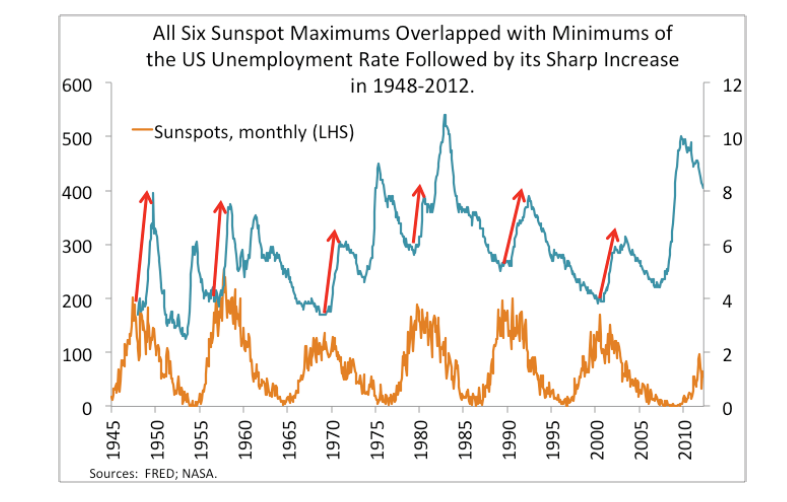
Gorbanev shows some interesting correlations and  goes on to predict that “For other advanced economies, the upcoming solar maximum also suggests higher chances of recessions. The 3-year period when the recessions are most likely to occur in the G7 countries would run from early 2013 till end-2015”.

Whether there will be a sharp increase in US unemployment after the solar maximum remains to be seen. But it is not so unlikely that the world economy has another 2 – 3 tough years ahead!


Sunspot cycles and US unemployment (Gorbanev 2012)

Sunspot cycles and US unemployment (Gorbanev 2012)

Abstract 

 Over the last 77 years (from 1935), all 7 cyclical maximums of the solar activity overlapped closely with the US recessions, thus predicting (or triggering?) 8 out of 13 recessions officially identified by NBER (including one “double-deep” recession). Over the last 64 years (from 1948), all 6 maximums of the solar activity were preceded by minimums of the US unemployment rate, and the spikes in the unemployment rate followed with lags of 2-3 years. On the world scale, over the last 44 years (for which the data is available), all 4 maximums of the solar activity overlapped with minimums of the unemployment rate in the G7 countries, followed by its spikes within 2-3 years. From 1965, when consistent recession dating is available for all G7 countries, nearly 3/5 of the recessions started in the 3 years around and after the sunspot maximums. Was it a mere coincidence or a part of a broader pattern? This paper explores the correlation between the solar activity cycles (as measured by the number of sunspots on the sun surface) and the timing of recessions in the US and other economies. It finds out that the probability of recessions in G7 countries greatly increased around and after the solar maximums, suggesting that they can cause deterioration in business conditions and trigger recessions. This opens new approach for projecting recessions, which can be applied and tested with regard to the next solar maximum in 2013.

Prof. Peter A. Ziegler: Solar effects drive climate change not CO2

March 14, 2013
Peter Ziegler

Peter Ziegler: image The Geological Society

Prof. Peter Ziegler (b. 1928) is a Swiss geologist  and Titular Professor of Global Geology at the Geological-Paleontological Institute, University of Basel. He is a member of the Royal Netherlands Academy of Sciences, the Polish Academy of Arts and Sciences, the Russian Academy of Natural Sciences and the Academia Europaea. His presentation on the “Mechanisms of Climate Change” from February this year is pretty self-contained and self explanatory and my comments would only be superfluous.

Climate Change Ziegler 2013 (pdf)

I reproduce his conclusions slide below:

  • Climate change during industrial times can be fully explained by natural processes
  • During the last 550 Million years major natural climate changes involved large fluctuations in temperature and atmospheric CO2 concentrations
  • Apart from orbital forcing and the distribution of continents and oceans, variations in solar activity and the galactic cosmic ray flux controlled climate changes during the geological past and probably still do so
  • Despite rising atmospheric CO2 concentrations we may experience during the coming decades a serious temperature decline akin to the Maunder Minimum due to decreasing solar activity
  • There is overwhelming evidence that Temperature forces the Carbon Cycle and not vice-versa, as postulated by IPCC
  • IPCC underestimates the effects of direct and indirect solar climate forcing but overestimates CO2 forcing by assuming unrealistic positive temperature feedbacks from a concomitant water vapor and cloud increase
  • The IPCC consensus on anthropogenic CO2 emissions causing Global Warming cannot be reconciled with basic data and is therefore challenged

Double peak in Solar Cycle 24? as in SC14 and in SC5?

March 4, 2013

The NOAA/NASA Solar Cycle Prediction Panel is puzzled. They don’t know if we are reaching solar maximum or whether another little peak could be on its way which would shift solar maximum for SC24 to 2014 from 2013.

And should we compare SC24 with SC14 or should it be SC5?

But SC24 will still show the lowest sunspot activity for 100 years. I note that not only SC14 but even SC5 had a double peak – so my expectation remains that this Landscheidt Minimum may be comparable to the Dalton Minimum – though not perhaps to the Maunder Minimum.

credit Dr. Tony Phillips

credit Dr. Tony Phillips

This Sciencecast video is a good summary of what we don’t know:

Landscheidt’s prediction is that this Minimum will last till 2060 so we can expect low sunspot activity for the next 4 sunspot cycles (till SC28).

Landscheidt’s predicted solar minima

The Sc24 –  SC5 comparison looks like a repeating pattern but it would be wrong to assume that the Sun cares about this and it will surely continue to keep us perplexed as it does its own thing.

SC24 compared to SC5

The Big Picture is persuasive – even if we don’t really know what the sun is upto and even less about how the Earth dances to the Sun’s music.

Recent solar activity (Wikipedia) showing the Maunder and Dalton minima

Related:

Solar cycles and the Landscheidt minimum

Theodor landscheidt: Sun-Earth-Man and the Kepler ratios

Solar Cycle 24 will be the smallest sunspot cycle since 1906 (SC 14)

January 5, 2013

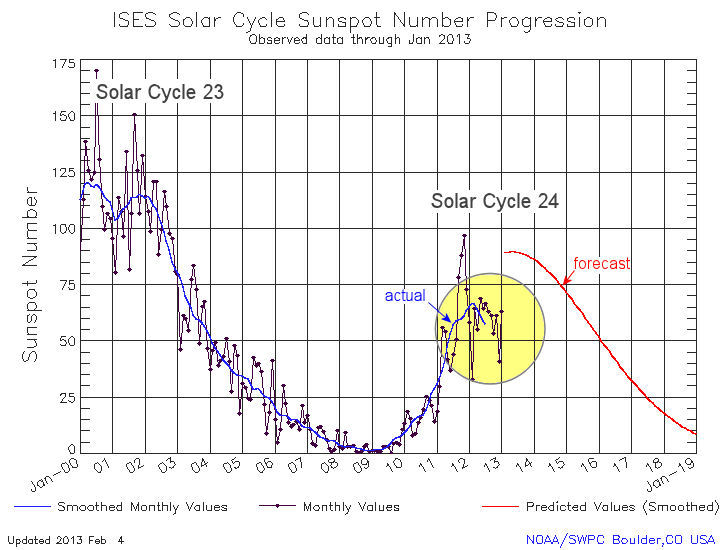
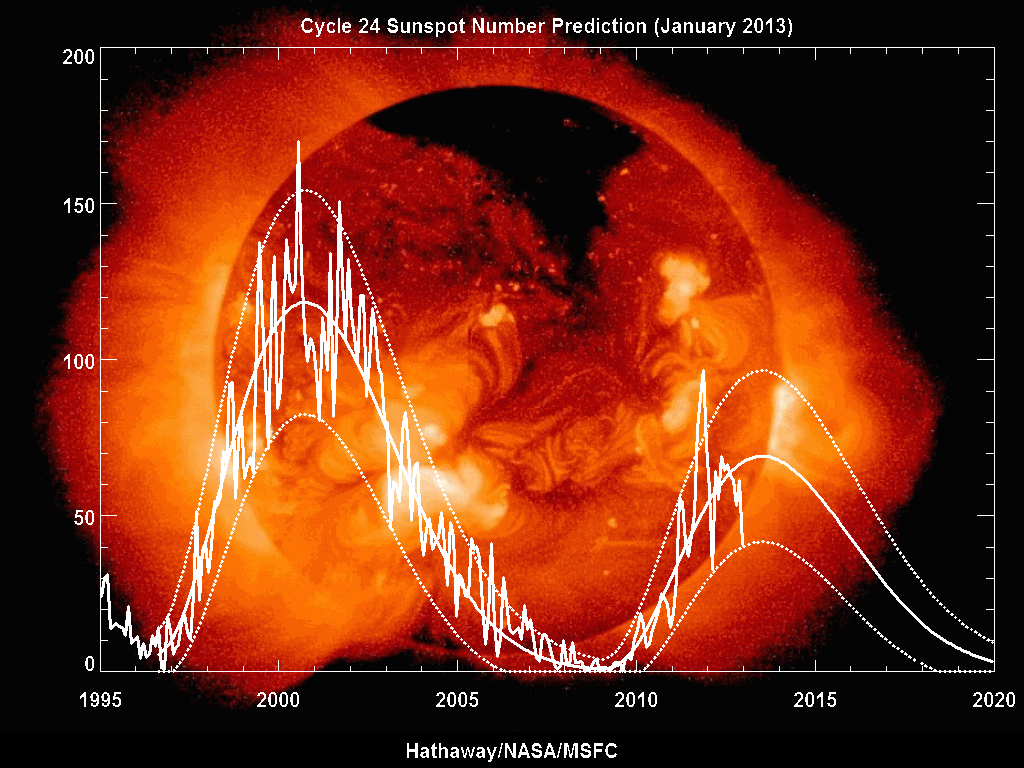
The January 2013 NASA forecast for the development of Solar Cycle 24 is out.

sc 24 prediction January 2013

SC 24 prediction Jan 2013 – Hathaway -NASA

The current prediction for Sunspot Cycle 24 gives a smoothed sunspot number maximum of about 69 in the Fall of 2013. The smoothed sunspot number has already reached 67 (in February 2012)due to the strong peak in late 2011 so the official maximum will be at least this high and this late. We are currently over four years into Cycle 24. The current predicted and observed size makes this the smallest sunspot cycle since Cycle 14 which had a maximum of 64.2 in February of 1906.

With sunspot activity at this low level the planet will cool. It remains to be seen whether this is the start of something like a Dalton Minimum (SC5 and 6) or even a Maunder Minimum. This cooling has begun and global temperatures peaked about 16 years ago and are now declining slightly while carbon dioxide concentration continues to increase. It is only a matter of time before the belief that carbon dioxide concentration (whether man-made or not) causes global warming will have to be completely discarded. But there is so much money now riding on this belief (and even though there is only conjecture and no direct evidence for this belief), that we will likely see a decade or more of rationalisation of reality before the belief is abandoned.

SC24 compared to SC5 in 2011 is shown below:

SC24 compared to SC5

One day the Sun will die, but till then – Dies Natalis Solis Invicti MMXII

December 24, 2012

Here at a latitude of 58.7057° N, the Sun is eagerly awaited every day and is sorely missed if it is obscured by clouds during our short days at this time of year.

Sol Invictus is not a matter of faith or belief. It is a daily reality.

The 21st of December was the shortest day of the year with sunrise at 0848 and sunset at 1503. But it has come and gone and the days are getting longer again. I can start my countdown to summer.

The renewal begins.

It is not difficult to imagine how worship of the Sun must have started at least 20,000 years ago and perhaps as early as 100,000 years ago. In fact it seems obvious that our understanding of periodicity and the very concept of time must have started with what we observed of the Sun. The counting of days and the inevitability of the seasons and the development of a calendar all originate with the unfailing appearance of the Sun every day. Perhaps the periodicity of the daily Sun even accounts for humans developing the very notion of counting and numbers. And it is more than mere speculation to assume that even the great expansion of humanity from Africarabia around 100,000 years ago was to no little extent guided into directions defined relative to the rising or the setting of the Sun.

One day – some 5 billion years hence – the Sun will have consumed all its hydrogen, will become a red giant and will swallow the earth. The earth will truly and inevitably die then.  Over the following one billion years or so the Sun will be consuming its helium and become a white dwarf.  And then the exhausted Sun – will cool and perhaps in 1000 billion years will be at the same temperature as that of surrounding space and will become a black dwarf  –  well and truly dead.

Long before then, perhaps in about one billion years from now, the energy output of the Sun will rise by about 10% and there will be no water left in our atmosphere. As the Sun’s energy output increases further, our rivers and lakes and oceans will all boil dry and the earth will be finally devoid of water. If humanity is still present on earth when free water disappears then it too – with all other species on earth – will die. But humanity – along with many other Earthly species – may well have moved elsewhere by then.

But for at least the next 0ne billion years we can continue to revel and bask in our invincible Sun.

In Vedic terms “Surya is the eye of Mitra, Varuna and Agni” where Surya, the Sun, is the “all-powerful life-giving force” with Mitra representing “all that happens with openness in the daylight” while Varuna lords “over the powers of the dark when Surya is not visible”. Agni (ignis in Latin) is of course fire and is the earthly manifestation of the Sun

So, in celebration of the annual renewal to come I send my greetings to all in the name of the invincible Sun.

(The picture this year is a blow-up of the banner for this blog and is of a sunrise, looking East, on a December morning in 2010).

sol invictus 2012

The sun at solstice 12.12 CET on 21.12.2012

December 22, 2012

The shortest day of the year has come and gone and the countdown to summer (in the Northern Hemisphere) has begun. From a day length of 6 hours 15 minutes yesterday the next 183 days will see the length of the day – at this latitude – increasing by an average of over 3 minutes every day reaching a day length of almost 17 hours at the summer solstice.

From Discovery News:

At 11:12 UT (6:12 a.m. EST), the world didn’t end (as far as I can tell), but it was a significant time none-the-less. That was the exact minute of the Winter Solstice in the Northern Hemisphere (or the Summer Solstice in the Southern Hemisphere) — when the daylight hours are shortest and the sun reaches its most southern position in the sky at noon.

Sun-solstice

The sun at solstice 12:12 CET on 21.12.2012: image NASA

NASA Solar Dynamics Observatory (SDO) captured the time of solstice from orbit. Although the SDO is always imaging the sun through a multitude of filters, this is a great excuse to showcase the fantastic beauty of our nearest star, while putting all the doomsday nonsense behind us.

The sun didn’t unleash a killer solar flare or devastating coronal mass ejection, but it is undergoing a fascinating period in its solar cycle.

As can be seen from the SDO image above, the solar magnetic field is twisted and warped, channeling million-degree plasma high into the sun’s atmosphere in the form of beautiful coronal loops. This is all because the sun is fast approaching “solar maximum” — an exciting time when the sun’s magnetic field is most stressed.

Solar Cycle 24 prediction: On track to be smallest in 100 years

June 12, 2012

NASA has updated its forecast for Solar Cycle 24.

Maximum is expected to be reached in Spring 2013 with a sunspot number of 60 and this prediction is for the lowest sunspot number in  100 years. This only confirms that we are currently in a solar minimum – the Landscheidt Minimum – though it remains to be seen whether this will be a Grand Minimum in the style of the Maunder Minimum or the Dalton Minimum. In any event a period of several decades of global cooling is to be expected and is already probably upon us (starting some 10 years ago).

(more…)

More evidence that cloud cover – and not carbon dioxide – dominates climate

May 17, 2012

The Hockey Shtick reports on a recent paper by Aldert J. van Beelen and Aarnout J. van Delden of the Institute for Marine and Atmospheric Research Utrecht, Utrecht University, The Netherlands which shows that the hours of sunshine decreased somewhat from 1958-1983 and then increased sharply between 1985 and 2010 at a number of places. The authors postulate that the reduction of cloud cover since 1985 was possibly due to the cleaner air with reduced aerosols during this period.

It was not so long ago that the CERN CLOUD experiments showed that cosmic rays could indeed influence cloud formation providing support for Svensmark’s hypothesis that it is solar effects via cloud formation which dominates climate.

If we assume that the reduction in sunshine hours between 1958 and 1983 was due to man-made pollution and that this was reversed in the period after 1985, it still needs Svensmark’s solar effects or some other mechanism to explain the very sharp reduction in cloud cover and increase in sunshine hours  after 1985. It seems patently obvious from every day observations that cloud cover is far more important to weather and climate than any far-fetched notions of man-made carbon dioxide having any significant influence.

The Hockey Shtick: A paper recently published in the journal Weather finds that global summer average sunshine [solar short-wave radiation that reaches Earth’s surface] dimmed during the period 1958-1983 [prompting an ice age scare], but markedly increased from 1985-2010. The increase in summer average sunshine between those two periods is 6 Watts per square meter, which dwarfs the alleged effects of CO2 by more than 5 times. [Alleged CO2 effect from 1958-2010 was calculated using the IPCC formula 5.35*ln(389.78/315) = 1.14 Watts per square meter]. At one measurement site [De Bilt], summer sunshine increased from 1985-2010 by 15 Watts per square meter, more than 23 times the IPCC alleged forcing from CO2 during the same timeframe [5.35*ln(389.78/346.04) = 0.64 Watts per square meter].

The paper states the increase in sunshine reaching the Earth’s surface is due to a decrease in aerosols including clouds, which are influenced by both anthropogenic and natural factors, and possibly changes in solar activity.

from van Beelen and van Delden “Weather” Vol.67 No. 1, January 2012

Droughts on the Tibetan plateau coincide with grand solar minima

May 14, 2012

Yet another paper indicating that climate and solar behaviour are related – at least over the Tibetan plateau and at least over the last 1000 years.

Tree ring based precipitation reconstruction in the south slope of the middle Qilian Mountains, northeastern Tibetan Plateau, over the last millennium

by Junyan Sun and Yu Liu,  Chinese Academy of Sciences, Xi’an, China

JOURNAL OF GEOPHYSICAL RESEARCH, VOL. 117, D08108, 11 PP., 2012
doi:10.1029/2011JD017290

Reconstruction of precipitation amounts for the edge of the Tibet Plateau. The bars on the chart depict prominent weak phases of solar activity, which correspond to Om = Oort Minimum; Wm = Wolf Minimum; Sm = Spörer Minimum; Mm = Maunder Minimum; Dm = Dalton Minimum). Figure from: Sun & Liu (2012).

Geologist Dr. Sebastian Lüning and chemist Prof. Fritz Vahrenholt have written a summary of this paper (in German), and this translation is from P Gosselin at NoTricksZone

New Study of the Tibet Plateau: Whenever Solar Activity is Weak, the Rains Disappear
By Sebastian Lüning and Fritz Vahrenholt

The Tibet Plateau is at 3000 to 5000 meters elevation and is the highest and (most) expansive high plateau on Earth. Therefore it reacts sensitively to climate changes. Junyan Sun and Yu Liu of the Chinese Academy of Sciences studied tree rings in the northwest plateau edge from two living 1000 year old trees. Tree growth in the area of study is particularly sensitive to the amount of precipitation. (more…)