Archive for the ‘Solar science’ Category

The Sun – not man – heats the earth

October 17, 2011

It would seem obvious – but it has not been – and it is still heresy for the AGW orthodoxy to entertain the notion that carbon dioxide effects are insignificant in relation to solar effects on climate.

A new paper in Energy & Environment, Vol. 22, No. 6 (Sept. 2011)

Long-Term Instrumental and Reconstructed Temperature Records Contradict Anthropogenic Global Warming

by Horst-Joachim LüdeckeEIKE, European Institute for Climate and Energy, PO.Box 11011, 07722 Jena, GERMANY

PDF 

There is no evidence that the temperature changes of the second half of the 20th Century are in any way extraordinary. No impact of the rise in CO2 concentration in the atmosphere can be found in the data.

One more nail in the AGW coffin.

Abstract:Monthly instrumental temperature records from 5 stations in the northern hemisphere are analyzed, each of which is local and over 200 years in length, as well as two reconstructed long-range yearly records – from a stalagmite and from tree rings that are about 2000 years long. In the instrumental records, the steepest 100-year temperature fall happened in the 19th century and the steepest rise in the 20th century, both events being of about the same magnitude. Evaluation by the detrended fluctuation analysis (DFA) yields Hurst exponents that are in good agreement with the literature. DFA, Monte Carlo simulations, and synthetic records reveal that both 100-year events were caused by external trends. In contrast to this, the reconstructed records show stronger 100-year rises and falls as quite common during the last 2000 years. These results contradict the hypothesis of an unusual (anthropogenic) global warming during the 20th century. As a hypothesis, the sun’s magnetic field, which is correlated with sunspot numbers, is put forward as an explanation. The long-term low-frequency fluctuations in sunspot numbers are not detectable by the DFA in the monthly instrumental records, resulting in the common low Hurst exponents. The same does not hold true for the 2000-year-long reconstructed records, which explains both their higher Hurst exponents and the higher probabilities of strong 100-year temperature fluctuations. A long-term synthetic record that embodies the reconstructed sunspot number fluctuations includes the different Hurst exponents of both the instrumental and the reconstructed records and, therefore, corroborates the conjecture.

This paper supports the results published by Prof. Sami Solanki back in 2004 and reported in Science Daily here:

Sami K. Solanki, Natalie A. Krivova Can solar variability explain solar warming since 1970? Journal of Geophysical Research,108, doi 10.1029/2002JA009753 (2003)

The authors  concluded  then that “based on a statistical study of earlier periods of increased solar activity, the researchers predict that the current level of high solar activity will probably continue only for a few more decades”.
Solar science re-emerging? and about time too!

October 12, 2011

It has always struck me as incredibly arrogant and amazingly stupid that the climate “scientists” have ignored the effects of the sun for 2 decades – presumably because:

  1. they did not understand the sun,
  2. doomsday scenarios were better for getting funding,
  3. they had such an overweening conviction about man made effects, and
  4. they actually believed their computer models were the greatest thing since sliced bread!
Perhaps that is changing. As Paul Hudson signs off his column on the BBC Weather blog:
This is an exciting time for solar physics, and its role in climate. As one leading climate scientist told me last month, it’s a subject that is now no longer taboo. And about time, too.
Related: New Scientist permits the sun to join the climate club

New papers confirm solar effects could bring on little ice ages

October 10, 2011

There seems to be a renewal of interest in solar effects on climate change and especially on little ice ages. It would be too much to expect an early abandonment of the carbon dioxide hypothesis. Equally unlikely is any acknowledgement that carbon dioxide in the atmosphere is of insignificant influence for climate. But the acknowledgement of solar influences on climate helps to redress some of the balance.

The UK Met office research referred to in yesterday’s Sunday Times article might well refer to this paper in Nature Geoscience published online yesterday which makes the link between UV radiation variation during solar cycles and cold winters in the Northern hemisphere. The authors are from the Met Office Hadley Centre, Oxford and Imperial College.

Solar forcing of winter climate variability in the Northern Hemisphere by Sarah Ineson, Adam A. Scaife, Jeff R. Knight, James C. Manners, Nick J. Dunstone, Lesley J. Gray & Joanna D. Haigh  Nature Geoscience (2011) doi:10.1038/ngeo1282

Sarah Ineson – Met Office Hadley Centre, FitzRoy Road, Exeter, Devon EX1 3PB, UK 

Abstract:An influence of solar irradiance variations on Earth’s surface climate has been repeatedly suggested, based on correlations between solar variability and meteorological variables. Specifically, weaker westerly winds have been observed in winters with a less active sun, for example at the minimum phase of the 11-year sunspot cycle. With some possible exceptions, it has proved difficult for climate models to consistently reproduce this signal. Spectral Irradiance Monitor satellite measurements indicate that variations in solar ultraviolet irradiance may be larger than previously thought. Here we drive an ocean–atmosphere climate model with ultraviolet irradiance variations based on these observations. We find that the model responds to the solar minimum with patterns in surface pressure and temperature that resemble the negative phase of the North Atlantic or Arctic Oscillation, of similar magnitude to observations. In our model, the anomalies descend through the depth of the extratropical winter atmosphere. If the updated measurements of solar ultraviolet irradiance are correct, low solar activity, as observed during recent years, drives cold winters in northern Europe and the United States, and mild winters over southern Europe and Canada, with little direct change in globally averaged temperature. Given the quasiregularity of the 11-year solar cycle, our findings may help improve decadal climate predictions for highly populated extratropical regions.

A sceond paper in Nature Geoscience also released online yesterday reports that simulations with a climate model using new observations of solar variability suggest a substantial influence of the Sun on the winter climate in the Northern Hemisphere.

Atmospheric science: Solar cycle and climate predictions by Katja Matthes Nature Geoscience (2011) doi:10.1038/ngeo1298

Katja Matthes is at the Helmholtz Centre Potsdam, GFZ German Research Centre for Geosciences, Telegrafenberg, 14473 Potsdam, Germany

Interestingly a paper from 2001 with Michael Mann and Gavin Schmidt  (of climategate infamy) as co-authors has similar findings:

Solar Forcing of Regional Climate Change During the Maunder Minimum by Drew T. Shindell, Gavin A. Schmidt, Michael E. Mann, David Rind and Anne Waple,  Science 7 December 2001: Vol. 294 no. 5549 pp. 2149-2152 DOI: 10.1126/science.1064363

Abstract:We examine the climate response to solar irradiance changes between the late 17th-century Maunder Minimum and the late 18th century. Global average temperature changes are small (about 0.3° to 0.4°C) in both a climate model and empirical reconstructions. However, regional temperature changes are quite large. In the model, these occur primarily through a forced shift toward the low index state of the Arctic Oscillation/North Atlantic Oscillation as solar irradiance decreases. This leads to colder temperatures over the Northern Hemisphere continents, especially in winter (1° to 2°C), in agreement with historical records and proxy data for surface temperatures.

Update! The BBC reports on this story here but takes great care to pay due respect to global warming orthodoxy with the statement “The researchers emphasise there is no impact on global warming”.

Of course not – It’s only the sun stupid! And what can the sun possibly have to do with warming the planet?!

Related:

Colder winters to come and solar influence on climate beginning to get its due

Is the Landscheidt minimum a precursor for a grand minimum? 

“It’s the Sun, stupid” > Svensmark vindicated: CERN shows cosmic rays do influence cloud formation

August 25, 2011

The much awaited results from the CLOUD experiments at CERN have now been published in Nature and show that cosmic rays can influence cloud formation – as Henrik Svensmark has hypothesised. This mechanism – ultimately dependent upon the sun – is far more credible as an explanation of the climate variations seen in recent times than dubious computer models based on implausible forcings due to carbon dioxide in the atmosphere.

Cloud formation may be linked to cosmic rays Kirkby, J. et alNature 476, 429-433 (2011).

Nigel Calder (via GWPF) writes:

Long-anticipated results of the CLOUD experiment at CERN in Geneva appear in tomorrow’s issue of the journal Nature (25 August). The Director General of CERN stirred controversy last month, by saying that the CLOUD team’s report should be politically correct about climate change (see my 17 July post below). The implication was that they should on no account endorse the Danish heresy – Henrik Svensmark’s hypothesis that most of the global warming of the 20th Century can be explained by the reduction in cosmic rays due to livelier solar activity, resulting in less low cloud cover and warmer surface temperatures.

Willy-nilly the results speak for themselves, and it’s no wonder the Director General was fretful.

Henrik Svensmark (born 1958) is a physicist at the Danish National Space Center in Copenhagen who studies the effects of cosmic rays on cloud formation. His work presents hypotheses about solar activity as an indirect cause of global warming; his research has suggested a possible link through the interaction of the solar wind and cosmic rays. His conclusions have been controversial as the prevailing scientific opinion on climate change considers solar activity unlikely to be a major contributor to recent warming, though it is thought to be the primary driver of many earlier changes in climate.

I cannot do any better than reproduce Nigel Calder’s explanation of the CERN experimental results:

Jasper Kirkby of CERN and his 62 co-authors, from 17 institutes in Europe and the USA, announce big effects of pions from an accelerator, which simulate the cosmic rays and ionize the air in the experimental chamber. The pions strongly promote the formation of clusters of sulphuric acid and water molecules – aerosols of the kind that may grow into cloud condensation nuclei on which cloud droplets form. What’s more, there’s a very important clarification of the chemistry involved.

(more…)

Solar Cycle 24: Still on track to be smallest sunspot number cycle in 100 years

August 25, 2011

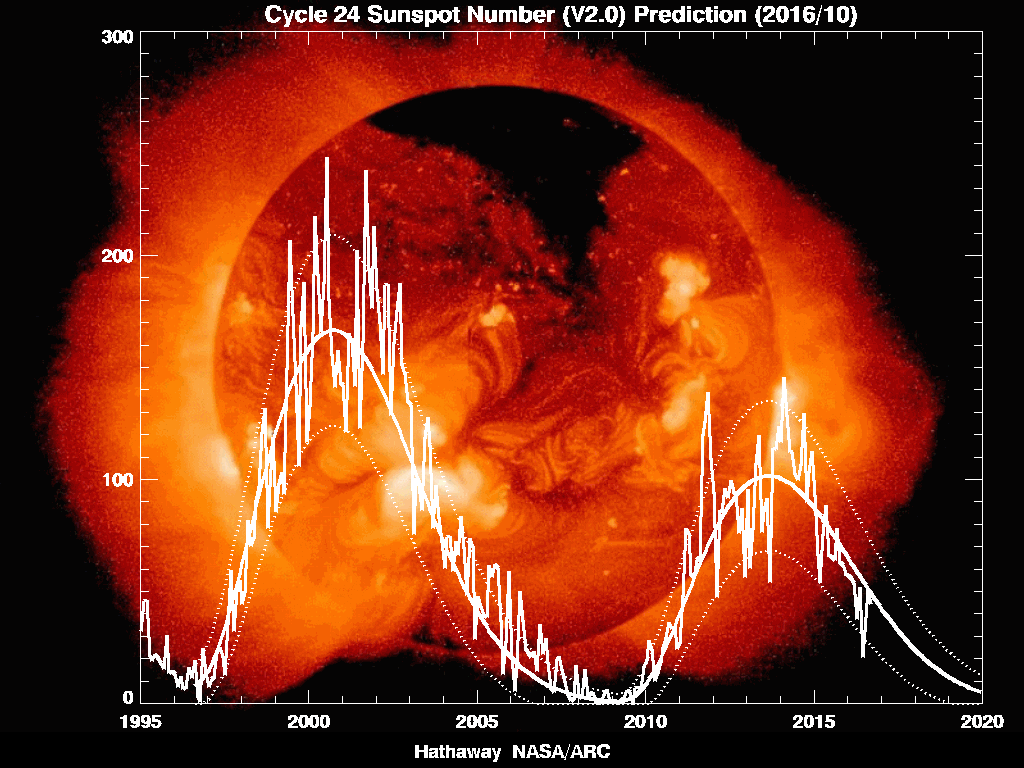
The August solar cycle 24 forecast from NASA is unchanged from the previous month though the maximum has increased to 69 from the 64 forecast about 6 months ago.

The current prediction for Sunspot Cycle 24 gives a smoothed sunspot number maximum of about 69 in June of 2013 (same as last month). We are currently over two and a half years into Cycle 24. Four out of the last five months with average daily sunspot numbers above 40 has raised the predicted maximum above the 64.2 for the Cycle 14 maximum in 1907. This predicted size still make this the smallest sunspot cycle in over 100 years.

NASA - Solar Cycle 24 forecast

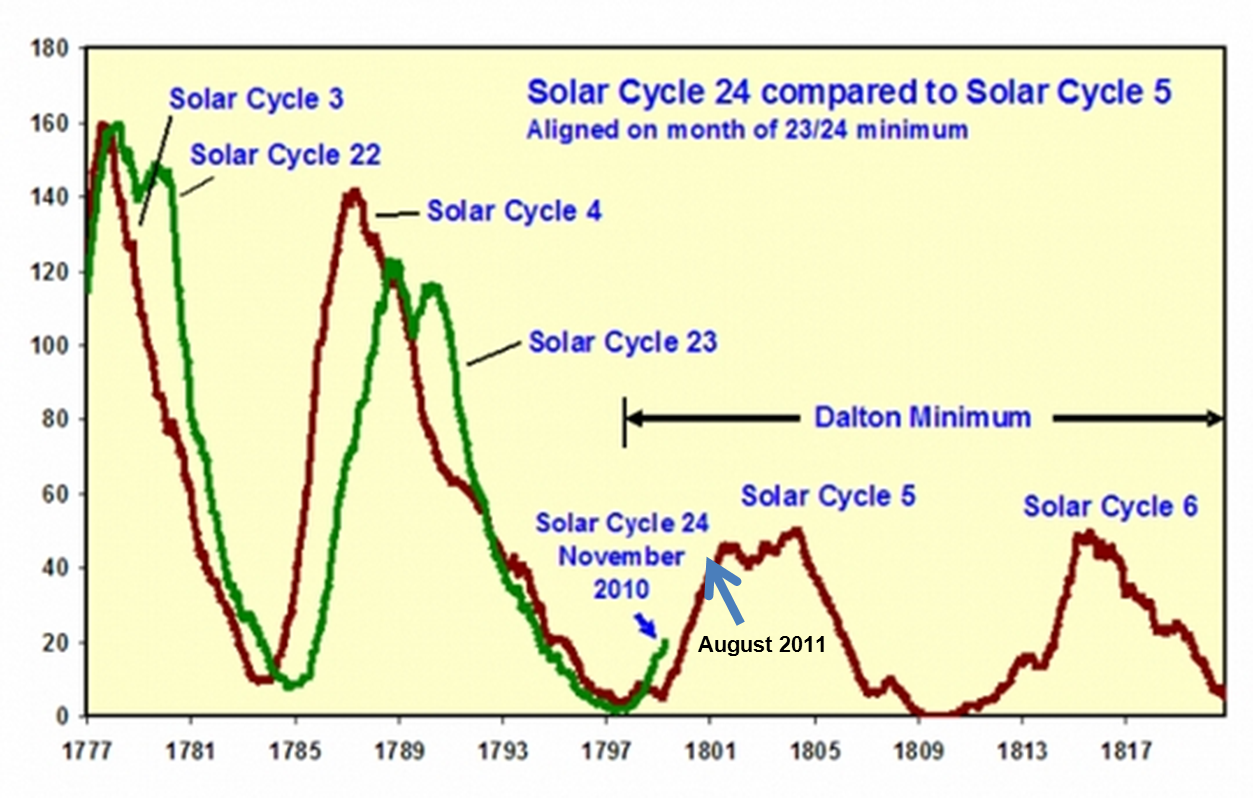
Solar Cycle 24 continues to invite comparisons with Solar Cycle 5.

SC24 versus SC5 - from http://sc25.com

Just coincidence? Burst of solar activity (Kp index) and 18 Indonesian volcanoes move to alert status

August 7, 2011

It may just be coincidence but I am inclined to believe that the sun does influence geo-magnetic activity on earth.

1.  The K7RA Solar Update

08/05/2011

Solar activity markedly increased this week, with the sunspot number rising to 130 on Monday, August 1 — the highest since a reading of 131 on April 14, 2011. The average daily sunspot numbers more than doubled this week compared to last, rising nearly 54 points to 99.3. ……

NOAA’s Space Weather Prediction Center: “Three coronal mass ejections (CMEs) are currently en route to Earth, with the commencement of geomagnetic storming expected early to mid-day on August 5 with the arrival of the CMEs associated with the August 2-3 events. The third of the string, seemingly the fastest CME, may catch up with the first two in the next 12-18 hours, compressing the plasma and enhancing the embedded magnetic field. Storming levels are expected to attain G3 (strong) conditions. The current Solar Radiation Storm may experience a kick with the shocks and attain S2 (moderate) thresholds.

“Some level of geomagnetic disturbance is expected to continue through August 7 as the series of CMEs affect the Earth. Continued activity is likely from these regions as they continue to rotate off the visible solar disk over the next seven days. The Space Weather Prediction Center will continue to monitor this event as it unfolds.”

 Estimated 3-hour Planetary Kp-index


article image

2. The Jakarta Post:

Sun, 08/07/2011 1:05 PM

Eighteen Indonesian volcanoes are on “alert” status, two of which are at Alert Level 3, which is called “Siaga”, the Volcanology and Geology Disaster Mitigation Center says. Center head Surono said Sunday in Jakarta the erupting Mount Lokon in North Sulawesi and Mount Ibu in North Maluku were the two volcanoes at Siaga status. The center has adopted four levels of alert status: “Normal” (Level 1), “Waspada” (Level 2), “Siaga” (Level 3) and “Awas” (Level 4).

Surono said the conditions at Mt Lokon and Mt Ibu were currently considered most worrisome because they had been consistently erupting searing clouds affecting a radius of 2.5 kilometers. …… 

Surono added that 16 other volcanoes were at Level 2 alert status, “Waspada”, including Mt. Papandayan and Mt. Guntur in West Java. “Locals have reported several quakes,” he said. ….

Surono said that President Susilo Bambang Yudhoyono had summoned him on Saturday to report the volcanoes’ status and the center’s preparations to anticipate possible disasters.

H/T – http://climaterealists.com/index.php

Related: 

Solar effects will give increased volcanic and earthquake activity in the next 2 years

Colder winters to come and solar influence on climate beginning to get its due

July 7, 2011

The BBC reports on a new paper in Environmental Research Letters which actually brings solar influence back into the climate picture.

We show that some predictive skill may be obtained by including the solar effect” says this new paper.

Yes Indeed!

But how was the sun’s influence ever discarded in climate models??

Britain is set to face an increase in harsh winters, with up to one-in-seven gripping the UK with prolonged sub-zero temperatures, a study has suggested. The projection was based on research that identified how low solar activity affected winter weather patterns.

“We could get to the point where one-in-seven winters are very cold, such as we had at the start of last winter and all through the winter before,” said co-author Mike Lockwood, professor of space environment physics at the University of Reading.

Using the Central England Temperature (CET) record, the world’s longest instrumental data series that stretches back to 1659, the team said that average temperatures during recent winters had been markedly lower than the longer-term average.

“The mean CET for December, January and February for the recent relatively cold winters of 2008/09 and 2009/10 were 3.50°C and 2.53°C respectively,” they wrote.

“Whereas the mean value for the previous 20 winters had been 5.04°C.

“The cluster of lower winter temperatures in the UK during the last three years had raised questions about the probability of more similar, or even colder, winters occurring in the future.” 

Professor Lockwood was keen to point out that his team’s paper did not suggest that the UK and mainland Europe was about to be plunged into a “little ice age” as a result of low solar activity, as some media reports had suggested.

M Lockwood et al 2011 Environ. Res. Lett. 6 034004 doi: 10.1088/1748-9326/6/3/034004

The solar influence on the probability of relatively cold UK winters in the future

M Lockwood, R G Harrison, M J Owens, L Barnard, T Woollings and F Steinhilber

Abstract: Recent research has suggested that relatively cold UK winters are more common when solar activity is low (Lockwood et  al 2010 Environ Res Lett 5 024001). Solar activity during the current sunspot minimum has fallen to levels unknown since the start of the 20th century (Lockwood 2010 Proc. R. Soc. A 466 303–29) and records of past solar variations inferred from cosmogenic isotopes (Abreu et al 2008 Geophys Res Lett. 35 L20109) and geomagnetic activity data (Lockwood et al 2009 Astrophys. J. 700 937–44) suggest that the current grand solar maximum is coming to an end and hence that solar activity can be expected to continue to decline. Combining cosmogenic isotope data with the long record of temperatures measured in central England, we estimate how solar change could influence the probability in the future of further UK winters that are cold, relative to the hemispheric mean temperature, if all other factors remain constant. Global warming is taken into account only through the detrending using mean hemispheric temperatures. We show that some predictive skill may be obtained by including the solar effect.

The BBC report continues:

Depiction of the 1683 Thames' frost fair (Getty Images)

Depiction of the 1683 Thames' frost fair (Getty Images)

Professor Lockwood said it was a “pejorative name” because what happened during the Maunder Minimum “was actually nothing like an ice age at all”.

“There were colder winters in Europe. That almost certainly means, from what we understand about the blocking mechanisms that cause them, that there were warmer winters in Greenland,” he observed. “So it was a regional redistribution and not a global phenomenon like an ice age. It was nothing like as cold as a real ice age – either in its global extent or in the temperatures reached. “The summers were probably warmer if anything, rather than colder as they would be in an ice age.” He added that the Maunder Minimum period was not an uninterrupted series of cold, harsh winters.

Data from the CET showed that the coldest winter since records began was 1683/84 “yet just two year later, right in the middle of the Maunder Minimum, is the fifth warmest winter in the whole record, so this idea that Maunder Minimum winters were unrelentingly cold is wrong”.

He explained that a similar pattern could be observed in recent events: “Looking at satellite data, we found that when solar activity was low, there was an increase in the number of blocking events of the jetstream over the Atlantic. “That led to us getting colder weather in Europe. The same events brought warm air from the tropics to Greenland, so it was getting warmer. “These blocking events are definitely a regional redistribution, and not like a global ice age.  


Serious earthquake and extreme weather prediction for June 27th to July 2nd

June 23, 2011

Piers Corbyn of WeatherAction predicts:

June 21 04:12 GMT (UTC)  C7 Solar flare and Coronal Mass ejection (CME) heading for Earth 23/24th.  This is expected to give K6 Geomagnetic storm and will be the driver of WeatherAction’s ‘Some activity Red warning’ ~24Jun. 

The next VERY SERIOUS earthquake and extreme weather period is 27th June to 2nd July.

http://www.weatheraction.com/displayarticle.asp?a=354&c=5

article image


Landscheidt Minimum could be a grand solar minimum lasting till 2100

June 20, 2011

It is noticeable that the upsurge of evidence that a solar minimum – and maybe a grand minimum – is upon is causing many of the global warming enthusiasts to try and rationalise the effects of the sun. Suddenly they begin to acknowledge that the sun may have some small effect on climate but rush to point out that the solar influence on climate is not yet understood (indeed!) and in any case it will be much too small to be significant compared to the effects of man.

The belated acknowledgement of the possible influence of the sun is welcome but  the belief that man made effects can overcome the power of the sun is just arrogant.

hockeyschtick

Dr. Cornelis de Jager is a renowned Netherlands solar physicist, past General Secretary of the International Astronomical Union, and author of several peer-reviewed studies examining the solar influence upon climateIn response to the recent press release of three US studies indicating the Sun is entering a period of exceptionally low activity, Dr. de Jager references his publications of 2010 and prior indicating that this Grand Solar Minimum will be similar to the Maunder Minimum which caused the Little Ice Age, and prediction that this “deep minimum” will last until approximately the year 2100. 

“The new episode is a deep minimum. It will look similar to the Maunder Minimum, which lasted from 1620 to 1720…This new Grand Minimum will last until approximately 2100.”


Related: 

  1. http://www.scostep.ucar.edu/archives/scostep11_lectures/de%20Jager.pdf 
  2. Solar activity and its influence on climate  
  3. Major Drop In Solar Activity Predicted: Landscheidt Minimum is upon us and a mini-ice age is imminent

An inconvenient solar minimum..

June 15, 2011

Solar science and the possibility that a Maunder-like Minimum may be approaching seems to have caught the fancy of the MSM — Al Gore notwithstanding.

  1. The Telegraph New Little Ice Age in store? 
  2. Sydney Morning Herald Quiet sun: drop in solar activity may signal second ‘Little Ice Age’ on Earth
  3. Fox News Global Warming Be Damned, We Might Be Headed for a Mini Ice Age
  4. International Business Times The Sun’s inactivity leading to second Little Ice Age, to Offset Global Warming?
  5. MSNBC Solar forecast hints at a big chill
  6. The Christian Science Monitor A sun with no sun spots? What that could mean for Earth and its climate
  7. Discovery News IS THE SUN ABOUT TO FIZZ OUT?
  8. ABC News Goodnight Sun: Sunspots May Disappear for Years
  9. New Scientist Sluggish sun may ‘sit out’ next solar cycle
  10. Arizona Daily Star Fewer sunspots could help offset global warming
Most of these publications are generally fairly uncritical adherents of whatever seems to be in vogue and have usually been very vocal in supporting the AGW creed. But it is nevertheless interesting to see how they have all picked up this news — as if they are bored with and tired of repeating the same old AGW story-line and are just waiting for a new star to follow.
Perhaps the political tide is turning, ……