Mount Sinabung gets deadly as sightseers return

February 1, 2014

Mount Sinabung which has been erupting since September last year, has caused the first fatalities reported. It erupted again on Saturday ejecting rocks and ash and killing 14. The evacuation zone which extended upto 7km from the mountain has been relaxed to 5km, but the 14 people killed were all from the Suka Meriah village which is within 3km of the volcano. A group of sightseeing schoolchildren is reported to be among those killed. Another 3 people were severely injured when  apparently they had been visiting a family grave and their abandoned homes when the volcano spewed its ash.

On Friday the disaster management agency had allowed people living in villages more than 5km from the mountain to return home. Sixteen villages have been evacuated and residents are not supposed to visit for any reason.

The first eruption occurred at 10:30 a.m. and lasted for eight-and-a-half-minutes, spewing 2-kilometer ash and 4.5-km thick clouds to the south. The second eruption took place at 10:38 a.m. for just over four minutes, followed by another eruption at 11:27 a.m. for 84 seconds.

A villager run as Mount Sinabung erupt at Sigarang-Garang village in Karo district, Indonesia's North Sumatra province, February 1, 2014. REUTERS/Stringer

A villager run as Mount Sinabung erupt at Sigarang-Garang village in Karo district, Indonesia’s North Sumatra province, February 1, 2014.
CREDIT: REUTERS/STRINGER

Sources: Jakarta Post, BBC, Reuters

Related: 5 km radius around Mount Sinabung volcano evacuated as eruptions continue

The next VEI 5+ volcanic eruption is overdue

Delhi beats Beijing for bad air quality

February 1, 2014

Indian media and Delhi administrators are not amused. They are up in arms and struggling to find reasons why the Yale 2014 Environmental Performance Index is not correct when it states that Delhi’s air is worse than in Beijing.

Times of India: Delhi’s air quality is indeed very poor but not as poor as Beijing’s, claim scientists. After an international newspaper recently reported that Delhi’s air quality this January has been worse than Beijing’s, System of Air Quality Forecasting and Research (SAFAR) – under the Union earth sciences ministry – issued a clarification on Tuesday.

Data from nine monitoring stations in Delhi states that PM 2.5 (fine respirable particles) never crossed 350 micrograms per cubic metre while in Beijing it did cross 500 microgram per cubic metre and went up to 650 micrograms per cubic metre. …

“It is true that Delhi is reeling under very poor air quality. But in terms of concentration of pollutants, we are doing far better than Beijing which has declared emergency conditions because of their air quality. Our PM 10 (coarse particles) and PM 2.5 are both high but not extreme. High PM 10 levels in Delhi can be attributed to road and construction dust while high PM 2.5 levels in Delhi can be attributed to incomplete combustion of fossil fuels and biomass,” said Gufran Beig, chief project scientist at SAFAR.

What they seem to forget is that while building wastes are the main source of PM10 coarse particles, they also – inevitably – produce a large quantity of fine particles. Incomplete combustion in diesel engines produce only fine particles.

They are wasting energy on the wrong fight. Whether Delhi is worse or better than Beijing is irrelevant. The point is that Delhi is as bad as it is.

I visit Delhi 5 or 6 times every year and it has the worst air quality that I experience. It is dust particles in the main – and a lot of that is from the ubiquitous building rubble and  building materials lying in piles (some small and some large) all over the city. The diesel engine particulates have – I think – reduced after the introduction of Compressed Natural Gas (CNG) for taxis and autos but they build up every night when the long-distance trucks roll through the city (they are banned during the day).

But Delhi is essentially a huge building site. In new building projects (many for domestic dwellings), building materials (bricks, sand, cement, tiles, sewer pipes….) are all brought and dumped in open piles on the street long before any building actually commences. Even completed building projects leave behind their piles of sand and bricks and rubble on the street which are never cleaned up. If a road is dug up for any reason the remaining mud and rubble is never actually cleared up . it is usually just pushed to one side. The last mile syndrome applies and nothing ever gets finally or properly finished.

But the real issue is one of attitude and behaviour. It is not that all the building rubble and waste could not be removed or that funds are lacking. The real issue is that “civic sense” is not of great value. The city administrators themselves do not see any point in requiring their contractors to finish a job and the citizens of Delhi are too busy with large issues and cannot be bothered with such minor matters. The administrators pay lip-service to the problem by putting up signs banning the open storage of building materials – which are promptly ignored.

Typical street Delhi

Typical street Delhi

Delhi’s atmosphere is what it is because the citizens of Delhi do not give any value to it being any better.

No pay, no play

February 1, 2014
Spelarna stod stilla i protest.

Racing Santander players refused to play since they haven’t been payed for a number of months

My sympathies – for a change – are with the footballers and the Santander fans and not with the Club administrators.

Daily Mail: Racing Santander have been banned from next year’s Copa del Rey after they refused to play their quarter-final second-leg tie against Real Sociedad on Thursday night in protest at not being paid since September. 

Earlier in the week the players had said they would only play if the club’s president resigned.

In the statement on Monday, Racing captain Mario Fernandez said the players had not been paid for a number of months despite promises they would be.

With still no response to that ultimatum throughout the week, Association of Spanish Footballers (AFE) chief Luis Rubiales met with the Racing players and coaching staff in Santander on Thursday, and afterwards he confirmed there had been no change in the team’s stance.

Rubiales told a press conference: ‘If at 2100 (CET) the Racing board is the same as now, they will not play.

‘The squad decided something last Monday which they made public, and they continue thinking exactly the same, that if the current board has not resigned by the time of the game they are not going to play. They have the complete backing of the AFE, as always.’

Rubiales reminded the Racing players at the meeting that ‘there are rules and their decision not to play could have consequences, but they are strong and united and we have to be together with them’.

Racing Santander League Table

Thank goodness for Prince Charles

January 31, 2014

I am a fairly sceptical sort – on most things and not just about global warming. I am not impressed by ungrounded statements and I tend to dislike appeals to authority.

He is generally quite harmless and now getting frustrated with his mother’s refusal to abdicate. But I also rely on Prince Charles as the ultimate non-authority on everything he cares to open his mouth about. Among other things he believes in Kabbalistic teachings, herbal medicine and homeopathy. He was an avid fox hunter (now banned and he is therefore against it) and seems to approve of Robert Mugabe!

So I do not mind being called a headless chicken, and since it is from Prince Charles, I can take it as an accolade.

The Guardian (where else):

Climate change sceptics are ‘headless chickens’, says Prince Charles

“It is baffling, I must say, that in our modern world we have such blind trust in science and technology that we all accept what science tells us about everything – until, that is, it comes to climate science,” 

It does not take much to baffle him, and in any case it is best as a future King of England that he not think too much for himself.

Rosling’s health, wealth and statistics

January 31, 2014

Hans Rosling’s tour de force: 200 countries, 200 years, 4 minutes.

This is not new and I think I first saw it about 3 years ago.

But it is worth looking at not just for the content but also for the power of the presentation.

Just a reminder that the world is feeding more people than ever before, we are living longer than ever before, and things are not as black as some alarmists would have us think. And by 2100 total population will be declining.

The glass is more than half-full.

A much longer (20 minutes) presentation is also well worth watching.

Neanderthal genes are everywhere

January 30, 2014

Neanderthal genes are everywhere

We seek them here, we seek them there,

We met them often – but when? And where?

They are in our skins and in our hair,

Neanderthal genes are everywhere

From, Sriram Sankararaman et al, The genomic landscape of Neanderthal ancestry in present-day humansNature, 2014; DOI:10.1038/nature12961

Harvard Press ReleaseRemnants of Neanderthal DNA in modern humans are associated with genes affecting type 2 diabetes, Crohn’s disease, lupus, biliary cirrhosis and smoking behavior. They also concentrate in genes that influence skin and hair characteristics. At the same time, Neanderthal DNA is conspicuously low in regions of the X chromosome and testes-specific genes.

Coal is still king in Svalbard

January 29, 2014

Svalbard, ranging in latitude from 74°N to 81°N,  is about as close as you can come to the “top of the world”. The mining of coal would not normally be thought of in the Arctic and that close to the North Pole but the Svalbard economy is dominated by coal mining. The population of Svalbard had increased by two percent, to 2,158 at the end of 2012.

CIA Factbook: The settlements on Svalbard are essentially company towns. The Norwegian state-owned coal company employs nearly 60% of the Norwegian population on the island, runs many of the local services, and provides most of the local infrastructure. There is also some hunting of seal, reindeer, and fox. Goods such as alcohol, tobacco, and vehicles, normally highly taxed on mainland Norway, are considerably cheaper in Svalbard in an effort by the Norwegian government to entice more people to live on the Arctic archipelago. By law, the Norwegians collect only enough taxes to pay for the needs of the local government. None of tax proceeds go to Norway.

Svalbard

Svalbard

Science Nordic reports:

The economy of Svalbard, the Norwegian arctic archipelago that lies between the country’s mainland and the North Pole, is still dominated by coal even as its value dwindles and employment in the mines drops. …

Tourism, a college and polar and space research activities have yet to make this community independent of coal. This has been verified by a recent analysis of Svalbard’s socio-economic status by the Norwegian Institute for Urban and Regional Research (NIBR).

“Coal mining has always been the mainstay here, and it still is,” says researcher Steinar Johansen, who wrote the report with his colleague Hild Marte Bjørnsen. ….. In addition to all who are directly employed by the local coal company, Store Norske, mining requires a number of sub-venders, and services need to be provided to family members who move to Svalbard’s little town, Longyearbyen, at the chilly latitude of 78° N. …

But can the Svalbard community surive without coal? Not without major changes, according to the researchers.

Tthe statue of the coal miner in the town of Longyearbyen is a reminder of who – or what – really dominates the economy. (Photo: Georg Mathisen)

From graphene to borophene

January 29, 2014

Technology development waves

The discovery of graphene is leading to a new excitement in materials research. I have a notion that technology advances take place in step waves, where each step is both enabled and constrained by the materials available. Each time a new material (or material family is discovered), technology development starts very fast and then tapers off until another material comes along and ignites a new development wave.

Boron is Carbon’s neighbour in the periodic table and the discovery of graphene has ignited studies to see if a similar variation of boron would be possible.

Boron is a Group 13 element that has properties which are borderline between metals and non-metals (semimetallic). It is a semiconductor rather than a metallic conductor. Chemically it is closer to silicon than to aluminium, gallium, indium, and thallium. Crystalline boron is inert chemically and is resistant to attack by boiling HF or HCl. When finely divided it is attacked slowly by hot concentrated nitric acid.

Boron, Symbol: B, Atomic number: 5, Atomic weight: 10.811, solid at 298 K

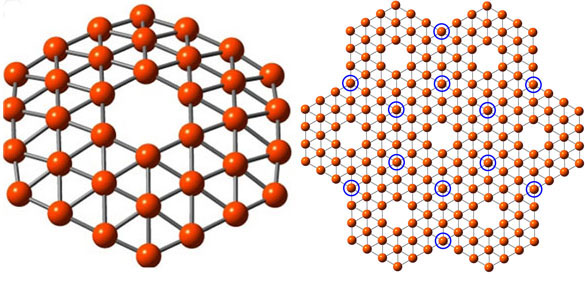
“Boron has one fewer electron than carbon and as a result can’t form the honeycomb lattice that makes up graphene. For boron to form a single-atom layer, theorists suggested that the atoms must be arranged in a triangular lattice with hexagonal vacancies — holes — in the lattice.”

A new paper shows that borophene is possible – now it just has to be made!

Zachary A. Piazza, Han-Shi Hu, Wei-Li Li, Ya-Fan Zhao, Jun Li, Lai-Sheng Wang.Planar hexagonal B36 as a potential basis for extended single-atom layer boron sheetsNature Communications, 2014; 5 DOI: 10.1038/ncomms4113

Brown University Press Release:

Unlocking the secrets of the B36 cluster
A 36-atom cluster of boron, left, arranged as a flat disc with a hexagonal hole in the middle, fits the theoretical requirements for making a one-atom-thick boron sheet, right, a theoretical nanomaterial dubbed “borophene.” Credit: Wang lab/Brown University

Graphene, a sheet of carbon one atom thick, may soon have a new nanomaterial partner. In the lab and on supercomputers, chemical engineers have determined that a unique arrangement of 36 boron atoms in a flat disc with a hexagonal hole in the middle may be the preferred building blocks for “borophene.”

Researchers from Brown University have shown experimentally that a boron-based competitor to graphene is a very real possibility.

Lai-Sheng Wang, professor of chemistry at Brown and his research group, which has studied boron chemistry for many years, have now produced the first experimental evidence that such a structure is possible. In a paper published on January 20 in Nature Communications, Wang and his team showed that a cluster made of 36 boron atoms (B36) forms a symmetrical, one-atom thick disc with a perfect hexagonal hole in the middle.

“It’s beautiful,” Wang said. “It has exact hexagonal symmetry with the hexagonal hole we were looking for. The hole is of real significance here. It suggests that this theoretical calculation about a boron planar structure might be right.”

It may be possible, Wang said, to use B36 basis to form an extended planar boron sheet. In other words, B36 may well be the embryo of a new nanomaterial that Wang and his team have dubbed “borophene.”

“We still only have one unit,” Wang said. “We haven’t made borophene yet, but this work suggests that this structure is more than just a calculation.” ……..

Wang’s experiments showed that the B36 cluster was something special. It had an extremely low electron binding energy compared to other boron clusters. The shape of the cluster’s binding spectrum also suggested that it was a symmetrical structure. ……..

…… That structure also fits the theoretical requirements for making borophene, which is an extremely interesting prospect, Wang said. The boron-boron bond is very strong, nearly as strong as the carbon-carbon bond. So borophene should be very strong. Its electrical properties may be even more interesting. Borophene is predicted to be fully metallic, whereas graphene is a semi-metal. That means borophene might end up being a better conductor than graphene.

“That is,” Wang cautions, “if anyone can make it.”

AbstractBoron is carbon’s neighbour in the periodic table and has similar valence orbitals. However, boron cannot form graphene-like structures with a honeycomb hexagonal framework because of its electron deficiency. Computational studies suggest that extended boron sheets with partially filled hexagonal holes are stable; however, there has been no experimental evidence for such atom-thin boron nanostructures. Here, we show experimentally and theoretically that B36 is a highly stable quasiplanar boron cluster with a central hexagonal hole, providing the first experimental evidence that single-atom layer boron sheets with hexagonal vacancies are potentially viable. Photoelectron spectroscopy of B36 reveals a relatively simple spectrum, suggesting a symmetric cluster. Global minimum searches for B36 lead to a quasiplanar structure with a central hexagonal hole. Neutral B36 is the smallest boron cluster to have sixfold symmetry and a perfect hexagonal vacancy, and it can be viewed as a potential basis for extended two-dimensional boron sheets.

Parsing Obama’s SOTU on climate matters: A paean to shale gas

January 29, 2014

Obama’s SOTU address will be spun in many different ways but I felt it was a remarkable paean to gas. Climate change is undeniable but he took care not to call it global warming. Not a lot of alarmism as he praised the effects of using gas. He avoided mentioning the words “fracking” or “shale”. It was all “natural” gas. He tried to give some credit to solar energy but only as an afterthought. Besides, his implication was that gas is not really a fossil fuel!

The entire section is just GAS! Gas! Gas! 

Extracts from Obama’s speech in blue. My comments in red.

“Now, one of the biggest factors in bringing more jobs back is our commitment to American energy.  The all-of-the-above energy strategy I announced a few years ago is working, and today, America is closer to energy independence than we’ve been in decades.

Yes. Entirely due to fracking and shale gas and shale oil. The effect of renewables has been negligible.

One of the reasons why is natural gas – if extracted safely, it’s the bridge fuel that can power our economy with less of the carbon pollution that causes climate change.  Businesses plan to invest almost $100 billion in new factories that use natural gas.  I’ll cut red tape to help states get those factories built, and this Congress can help by putting people to work building fueling stations that shift more cars and trucks from foreign oil to American natural gas.  My administration will keep working with the industry to sustain production and job growth while strengthening protection of our air, our water, and our communities.  

A tribute to shale fracking – without saying so.

And while we’re at it, I’ll use my authority to protect more of our pristine federal lands for future generations.

Except if there is shale gas to be found.

It’s not just oil and natural gas production that’s booming; we’re becoming a global leader in solar, too.  Every four minutes, another American home or business goes solar; every panel pounded into place by a worker whose job can’t be outsourced. 

Really! Pounding a solar panel into place!!!!! And not one of those homes gives up its connection to the grid.

Let’s continue that progress with a smarter tax policy that stops giving $4 billion a year to fossil fuel industries that don’t need it, so that we can invest more in fuels of the future that do.

Like shale gas – which as we all know – cannot be called fossil energy.

And even as we’ve increased energy production, we’ve partnered with businesses, builders, and local communities to reduce the energy we consume.  When we rescued our automakers, for example, we worked with them to set higher fuel efficiency standards for our cars.  In the coming months, I’ll build on that success by setting new standards for our trucks, so we can keep driving down oil imports and what we pay at the pump.

And while he was speaking it was 17°F with light snow in Washington and fossil fuels were heating the city.

Taken together, our energy policy is creating jobs and leading to a cleaner, safer planet.  Over the past eight years, the United States has reduced our total carbon pollution more than any other nation on Earth. 

True and entirely due to the use of gas.

But we have to act with more urgency – because a changing climate is already harming western communities struggling with drought, and coastal cities dealing with floods. 

Forget that we had less storms in 2013 than ever before. And Califiornia’s drought is due to climate change. Schwarzenegger said so and he should know.

That’s why I directed my administration to work with states, utilities, and others to set new standards on the amount of carbon pollution our power plants are allowed to dump into the air. 

The EPA will be my palace police. And of course if we reduce carbon (dioxide) emissions all droughts and storms and ice melting will miraculously cease!!

The shift to a cleaner energy economy won’t happen overnight, and it will require tough choices along the way.  But the debate is settled.  Climate change is a fact. 

Oh my!. Climate change is settled – ( He never said it was global warming)!

And when our children’s children look us in the eye and ask if we did all we could to leave them a safer, more stable world, with new sources of energy, I want us to be able to say yes, we did.”

Meaningless rhetoric. Just how his children’s children will get to look him in the eye is a little unclear. When was the last time you looked into the eyes of a grandparent and blamed them or praised them for the state of the world?

Sochi Winter Olympics: Champions of Corruption

January 28, 2014

A new site defines the Champions of Corruption at the Sochi Winter Games.

The site asserts:

sochi champions of corruption

Athletes are not the only people who compete in Sochi. Officials and businessmen also took part in the Games and turned them into a source of income. The Anti-Corruption Foundation honored the most distinguished money siphoners in five different sports

Classic Embezzlement, Arkady Rotenberg  

Verbal Freestyle, Vladimir Putin 

Ecological Multi-Sport, Vladimir Yakunin 

Pair Contract, Alexander Tkachyov and Roman Batalov 

Figure Lending, Vladimir Potanin

The site is ostensibly anti-corruption but the objectives are clearly political:

The AustralianAlexei Navalny, an anti-corruption campaigner who ran for mayor of Moscow last September, has used the site to combine data gathered during his own investigations with media accounts and other activists’ reports. According to Mr Navalny’s Encyclopaedia of Spending, the athletes are not the only people who compete: “Officials and businessmen also took part in the Games and turned them into a source of income.”

His site honours five “champions of corruption”, including President Vladimir Putin, who is accused of lying about the cost of the project when he claimed it was $US6.5 billion. Mr Putin has rejected the claims.