Solar Cycle 24’s double peak is not over yet

November 4, 2013

I thought we had reached solar maximum (albeit at a very low level) for this Solar Cycle 24 about a month ago with a double peak apparently having been evident in May. But the recent burst of solar activity during October suggests that the double peak may not be quite over yet.

SC24 sunspot activity October 2013

SC24 sunspot activity October 2013

Nasa’s prediction for SC24  (Wilson, Hathaway, and Reichmann) now looks like this:

SC24 prediction November 2013

SC24 prediction November 2013

Solar Maximum which was expected this fall may be somewhat delayed and might even be pushed back to the end of 2013.

The activity levels are still historically low and if SC 25 continues at very low levels then we will be getting close to the conditions of the Dalton and perhaps the Maunder Minimum. The sequence of solar cycles SC23,24 and 25 (Landscheidt Minimum) are then to be compared to the sequence of cycles SC4,5 and 6 for the Dalton Minimum whereas the Maunder Minimum corresponds to the period before solar cycle numbering started (prior to SC1).

Solar science is a long, long way from being a settled science and it always amazes me that “climate science”, which is overwhelmingly dependent upon the solar dynamo in its many various forms, can be considered to be settled. And not only settled, but so little dependent upon solar effects!

We ignore the Sun at our peril!

He-she-it (der-die-das) now legal for babies in Germany

November 4, 2013

The German language has long had 3 genders. The rules are deceptively simple but I did not find it easy when learning the language.

German, besides capitalizing all nouns, goes them one better and adds a third gender: neuter. The masculine definite article (“the”) is der, feminine is die, and neuter is das.

It gets confusing when a girl can be masculine as in das Madchen or a boy can be feminine (die Junge) or when the sea can be all three genders – der Ozean, das Meer, die See. The sun is feminine (die Sonne) while the moon is masculine (der Mond).

If you’re going to guess, guess der. The highest percentage of German nouns are masculine. … All German nouns, regardless of gender, become die in the nominative and accusative plural. So a noun such as das Jahr (year) becomes die Jahre (years) in the plural. Sometimes the only way to recognize the plural form of a German noun is by the article: das Fenster (window) – die Fenster (windows). 

Rivers can be masculine (der Rhein) or feminine (die Donau) but never neuter. But rivers outside Europe are always masculine! Most chemical elements are neuter but some are particularly virile and masculine (hydrogen, carbon, oxygen, nitrogen, sulphur and phosphorous). Names of cars are masculine (der Mercedes, der VW, der BMW) but names of motorcycles, ships and aircraft are feminine (die BMW, die Titanic, die Boeing 787).

One in about 2,000 births is a transgender birth to some extent. Germany is now the first European country to acknowledge this legally. The view is growing that the gender paradigm is not the simple dimorphic view but represents a bimodal continuum.

Gender continuum blackless et al

Gender continuum blackless et al

BBC:  Germany has become Europe’s first country to allow babies with characteristics of both sexes to be registered as neither male nor female. Parents are now allowed to leave the gender blank on birth certificates, in effect creating a new category of “indeterminate sex”.

The move is aimed at removing pressure on parents to make quick decisions on sex assignment surgery for newborns.

As many as one in 2,000 people have characteristics of both sexes.

Greens fail in Berlin referendum

November 4, 2013

In Germany the greens believe that it is worthwhile to pay exorbitant prices for electricity if it is from renewable sources. That “feel-good” view does not quite pass muster in not so good times. It is beginning to sink in through the German electorate that the shift away from nuclear and coal is not only very expensive, it also achieves nothing.  A referendum called in Berlin to satisfy the Greens’ needs to reduce coal utilisation has failed to garner enough votes to go forward.

BBCA bid to renationalise the electricity grid in the German capital Berlin has narrowly failed in a referendum. 

The measure was backed by 24% of those eligible to vote, but a quorum of 25% was needed for it to pass. It had been supported by green groups, who believe the current provider relies too much on coal. Opponents said it would burden Berlin with debt.

The wording had called for Berlin to set up a public enterprise to trade in electricity from green sources and sell it to residents. Voters were also asked to decide whether the city government should open the way for the grid to be taken back into public ownership.

There has been disappointment in Germany that privatisation of the energy grid has not always led to the hoped-for falls in prices and improvements in quality. The switch from nuclear to solar and wind power has also led to a steep rise in electricity costs.

But the authorities in Berlin – which is already 60bn euros (£50bn; $80bn) in debt – said the city could not afford to renationalise the grid.

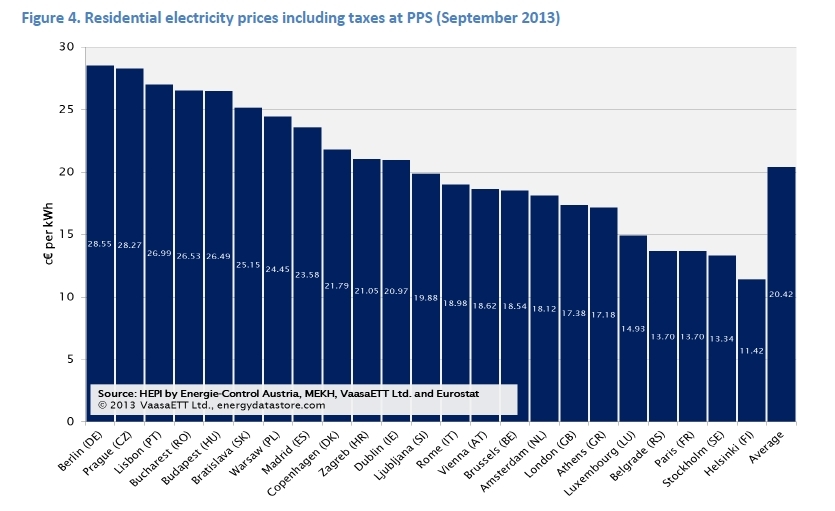
Berlin has the dubious pleasure of paying the highest electricity prices in Europe (which may ensure a place for some residents in their imagined green heaven but may lead them to bankruptcy in this life). Berlin residents pay more than twice the price that Helsinki residents pay.

Forbes: 

Residential-Energy-Prices-by-City-EU-2013

The good people of Berlin pay more for electricity than residents of any other major city in the European Union, according to the Household Energy Price Index for Europe.

VaasaETT, an energy think tank based in Helsinki, Finland, tracks monthly prices of electricity and natural gas for utility customers in the capital cities of 23 European countries.

The price customers pay per kilowatt-hour (kWh) of electricity varies by as much as 127% across these 23 countries.

After adjusting for purchasing power, Berlin becomes the place with the most expensive electricity in Europe followed by Prague and Lisbon.

Meanwhile, Helsinki has the cheapest electricity followed by Stockholm. …


Another Sunday, another week — but why?

November 3, 2013

The seven-day week must go down as being one of the most “unnatural” yet persistent creations of man. It is very practical of course, but why do we have it?

There are no discernible periodicities that we have been able to find outside ourselves which take 7 days. There are no periodicities within ourselves either that are 7 days or multiples of 7 days.  There are no celestial or astronomical cycles in tune with 7 days. There are no movements of the sun or the moon or the stars that give rise to a 7-day period. There are no weather or climate phenomena that repeat with a 7-day period. There are no human behavioural patterns that dance to a 7-day tune. There are no living things that have a 7-day life cycle. (There is a branch of pseudoscience which claims that living cells may be associated with a weekly or a half-weekly cycle – a circaseptan or a circasemiseptan rythm – but this is still in the realms of fantasy).

It would seem logical that our ancestors must have first noted the daily cycle long before they were even recognisable as human.  As humans they probably then noted the lunar cycle of about 29 days and the yearly cycle of about 365 days. Our distant ancestors would also have noted that the period of the yearly cycle was a little more than 12 lunar cycles. By about 35,000 years ago we have evidence that the lunar cycle was known and was being tracked. This evidence is in the form of a tally stick with 29 marks – the Lebombo bone.

The development of beliefs in gods of light and separate gods of darkness is not so difficult to understand. The gods of winds and fires and mountains and rivers are equally understandable. The fact that the lunar cycle was rather badly synchronised with the annual solar cycle could well have led to the concept of sun-gods and moon-goddesses, each with their own areas of influence.  (In fact, considering the imperfection of the design of the universe which is manifested in the lack of synchronisation between the various celestial cycles, it is difficult to understand how a concept of a single all-powerful creator ever arose. Why would such a poor design be the product of an all-powerful creator? Surely he could have managed the simple 3-body problem to synchronise the various rotations of the earth, the moon and the Sun?)

The invention of the seven-day week can best be dated to be at least 5,000 years ago to the time of the Babylonians. It was certainly long before the Old Testament came to be written to fit with the 7-day week which had already been invented and established. The story goes that

the seven-day week was actually invented by the Assyrians, or by Sargon I (King of Akkad at around 2350 B.C.), passed on to the Babylonians, who then passed it on to the Jews during their captivity in Babylon around 600 B.C.  The ancient Romans used the eight-day week, but after the adoption of the Julian calendar in the time of Agustus, the seven-day week came into use in the Roman world. For a while, both the seven and eight day weeks coexisted in the Roman world, but by the time Constantine decided to Christianize the Roman world (around A.D. 321) the eight-day weekly cycle had fallen out of use in favor of the more popular seven-day week.

The idea that the 7-days originates from a division of the lunar cycle into 4 seems improbable. The lunar cycle (synodic period) is 29.5305882 days long. Three weeks of 10 days each or five 6 day weeks would fit better. That the annual cycle of 365.2425 days comes to dominate is not so surprising. Our calendar months are now attuned to the annual cycle and have no direct connection to the lunar cycle. But it is our 7 – day weeks which remain fixed. We adjust the length of our months and have exactly 365 days for each of our  normal years. We then add an extra day every 4 years  but omit 3 such extra days in every 400 years to cover the error. We make our adjustments by adding a day to the month of February for the identified leap years but we do not mess with the 7 days of the week.

It is far more likely that the 7 days comes from the seven celestial objects visible to the naked eye from earth and probably known to man some 5,000 to 10,000 years ago. They were familiar with the Sun, the Moon, Mars, Mercury, Jupiter, Venus, and Saturn by then. Naturally each was a god in his own heaven and had to have a day dedicated just to him/her/it. The same 7 celestial objects are used for the days of the week not only in the Greek/Roman Western tradition, but also in Indian astrology. The Chinese /East Asian tradition uses the Sun, Moon, Fire, Water, Wood, Gold and Earth to name the seven days of the week. But this must have come after the 7 day week had already been established elsewhere. (For example, to name up to 10 days they could just have chosen to add days named for the Air, Beasts, Birds ….). Some languages use a numbering system and some use a mixture of all of the above. Rationalists and philosophers and dreamers have tried to shift to 5 and 6, and 8 and 10 day weeks but none of these efforts has managed to challenge the practicality or to dislodge the dominance of the seven-day week.

And now the whole world lives and marches – socially, culturally, politically – to the inexorable beat of the 7-day week.

Just because some long-forgotten astrologer/astronomer decided that he would dedicate each day to one of his seven known celestial gods (and he only had seven)! Even if he (unlikely to have been a “she”) worshipped an Earth-goddess, she must have been considered inferior to the celestial gods. Otherwise we would have had an 8-day week! 

An alien race could be excused for concluding that humans must have evolved from once having seven fingers on each limb. Or that we once had seven limbs and have lost 3. Or that humans have an innate circaseptan rythm requiring extra rest and sleep every 7 days. Or that humans have a physiological need to go binge drinking on the sixth day and need the seventh day to recover!

But if the 7-day week is a Divine creation then the aliens will also have a 7-day week and will not be in the least surprised.

The number seven does have a few special properties:

Not forgetting the Seven Wonders of the Ancient World. But they only came after the seven day week had been invented and introduced.


Intelligence Agencies have become a law unto themselves – by public consent

November 2, 2013

No politician wants to oppose anything said to be in the interests of National Security. Even politicians on oversight committees and the like would prefer not to know too much about the substance of what the Intelligence and Security Agencies get up to as long as proper form is observed. Very few politicians would have the courage to apply a moral or ethical judgement to what their charges get up to. They are quite ready to apply budget limitations or disapprove funding for a project but rarely to object to the substance of any program.

Invoking the spectre of “terrorism” or the “war on terrorism” appears to silence politicians with remarkable rapidity and to bypass any attempt to apply ethical standards. The end justifies any means whether it involves simple snooping or secret renditions, secret prisons or torture. If we judge by the level to which “fear of terrorism” governs our actions one could conclude that the terrorist attacks have mainly achieved their objective of getting their targets to operate in an atmosphere of fear.

The Snowden revelations are fascinating. It would seem that the Intelligence Community works across national boundaries – and it seems – behind the backs of their respective political masters. Almost as if these agencies in different countries apply their own code of ethics or morality. it seems they decide among themselves as to what level of transgressions of the integrity of private individuals  is acceptable and proper. US Agencies worked together with British, German, French, Spanish and Swedish intelligence agencies – probably on their own initiative and without feeling any need to inform their oversight politicians – about the details of their collaboration. After all, these politicians “do not need to know” and to help matters along, “they do not wish to know”.

But politicians only reflect the views of the general public.  Most of the security checking and scans at airports is of little use. The bans on electronic equipment during flights is totally pointless. But we, the general public, accept it since it panders to our fears. We accept the excesses of intelligence and security agencies for the same reason. So far the 21st century is characterised by actions being subservient to the “fear of terror”. And that I would define as cowardice. Courage consists of fears being subservient to actions.

Intelligence and Security Agencies have become a law unto themselves and our politicians have acquiesced on our behalf.

The Guardian: 

The German, French, Spanish and Swedish intelligence services have all developed methods of mass surveillance of internet and phone traffic over the past five years in close partnership with Britain’s GCHQ eavesdropping agency.

The bulk monitoring is carried out through direct taps into fibre optic cables and the development of covert relationships with telecommunications companies. A loose but growing eavesdropping alliance has allowed intelligence agencies from one country to cultivate ties with corporations from another to facilitate the trawling of the web, according to GCHQ documents leaked by the former US intelligence contractor Edward Snowden.

The files also make clear that GCHQ played a leading role in advising its European counterparts how to work around national laws intended to restrict the surveillance power of intelligence agencies.

The German, French and Spanish governments have reacted angrily to reports based on National Security Agency (NSA) files leaked by Snowden since June, revealing the interception of communications by tens of millions of their citizens each month. US intelligence officials have insisted the mass monitoring was carried out by the security agencies in the countries involved and shared with the US.

The US director of national intelligence, James Clapper, suggested to Congress on Tuesday that European governments’ professed outrage at the reports was at least partly hypocritical. “Some of this reminds me of the classic movie Casablanca: ‘My God, there’s gambling going on here,’ ” he said.

Swedenwhich passed a law in 2008 allowing its intelligence agency to monitor cross-border email and phone communications without a court order, has been relatively muted in its response.

…….

Shubh Diwali

November 2, 2013

It is that time of year again. Diwali is celebrated this year on 2nd November in the South and on 3rd November in North India.

For Indians and the Indian diaspora it is the biggest festival of the year. For the children, the excitement is unbearable and the anticipation is sublime.

A time for Presents. New clothes. Lights. Fireworks. Nuts. Sweets galore. And for the young men (mainly) there a session of teen patte (three-card brag) with a modicum of alcohol through the night. And the whiff of bhang is not unkown.

If there was any religious significance to the day it has long since gone (though it may still seem faintly religious on the surface). It is also the time for corporate gift giving in a very big way. Suppliers to customers. Petitioners to politicians. Litigants to the legal fraternity. Tenants to landlords. Patients to their doctors. Giving thanks in advance (call it relationship building to be kind or you could call it a form of social bribery) for the year to come.

But within the family or feudal unit it is different. Here there are new clothes, sweets and money and presents. From parents to children, From the head of the family to the servants. From the zamindars to the tenant farmers. From the masters to the serfs. At every household the local artisans and service providers will call to receive their baksheesh. The newspaper guy, the electrician, the plumber, the carpenter, the cable guy, the vegetable hawker and even the beat policeman. (And you can be sure that the receivers compare notes about the generosity of the various households).

You may give little if you cannot afford more, but to refuse to give baksheesh is most unseemly and beyond the pale.

But it is generally a time of goodwill  – and I reckon the goodwill level is about 10% higher than the long -term average. (Which of course begs the question as to when the goodwill is lower than average?).

A Happy Diwali to you all.

File:DiwaliOilLampCrop.JPG

A waggish tale of tails and wagging and of the sinister

November 1, 2013

Tail wagging in dogs certainly originates from their wolf ancestry. Wolves also communicate with their tails.

There are two specific styles of tail wagging that wolves perform: rigid or fluid movement. A rigid tail (like a pendulum) wag means the wolf is excited and has dominant tendencies. A fluid, or snake-like wag typically is a signal of play or greeting toward other pack members. 
The elevation and movement of each wolf’s tail work together to describe the behavior of each individual. So, a wolf who is rigidly wagging a T1 tail is exhibiting intense dominance, however a wolf fluidly wagging a T3 tail is probably soliciting social play with other pack members. 

But new research shows that in dogs, wagging on the left is quite different and communicates a different message to wagging on the right. Needless to say tail-wagging on the sinister side was a cause for concern to other dogs while a wag on the dexter side was reassuring!

 Siniscalchi et al.Current Biology, Seeing left or right asymmetric tail wagging produces different emotional responses in dogs10.1016/j.cub.2013.09.027

EurekAlert:The findings reported in the Cell Press journal Current Biology on October 31 show that dogs, like humans, have asymmetrically organized brains, with the left and right sides playing different roles.

The discovery follows earlier work by the same Italian research team, which found that dogs wag to the right when they feel positive emotions (upon seeing their owners, for instance) and to the left when they feel negative emotions (upon seeing an unfriendly dog, for example). That biased tail-wagging behavior reflects what is happening in the dogs’ brains. Left-brain activation produces a wag to the right, and right-brain activation produces a wag to the left.

While monitoring their reactions, the researchers showed dogs videos of other dogs with either left- or right-asymmetric tail wagging. When dogs saw another dog wagging to the left, their heart rates picked up and they began to look anxious. When dogs saw another dog wagging to the right, they stayed perfectly relaxed.

“The direction of tail wagging does in fact matter, and it matters in a way that matches hemispheric activation,” says Giorgio Vallortigara of the Center for Mind/Brain Sciences of the University of Trento. “In other words, a dog looking to a dog wagging with a bias to the right side—and thus showing left-hemisphere activation as if it was experiencing some sort of positive/approach response—would also produce relaxed responses. In contrast, a dog looking to a dog wagging with a bias to the left—and thus showing right-hemisphere activation as if it was experiencing some sort of negative/withdrawal response—would also produce anxious and targeting responses as well as increased cardiac frequency. That is amazing, I think.”

Not so implausible.

We take sticking out the left hand when greeting someone as not quite the proper thing to do. In Asia where the left hand is associated with cleaning oneself, the use of the left hand inappropriately could be taken as insulting. Monica Watkins writes, “Left-handedness has been, and in some cases still is, considered an inconvenience, a bad habit, or a symbol of the “sinister””.  A Yale study just published also claims that left-handed people are more likely to have psychotic disorders such as schizophrenia. Another study claims that our handedness is a major subliminal influence in the choices and decisions we make in all aspects our daily lives.

And it might have sinister implications if the Queen were to start waving with her left hand.

What's wrong

A sinister wave?

And I wonder if dogs distinguish between humans who pat them with their right hands and those who use their sinister side?

Broken link between carbon dioxide and global warming could be causing a paradigm shift in climate change theory

November 1, 2013

Dr. David Stockwell writing in Quadrant suggests that a paradigm shift in global warming theory may be underway.

Remember Thomas Kuhn and his paradigm shift?  According to his Structure of Scientific Revolutions, theories change only when anomalous observations stress the ”dominant paradigm” to the point that it becomes untenable. Until then, failure of a result to conform to the prevailing paradigm is not seen as refuting the dominant theory, but explained away as a mistake of the researchers, errors in the data, within the range of uncertainty, and so on. Only at the point of crisis does science become open to a new paradigm.  So, does Kuhn inform the current climate debate, help identify important information or an alternative paradigm?

The link between carbon dioxide concentrations and global warming effects is not based on any direct evidence. It is based on the absorption spectrum of the gas and then on assumptions about the “forcing” caused by the trace amounts of the gas in the atmosphere on other parameters such as clouds. This assumed impact is “confirmed” by correlations between global temperature (or temperature proxies) and carbon dioxide concentration and the assumption that anthropogenic effects (fossil fuel combustion)  dominate the undoubted increase of carbon dioxide concentrations in the atmosphere.  It is said that there is no better correlation but that is not true. Ocean cycles have been shown to have a much stronger correlation. But this assumed link is now looking decidedly shaky as long-ignored parameters (solar effects and the oceans) are also taken into account. Carbon dioxide concentrations have been increasing steadily but global temperatures have remained still for the last 17 – 18 years. In fact over the last 10 years global temperatures have shown a slight decline. Climate models have used the assumed carbon dioxide effect as input. But the predictions they have made about antarctic ice extent, sea level, hurricanes and stormy weather and hot spots in the troposphere have all proved wrong. Real global temperatures are increasingly diverging from these model results. The increase of information is increasing the uncertainty which is very odd.

Climate models can be seen as encapsulating the dominant theory, even though they are composed of many different theories regarding land, the ocean and atmosphere.  Despite their differences they are also similar in many ways, sharing terminology such as the ‘radiative kernel’.  Lets agree, for the purpose of argument, that the dominant AGW paradigm is of global temperature’s high sensitivity to  CO2 doubling, resulting in an increase of around 3°C, which appears to be about the central estimate of the climate models.

Does the 15-year ‘pause’ in global temperatures stress this theory? Certainly to some, the stress has already reached a ‘crisis’; while to others the divergence can be explained away by natural variation, uncertainty, and errors in the data. 

Do failed models and their predictions of increasing extreme events, like hurricanes, droughts and floods, stress the climate models?  Possibly not.  From a physical perspective, these phenomena lie at the boundaries of the theory.  Hurricanes, droughts and floods are ‘higher order’ statistics — extremes not climate averages. Surface temperature is only a part of the greater global climate system. Because anomalous behavior at the margins can be discarded without sacrificing the main theory, their power to confirm or reject the dominant paradigm is somewhat limited. 

Ocean heat content, however, is in a unique position.  The world’s oceans store over 90% of the heat in the climate system.  Arguably, therefore, increases in ocean heat determine overall global warming.  Ocean heat represents the physical bulk of the global heat store, and so should carry the most weight in our assessment of the status of AGW. Observations of ocean heat uptake represent the crucial experiment  — observations capable of decisively dismantling a theory despite its widespread acceptance in the scientific community.  The ARGO project to monitor ocean heat with thousands of drifting buoys is the crucial experiment of the AGW stable. 

A number of climate bloggers have remarked on the very low rate of ocean heat uptake (here, and here, and here), much lower than predicted by the models (herehere, and here).  The last link is about Nic Lewis, a coauthor on Otto et al. 2013, who feels that recent findings of low climate sensitivity, many based on ocean heat content, have led a number of prominent IPCC authors to abandon the higher estimates of climate sensitivity. That may not be a ‘catastrophe’ for the dominant AGW paradigm, but it is certainly a lurch by insiders towards the lower ends of risk and urgency. 

The IPCC panel preparing the AR5 report may not have been devastated when they changed the likely range of climate sensitivity, which had stood at 4.5–2°C since 1990. The lower extimate has now been dropped from 2°C to 1.5°C. What has not been appreciated is that increasing the range of uncertainty is impossible in a period of Kuhnian ‘normal science’, where new information always decreases uncertainty. 

The ‘blow-out’ in the range of likely climate sensitivity can only mean one thing: We are no longer in a period of ‘normal’ science, but entering a period of ‘paradigm shift’. ….

…..

Dr. Stockwell concludes:

Climate skeptics don’t want to say we told you so but, well, we told you so. Even though we do not yet have an accepted theory of solar influence, there are 25 unique models in the AR5-sponsored CIMP5 archive, most with a climate sensitivity untenable on observations from the last decade. 

Take out Occam’s razor and cull them – deep and hard.

Dr David Stockwell, Adjunct Researcher, Central Queensland University

Ice Age must be imminent: UK government predicts no cooling for “several centuries”

November 1, 2013

We are in a global cooling cycle and this may be a:

  1. a regular c. 30 year warming/cooling cycle influenced heavily by the multi-decadal ocean cycles, or
  2. another Little Ice Age – dominated by the solar sunspot cycles –  with the current Landscheidt Minimum comparable to the Dalton or the Maunder Minimum, or
  3. the ending of this interglacial  with a gradual return to glacial condition.

If anything can ensure that we are in for another Ice Age it must be this rather inane statement by the UK Parliamentary Under-Secretary of State, Department of Energy and Climate Change (Baroness Verma) when answering a question in the House of Lords:

All of the climate models and policy-relevant pathways of future greenhouse gas and aerosol emissions considered in the Intergovernmental Panel on Climate Change’s (IPCC) recent Fifth Assessment Report show a long-term global increase in temperature during the 21st century is expected. In all cases, the warming from increasing greenhouse gases significantly exceeds any cooling from atmospheric aerosols. Other effects such as solar changes and volcanic activity are likely to have only a minor impact over this timescale.

With regard to future glaciation the timescales are very long. Changes in the Earth’s orbit are considered to have driven the glacial cycles that have occurred every 100,000 years approximately, during the past one million years. The British Antarctic Survey has advised that the Earth is about halfway through the current interglacial period and the onset of the next glaciation is not expected for around 10,000 years at least. Although a future extensive glaciation would have huge geopolitical consequences, the transition into such a state would be slow, allowing for adaptation over many generations.

The slow changes in the Earth’s orbit are not, however, expected to cause any net global cooling over the next several centuries, which will be dominated by a warming global climate due to greenhouse gas emissions.

Baroness Verma’s faith in the IPCC and her religious adherence to global warming orthodoxy is touching. But the only thing we can be absolutely certain about is that the UK Government and Baroness Verma have surely got it wrong. In fact, the propensity of Baroness Verma to get (all) things wrong would suggest that glaciation has already started.

Global crisis! Wine consumption exceeds production

October 31, 2013

Wikimedia

This is serious!

Forget peak oil, never mind peak gas, global warming can take its time and Syrian chemical weapons have been destroyed.

Call a meeting of the UN Security Council.

The wine in the world is running out!!

Consumption exceeds production and reserves are sharply down.

A Jug of Wine, a Loaf of Bread — and Thou 

New York Post:A world-wide wine shortage is set to strike because the industry is under-supplied by roughly 300 million cases a year — the worst dry spell in 50 years, the research firm Morgan Stanley claims.

Wine drinkers across the globe are guzzling more vino than vinyards are producing, thanks to a spike in popularity in the U.S. and China, which has quadrupled its wine consumption in the past five years.

At the same time, top wine-making countries such as France, Spain and Italy are producing less due to land use problems, poor harvests and bad weather, the report claims.

And it’s going to get worse before it gets better, which could cause the cost of wine to spike, experts say.

BBC: The report by Morgan Stanley’s analysts Tom Kierath and Crystal Wang says global wine consumption has been rising since 1996 (except a drop in 2008-09), and presently stands at about 3bn cases per year.

At the same time, there are currently more than one million wine producers worldwide, making some 2.8bn cases each year.

The authors predict that – in the short term – “inventories will likely be reduced as current consumption continues to be predominantly supplied by previous vintages”

And as consumption then inevitably turns to the 2012 vintage, the authors say they “expect the current production shortfall to culminate in a significant increase in export demand, and higher prices for exports globally”.

Bache, bene venies
gratus et optatus
per quem noster animus
fit letificatus.

Iste cyphus concavus
de bono mero profluus
siquis bibit sepius
satur fit et ebrius

Hec sunt vasa regia
quibus spoliatur
ierusalem et regalis
babilon ditatur.

Istud vinum, bonum vinum,
vinum generosum,
reddit virum curialem,
probum, animosum.