Rafale de l'Escadron de Chasse 1/7 Provence: Wikipedia
It is not unexpected or unusual in the award of large Indian contracts that the “losing” bidder cries “foul” and claims that the evaluation process was manipulated. From my own experience in the Power industry it is “standard practice” for a losing bidder to enlist the aid of the media, politicians and the courts in crying foul and in trying to get an award to a competitor overturned. Again, from my own experience, such tactics can often delay awards but rarely succeed. Such “spoiling” can cause much rancour with the client and – more often than not – is counter-productive. In marketing and sales for large projects in India, “spoiling” a competitor’s award is rather easy but only delays matters and is not really worthwhile. The real sales skill lies in getting to be the lowest bidder and then beating off the “spoilers”.
Dassault’s Rafale was announced as being the lowest bidder beating the Eurofighter for the $20billion Indian MMRCA contract at the end of January. Now comes the cry of “possible foul” from a Member of the Upper House of Parliament (Rajya Sabha) who is also a member of Parliament’s standing Defence Committee. (The MP, MV Mysura Reddy, is a former member of the Congress Party who left to join the regional Telegu Desam party. He has lost 3 elections for Parliament but has been appointed by his party to the Upper House).
A recent paper from a multinational team of researchers from the UK, USA, Iceland, Denmark and Sweden describes studies of mytochondrial DNA (mtDNA) in mice to track ancient Viking movements. The mice genetics confirm the movements of the Vikings some 1000 years ago to Britain and Greenland and Iceland. They do not however provide any confirmation of the fleeting Viking presence in Newfoundland.
Viking movements: map from bbc.co.uk
“Modern house mouse populations were sampled across Iceland (9 localities), at Narsaq in Greenland (near the Viking Age ‘Eastern Settlement’) and in the north-west of Newfoundland (near the Norwegian Viking archaeological site at L’Anse aux Meadows, 4 localities). Ancient DNA was obtained from archaeological house mouse bones. In Greenland, these were from the Norwegian Viking ‘Eastern Settlement’ (3 individuals) and ‘Western Settlement’ (2 individuals), dating from between 1015– 1165 AD. In Iceland, these were from four archaeological sites in the north of Iceland, three of which date to the 10th C (1 individual per site) and one of which dates to the Medieval period or later (1477–1717 AD; 2 individuals”.
There has been a debate going on in Sweden over the last few days as to whether surrogate motherhood should be permitted. In following the various views I cannot help feeling that a fundamental ethical consideration is being avoided – perhaps intentionally. The Swedish Parliament’s Social Affairs Committee voted by a large – and very politically correct – majority to carry out an investigation into whether Swedish surrogacy laws should be changed.
The Local:Sweden took a step toward a possible lifting of its ban on surrogate motherhood on Tuesday, despite impassioned opposition from political parties on both the left and right.
The Riksdag’s Committee on Social Affairs voted by a wide majority on Tuesday to authorize the government to carry out an inquiry into surrogate motherhood. Currently, surrogate motherhood is outlawed in Sweden. However, the Christian Democrats and the Left Party both opposed the measure. “The issue of childlessness shouldn’t be solved by having women’s bodies used to carry and give birth to children for other people. Women’s bodies aren’t a commodity,” the Left Party’s Eva Olofsson told the TT news agency. Even if surrogate motherhood is allowed on a non-commercial basis, there is nevertheless a risk for a black market trade in surrogate births, argued Olofsson. She said that legalizing surrogate motherhood would send a signal that would increase acceptance of the practice that would open the door to trade with surrogate mothers in other countries, citing India as an example. “It’s possible that we need more regulations that would make it so that it’s not allowed in Sweden to buy a child that has been born this way in India. But that’s not how the proposal looks,” said Olofsson.
With all new medical procedures I think the fundamental ethical requirement is the informed consent of all those involved. And for surrogacy that includes the child-to-be. But much of the debate about surrogacy laws in Sweden has been focused on the “rights” of women or the gay community to have children (or not). There is more concern for the “convenience” of these groups rather than for the welfare of the would-be child. Of course the “informed consent” of the would-be child is not available. But it should not be beyond the wit of man to consider the views the child would have – if it could. Read the rest of this entry »
Smeets is actually Dutch filmmaker and animator Floris Kaayk, who worked in collaboration with media production company Revolver on the “media art project” that took the world by storm.
It’s been a dream of scientists ever since the days of Leonardo DiVinci and even Icarus — human-powered flight. But where some of the greatest scientific minds in history have failed, did Jarno Smeets, a mechanical engineer from the Netherlands, finally succeed in building a pair of working human wings?
The above video showing human flight was created by Smeets, and uploaded to YouTube earlier this week. It’s generating an incredible amount of controversy — half from people stunned that such a feat was accomplished, and half from people convinced the feat was a fraud.
I like this flash animation from NASA which is a modern version of the classic video Powers of Ten and travels from billionths of a yoctometre (10 -24 metres) up to tens of Gigaparsecs (about 3.1 x 10 25 metres). A journey of 60 powers of 10 from the Planck length of 1.616199(97)×10 -35 metres to the size of the observable universe at 10 27 metres.
“From where neutrinos are like suns to where galaxies are like dust”
It was high time and even though they have tried before, the new measures just announced by the Chinese Education Ministry will hopefully begin to curb the widespread plagiarism, data manipulation and even data fakery that allegedly goes on.
India needs to institutionalise something similar. The Society of Scientific Values in India is an independent body and tries valiantly to act as a watch-dog but it has no teeth and no official standing. Of course in India the danger with creating institutions under a Ministry – and therefore under a Minister – is that the institution will very quickly become politicised. And Indian politicians are perhaps not the best choice when it comes to monitoring and establishing ethical standards. Nevertheless a start has to be made and the Ministry of Science and Technology in India is the natural home of an institution to promote ethical standards in scientific research and at institutes of higher education. The key will be to provide the backing of the Ministry to give it sufficient weight but to maintain its independence from party political influences. Giving such an institution semi-judicial status is one way but could be very heavy handed.
China’s Ministry of Education on Wednesday issued new rules to supervise universities’ scientific research and academic activities in order to “effectively prevent and curb academic misconduct.”
Professor Akihisa Inoue is the President of Tohoku University, is a leading materials scientist and the author of over 2,500 publications. But criticism from other Japanese scientists (as on this Japanese website) has now led to at least 7 retractions for plagiarism. Three investigations have been conducted so far with rather wishy-washy conclusions. The investigations are in uncharted territory since Japan has no established processes for handling cases of scientific wrong-doing. There is no institution or body for supervising ethics or misconduct in research. And now yet another investigation committee is proposed. Without the guidance of precedent Tohoku University and even the Japanese Science and Technology Agency are not really sure how to proceed – especially when the allegations are against as prominent a person as the President of a University. Almost a classic case of what in industry would be called “paralysis by analysis” where every analysis shirks the task of coming to conclusions, declines to make judgements and merely proposes further analysis.
The Indian 2011 Census has some fascinating – and sometimes surprising – information on the trends and manner in which development is taking place. In 2011 the population had reached 1,201 million people. Population growth rate continues to decline with the sharpest decline during 2001-2011. The percentage increase during the decade 2001-2011 was the lowest since Indian Independence in 1947. The urban-rural divide is still very strong. Mobile phone connectivity is penetrating the rural heartland faster than toilets. While almost half of all rural households had access to mobile phones less than 1% had access to the internet. Radio is not going anywhere fast but TV continues to penetrate. The joint family system with multiple couples in a household is giving way to nuclear families. Two-thirds of all households now have access to electricity but two-thirds still use “smoky fuels” ( firewood, crop residue, cow dung cakes or coal) for cooking. But only a third of all households (and less than 20% of rural households) have access to treated drinking water. The bicycle is still the primary mode of travel.
In December I posted about the suspicious goings on at Kyoto Prefectural University:
A Japanese investigative website (http://blog.m3.com/Retraction/) has found 12 published articles where manipulation of images is very likely. The suspicious images in the papers published by the Matsubara lab are carefully deconstructed by Abnormal Sciencein an ongoing series of posts: here, hereand here.
Today Retraction Watch reports that the efforts of M3 (now discontinued) and Abnormal Science have not gone unnoticed:
The American Heart Association, which publishes a number of journals, has issued an Expression of Concern about five papers in three of their publications, following allegations of image manipulation. All of the papers include Hiroaki Matsubara, of Kyoto Prefectural University, as a co-author.
It has come to the attention of the American Heart Association (AHA), in a public manner, that there are questions concerning a number of figures in several AHA journals’ articles…
The “public manner” was three posts last year on the Abnormal Science blog… alleging that images were manipulated in the manuscripts, and that histology slides were reused.
The notice continues:
After reviewing these concerns, we have asked the institution, Kyoto Prefectural University of Medicine, to investigate the allegations. Until we learn the outcome, we feel it is best to post this Expression of Concern to alert our readers that concerns about these articles have been raised.
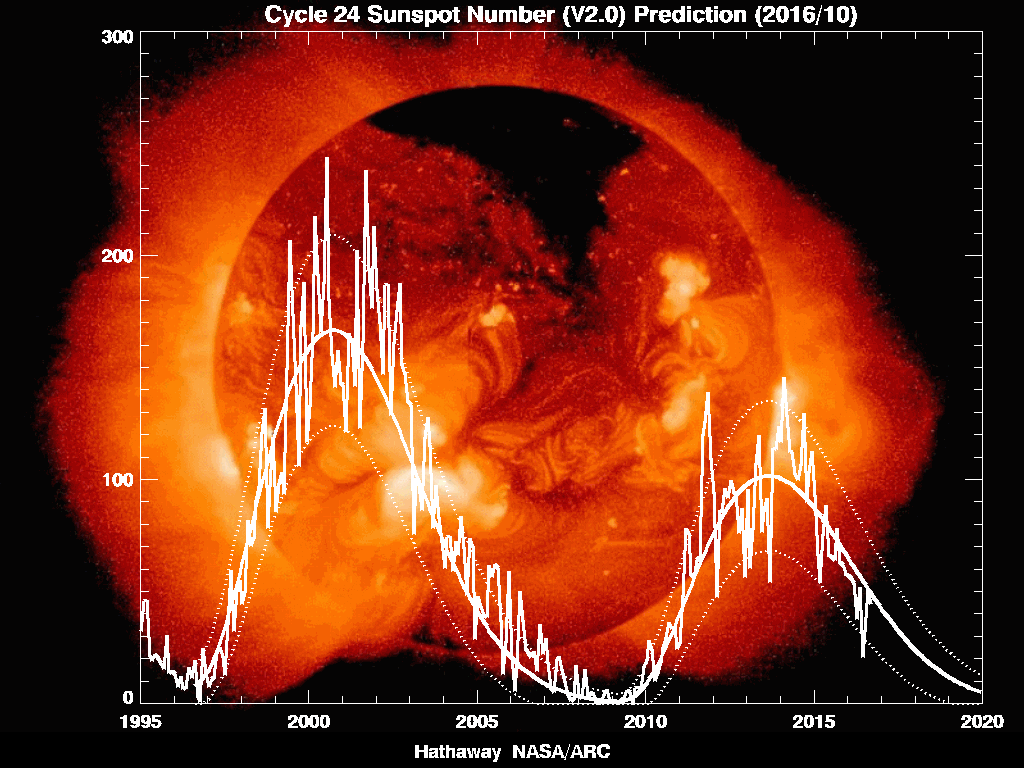
The current prediction for Sunspot Cycle 24 gives a smoothed sunspot number maximum of about 59 in early 2013. We are currently over three years into Cycle 24. The current predicted size makes this the smallest sunspot cycle in about 100 years.
SC24 forecast: updated 2nd March 2012
SC25 will likely be even smaller and it now remains to be seen if this Landscheidt Minimum is closer to a Dalton Minimum or a Maunder Minimum.