Posts Tagged ‘global cooling’

Solar Cycle 24 prediction: On track to be smallest in 100 years

June 12, 2012

NASA has updated its forecast for Solar Cycle 24.

Maximum is expected to be reached in Spring 2013 with a sunspot number of 60 and this prediction is for the lowest sunspot number in  100 years. This only confirms that we are currently in a solar minimum – the Landscheidt Minimum – though it remains to be seen whether this will be a Grand Minimum in the style of the Maunder Minimum or the Dalton Minimum. In any event a period of several decades of global cooling is to be expected and is already probably upon us (starting some 10 years ago).

(more…)

Hundreds die as cold wave in Europe provides a taste of what a little ice age could do

February 3, 2012

As Europe freezes in Siberian weather and people die it is not so difficult to imagine what life would be like in the throes of a Little Ice Age. Humans have endured and survived during the ice ages but have only developed and thrived and expanded when the Earth goes through its  interglacial periods.

It is global cooling and the potential for a little ice age that poses the real threat to humans. Not some fantasy about anthropogenic global warming. The demonisation of carbon dioxide in the assumed – but unproven – belief that it contributes to global warming will turn out to be one of the most wasteful contentions of modern science.

If only it was that easy to change the climate!

NoTricksZone reports:

Germany’s no. 1 daily Bild (by circulation numbers) reports on the Killer Cold now paralyzing Europe and Asia, and calls it the worst in 25 years. The cold has hit Eastern Europe especially hard, with temperatures plummeting to -30°C throughout the Ukraine and Poland. So far the cold has claimed 139 lives, with 3 in Germany.

(more…)

Bicentennial cycle of deep cooling starting in 2014 – another little ice age in 2055±11 years

February 1, 2012

Well now!!!

Perhaps this just panders to my opinions but I find this more convincing than the Hockey Stick.

A new paper in Applied Physics Research:

Bicentennial Decrease of the Total Solar Irradiance Leads to Unbalanced Thermal Budget of the Earth and the Little Ice Age by Habibullo I. Abdussamatov, Pulkovo Observatory of the Russian Academy of Science, St. Petersburg, 196140, Russia

Applied Physics Research   ISSN 1916-9639 (Print)   ISSN 1916-9647 (Online)

Abstract 

Temporal changes in the power of the longwave radiation of the system Earth-atmosphere emitted to space always lag behind changes in the power of absorbed solar radiation due to slow change of its enthalpy. That is why the debit and credit parts of the average annual energy budget of the terrestrial globe with its air and water envelope are practically always in an unbalanced state. Average annual balance of the thermal budget of the system Earth-atmosphere during long time period will reliably determine the course and value of both an energy excess accumulated by the Earth or the energy deficit in the thermal budget which, with account for data of the TSI forecast, can define and predict well in advance the direction and amplitude of the forthcoming climate changes. From early 90s we observe bicentennial decrease in both the TSI and the portion of its energy absorbed by the Earth. The Earth as a planet will henceforward have negative balance in the energy budget which will result in the temperature drop in approximately 2014. Due to increase of albedo and decrease of the greenhouse gases atmospheric concentration the absorbed portion of solar energy and the influence of the greenhouse effect will additionally decline. The influence of the consecutive chain of feedback effects which can lead to additional drop of temperature will surpass the influence of the TSI decrease. The onset of the deep bicentennial minimum of TSI is expected in 2042±11, that of the 19th Little Ice Age in the past 7500 years – in 2055±11.

The full paper (pdf) is here: Abdussamatov App Physics Research

(more…)

Reducing sulphur emissions caused post-1970 global warming!!!!

July 5, 2011

Whether warming or cooling it would seem that anthropogenic effects and man’s burning of coal is responsible.

“The post 1970 period of warming, which constitutes a significant portion of the increase in global surface temperature since the mid 20th century, is driven by efforts to reduce air pollution in general and acid deposition in particular”.

That’s the conclusion of a new paper from the “peer-reviewed” literature confirming the obvious that global temperatures have plateaued since 1998.

Reconciling anthropogenic climate change with observed temperature 1998–2008

Robert K. Kaufmann, Heikki Kauppi, Michael L. Mann, James, H. Stock

pnas. 201102467

PDF from WUWT

And though the paper cuts off  data in 2008 this temperature stability certainly continues till 2010 and it seems – on my own empirical observations  – even in 2011.

As the paper title shows this real stabilisation of temperatures which is not predicted by any climate model and which may well be a precursor of a few decades of global cooling is of some concern to the Anthropogenic Global Warming enthusiasts. The presumption is that the model results are supreme and that reality must be reconciled by invoking further anthropogenic effects.

Needless to say any global cooling is not acknowledged since that would be heretical and instead short-term anthropogenic factors (sulphur emissions from coal burning in China)  are blamed for this cessation of global warming!!

Given the widely noted increase in the warming effects of rising greenhouse gas concentrations, it has been unclear why global surface temperatures did not rise between 1998 and 2008. We find that this hiatus in warming coincides with a period of little increase in the sum of anthropogenic and natural forcings. Declining solar insolation as part of a normal eleven-year cycle, and a cyclical change from an El Nino to a La Nina dominate our measure of anthropogenic effects because rapid growth in short-lived sulfur emissions partially offsets rising greenhouse gas concentrations. As such, we find that recent global temperature records are consistent with the existing understanding of the relationship among global surface temperature, internal variability, and radiative forcing, which includes anthropogenic factors with well known warming and cooling effects.

The conclusion is formulated to avoid any semblance of heresy and to ensure publication no doubt.

The finding that the recent hiatus in warming is driven largely by natural factors does
not contradict the hypothesis: “most of the observed increase in global  average temperature since the mid 20th century is very likely due to the observed increase in anthropogenic greenhouse gas concentrations (14)”. As indicated in Figure 1, anthropogenic activities that warm and cool the planet largely cancel after 1998, which allows natural variables to play a more significant role. ……   

The post 1970 period of warming, which constitutes a significant portion of the increase in global surface temperature since the mid 20th century, is driven by efforts to reduce air pollution in general and acid deposition in particular, which cause sulfur emissions to decline while the concentration of greenhouse gases continues to rise. 

That reality is being acknowledged is heartening but relying on the anthropogenic effects effects of coal burning alone (carbon dioxide emissions causing warming and sulphur emissions causing cooling) with only a passing reference to solar effects is not just naive – it is denying the obvious.

Related:

http://wattsupwiththat.com/2011/07/04/a-peer-reviewed-admission-that-global-surface-temperatures-did-not-rise-dr-david-whitehouse-on-the-pnas-paper-kaufmann-et-al-2011/

An inconvenient solar minimum..

June 15, 2011

Solar science and the possibility that a Maunder-like Minimum may be approaching seems to have caught the fancy of the MSM — Al Gore notwithstanding.

  1. The Telegraph New Little Ice Age in store? 
  2. Sydney Morning Herald Quiet sun: drop in solar activity may signal second ‘Little Ice Age’ on Earth
  3. Fox News Global Warming Be Damned, We Might Be Headed for a Mini Ice Age
  4. International Business Times The Sun’s inactivity leading to second Little Ice Age, to Offset Global Warming?
  5. MSNBC Solar forecast hints at a big chill
  6. The Christian Science Monitor A sun with no sun spots? What that could mean for Earth and its climate
  7. Discovery News IS THE SUN ABOUT TO FIZZ OUT?
  8. ABC News Goodnight Sun: Sunspots May Disappear for Years
  9. New Scientist Sluggish sun may ‘sit out’ next solar cycle
  10. Arizona Daily Star Fewer sunspots could help offset global warming
Most of these publications are generally fairly uncritical adherents of whatever seems to be in vogue and have usually been very vocal in supporting the AGW creed. But it is nevertheless interesting to see how they have all picked up this news — as if they are bored with and tired of repeating the same old AGW story-line and are just waiting for a new star to follow.
Perhaps the political tide is turning, ……

Major Drop In Solar Activity Predicted: Landscheidt Minimum is upon us and a mini-ice age is imminent

June 15, 2011

The stunning announcement made at the annual meeting of the American Astronomical Society exceeded the expectations from the advance publicity!

The results of new studies were announced today (June 14) at the annual meeting of the solar physics division of the American Astronomical Society, which is being held this week at New Mexico State University in Las Cruces. 

The results of three separate studies seem to show that even as the current sunspot cycle (SC24) moves toward the solar maximum, the sun could be heading into a more-dormant period, with activity during the next 11-year sunspot cycle (SC25) greatly reduced or even eliminated.

The indicators have been  growing for some time that we are in for a a new solar minimum – the Landscheidt minimum – which could be similar to the Dalton Minimum and may even approach the Maunder Minimum. This could mean a cooling period for the earth of 20 – 30 years or for as long as 60 – 70 years. In any event the signs will be unambiguous and inescapable within a decade.

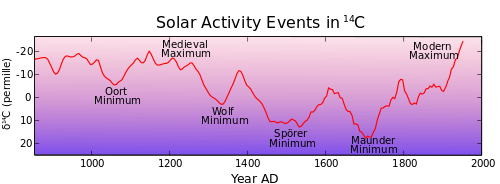
It is reasonable to assume that climatic conditions over the next 20 – 30 years will resemble those prevailing between 1790 and 1820. But SC24 has a way to go yet and it could be that solar activity for SC24 and 25 will be even lower than during the Dalton minimum and perhaps closer to the Spörer minimum but perhaps not as deep as the Maunder minimum.

But in either case the solar activity to come following the Modern maximum may well resemble the 500 years of decline in solar activity which followed the Medieval maximum.

Solar activity events recorded in radiocarbon. Present period is on left. Values since 1950 not shown: Wikipedia

The three papers are: 

  1. “Large-Scale Zonal Flows During the Solar Minimum — Where Is Cycle 25?” by Frank Hill, R. Howe, R. Komm, J. Christensen-Dalsgaard, T.P. Larson, J. Schou & M. J. Thompson.
  2. “A Decade of Diminishing Sunspot Vigor” by W. C. Livingston, M. Penn & L. Svalgard.
  3. “Whither Goes Cycle 24? A View from the Fe XIV Corona” by R. C. Altrock.

 Spacedaily reports:

Major Drop In Solar Activity Predicted

As the current sunspot cycle, Cycle 24, begins to ramp up toward maximum, independent studies of the solar interior, visible surface, and the corona indicate that the next 11-year solar sunspot cycle, Cycle 25, will be greatly reduced or may not happen at all.

“This is highly unusual and unexpected,” Dr. Frank Hill, associate director of the NSO’s Solar Synoptic Network, said of the results. “But the fact that three completely different views of the Sun point in the same direction is a powerful indicator that the sunspot cycle may be going into hibernation.”

Hill is the lead author on one of three papers on these results being presented this week. Using data from the Global Oscillation Network Group (GONG) of six observing stations around the world, the team translates surface pulsations caused by sound reverberating through the Sun into models of the internal structure.

One of their discoveries is an east-west zonal wind flow inside the Sun, called the torsional oscillation, which starts at mid-latitudes and migrates towards the equator. The latitude of this wind stream matches the new spot formation in each cycle, and successfully predicted the late onset of the current Cycle 24.

“We expected to see the start of the zonal flow for Cycle 25 by now,” Hill explained, “but we see no sign of it. This indicates that the start of Cycle 25 may be delayed to 2021 or 2022, or may not happen at all.”

In the second paper, Matt Penn and William Livingston see a long-term weakening trend in the strength of sunspots, and predict that by Cycle 25 magnetic fields erupting on the Sun will be so weak that few if any sunspots will be formed. Spots are formed when intense magnetic flux tubes erupt from the interior and keep cooled gas from circulating back to the interior.

For typical sunspots this magnetism has a strength of 2,500 to 3,500 gauss (Earth’s magnetic field is less than 1 gauss at the surface); the field must reach at least 1,500 gauss to form a dark spot.

Using more than 13 years of sunspot data collected at the McMath-Pierce Telescope at Kitt Peak in Arizona, Penn and Livingston observed that the average field strength declined about 50 gauss per year during Cycle 23 and now in Cycle 24.

They also observed that spot temperatures have risen exactly as expected for such changes in the magnetic field. If the trend continues, the field strength will drop below the 1,500 gauss threshold and spots will largely disappear as the magnetic field is no longer strong enough to overcome convective forces on the solar surface.

Moving outward, Richard Altrock, manager of the Air Force’s coronal research program at NSO’s Sunspot, NM, facilities has observed a slowing of the “rush to the poles,” the rapid poleward march of magnetic activity observed in the Sun’s faint corona. Altrock used four decades of observations with NSO’s 40-cm (16-inch) coronagraphic telescope at Sunspot.

“A key thing to understand is that those wonderful, delicate coronal features are actually powerful, robust magnetic structures rooted in the interior of the Sun,” Altrock explained. “Changes we see in the corona reflect changes deep inside the Sun.”

Altrock used a photometer to map iron heated to 2 million degrees C (3.6 million F). Stripped of half of its electrons, it is easily concentrated by magnetism rising from the Sun. In a well-known pattern, new solar activity emerges first at about 70 degrees latitude at the start of a cycle, then towards the equator as the cycle ages. At the same time, the new magnetic fields push remnants of the older cycle as far as 85 degrees poleward.

“In cycles 21 through 23, solar maximum occurred when this rush appeared at an average latitude of 76 degrees,” Altrock said.

“Cycle 24 started out late and slow and may not be strong enough to create a rush to the poles, indicating we’ll see a very weak solar maximum in 2013, if at all. If the rush to the poles fails to complete, this creates a tremendous dilemma for the theorists, as it would mean that Cycle 23’s magnetic field will not completely disappear from the polar regions (the rush to the poles accomplishes this feat). No one knows what the Sun will do in that case.”

All three of these lines of research to point to the familiar sunspot cycle shutting down for a while. “If we are right,” Hill concluded, “this could be the last solar maximum we’ll see for a few decades. That would affect everything from space exploration to Earth’s climate.”

That last may be the understatement of the century!!!

A photo of a sunspot taken in May 2010, with Earth shown to scale. The image has been colorized for  aesthetic reasons. This image with 0.1 arcsecond resolution from the Swedish 1-m Solar  Telescope represents the limit of what is currently possible in te

A photo of a sunspot taken in May 2010, with Earth shown to scale.This image with 0.1 arcsecond resolution from the Swedish 1-m Solar Telescope represents the limit of what is currently possible in terms of spatial resolution. CREDIT: The Royal Swedish Academy of Sciences, V.M.J. Henriques (sunspot), NASA Apollo 17 (Earth)

Nothing new under the sun: Global warming in the 80’s followed by global cooling after 2000 was predicted back in 1979

June 1, 2011

From JoNova

St Petersburg Times, Jan 1, 1979

Drs Leona Libby and Louise Pandolfi projected world temperatures in 1979 for the next 70 years and got results that, 30 years later, appear to have been broadly correct if out by 5 – 7 years. Ironically, they used, of all things, … tree ring data (going back 1,800 years). The critical difference was they assumed that the climate changes in natural cycles.

Visit Steven Goddard’s blog to read the full news story.

Climate Predictions 1979

St Petersburg times news 1979

http://joannenova.com.au/2009/04/global-warming-a-classic-case-of-alarmism/

Global cooling indicators are increasing

January 23, 2011

The conditions in the relatively thin, chaotic surface layer of atmosphere surrounding the earth within the earth-sun system are what we call climate in the long term over large geographic regions and what we call weather in the short term over small geographic regions. I am convinced that these conditions are dominated by the sun and that the primary vehicles for transporting energy around the earth’s surface (and which is decisive for the chaotic boundary layer) are the oceans. The energy carrying capacity of the atmosphere is small compared to that of the oceans.

The major ocean cycles which seem to be most relevant are the Atlantic Multidecadal Oscillation (AMO) and the Pacific Decadal Oscillation (PDO). The El Niño-Southern Oscillation (ENSO) seems to be superimposed on the major cycles which which may even derive from ENSO and the deep ocean circulation patterns. The major cycles also contain sub-cycles such as the Nothern Atlantic Oscillation (NAO) or the Southern Oscillation Index (SOI). There are other minor cycles such as the Arctic Oscillation Index (AO) and the Antarctic Oscillation (AAO).

The indicators that we are in a period of 20 – 30 years of global cooling are increasing:

1. The quiet sun is perhaps the most important indicator we have that we are entering (or have entered) a global cooling period. The period 2000 – 2030 could well be similar to that during the Dalton Minimum between 1790 – 1820.

Image Attachment

graphics credit: sc25.com

2. There have been regular periods of warming and cooling in the past.

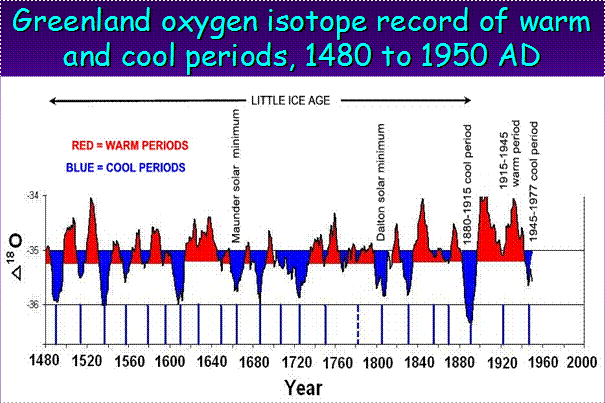
Alternating periods of warm and cooler weather have been with us as far back as our climate records go. Some of the past cooler periods have been more severe than others, like the Sporer, Maunder and Dalton Minimums. Professor Don Easterbrook has documented some 20 such cool periods over the last 500 years

Figure 1

graphic: Don Easterbrook

3. Taking just the main ocean cycles, the AMO is a 66 year cycle.

AMO peaks occurred on May 1878 and November 1944. The next peak is forecasted to occur in April 2011. The last trough occurred in January 1978, and the next trough is expected to occur in June 2044. As we see here, the length of a complete cycle is about 66.5 years.

The AMO went positive in 1994 and actually peaked in July 2010 and is now on its way down. It should go negative sometime in 2015 and remain negative till about 2048.

4. The Pacific Decadal Oscillation (PDO) has a shorter cycle of about 60 years.

graphic: digitaldiatribes.files.wordpress.com

The PDO cycle is not quite as long as AMO. Because the periods differ, their peaks and troughs will vary relative to each other. This has an interesting long-term result in terms of warming and cooling. The PDO had a peak in the function in October 1929 (about 15 years prior to AMO). The next peak occurred May 1990 (about 21 years prior to the anticipated AMO peak). The period here is about 60.5 years.

PDO has gone negative since September 2007  and will remain in negative territory probably for the next 30 years. For about 2 decades the PDO and the AMO will both be negative (but as can be seen above the amplitude of the short term variations are so large that short periods in the positive region are perfectly possible and inevitable, even while the long term average is negative or vice versa.)

5. ENSO and the efects of La Niñas and El Niños.

Returning to Matti Vooro’s article:

During negative or cool phases of PDO and AMO, there are more La Niñas than during the positive phases. This contributes to more cold winters and colder years during negative PDO. During positive or warm phases of PDO and AMO, there are significantly more El Niños. This is why there is more warming when the PDO is positive. The current negative or cool PDO and the La Niña are why we have had all the recent cold weather. The La Niña’s may have directly contributed to the Red River Flooding of 2009 and the recent flooding in Australia and Brazil.

…. The AMO is affected by ENSO cycles, especially El Ninos, so we saw a brief warming of AMO during 2010. Climate history shows that global cooling was strongest when both the PDO andAMO were both simultaneously in the negative or cool mode – like in 1964-1976 and again 1916 to 1923. The AMO cycles have been quite variable. During its last cycle it was in the negative or cool mode for 30 years (1964-1994] and its cycle seems to be related to the Meridional Overturning Circulation [MOC] and the changes in the Atlantic Thermohaline Circulation [THC]. There are a number of estimates when it will again go negative. My best estimate is about 2015 based on the most frequent past intervals of around 20 years and the cooler waters that feed the MOC from the Southern Oceans. Once it does go negative, the global temperature anomalies may drop further until about 2030, the Arctic temperature may cool further and the Arctic ice extent should increase again.

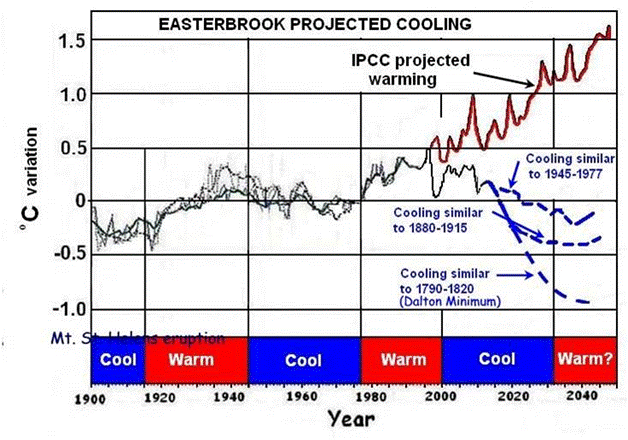
Professor Easterbrook has made a global forecast for temperature:

The IPCC projections are no longer credible but it must be borne in mind that these projections had little to do with actually bringing science to make the best forecast possible but instead were focused on poltical objectives; it seems mainly to redistribute wealth and to demonise CO2 so as to drive the carbon trading market.

That global cooling is upon us seems more and more likely and I apprehend that Easterbrooks’s lowest curve will materialise and show that the current Landscheidt minimum will be comparable to the Dalton minimum.


Since last ice age, warming and cooling have been caused by ocean currents

January 16, 2011

A new paper in Science giving ocean currents in the Atlantic their due (and without finding it necessary to appeal to tales of carbon dioxide). Perhaps the science is not so settled after all!

File:Oceanic gyres.png

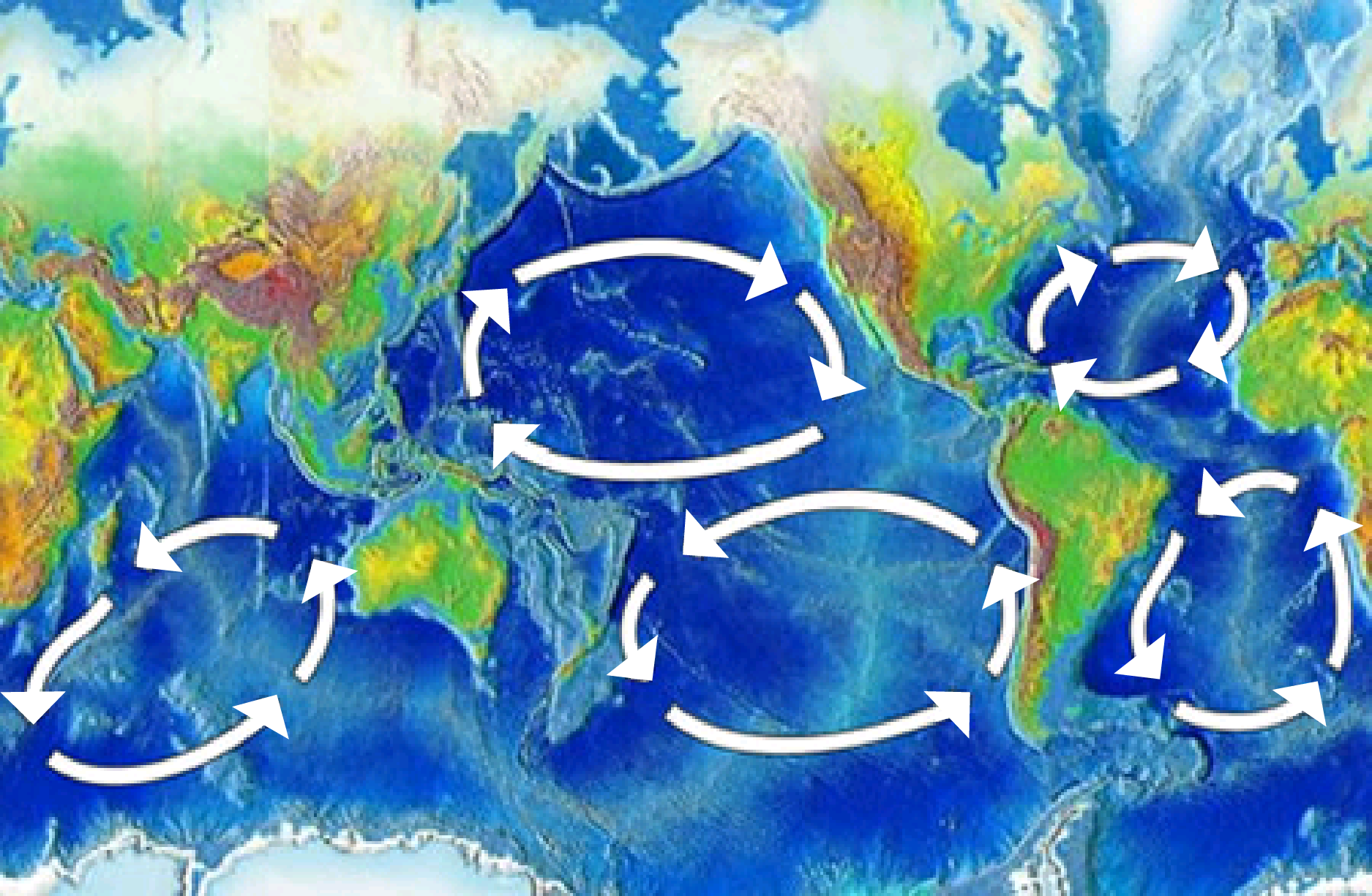
The five major ocean-wide gyres — the North Atlantic, South Atlantic, North Pacific, South Pacific, and Indian Ocean gyres. Each is flanked by a strong and narrow “western boundary current,” and a weak and broad “eastern boundary current”: Wikimedia

The Deglacial Evolution of North Atlantic Deep Convection. by D. J. R. Thornalley, S. Barker, W. S. Broecker, H. Elderfield, I. N. McCave.  Science, 2011; 331 (6014): 202 DOI: 10.1126/science.1196812

Science Daily reports:

… Scientists have long suspected that far more severe and longer-lasting cold intervals have been caused by changes to the circulation of the warm Atlantic ocean currents themselves.

Now new research led by Cardiff University, with scientists in the UK and US, reveals that these ocean circulation changes may have been more dramatic than previously thought. The findings, published January 14, 2011 in the journal Science, show that as the last Ice Age came to an end (10,000 — 20,000 years ago) the formation of deep water in the North-East Atlantic repeatedly switched on and off. This caused the climate to warm and cool for centuries at a time.

The circulation of the world’s ocean helps to regulate the global climate. One way it does this is through the transport of heat carried by vast ocean currents, which together form the ‘Great ocean conveyor’. Key to this conveyor is the sinking of water in the North-East Atlantic, a process that causes warm tropical waters to flow northwards in order to replace the sinking water. Europe is kept warmer by this circulation, so that a strong reduction in the rate at which deep water forms can cause widespread cooling of up to 10 degrees Celsius. ….. The new results suggest that the Atlantic ocean is capable of radical changes in how it circulates on time scales as short as a few decades.

Dr Thornalley said: “These insights highlight just how dynamic and sensitive ocean circulation can be. Whilst the circulation of the modern ocean is probably much more stable than it was at the end of the last Ice Age, and therefore much less likely to undergo such dramatic changes, it is important that we keep developing our understanding of the climate system and how it responds when given a push.”

Paper Abstract:

Deepwater formation in the North Atlantic by open-ocean convection is an essential component of the overturning circulation of the Atlantic Ocean, which helps regulate global climate. We use water-column radiocarbon reconstructions to examine changes in northeast Atlantic convection since the Last Glacial Maximum. During cold intervals, we infer a reduction in open-ocean convection and an associated incursion of an extremely radiocarbon (14C)–depleted water mass, interpreted to be Antarctic Intermediate Water. Comparing the timing of deep convection changes in the northeast and northwest Atlantic, we suggest that, despite a strong control on Greenland temperature by northeast Atlantic convection, reduced open-ocean convection in both the northwest and northeast Atlantic is necessary to account for contemporaneous perturbations in atmospheric circulation.


“Not inconsistent with man-made global warming” !!

January 15, 2011

Climate Science – if there is such a thing – had long ago abandoned science to become a lobby for “global warming theory”. But the “scientists” are plumbing new depths.

It has not taken long for “climate scientists” to claim that all extreme weather events (heat wave in Russia, floods in Pakistan, coldest December in 100 years , droughts in Australia and now floods in Brazil and Australia)  are all “not inconsistent with global warming” implying by some strange, convoluted logic that all these weather events (which are also consistent with history repeating itself) somehow add to the body of “evidence” which “proves” that man-made global warming is happening. There have even been crack-pot scientists with such a vested interest in the “man-made global warming” ideology  who have found it possible to blame volcanic activity and even the earthquake in Haiti on “global warming”!!!

The current strength of the La Ninã conditions are perfectly consistent with other theories based on ocean variation and the frigid winters are quite consistent with the quiet Sun (which went spotless again yesterday). All current weather is also consistent with man-made effects being totally negligible and instead being dominated by the sun’s cycles and with the oceans as the primary vehicle for transporting heat around the globe. Weather is not climate and in fact none of the “extreme” weather events  are outside the range of weather variations that have been experienced over the last 1000 years.

The floods in Brazil have claimed over 500 lives and in Australia – which is far better prepared – the death toll will likely be between 20 – 30. In Australia where a higher flood occurred in 1974 in Brisbane voices are beginning to be raised that the “global warming” lobby have actually prevented the use of dams and implementation of proposed water management policies which could have been able to better manage these regular and recurring flood conditions.

The history of floods in Brisbane is telling:

Highest annual flood peaks for Brisbane

Highest annual flood peaks for Brisbane

The floods this year in Queensland are nothing new. Why would this flood be evidence of man-made global warming but not the floods of the 1800s? In fact the history of these weather conditions in Brisbane is not inconsistent with global cooling, the coming of an ice-age or an apocalyptic end to the earth in 2012!

thepunch.com.au

Any scientist who is concerned with science and not with religion, politics or defending his past conclusions would know that being “not inconsistent” with some theory carries no weight in a scientific proof – but it does sound so credible in a TV sound-bite.

But we can expect that over the next few years that every natural disaster or extreme weather event will be taken by the members of a dying religion as being “not inconsistent with” and therefore as proof of man-made global warming.