When the law is an ass

April 4, 2013

“‘You were present on the occasion…and, indeed, you are the more guilty of the two, in the eye of the law; for the law supposes that your wife acts under your direction.

“‘If the law supposes that,’ said Mr. Bumble, squeezing his hat emphatically in both hands, ‘the law is a ass — a idiot. If that’s the law, the law is a bachelor; and the worst I wish the law is, that his eye may be opened by experience — by experience.'”  Oliver Twist, Charles Dickens

Of course any society can make any law it likes to ensure the proper functioning of that society. And such laws are nothing more than rules made by the majority of that time for the functioning of the society of that time. Systems of law are thus just exercises in pragmatism for the current time. But there is an implied “sanctity” and “immutability”  to systems of law which is neither justified nor rational. They are never laws in the sense of the Natural Laws which are not time-dependent and where compliance is inherent in the formulation of the law. Even the laws of God depend upon which religion one chooses to follow and when that religion was invented. The Big Ten as handed down to Moses no longer all apply. Times change, societies change and the laws of man (and those of God as formulated by man) must follow – but they don’t. It should not be beyond the wit of man to make such laws subject to the common sense of the time. Perhaps every law made by man should also have a term of validity. But that would be asking too much. And time and time again “the law is an ass” in its formulation or in its application!

“It is a rule of evidence deduced from the experience of mankind and supported by reason and authority that positive testimony is entitled to more weight than negative testimony but by the latter term is meant negative testimony in it’s true sense and not positive evidence of a negative, because testimony in support of a negative may be as positive as that in support of an affirmative…” Blackburn v. State, 254 Pac. 467, 472 (Ariz. 1927)

Just 3 examples from today’s news.

  1. The Independent: A Dutch appeals court has lifted a ban on an organisation which lobbies for the legalisation of sex between adults and children, after finding that the group was not breaking any laws in The Netherlands. ….. an appeals court in Leeuwarden has ruled that the group, which claims it does not promote sexual abuse and insists it is “a platform for discussion of paedophilia”, could not be outlawed because its existence did not threaten society, the Dutch News website reported.
  2. (Reuters) – Amnesty International has condemned a reported Saudi Arabian court ruling that a young man should be paralyzed as punishment for a crime he committed 10 years ago which resulted in the victim being confined to a wheelchair. The London-based human rights group said Ali al-Khawaher, 24, was reported to have spent 10 years in jail waiting to be paralyzed surgically unless his family pays one million Saudi riyals ($270,000) to the victim.
  3. RollingStone: …. Despite the passage in late 2012 of a new state ballot initiative that prevents California from ever again giving out life sentences to anyone whose “third strike” is not a serious crime, thousands of people – the overwhelming majority of them poor and nonwhite – remain imprisoned for a variety of offenses so absurd that any list of the unluckiest offenders reads like a macabre joke, a surrealistic comedy routine. Have you heard the one about the guy who got life for stealing a slice of pizza? Or the guy who went away forever for lifting a pair of baby shoes? Or the one who got 50 to life for helping himself to five children’s videotapes from Kmart? How about the guy who got life for possessing 0.14 grams of meth? ….

Delta Airlines sues US Ex-IM for supporting Boeing sales to foreign airlines

April 4, 2013

I think Delta doth protest too much and is clutching at straws. Loss of jobs at Boeing is of much more consequence to the US economy than Delta’s dubious claim of loss of competitiveness against foreign airlines.

Of course the real problem is that Delta is weak competitively. Its costs are too high and its service is too inferior. By the end of trading session, Delta Air Lines, Inc. shares slumped 8.06% to US$14.94 with more than 41.03 million shares traded, compared to its average volume of 12.11 million shares. Delta Air Lines’s unit revenues increased only 2% in March, and most of it came from its trans-Atlantic and Latin offerings.  Delta were expecting a March growth of 4 – 5%. And they are more than a little worried by the US Air merger with American Airlines.

(Reuters) –Delta Air Lines Inc has sued the Export-Import Bank of the United States over loan guarantees given to support purchases of Boeing Co’s widebody planes by certain foreign airlines, according to a court filing.

Delta are claiming that Ex-Im bank’s guarantees (to Boeing) and/or buyers credits (to foreign airlines) for aircraft sales to foreign airlines, including Emirates Airlines, Etihad Airways and Korean Air Co Ltd, amount to subsidies and would cause a loss of competitiveness and adverse economic effects on Delta and its employees.

Ex-Im Bank, a government agency, provides loan guarantees and direct loans to help companies maintain and create jobs.

In a complaint filed in federal court in Washington D.C. late on Wednesday, Delta said one of the types of exports that Ex-Im Bank subsidizes is the export of aircraft by U.S. manufacturers, especially ones made by Boeing.

“In 2012, the bank’s total exposure to outstanding financial commitments was $106.6 billion. About 46 percent of this amount was for air transportation loans and loan guarantees, more than the three next largest industrial sectors combined,” Delta said in the filing.

Delta said the Ex-Im Bank loan guarantees help lower the cost of capital for foreign airline companies.

“These foreign airlines will recoup their investment in their new aircraft faster or reduce ticket prices on competing routes without adversely impacting their relative rate of return on those investments,” Delta said in the filing.

Delta argued that unsubsidized U.S. airlines will be forced to respond by “reducing their prices and reducing or altogether eliminating their capacity to serve those routes where they compete with bank-subsidized foreign airlines.”

I don’t think I will be buying any Delta stock any time soon.


Middle managers are like monkeys

April 3, 2013

Middle managers are the ones with the fewest “degrees of freedom”. They have the least space to escape from pressure from their superiors because of the demands from their subordinates. Conflict situations in the work place  can generally be avoided by those at the lowest hierarchical levels and can be unilaterally resolved by those at the highest. But those in the middle have no place to run. It seems to be an inherent characteristic of all human organisations. Which is why conventional wisdom tells us that it is middle managers who are subjected to the highest levels of stress and run the highest risk of stress-related disabilities.

Now a new paper shows that it is an organisational characteristic which can also be observed in the hierarchical structure of troops of monkeys. Monkeys in the middle experience the greatest stress. Perhaps it is in our genes? How we (or monkeys) organise  is a natural consequence of the need to cooperate. And it is probably our genes which have given us the propensity to cooperate.

Katie L. Edwards, Susan L. Walker, Rebecca F. Bodenham, Harald Ritchie, Susanne Shultz. Associations between social behaviour and adrenal activity in female Barbary macaques: Consequences of study design. General and Comparative Endocrinology, 2013; 186: 72 DOI: 10.1016/j.ygcen.2013.02.023

From the Manchester University press release:

A study by the universities of Manchester and Liverpool observing monkeys has found that those in the middle hierarchy suffer the most social stress. Their work suggests that the source of this stress is social conflict and may help explain studies in humans that have found that middle managers suffer the most stress at work.

Female Barbary macaques at Trentham Monkey Forest

Female Barbary macaques at Trentham Monkey Forest

Katie Edwards from Liverpool’s Institute of Integrative Biology spent nearly 600 hours watching female Barbary macaques at Trentham Monkey Forest in Staffordshire. Her research involved monitoring a single female over one day, recording all incidences of social behaviour. These included agonistic behaviour like threats, chases and slaps, submissive behaviour like displacing, screaming, grimacing and hind-quarter presentation and affiliative behaviour such as teeth chatter, embracing and grooming. 

The following day faecal samples from the same female were collected and analysed for levels of stress hormones at Chester Zoo’s wildlife endocrinology laboratory.  

Katie explains what she found: “Not unsurprisingly we recorded the highest level of stress hormones on the days following agonistic behaviour. However, we didn’t find a link between  lower stress hormone levels and affiliative behaviour such as grooming.”  

She continues: “Unlike previous studies that follow a group over a period of time and look at average behaviours and hormone levels, this study allowed us to link the observed behaviour of specific monkeys with their individual hormone samples from the period when they were displaying that behaviour.”  

Another key aspect of the research was noting where the observed monkey ranked in the social hierarchy of the group. The researchers found that monkeys from the middle order had the highest recorded levels of stress hormones.  

Dr Susanne Shultz, a Royal Society University Research Fellow in the Faculty of Life Sciences at The University of Manchester oversaw the study: “What we found was that monkeys in the middle of the hierarchy are involved with conflict from those below them as well as from above, whereas those in the bottom of the hierarchy distance themselves from conflict. The middle ranking macaques are more likely to challenge, and be challenged by, those higher on the social ladder.”  

Katie says the results could also be applied to human behaviour: “It’s possible to apply these findings to other social species too, including human hierarchies. People working in middle management might have higher levels of stress hormones compared to their boss at the top or the workers they manage. These ambitious mid-ranking people may want to access the higher-ranking lifestyle which could mean facing more challenges, whilst also having to maintain their authority over lower-ranking workers.”   

The research findings have been published in the journal General and Comparative Endocrinology.   

Swarm of 482 earthquakes (so far) in Iceland

April 2, 2013

Something to watch closely over the next few days. Could a new island be forming?

UPDATE2: 04 Apr 18:57 GMT

The aviation colour code for Hekla volcano has been changed from yellow to green as no further signs of unrest have been detected since it was changed to yellow. The activity in North Iceland has been decreasing today. The activity could still continue for a some time with intense activity in between.

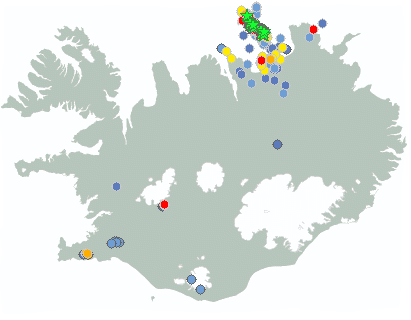
UPDATE: A M5.5 earthquake occurred at 00:59 on 2nd April 2013 about 15 km east of Grímsey island offshore North Iceland. The earthquake was felt at Grímsey, Húsavík, Raufarhöfn, Mývatnssveit, Akureyri and Sauðarkrókur. Several hundruds aftershocks have been detected following the mainshock. The source region is located on a fault system that reaching from Öxarfjörður to the north of Grímsey, the so called Grímsey lineament. Another M4.7 earthquake followed this morning at 08:56 and was located about 7.5km northwest of the night’s main event.

Earthquake sequences are common in this area. It is impossible to predict the further development of the seismic activity and how it might influence faults in its vicinity. Further large events can not be excluded.

==========================================

The Iceland earthquake swarm has now reached a count of 482 according to the Icelandic Met Office.

  • Magnitude less than 1 in all:  39
  • Magnitude 1 to 2 in all:  173
  • Magnitude 2 to 3 in all:  232
  • Magnitude more than 3 in all:  38
  • Total: 482 (upto 712 on 3rd April)
Earthquakes during last 48 hours.  at 04 Apr 19:50 GMT

Earthquakes during last 48 hours. at 04 Apr 19:50 GMT

From Earthquake Report:

Update 10:49 UTC : We have added a Google Earth screenshot to the image series. This Google earth image shows very clearly the many volcanic bubbles at the ocean floor, a result of the separating diverging plates. The 2 tectonic plates are pullling away from each other  (left plate to the West, right plate to the East. This kind of phenomenon is also occurring in the Oceans all over the world. New life (in other words new magma) is added this way to the tectonic plates. The plates are melting away again below ie. the deep trenches of the Pacific Ocean.

Update 10:12 UTC : The Icelandic seismological Bureau wrote : At 00:59 an earthquake about 5.5 occurred, 15 km east of Grímsey. the earthquake was felt in substantial part of central north Iceland. Following the this event at 1:13 another earthquake 4,3 was observed 16 km east of Grímsey and at 08:55 an earthquake 4,7 at same location. Substantial aftershock activity has been observed and still continues. More activity can be expected.

This earthquake is part of a strong swarm at a well know location in the Ocean. The location of the swarm is a relatively shallow ridge area (the zigzagging ridge creates the transform-like earthquakes) . A ridge is a location where 2 tectonic plates are pulling away from each other. Fresh magma will have an easier job to reach the seabed and hot volcanic vents are often found on these locations. A new island in such an area is almost a certainty in the geological future. A pity that there are no permanent ROV’s in this location, we might see some submarine fireworks!
At the time of writing this article, we have counted 314 earthquakes in less than 48 hours!

Screen Shot 2013-04-02 at 12.48.02

Swarm area on Google Earth

Indian surrogate mother dies after delivery of child for a Norwegian couple

April 2, 2013

UPDATE – from the Norwegian press—

The surrogate mother bore twins but one of them died after birth.

The Norwegian Embassy in India confirmed that preparations were underway for the other child to be taken to Norway.

The surrogate mother was apparently paid 31,000 Norwegian Kronor (about $6,000) (corrected below)

================================

This report in the Svenska Dagbladet today is disturbing not because there is anything inherently wrong with surrogacy but because it smacks of exploitation – of wealth being used to pass on the risks of childbirth to a “poor” surrogate mother. There are some very gray ethics involved in a “rich” Norwegian couple exploiting the poverty of a “poor” surrogate mother who dies – especially in doing something not permitted in Norway. No doubt the surrogate was paid the “going rate” for surrogacy (about $6,000). But I doubt the surrogate had made any real assessment of the risk of losing her life or that the “contract” had a clause to cover for the death of the surrogate.

Svenska Dagbladet: An Indian woman who was the surrogate for a Norwegian couple died shortly after birth. The woman, who was married and had children of  her own developed Hepatitis E during the pregnancy. 

“Pregnancy and childbirth is unpredictable for us all. Unforseen things can happen and the surrogate contract and the parties should take this into account”, says anthropologist Kristin Engh Førde.

Surrogates are not allowed in Norway and Norwegians make use of egg donation abroad.

The article does not report on the condition of the baby nor on the condition of the surrogate’s own children.

I hope the Norwegian couple get their child — but what is their responsibility for those other children?

I am not sure if the quote from anthropologist Kristin Engh Førde is meant to imply – and I hope it does not – that it is the responsibility of every surrogate mother to accept the risk of dying and contract accordingly.

Would the surrogate have died if she had been giving birth at a Norwegian hospital? Would her Hepatitis E have been treated in time?

Mortality rates are generally low, for hepatitis E is a “self-limiting” disease. …  However, during the duration of the infection (usually several weeks), the disease severely impairs a person’s ability to work, care for family members, and obtain food. Hepatitis E occasionally develops into an acute, severe liver disease, and is fatal in about 2% of all cases. Clinically, it is comparable to hepatitis A, but in pregnant women the disease is more often severe and is associated with a clinical syndrome called fulminant hepatic failure. Pregnant women, especially those in the third trimester, suffer an elevated mortality rate from the disease of around 20%.

Does the solar cycle impact the global economic cycle?

April 2, 2013

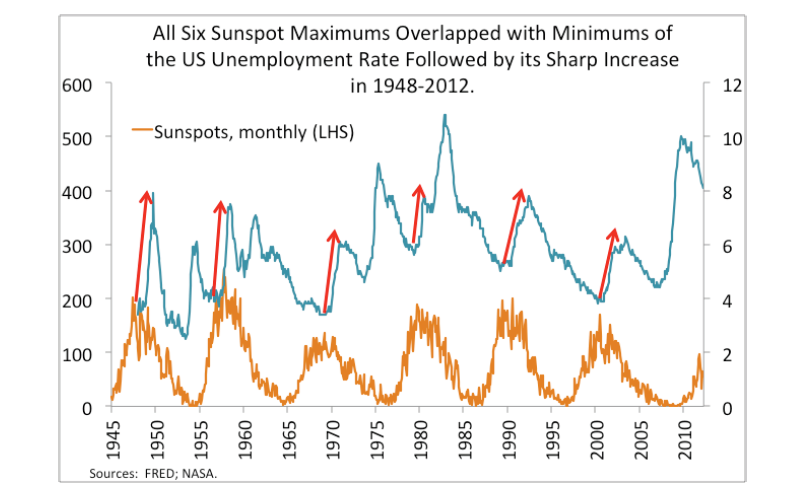
That weather and climate are affected by solar cycles is highly likely even if it is not part of the mainstream climate theories (though I think it is patently obvious). That climate and weather affect food production is clear and that this must impact the economic cycle is not so far fetched. Yet it has never been part of mainstream economic thinking that there will be a connection from the solar cycle to global economic cycles. Back in 1801 William Herschel observed the apparent connection between the sunspot cycles and the price of wheat. Since then many economists have returned at regular intervals to studying the link between the 11 year sunspot cycle and the behaviour of the global economic cycle. It is becoming increasingly clear that the economic cycle is not unconnected with solar cycles but the mechanisms are far from clear.

Mikhail Gorbanev an economist at the IMF has a fascinating new paper that became available last month at the University of Munich. He does add this Caution though!

Caution: This research is not in the “mainstream” of the economic thought. Read at your own risk!

“Sunspots, unemployment, and recessions, or Can the solar activity cycle shape the business cycle?,” MPRA Paper 40271, University Library of Munich, Germany. (pdf Gorbanev Business Cycle and solar cycles MPRA_paper_40271)

Gorbanev shows some interesting correlations and  goes on to predict that “For other advanced economies, the upcoming solar maximum also suggests higher chances of recessions. The 3-year period when the recessions are most likely to occur in the G7 countries would run from early 2013 till end-2015”.

Whether there will be a sharp increase in US unemployment after the solar maximum remains to be seen. But it is not so unlikely that the world economy has another 2 – 3 tough years ahead!


Sunspot cycles and US unemployment (Gorbanev 2012)

Sunspot cycles and US unemployment (Gorbanev 2012)

Abstract 

 Over the last 77 years (from 1935), all 7 cyclical maximums of the solar activity overlapped closely with the US recessions, thus predicting (or triggering?) 8 out of 13 recessions officially identified by NBER (including one “double-deep” recession). Over the last 64 years (from 1948), all 6 maximums of the solar activity were preceded by minimums of the US unemployment rate, and the spikes in the unemployment rate followed with lags of 2-3 years. On the world scale, over the last 44 years (for which the data is available), all 4 maximums of the solar activity overlapped with minimums of the unemployment rate in the G7 countries, followed by its spikes within 2-3 years. From 1965, when consistent recession dating is available for all G7 countries, nearly 3/5 of the recessions started in the 3 years around and after the sunspot maximums. Was it a mere coincidence or a part of a broader pattern? This paper explores the correlation between the solar activity cycles (as measured by the number of sunspots on the sun surface) and the timing of recessions in the US and other economies. It finds out that the probability of recessions in G7 countries greatly increased around and after the solar maximums, suggesting that they can cause deterioration in business conditions and trigger recessions. This opens new approach for projecting recessions, which can be applied and tested with regard to the next solar maximum in 2013.

James Hansen’s exit strategy unfolding as he retires from NASA

April 2, 2013

It was just last week that I asked “Are global warmists preparing exit strategies?”, about warmists in general and about James Hansen in particular.

And today the New York Times reports that Hansen is to retire from NASA – ostensibly to free his hands as an activist. But it has been his association with NASA which has given him the pondus he has had in the global warming priesthood. He has been an embarrassment to NASA for some time but he is 72 and is surely ripe for retirement. I suspect he actually did resign (rather than being required to resign) and his “exit strategy” is playing out. It will allow him to fade quietly out of the alarmist picture he helped create before it is erased completely.

New York Times: James E. Hansen, the climate scientist who issued the clearest warning of the 20th century about the dangers of global warming, will retire from NASA this week, giving himself more freedom to pursue political and legal efforts to limit greenhouse gases.

….. At the same time, retirement will allow Dr. Hansen to press his cause in court. He plans to take a more active role in lawsuits challenging the federal and state governments over their failure to limit emissions, for instance, as well as in fighting the development in Canada of a particularly dirty form of oil extracted from tar sands.

“As a government employee, you can’t testify against the government,” he said in an interview.

Dr. Hansen had already become an activist in recent years, taking vacation time from NASA to appear at climate protests and allowing himself to be arrested or cited a half-dozen times.

But those activities, going well beyond the usual role of government scientists, had raised eyebrows at NASA headquarters in Washington. “It was becoming clear that there were people in NASA who would be much happier if the ‘sideshow’ would exit,” Dr. Hansen said in an e-mail.

When hockey sticks are not robust …

April 1, 2013

I had almost got the 1st of April out of my system but I could not resist noting that when things are not “robust” they break and the broken pieces don’t stay put.

This gets classified as misconduct.

The Marcott Filibuster

Marcott et al:  ” … 20th century portion of our paleotemperature stack is not statistically robust, cannot be considered representative of global temperature changes, and therefore is not the basis of any of our conclusions”.

Not robust

Not robust

Global warming will contaminate signals and cut internet speeds

April 1, 2013

Over the coming years we can all expect to spend more time staring at our download dialog boxes, waiting for our music or our videos to buffer and clicking away impatiently as we wait for our web pages to reload.

And it will not be the OS or our internet service providers who are to blame. It will be the effects of global warming.

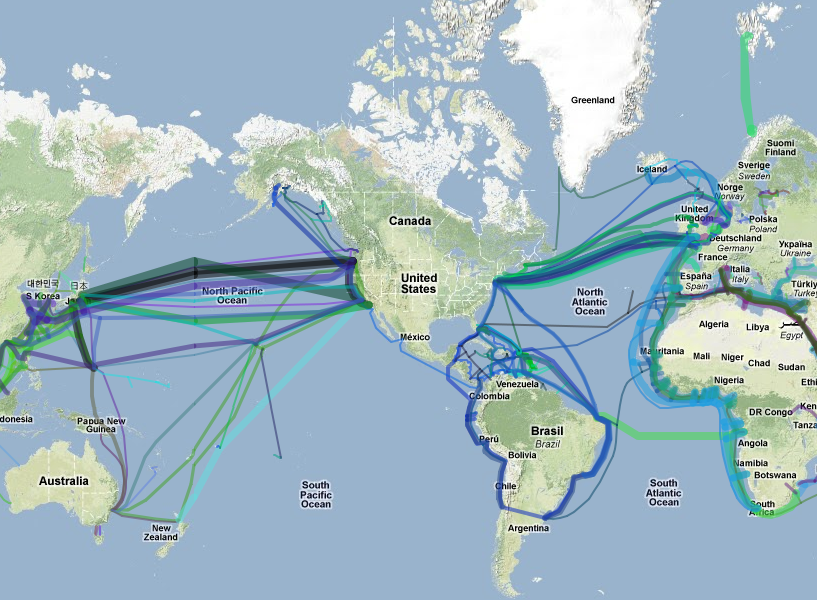
As global warming sets in and the seas warm the performance of all the undersea cables that are a critical part of global connections will be affected. A significant part of voice and data signals are transmitted through these cables and many communications services companies are entirely dependent on them. As the seas warm they will absorb increasing amounts of carbon dioxide from the atmosphere and turn acidic. While fish and all marine life have evolution to fall back upon and will adapt to the changing conditions, undersea cables being inanimate and unable to reproduce will suffer. Firstly the increasing temperature itself will cause the component fibres in the undersea cable to expand; both in length and in diameter. Secondly the acidic environment will cause them to corrode and distort.

Undersea Cable Map – The Big Picture (www.ritholtz.com)

These cables, which connect land-based transmission terminal stations across continents, are laid for tens of thousands of kilometres along the seabed. It is well known that these thick optic fibre cables can be disrupted due to many natural phenomena, such as temperature, earthquakes, extreme turbidity, current, or by coming in contact with fishing vessels or being attacked by marine life ranging from plankton to sharks.

It has now been shown conclusively by research at the International Marine Cable Research Centre (IMCRC) that increasing global temperatures will lead not only to the slowing down of signals as the marine cables expand in length, but that the integrity of signals being carried will suffer as the cable distortions lead to intertwined parallel signals getting mixed up with each other.

Just having cables in parallel cannot solve this problem. Global warming will affect all the cables. Longer cables will be affected most. Scientists at the IMCRC have modelled the performance under deteriorating conditions and calculate that these cables could become completely unusable as quickly as within 1,000 years. “We are working on an innovative solution”, said Dr. Peter Sellers, Director of the IMCRC. The International project to find a solution is being led by Dr. Martin Strangelove of the University of Pennsylvania who says, “A drastic problem requires a drastic solution. We are now working on ways in which we can trigger a new ice age as a comprehensive global solution. Not only will undersea temperatures reduce but in many places alternative cables could be placed on the surface of the newly created ice sheets”.

(XPI – 1st April 2013)

Boston marathon winning times fail as a proxy for global warming temperature rise

March 31, 2013

I am not sure whether to call this “bad science” or to be generous and call it “trivial science”.

There is a new paper in PLOS ONE (open access) from “researchers” at Boston University:

Effects of Warming Temperatures on Winning Times in the Boston Marathon by Abraham J. Miller-Rushing, Richard B. Primack, Nathan Phillips and Robert K. Kaufmann, PLoS ONE 7(9): e43579. doi:10.1371/journal.pone.0043579

The only conclusions of any little value in this paper are that

  • Boston marathon winning times fail – so far – as a proxy for global warming temperature rise, and
  • if global warming increases Boston temperatures by about 5.8°C there is a 95% chance that the effect on winning time may be detectable!

Of course they could simply have reported that the variability of temperatures on race day drowned out the effects – if any – of any global temperature change. But that would have been too simple, too truthful and would not have helped towards publication.

The findings of this so-called “research” are:

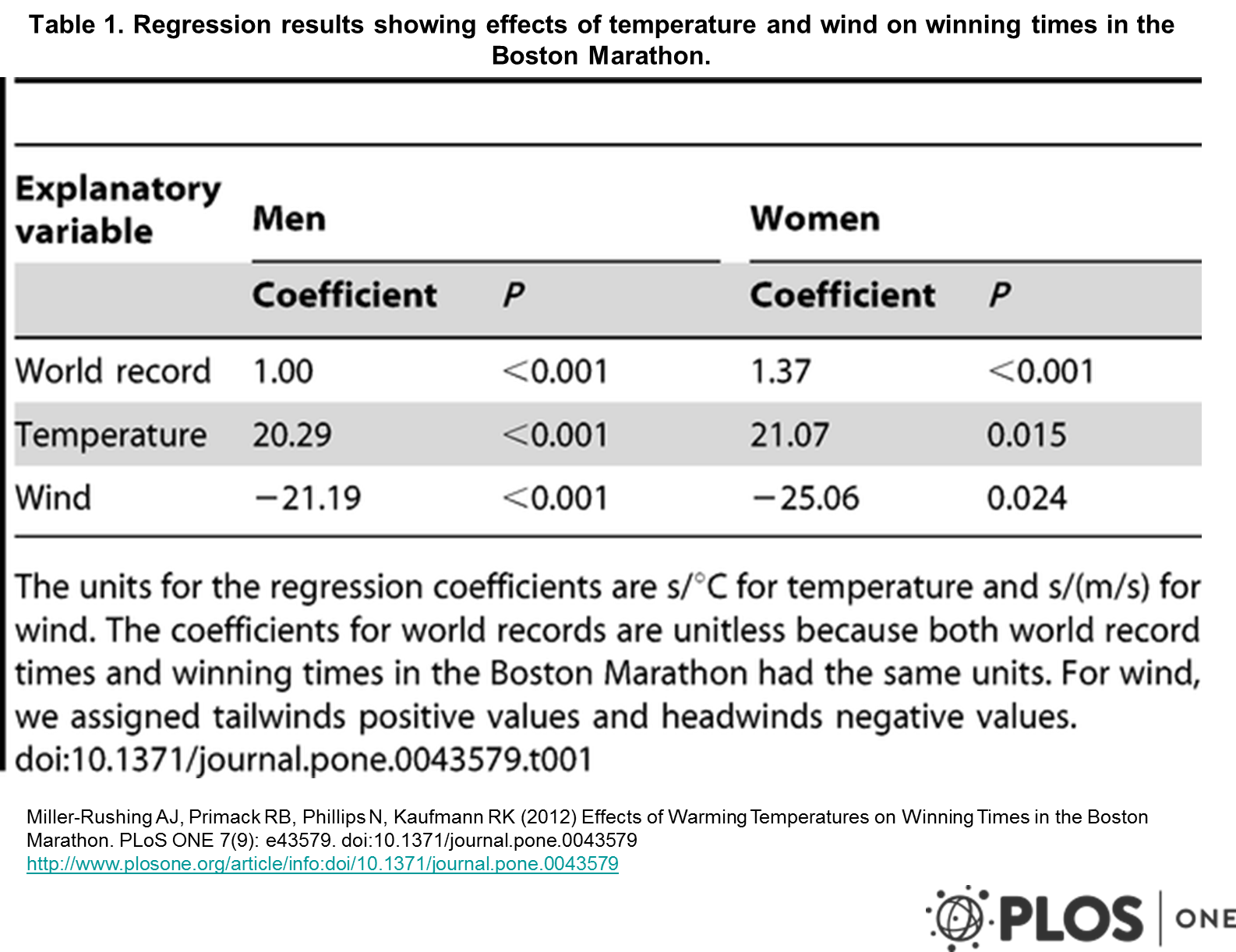
  1. Higher temperatures and higher headwinds on the day of the race increase winning times for the marathon. Who would think otherwise? I would not have thought that weather conditions on any other day than race day would have much impact. Collecting this data is mildly useful but it is all readily available. Trivial.
  2. If temperatures do not increase relative to temperature variability on race days, the effects of warming on marathon times may not be detectable. However, at some point temperature increases may be large enough to affect marathon times. Amazing! So what exactly was the point of this work? Trivial.
  3. In summary, despite the well-known effect of temperature on marathon performance, we found that warming trends in Boston have not caused winning times to slow over time because of high variability in temperatures on race day. So race day temperature overrides any effects – due to global warming or anything else – on average annual temperatures. Obvious and Trivial.
  4. …. our models indicate that if race starting times had not changed and average race day temperatures continue to warm by 0.058°C/yr, a high-end estimate, we would have had a 95% chance of detecting a consistent slowing of winning marathon times by 2100. If average race day temperatures warm by 0.028°C/yr, a mid-range estimate, we would have had a 64% chance of detecting a consistent slowing of winning times by 2100. So your model says that if global warming increases race day temperatures above and beyond the natural daily variability then you have some chance of detecting this effect in the winning times! By modelling high rates of global warming  (5.8°C per century) you can force the race day temperatures to show an underlying increase such that there is a 95% chance that the effect on winning times could be detected.  The Boston marathon itself provides no evidence of global warming so far. Wow!! This is not just trivial but borders on “idiot science”.

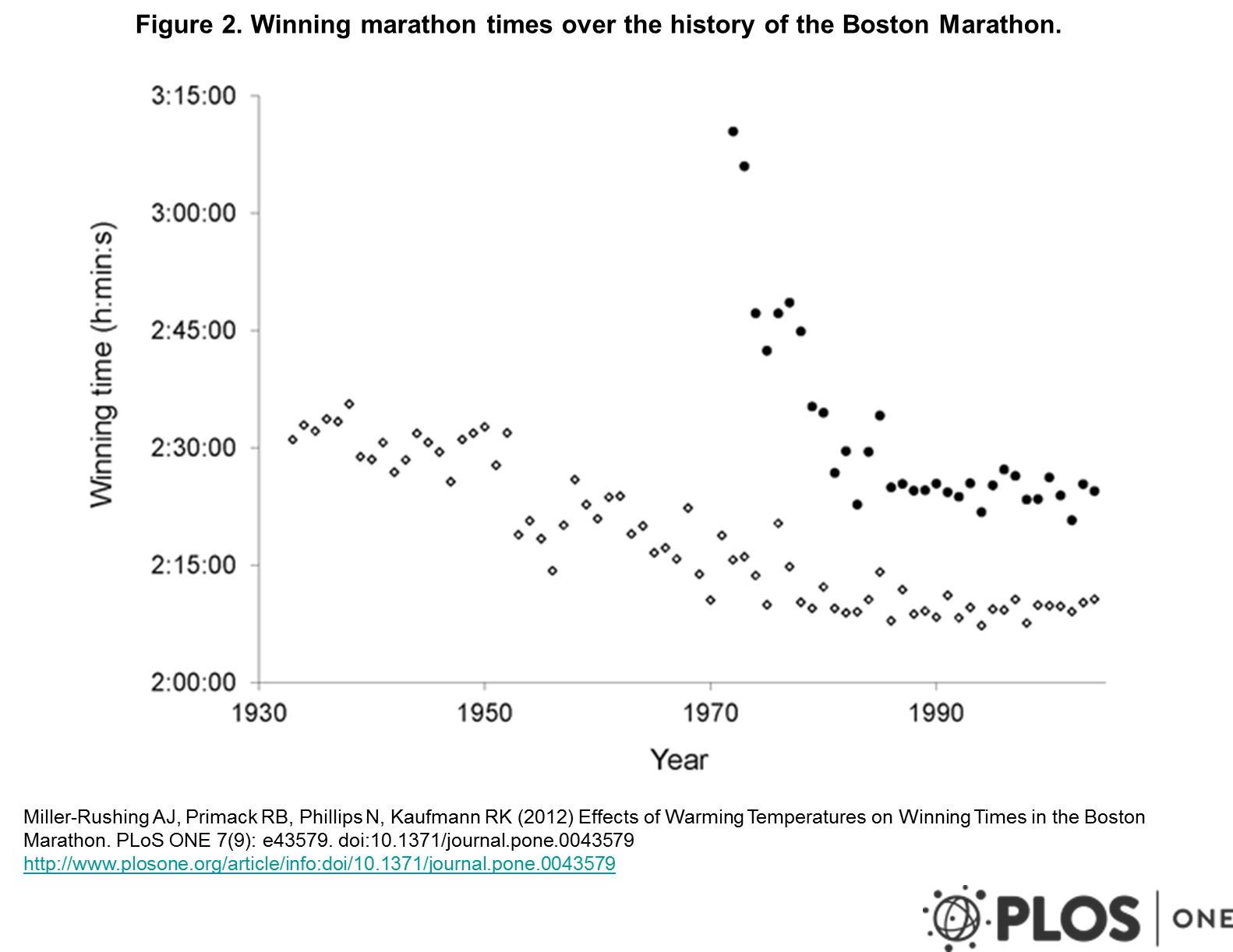
The effects of global warming clearly cannot be detected in the results of the Boston marathon. In the paper their Figure 2 and Table 1 are fairly trivial but of passing interest. The rest of their modelling efforts (input and output) are just garbage.

Miller-Rushing et al Figure 2

Open diamonds represent men’s times from 1933–2004. Closed circles represent women’s times from 1972–2004. Women’s running times improved rapidly in the first 14 yr of women’s participation in the marathon. From 1983 to 2004, the differences between men and women’s winning times held relatively constant at an average of 15 min 47 s.

Table 1. Regression results showing effects of temperature and wind on winning times in the Boston Marathon.

Table 1. Regression results showing effects of temperature and wind on winning times in the Boston Marathon.

Abstract: It is not known whether global warming will affect winning times in endurance events, and counterbalance improvements in race performances that have occurred over the past century. We examined a time series (1933–2004) from the Boston Marathon to test for an effect of warming on winning times by men and women. We found that warmer temperatures and headwinds on the day of the race slow winning times. However, 1.6°C warming in annual temperatures in Boston between 1933 and 2004 did not consistently slow winning times because of high variability in temperatures on race day. Starting times for the race changed to earlier in the day beginning in 2006, making it difficult to anticipate effects of future warming on winning times. However, our models indicate that if race starting times had not changed and average race day temperatures had warmed by 0.058°C/yr, a high-end estimate, we would have had a 95% chance of detecting a consistent slowing of winning marathon times by 2100. If average race day temperatures had warmed by 0.028°C/yr, a mid-range estimate, we would have had a 64% chance of detecting a consistent slowing of winning times by 2100.

On balance I shall just classify this as Trivial Science bordering on Bad Science