Posts Tagged ‘Sun’

Visibility of the Venus transit today and tomorrow

June 5, 2012

WARNING!

Direct viewing of the Sun with the naked eye or through open telescopes or binoculars should be avoided. Indirect observation of a projected image is advised.

Transit times

Venus transit 5th-6th June 2012: image BBC

BBC: Venus transits occur four times in approximately 243 years; more precisely, they appear in pairs of events separated by about eight years and these pairs are separated by about 105 or 121 years. The reason for the long intervals lies in the fact that the orbits of Venus and Earth do not lie in the same plane and a transit can only occur if both planets and the Sun are situated exactly on one line.

This has happened only seven times in the telescopic age: in 1631, 1639, 1761, 1769, 1874, 1882 and 2004. Once the latest transit has passed, the next pair will not occur until 2117 and 2125. Most people alive today will probably be dead by then.

Sol Invictus: Greetings on Dies Natalis Solis Invicti

December 25, 2011

It is the 25th of December of the year 2011 of the Gregorian Calendar and it is the anniversary of the day of the birth of the Invincible Sun (Dies Natalis Solis Invicti).

More correctly, of course it is the presumed date of the birth of the Earth’s revolutions around the Sun. This revolution would have existed even when the Earth was just an amorphous conglomeration of gas and particles orbiting the Sun and still waiting to coalesce as the Earth. Since the seasonal celebrations could never be suppressed, it is the date which was hijacked as the day of the birth of Christ (first recorded in 354AD), some 1,657 years ago. But Natalis Solis Invicti goes back much longer than that. And to the best of our knowledge that was about 4,540,000,000 (±1%) years ago.

And while the celebrations around the world at this dark time of the year remain of vital importance in the human calendar, its relevance as the birthday of Christ has become largely meaningless. It is the celebration of renewal, of the beginning of a new year, of the coming lengthening of the days after the winter solstice which pre-dates Christian tradition and will continue long after its inevitable extinction. It is the certainty of belief that the earth will continue to revolve around the Sun and all that follows from that which lifts the human spirit.

Here the sun rises today at 08:48 and sets at 15:05 – a day-length of just over 6 hours. But the days are getting longer and already by next Saturday the day at this latitude will be 6 minutes longer. Over the next 200 days the length of each day will increase by an average of more than 3 minutes each day and by high summer the length of the day will be around 17 hours. And it is the affirmation of this renewal, this anticipation of what is to come and the reconfirmation of “certain” belief in Sol Invictus which lifts my spirit.

And so my greetings to all on this day to celebrate the day of the birth of the Invincible Sun.

Solar science re-emerging? and about time too!

October 12, 2011

It has always struck me as incredibly arrogant and amazingly stupid that the climate “scientists” have ignored the effects of the sun for 2 decades – presumably because:

  1. they did not understand the sun,
  2. doomsday scenarios were better for getting funding,
  3. they had such an overweening conviction about man made effects, and
  4. they actually believed their computer models were the greatest thing since sliced bread!
Perhaps that is changing. As Paul Hudson signs off his column on the BBC Weather blog:
This is an exciting time for solar physics, and its role in climate. As one leading climate scientist told me last month, it’s a subject that is now no longer taboo. And about time, too.
Related: New Scientist permits the sun to join the climate club

Solar Cycle 24: Still on track to be smallest sunspot number cycle in 100 years

August 25, 2011

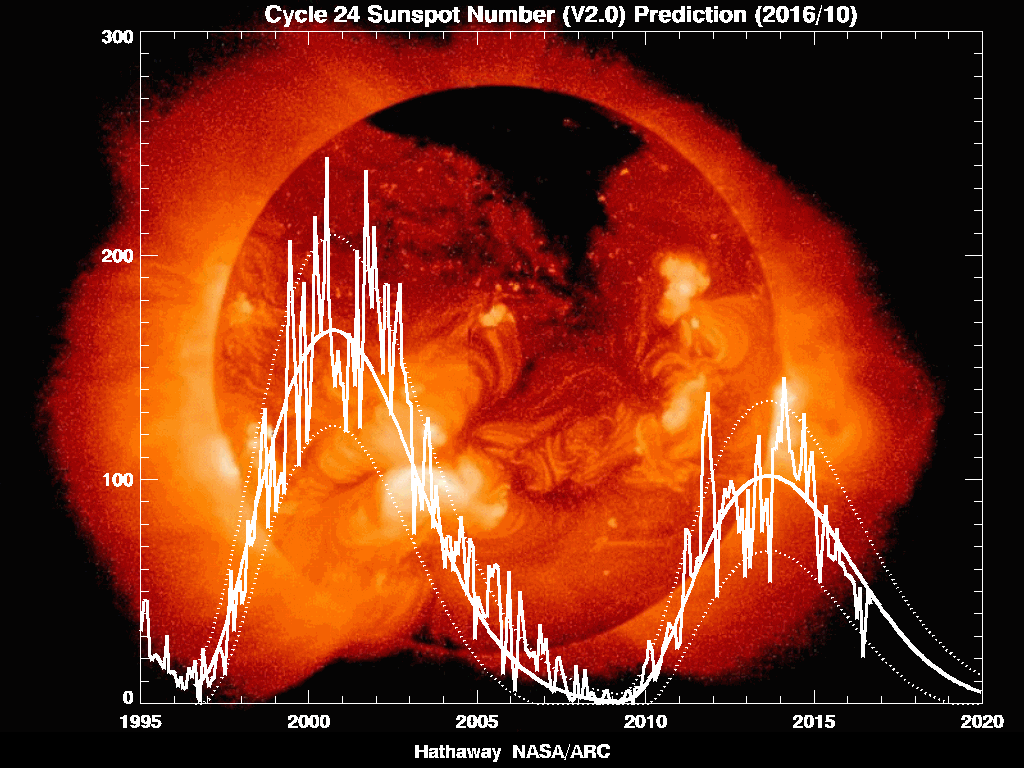
The August solar cycle 24 forecast from NASA is unchanged from the previous month though the maximum has increased to 69 from the 64 forecast about 6 months ago.

The current prediction for Sunspot Cycle 24 gives a smoothed sunspot number maximum of about 69 in June of 2013 (same as last month). We are currently over two and a half years into Cycle 24. Four out of the last five months with average daily sunspot numbers above 40 has raised the predicted maximum above the 64.2 for the Cycle 14 maximum in 1907. This predicted size still make this the smallest sunspot cycle in over 100 years.

NASA - Solar Cycle 24 forecast

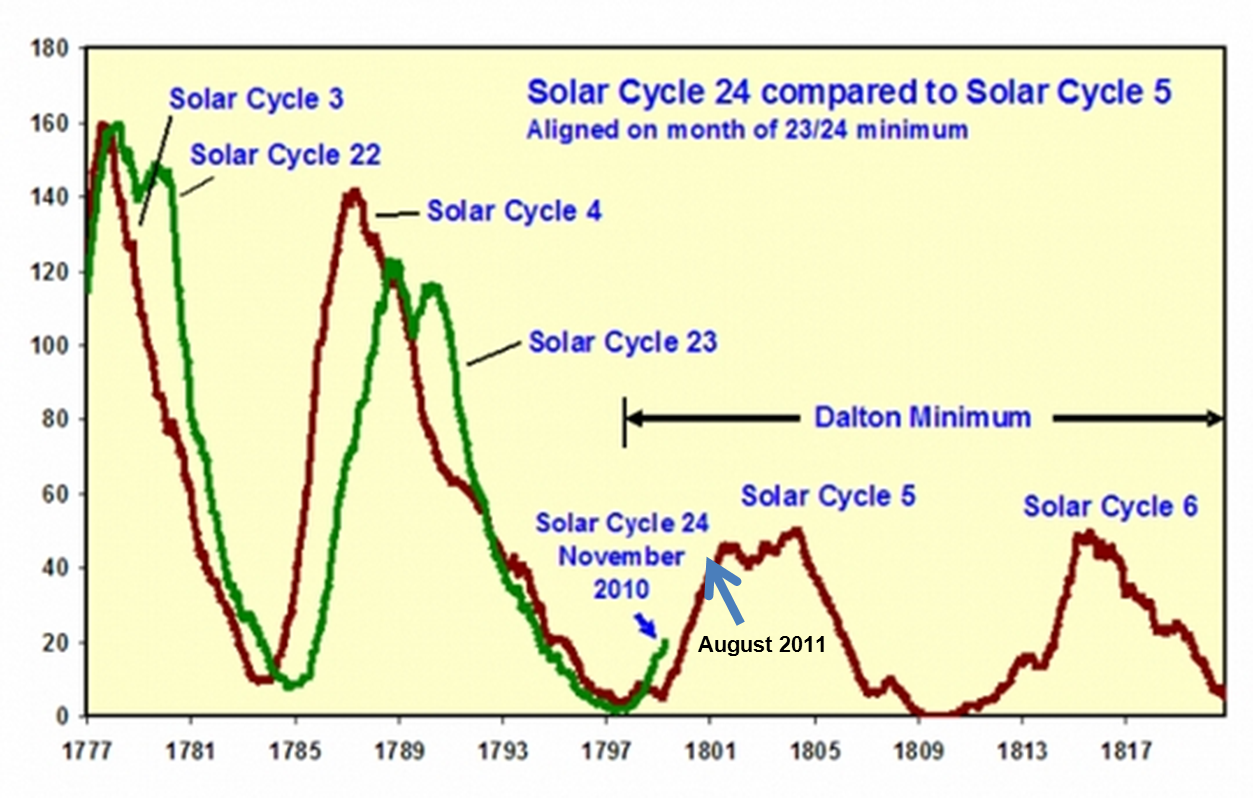
Solar Cycle 24 continues to invite comparisons with Solar Cycle 5.

SC24 versus SC5 - from http://sc25.com

Longest Day

June 21, 2011

The Summer Solstice is today (at about 1800 local time).

At this latitude (58° 43′ 0″ N), sunrise is at 0346 and sunset is at 2211 giving us the longest day of the year – even though the official Midsommar holiday in Sweden will be celebrated on Friday and Saturday (when the day will be about a minute shorter).

But we are expecting a good deal of rain and the number of hours of sunshine and temperatures – maximums of about 18 °C – will not break any records.

from eclipsetraveler.com

Wikipedia: In modern Sweden, Midsummer’s Eve and Midsummer’s Day celebration are held on the Friday and Saturday between 19 June and 26 June. It is one of the most important holidays of the year in Sweden, and probably the most uniquely Swedish in the way it is celebrated. The main celebrations take place on the Friday, and the traditional events include raising and dancing around a huge maypole. Before the maypole is raised, greens and flowers are collected and used to cover the entire pole.

Hoisting and dancing around a maypole  (majstång or midsommarstång) is an activity that attracts families and many others. People dancing around the pole listen to traditional music and some even wear traditional folk costumes. In addition, many wear crowns made of wild springs and wildflowers on their heads. The year’s first potatoes, Sour herring, Chives, Sour Cream, Beer, Snaps and the first strawberries of the season are on the menu. Drinking songs (Snapsvisor) are also important at this feast, and many drink heavily. When Sweden got its National day (6 June), discussions were held about making Midsummer the Swedish national day because of the strong civil celebration on this day.

Because Midsummer was thought to be one of the times of the year when magic was strongest, it was considered a good night to perform rituals to look into the future. Traditionally, young people pick bouquets of seven or nine different flowers and put them under their pillow in the hope of dreaming about their future spouse. In the past it was believed that herbs picked at Midsummer were highly potent, and water from springs could bring good health. Greenery placed over houses and barns were supposed to bring good fortune and health to people and livestock; this old tradition of decorating with greens continues, even though most don’t take it seriously. To decorate with greens was called att maja (to may) and may be the origin of the word majstångmaja coming originally from the month May. Other researchers say the term came from German merchants who raised the maypole in June because the Swedish climate made it impossible to find the necessary greens and flowers in May, and continued to call it a maypole. Today, however, it is most commonly called  a “midsommarstång”  (literally midsummer’s pole).

In earlier times, small spires wrapped in greens were erected; this probably predates the maypole tradition, which is believed by many to have come from the continent in the Middle Ages. Others argue that some form of Midsummer pole occurred in Sweden during the pre-Christian times, and was a phallic fertility symbol, meant to impregnate the earth, but as there were no records from those times it cannot be proven, and this idea might just be a modern interpretation of the pole’s form. The earliest historical mention of the maypole in Sweden is from the Middle Ages. Midsummer was, however, linked to an ancient fertility festival which was adapted into St. John’s Day by the church, even though it retained many pagan traditions, as the Swedes were slow to give up the old heathen customs. The connection to fertility is naturally linked to the time of year. Many young people became passionate at Midsummer, and this was accepted, probably because it resulted in more childbirths in March which was a good time for children to be born.

Midsommarstång on Gålö, Sweden: image Wikipedia

Major Drop In Solar Activity Predicted: Landscheidt Minimum is upon us and a mini-ice age is imminent

June 15, 2011

The stunning announcement made at the annual meeting of the American Astronomical Society exceeded the expectations from the advance publicity!

The results of new studies were announced today (June 14) at the annual meeting of the solar physics division of the American Astronomical Society, which is being held this week at New Mexico State University in Las Cruces. 

The results of three separate studies seem to show that even as the current sunspot cycle (SC24) moves toward the solar maximum, the sun could be heading into a more-dormant period, with activity during the next 11-year sunspot cycle (SC25) greatly reduced or even eliminated.

The indicators have been  growing for some time that we are in for a a new solar minimum – the Landscheidt minimum – which could be similar to the Dalton Minimum and may even approach the Maunder Minimum. This could mean a cooling period for the earth of 20 – 30 years or for as long as 60 – 70 years. In any event the signs will be unambiguous and inescapable within a decade.

It is reasonable to assume that climatic conditions over the next 20 – 30 years will resemble those prevailing between 1790 and 1820. But SC24 has a way to go yet and it could be that solar activity for SC24 and 25 will be even lower than during the Dalton minimum and perhaps closer to the Spörer minimum but perhaps not as deep as the Maunder minimum.

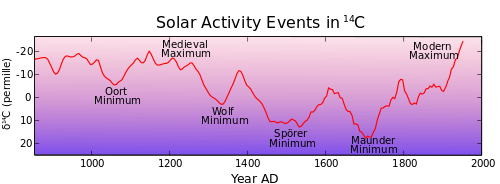
But in either case the solar activity to come following the Modern maximum may well resemble the 500 years of decline in solar activity which followed the Medieval maximum.

Solar activity events recorded in radiocarbon. Present period is on left. Values since 1950 not shown: Wikipedia

The three papers are: 

  1. “Large-Scale Zonal Flows During the Solar Minimum — Where Is Cycle 25?” by Frank Hill, R. Howe, R. Komm, J. Christensen-Dalsgaard, T.P. Larson, J. Schou & M. J. Thompson.
  2. “A Decade of Diminishing Sunspot Vigor” by W. C. Livingston, M. Penn & L. Svalgard.
  3. “Whither Goes Cycle 24? A View from the Fe XIV Corona” by R. C. Altrock.

 Spacedaily reports:

Major Drop In Solar Activity Predicted

As the current sunspot cycle, Cycle 24, begins to ramp up toward maximum, independent studies of the solar interior, visible surface, and the corona indicate that the next 11-year solar sunspot cycle, Cycle 25, will be greatly reduced or may not happen at all.

“This is highly unusual and unexpected,” Dr. Frank Hill, associate director of the NSO’s Solar Synoptic Network, said of the results. “But the fact that three completely different views of the Sun point in the same direction is a powerful indicator that the sunspot cycle may be going into hibernation.”

Hill is the lead author on one of three papers on these results being presented this week. Using data from the Global Oscillation Network Group (GONG) of six observing stations around the world, the team translates surface pulsations caused by sound reverberating through the Sun into models of the internal structure.

One of their discoveries is an east-west zonal wind flow inside the Sun, called the torsional oscillation, which starts at mid-latitudes and migrates towards the equator. The latitude of this wind stream matches the new spot formation in each cycle, and successfully predicted the late onset of the current Cycle 24.

“We expected to see the start of the zonal flow for Cycle 25 by now,” Hill explained, “but we see no sign of it. This indicates that the start of Cycle 25 may be delayed to 2021 or 2022, or may not happen at all.”

In the second paper, Matt Penn and William Livingston see a long-term weakening trend in the strength of sunspots, and predict that by Cycle 25 magnetic fields erupting on the Sun will be so weak that few if any sunspots will be formed. Spots are formed when intense magnetic flux tubes erupt from the interior and keep cooled gas from circulating back to the interior.

For typical sunspots this magnetism has a strength of 2,500 to 3,500 gauss (Earth’s magnetic field is less than 1 gauss at the surface); the field must reach at least 1,500 gauss to form a dark spot.

Using more than 13 years of sunspot data collected at the McMath-Pierce Telescope at Kitt Peak in Arizona, Penn and Livingston observed that the average field strength declined about 50 gauss per year during Cycle 23 and now in Cycle 24.

They also observed that spot temperatures have risen exactly as expected for such changes in the magnetic field. If the trend continues, the field strength will drop below the 1,500 gauss threshold and spots will largely disappear as the magnetic field is no longer strong enough to overcome convective forces on the solar surface.

Moving outward, Richard Altrock, manager of the Air Force’s coronal research program at NSO’s Sunspot, NM, facilities has observed a slowing of the “rush to the poles,” the rapid poleward march of magnetic activity observed in the Sun’s faint corona. Altrock used four decades of observations with NSO’s 40-cm (16-inch) coronagraphic telescope at Sunspot.

“A key thing to understand is that those wonderful, delicate coronal features are actually powerful, robust magnetic structures rooted in the interior of the Sun,” Altrock explained. “Changes we see in the corona reflect changes deep inside the Sun.”

Altrock used a photometer to map iron heated to 2 million degrees C (3.6 million F). Stripped of half of its electrons, it is easily concentrated by magnetism rising from the Sun. In a well-known pattern, new solar activity emerges first at about 70 degrees latitude at the start of a cycle, then towards the equator as the cycle ages. At the same time, the new magnetic fields push remnants of the older cycle as far as 85 degrees poleward.

“In cycles 21 through 23, solar maximum occurred when this rush appeared at an average latitude of 76 degrees,” Altrock said.

“Cycle 24 started out late and slow and may not be strong enough to create a rush to the poles, indicating we’ll see a very weak solar maximum in 2013, if at all. If the rush to the poles fails to complete, this creates a tremendous dilemma for the theorists, as it would mean that Cycle 23’s magnetic field will not completely disappear from the polar regions (the rush to the poles accomplishes this feat). No one knows what the Sun will do in that case.”

All three of these lines of research to point to the familiar sunspot cycle shutting down for a while. “If we are right,” Hill concluded, “this could be the last solar maximum we’ll see for a few decades. That would affect everything from space exploration to Earth’s climate.”

That last may be the understatement of the century!!!

A photo of a sunspot taken in May 2010, with Earth shown to scale. The image has been colorized for  aesthetic reasons. This image with 0.1 arcsecond resolution from the Swedish 1-m Solar  Telescope represents the limit of what is currently possible in te

A photo of a sunspot taken in May 2010, with Earth shown to scale.This image with 0.1 arcsecond resolution from the Swedish 1-m Solar Telescope represents the limit of what is currently possible in terms of spatial resolution. CREDIT: The Royal Swedish Academy of Sciences, V.M.J. Henriques (sunspot), NASA Apollo 17 (Earth)

The Great Sendai quake of 2011 is part of the Sun’s Dance

March 11, 2011

I was woken up in Tokyo in 1995 when the Great Hanshin Earthquake hit Kobe (having left Kobe 6 hours earlier on the last Shinkansen to Tokyo the night before) where the epicentre was just off Awaji Island but there was no tsunami then. The destruction was massive and Kobe burned and over 6,000 people perished.

All day today I have been watching the riveting pictures of the tsunami hitting the Sendai coast. The sheer power of the water sweeping irresistibly across the landscape picking up houses, ships, buses and cars like little cardboard models was terrible and awe-inspiring. The memories of 1995 came flooding back and it once again reminded me of the puny impact mankind has in the face of such forces.

And all the energy that is released by these great movements of the continents on Earth have their origin in the energy stored at the time of Earth’s creation and the energy it has received from the Sun since then. And all the energy of all these earthquakes and volcanoes and tsunamis and cyclones are as nothing to the energy released continuously by the Sun. To the Earth this Great Sendai quake of 2011 is just a very small adjustment of stresses and strains and is of little significance. The Great Dance orchestrated and choreographed by the  Sun will go on and the continents will keep drifting and moving under each other  and volcanoes will keep erupting. And our Science will continue to try and understand and predict when catastrophic events will occur. But we will have to tame the Sun if we are ever to be able to control these events.

The death toll in Sendai is rising and and as morning comes in a few hours to Japan the full extent of the destruction will begin to be revealed. Whole villages could well have been wiped out, entire trains have been carried away by the force of the waters and some ships are missing.  Fires are breaking out and the Fukushima nuclear plant was swamped.

Science and technology are our best defence against loss of life and loss of property by “natural” disasters. The preparedness of Japan is a tribute to this when comparing today’s tsunami with that after the Aceh quake of 2004. Science and technology will help us to cope with the consequences of these events and maybe – some day – will help us predict some of them. But they will not prevent such disasters.

The Sun is going through an unusual – but not unprecedented – minimum. There is no proof and there is no evidence of any causal relationship but there are correlations between increased earthquake and volcanic activity with solar minima and solar proton events. We have a further 2 or 3 years of increased earthquake and volcanic activity if this correlation holds true.

It seems not only plausible but also fitting that such great and terrible events can only be a part of the Great Dance of the Sun.

A quiet sun flexes its muscles

February 17, 2011

Update: February 18th 0700 CET

http://www.spaceweather.com/

A CME hit Earth’s magnetic field at approximately 0100 UT on Feb. 18th (8:00 pm EST on Feb. 17th). The impact was not as strong as expected considering the cloud’s X-class origin.

Solar Cycle 24 is generally exhibiting a very low level of activity but the sun occasionally does flex its muscles just to show what it is capable of.

http://solarcycle24.com/

Geomagnetic Storm Watch – From the Space Weather Prediction Center: February 16, 2011 — The calm before the storm. Three CMEs are enroute, all a part of the Radio Blackout events on February 13, 14, and 15 (UTC). The last of the three seems to be the fastest and may catch both of the forerunners about mid to late day tomorrow, February 17.

http://www.swpc.noaa.gov/

February 17, 2011 — The first interplanetary shock, driven by the CME from Sunday, is expected any time. Soon thereafter, the shock from Monday evening’s R3/CME is due. Look for G1-G2 (and maybe periods of G3 if the following shock compresses and enhances the CME magnetic field). Geomagnetic storming should persist 24- 48 hours. Back at the Sun, Region 1158 is still hot and fast-growing, Region 1161 is producing small flares.

image NOAA

3-day Solar-Geophysical Forecast issued Feb 16 22:00 UTC

Solar Activity Forecast: Solar activity is expected to be moderate with a chance for an isolated major flare for the next three days (17-19 February). Region 1158 is expected to produce more M-class flares and still has the potential for producing an M5 or greater x-ray event. There is a chance for isolated M-class activity from Region 1161.

Geophysical Activity Forecast: The geomagnetic field is expected to be predominately quiet on day one (February 17). An increase to unsettled to active conditions, with a chance for minor storm periods is expected late on day one into day two (18 February). The increased activity is forecast due to the expected arrival of the CME associated with the X2 flare that occurred on 15/0156Z. Day three (19 February) is expected to be quiet to active as the disturbance subsides.


An active Sunday for the Sun

February 14, 2011

An unusually active Sunday for the Sun yesterday mainly from the very large sunspot 1158 with magnetic flux values not seen since 2006.

From Solarcycle24.com:

Solar Flares: Mutiple Solar flares took place around Sprawling Sunspot 1158 on Sunday, including an M6.6 Flare which was the 2nd largest of Cycle 24 thus far.  ….. . There will continue to be a chance for M-Class flares and NOAA also lists a 5% chance for an X-Class event.

Solar Flux 107: For the first time in Cycle 24, the official daily solar flux number measured in Penticton, BC closed above 100. The solar flux of 107 is the highest since September 2005. The last time the solar flux finished above 100 was in December 2006.

Solar Update: Huge sunspot 1158 which is located in the southern hemisphere will continue to be a threat for strong solar flares. Elsewhere, Sunspot 1157 which is in the northern hemisphere showed growth late on Sunday and Sunspot 1160 which rotated into view on the eastern limb has sprouted a few new spots as well. The M6.6 Solar Flare did cause a Radio Blackout on HF which was short lived.

Sunspots (Early Monday): image solarcycle24.com

NOAA forecast:

Solar Activity Forecast: Solar activity is expected to be low to moderate with a chance for a major x-ray event for days one thru three (14-16 February). Region 1158 continued growth and recent major flare make this region the most likely source for a major event. There is a slight chance for C-class activity from Region 1157 and Region 1159.

Geophysical Activity Forecast: The geomagnetic field is expected to be predominately quiet on day one (14 February). Quiet to unsettled with a chance for active conditions are expected on days two and three (15-16 February), due to a recurrent coronal hole high speed stream becoming geoeffective.

Solar Cycle 24 forecast reduced yet again

February 10, 2011

We had a reduced forecast from NASA just a month ago and it has reduced yet again.

The peak is now expected in July 2013 but this could well slip a month or two. This Landscheidt Minimum continues to look like a Dalton Minimum.

December 2010 forecast smoothed sunspot number maximum of 64 in June 2013

January 2011 forecast smoothed sunspot number maximum of 59 in June/July 2013

February 2011

Current prediction for the next sunspot cycle maximum gives a smoothed sunspot number maximum of about 58 in July of 2013. We are currently two years into Cycle 24 and the predicted size continues to fall.

The latest forecasts for sunspot number and 10.7 Radio flux and Ap progression are here: http://www.swpc.noaa.gov/SolarCycle/

Related:

https://ktwop.wordpress.com/2010/12/23/is-the-landscheidt-minimum-a-precursor-for-a-grand-minimum/