The Hamza – a subterranean river to rival the Amazon: 6,000km long, 4,000 m down

August 25, 2011

Subterranean rivers are the stuff of mythology and there is something dark and mysterious and yet wonderful about them. Greek mythology includes the Styx, Phlegethon, Acheron, Cocytus, and Lethe as rivers within the Underworld. The Saraswati River is believed to have drained the north and northwest region of India in ancient times, supporting over 16,000 settlements. Although the river does not have a physical existence today many still believe that it flows underground. The River Fleet is London’s largest subterranean river. Forced underground by the city’s burgeoning populace the river still flows from its source in Hampstead Heath to its mouth where it joins London’s main waterway, the Thames. The longest known subterranean river was the Disu Subterranean river in Du’an, Guangxi Province, China – until now.

Forbes / AP: Sao Paulo

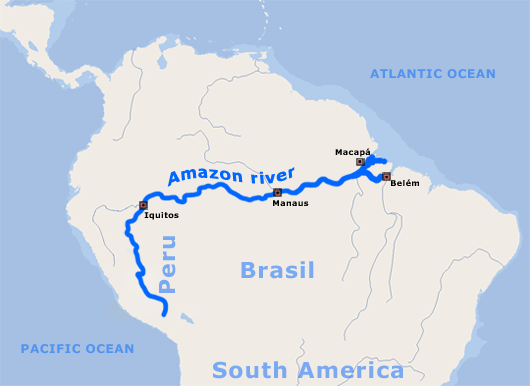
A huge underground river appears to be flowing thousands of feet beneath the Amazon River, Brazilian scientists said Thursday. Valiya Hamza of Brazil’s National Observatory said researchers found indications the subterranean river is 3,700 miles (6,000 kilometers) long, about the same length as the Amazon on the surface. Hamza said the discovery of the possible underground river came from studying temperature variations at 241 inactive oil wells drilled in the 1970s and 1980s by Brazil’s state-run oil company, Petrobras.

He said the “thermal information” provided by Petrobras allowed his team of researchers to identify the movement of water 13,100 feet (4,000 meters) under the Amazon River.

map of the amazon river

map of the amazon river image - 2.bp.blogspot.com

Their findings were presented last week in Rio de Janeiro at a meeting of the Brazilian Geophysical Society. The apparent underground river has been named after Hamza, honoring him as the head of the research team that found the signs of the flowing water. He said the existence of an underground river that also flows west to east would mean that the Amazon rain forest has two drainage systems – the Amazon and Hamza rivers.

There is much about the earth we still don’t know that we don’t know.

And the sense of wonder will remain alive as long as that is so.

UPDATE! Dr. Hamza explains the discovery in an email “interview” with The Hindu. 

“It’s the Sun, stupid” > Svensmark vindicated: CERN shows cosmic rays do influence cloud formation

August 25, 2011

The much awaited results from the CLOUD experiments at CERN have now been published in Nature and show that cosmic rays can influence cloud formation – as Henrik Svensmark has hypothesised. This mechanism – ultimately dependent upon the sun – is far more credible as an explanation of the climate variations seen in recent times than dubious computer models based on implausible forcings due to carbon dioxide in the atmosphere.

Cloud formation may be linked to cosmic rays Kirkby, J. et alNature 476, 429-433 (2011).

Nigel Calder (via GWPF) writes:

Long-anticipated results of the CLOUD experiment at CERN in Geneva appear in tomorrow’s issue of the journal Nature (25 August). The Director General of CERN stirred controversy last month, by saying that the CLOUD team’s report should be politically correct about climate change (see my 17 July post below). The implication was that they should on no account endorse the Danish heresy – Henrik Svensmark’s hypothesis that most of the global warming of the 20th Century can be explained by the reduction in cosmic rays due to livelier solar activity, resulting in less low cloud cover and warmer surface temperatures.

Willy-nilly the results speak for themselves, and it’s no wonder the Director General was fretful.

Henrik Svensmark (born 1958) is a physicist at the Danish National Space Center in Copenhagen who studies the effects of cosmic rays on cloud formation. His work presents hypotheses about solar activity as an indirect cause of global warming; his research has suggested a possible link through the interaction of the solar wind and cosmic rays. His conclusions have been controversial as the prevailing scientific opinion on climate change considers solar activity unlikely to be a major contributor to recent warming, though it is thought to be the primary driver of many earlier changes in climate.

I cannot do any better than reproduce Nigel Calder’s explanation of the CERN experimental results:

Jasper Kirkby of CERN and his 62 co-authors, from 17 institutes in Europe and the USA, announce big effects of pions from an accelerator, which simulate the cosmic rays and ionize the air in the experimental chamber. The pions strongly promote the formation of clusters of sulphuric acid and water molecules – aerosols of the kind that may grow into cloud condensation nuclei on which cloud droplets form. What’s more, there’s a very important clarification of the chemistry involved.

Read the rest of this entry »

Solar Cycle 24: Still on track to be smallest sunspot number cycle in 100 years

August 25, 2011

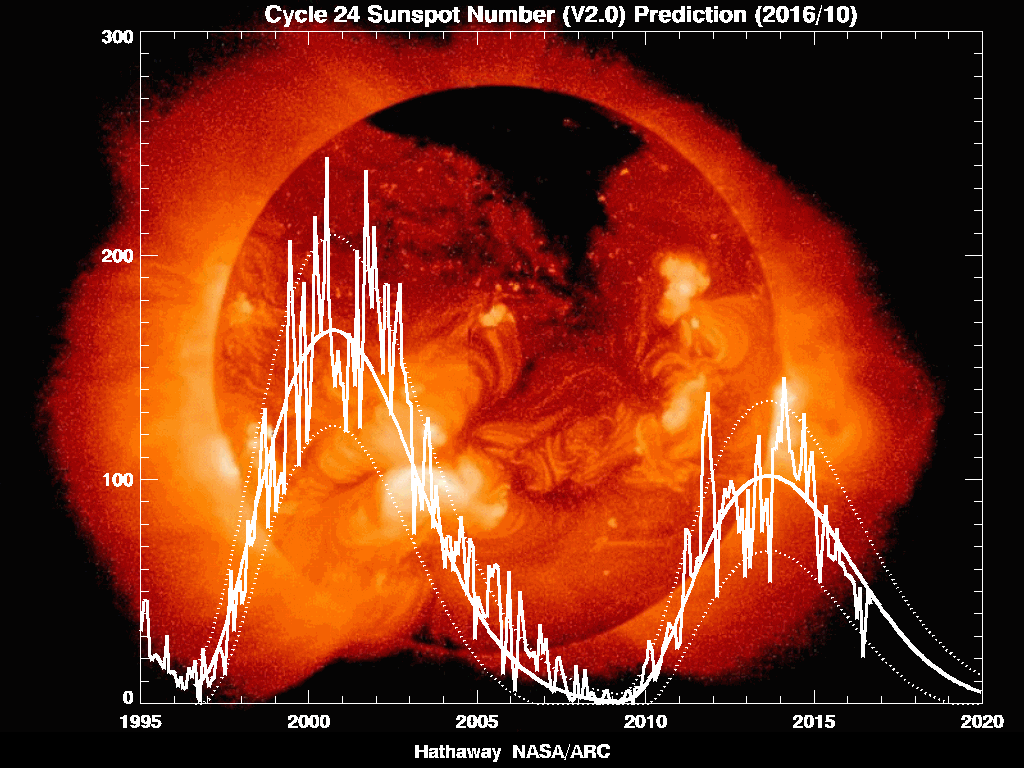
The August solar cycle 24 forecast from NASA is unchanged from the previous month though the maximum has increased to 69 from the 64 forecast about 6 months ago.

The current prediction for Sunspot Cycle 24 gives a smoothed sunspot number maximum of about 69 in June of 2013 (same as last month). We are currently over two and a half years into Cycle 24. Four out of the last five months with average daily sunspot numbers above 40 has raised the predicted maximum above the 64.2 for the Cycle 14 maximum in 1907. This predicted size still make this the smallest sunspot cycle in over 100 years.

NASA - Solar Cycle 24 forecast

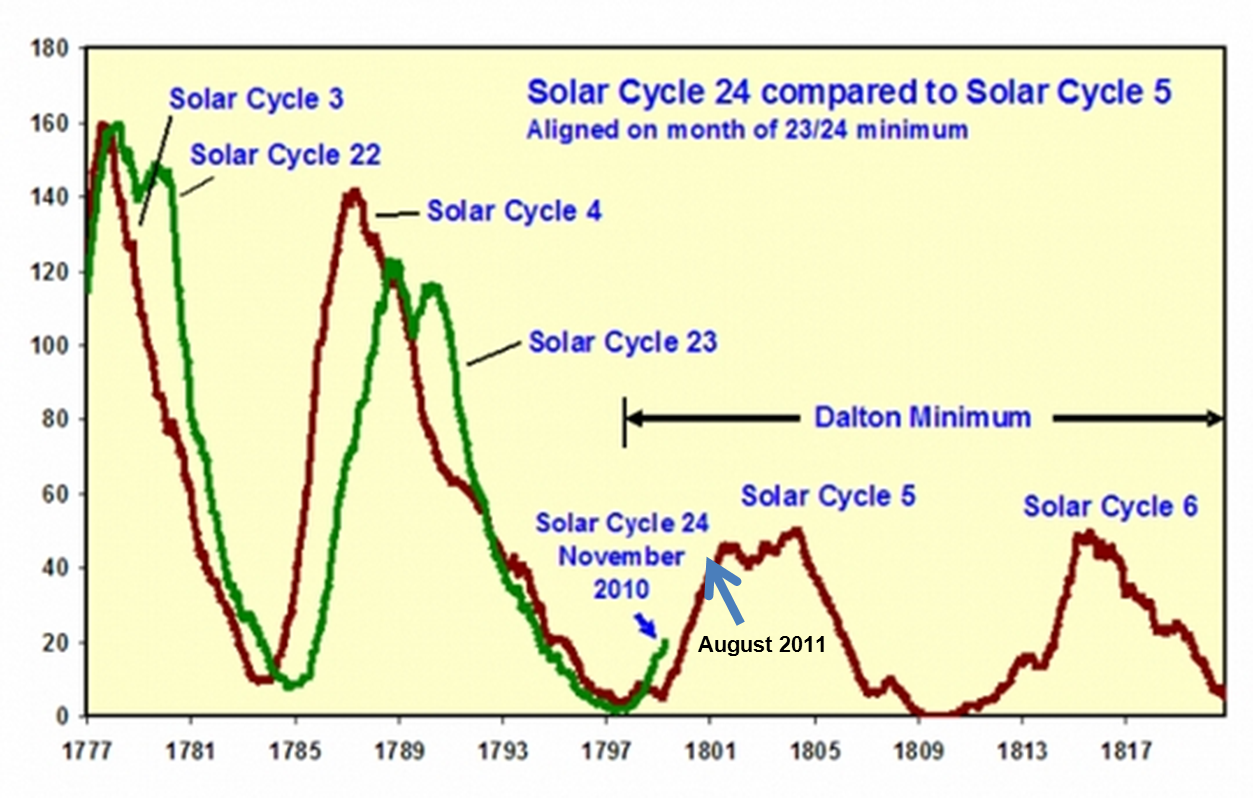
Solar Cycle 24 continues to invite comparisons with Solar Cycle 5.

SC24 versus SC5 - from http://sc25.com

What passes for science: Mindless number games show El Niño correlates with civil war!

August 25, 2011

Even making allowance for the fact that it is August when “silly season” stories come to the fore, this nonsense  does not bring much credit to the authors, Columbia University, Nature or the sponsors of the “study” who include the U.S. EPA, the brother of George Soros and the Environmental Defense Fund. Gullible journalists who are short of copy and create headlines from this kind of junk science are plentiful.

Civil conflicts are associated with the global climate Solomon M. Hsiang, Kyle C. Meng & Mark A. Cane, Nature 476, 438–441 (25 August 2011) doi:10.1038/nature10311 

pdf version here


The Guardian leads –

Climate cycles linked to civil war, analysis shows

Cyclical climatic changes double the risk of civil wars, with analysis showing that 50 of 250 conflicts between 1950 and 2004 were triggered by the El Niño cycle, according to scientists.

Researchers connected the climate phenomenon known as El Niño, which brings hot and dry conditions to tropical nations and cuts food production, to outbreaks of violence in countries from southern Sudan to Indonesia and Peru.

Solomon Hsiang, who led the research at Columbia University, New York, said: “We can speculate that a long-ago Egyptian dynasty was overthrown during a drought. This study shows a systematic pattern of global climate affecting conflict right now. We are still dependent on climate to a very large extent.”

JunkScience gives it short shrift:

Weather causes war, a new study claims. So should we limit CO2 emissions and give peace a chance? Make love not CO2?

The study published in this week’s Nature claims to correlate El Niño Southern Oscillation (ENSO) cycles with wars around the world during 1950-2009. The study’s intended implication, then, is that if only we can stop climate change (i.e., limit CO2 emissions), peace will be at hand.

The study’s major problem, however, is that even if there is a statistical correlation (pardon the redundancy) between ENSO events and wars, the study authors failed to examine any of the actual socio-political circumstances surrounding the wars. To insinuate weather cycles as a cause of or contributor to war simply because they can be correlated is to mindlessly exalt numerology over socio-political reality. 

Next ENSO cycles are real and result in actual weather phenomena. Extrapolating the actuality of ENSO to the dubious hypothesis of catastrophic manmade global warming, is yet another leap of faith. The goal of this research is to link CO2 emissions with national security. That is, we don’t just have to wish for world peace anymore; we can stop burning fossil fuels, cooling our homes, driving SUVs, eating meat, etc. It is merely a ploy to tug at the consciences of conservatives who, as a tribe, otherwise generally oppose Al Gore-ism.


Hydro power plants can release more CO2 emissions than a coal plant

August 24, 2011

Man-made carbon-dioxide emissions are of little significance in the global concentration of carbon dioxide in the atmosphere and the effect of carbon dioxide concentration on global climate is of even less significance. In fact it is much more likely that CO2 concentrations in the atmosphere follow global temperature rather than the other way around.

Nevertheless there are perceptions of fossil fuel fired power plants being terribly polluting and of being the dominant source of man-made emissions while hydro-power plants are perceived as being totally non-polluting. These perceptions are mainly based on pre-determined political positions and not necessarily on measurements or reality.

A new study from Brazil looking at the impact of hydro power plants and the Balbina dam has been published in the Journal of Geophysical Research. One caveat of course with many such studies is that it is not based on measurements but on some measurement followed by hypotheses built into computer models. Nothing wrong with that of course but the weakness with many model results – as with climate models – is that the results can neither be verified or dis-proved by measurements.

Kemenes, A., B. R. Forsberg, and J. M. Melack (2011), CO2 emissions from a tropical hydroelectric reservoir (Balbina, Brazil), J. Geophys. Res., 116, G03004, doi:10.1029/2010JG001465 

Swedish Radio P1:

Electricity from hydropower can lead to several times the emissions of greenhouse gas emissions than produced from fossil fuels. At least from hydro-electric dams in the rain forest areas, according to a new study from Brazil. 

The Balbina dam, which was built fifteen years ago, is located north of Amazonas state capital Manaus. When the rain forest area here was flooded large amounts of organic material ended up at the bottom of the pond. Rotting vegetation then caused large emissions of carbon dioxide and methane. According to this study this corresponded to three tonnes of carbon dioxide per megawatt-hour of energy produced, which is almost ten times that of a coal-fired power plants, and just over half of the emissions from burning fossil fuels in the city ​​of São Paulo.

A recently published study of 85 hydroelectric dams in the world shows that emissions vary between different ponds, depending on size, age and what kind of soil is soaked. How big emissions Swedish hydroelectric dams produce has not yet been studied, but estimates indicate that they are significantly lower than from those in tropical areas in Brazil says Professor Philip Fernside of  Instituto Nacional de Pesquisas da Amazônia (INPA) in Manaus. “It is true that dams in tropical areas such as the Amazon produces more than ponds in temperate climate, but there are emissions in these areas also” says Philip Fernside.

A pdf version of the paper is here.


Number of species on the planet is an unknown unknown – so what is the importance of biodiversity?

August 24, 2011
PLoS Biology_front page_2010-03-01

Image by Bettaman via Flickr

The importance of biodiversity and the loss of species as humans take over their habitats is one of the favourite themes of the environmental movement. But I have yet to see a clear exposition as to why the natural loss of species unable to cope with change is something to be opposed. The diversity of life is certainly one of the most striking aspects of our planet and it is not hard to accept that knowing how many species inhabit Earth is a fundamental question in science. In fact, without knowing this number any comments – let alone conclusions – about the danger of loss of species or the importance of bio-diversity to humanity can only be speculation.

The problem is not only that we have not identified all the eukaryote species in existence (and about 1.3 million have been classified and named) but we have no idea whether the number in existence is to be measured in millions or in hundreds of millions. About 15,000 new species are identified and catalogued each year. If  Bacteria and Archaea are added to eukaryotes, the total number of species could be in the billions.

A new paper in PLoS Biology using a relatively new methodology predicts the total number of species that exist. They claim that “the higher taxonomic classification of species (i.e., the assignment of species to phylum, class, order, family, and genus) follows a consistent and predictable pattern from which the total number of species in a taxonomic group can be estimated”. Using this approach they conclude that “there are ~8.7 million (±1.3 million SE) eukaryotic species globally, of which ~2.2 million (±0.18 million SE) are marine. …. (and) some 86% of existing species on Earth and 91% of species in the ocean still await description”.

Mora C, Tittensor DP, Adl S, Simpson AGB, Worm B (2011) How Many Species Are There on Earth and in the Ocean? PLoS Biol 9(8): e1001127. doi:10.1371/journal.pbio.1001127 

But the paper is already facing objections. The methodology – some claim – actually only estmates human activity in classifying species and not the species themselves. It does seem like an extrapolation from “what has been found” to predict “all that can possibly be found” and the argument is somewhat circular and not fully convincing. It brings to mind the quotation from Donald Rumsfeld which he was castigated for but which I am finding increasingly profound:

There are known knowns; there are things we know we know.
We also know there are known unknowns; that is to say we know there are some things we do not know.
But there are also unknown unknowns – the ones we don’t know we don’t know.

I think we are still in the state of not knowing what we do not know.

NY Times

“It’s astounding that we don’t know the most basic thing about life,” said Boris Worm, a marine biologist at Dalhousie University in Nova Scotia. On Tuesday, Dr. Worm, Dr. Mora and their colleagues presented the latest estimate of how many species there are, based on a new method they have developed. They estimate there are 8.7 million species on the planet, plus or minus 1.3 million.

In 1833, a British entomologist named John Obadiah Westwood made the earliest known estimate of global biodiversity by guessing how many insect species there are. He estimated how many species of insects lived on each plant species in England, and then extrapolated that figure across the whole planet. “If we say 400,000, we shall, perhaps, not be very wide of the truth,” he wrote. Today, scientists know the Westwood figure is far too low. They’ve already found more than a million insect species, and their discovery rate shows no signs of slowing down.

In 1988, Robert May, an evolutionary biologist at the University of Oxford, observed that the diversity of land animals increases as they get smaller. He reasoned that we probably have found most of the species of big animals, like mammals and birds, so he used their diversity to calculate the diversity of smaller animals. He ended up with an estimate 10 to 50 million species of land animals.

For the new estimate, the scientists came up with a method of their own, based on how taxonomists classify species. Each species belongs to a larger group called a genus, which belongs to a larger group called a family, and so on. .. In 2002, researchers at the University of Rome published a paper in which they used these higher groups to estimate the diversity of plants around Italy. There were fewer higher-level groups than lower ones at each site, like the layers of a pyramid. The scientists could estimate how many species there were at each site, much as it’s possible to estimate how big the bottom layer of a pyramid based on the rest of it. . … The scientists built a taxonomic pyramid to estimate the total number of species in well-studied groups, like mammals and birds. (They) then used it on all major groups of species, coming up with estimates of 7.7 million species of animals, for example, and 298,000 species of plants.

Terry Erwin, an entomologist at the Smithsonian Institution, think there’s a big flaw in the study. There’s no reason to assume that the diversity in little-studied groups will follow the rules of well-studied ones. “They’re measuring human activity, not biodiversity,” he said. David Pollock, an evolutionary biologist at the University of Colorado who studies fungi — a particularly understudied group — agrees. “This appears to be an incredibly ill-founded approach,” he said. There are 43,271 cataloged species of fungi, based on which Dr. Mora and his colleagues estimate there are 660,000 species of fungi on Earth. But other studies on fungus diversity suggest the number may be as high as 5.1 million species. ….

Jonathan Eisen, an expert on microbial diversity at the University of California, Davis, said he found the new paper disappointing. “This is akin to saying, ‘Dinosaurs roamed the Earth more than 500 years ago,’ ” he said. “While true, what is the point of saying it?”

At least it could be argued that there are not less than 8.7 million eukaryotic species. This is not likely to be the end of this story. Nevertheless it does at least show the scale of the problem and that the number of all living species (and not just eukaryotes) is still in the realm of the unknown.

And the importance of the disappearance of unsuccessful species and of the resulting bio-diversity on humanity is still an unknown unknown.
Mosquitos increasing in the UK but global warming not blamed – yet

August 23, 2011

This is a very mildly interesting story from the BBC.

I read every word and realised that I continued reading long after it had ceased to be interesting only because I was waiting for the punch line that it “was all due to global warming”.

It never came.

But it will.

Based on a survey of UK local authorities, reports of mosquito bites over the last 10 years are 2.5 times greater than in the 10 years up to 1996. NHS Direct statistics show 9,061 calls in England complaining of bites and stings from early May this year to now – up nearly 15% from last summer. Not all bite complaints are due to mosquitoes – many can be attributed to bedbugs, midges and fleas.

But conditions in the UK, particularly in southeastern England, are increasingly hospitable to mosquitoes.

“The wet weather through May and June this year, along with a warm summer, has affected the population because mosquitoes like the standing breeding water,” says zoologist Michael Bonsall at Oxford University. …. 

But once upon a time, malaria-carrying mosquitoes could be found in the salt marshes of southeastern England. It is believed that malaria – literally “bad air” – dates back at least to Roman times in the UK, and outbreaks occurred as recently as the years just following World War I.

British doctor Ronald Ross, who discovered the malarial parasite living in the gastrointestinal tract of the Anopheles mosquito in the 19th Century, recruited teams to eliminate the larvae from stagnant pools and marshes. … 

Malaria in England had effectively died out by the 1950s, mostly due to the draining of much of the marshland where mosquitoes bred. But because of the growth of global travel, the number of imported cases of the disease in the UK has risen, with nearly 2,000 a year today.

Go to BBC article 


Discovery of Icelandic ocean current unsettles “settled” climate theories

August 23, 2011

So much for settled science.

A new paper overturns previous thinking that the East Greenland Current was the main source of the Atlantic Meridional Overturning Circulation (AMOC). The newly discovered North Icelandic Jet (NIJ) is now thought to dominate the return of dense water south through gaps in the Greenland-Scotland Ridge to keep the “great ocean conveyor belt” moving.

Kjetil Våge, Robert S. Pickart, Michael A. Spall, Héðinn Valdimarsson, Steingrímur Jónsson, Daniel J. Torres, Svein Østerhus & Tor Eldevik. Significant role of the North Icelandic Jet in the formation of Denmark Strait overflow waterNature Geoscience, 21 August 2011 DOI:10.1038/ngeo1234

graphic by Reuters

 Science Daily reports:

ScienceDaily (Aug. 21, 2011) — An international team of researchers, including physical oceanographers from the Woods Hole Oceanographic Institution (WHOI), has confirmed the presence of a deep-reaching ocean circulation system off Iceland that could significantly influence the ocean’s response to climate change in previously unforeseen ways. 

The current, called the North Icelandic Jet (NIJ), contributes to a key component of the Atlantic Meridional Overturning Circulation (AMOC), also known as the “great ocean conveyor belt,” which is critically important for regulating Earth’s climate. As part of the planet’s reciprocal relationship between ocean circulation and climate, this conveyor belt transports warm surface water to high latitudes where the water warms the air, then cools, sinks, and returns towards the equator as a deep flow.

Crucial to this warm-to-cold oceanographic choreography is the Denmark Strait Overflow Water (DSOW), the largest of the deep, overflow plumes that feed the lower limb of the conveyor belt and return the dense water south through gaps in the Greenland-Scotland Ridge.

For years it has been thought that the primary source of the Denmark Overflow is a current adjacent to Greenland known as the East Greenland Current. However, this view was recently called into question by two oceanographers from Iceland who discovered a deep current flowing southward along the continental slope of Iceland. They named the current the North Icelandic Jet and hypothesized that it formed a significant part of the overflow water.

Now, in a paper published in the Aug. 21 online issue of the journal Nature Geoscience, the team of researchers — including the two Icelanders who discovered it — has confirmed that the Icelandic Jet is not only a major contributor to the DSOW but “is the primary source of the densest overflow water.” ……..

David Cameron was “played” by News International

August 23, 2011

David Cameron’s judgement in employing Andy Coulson has already been brought into question. Apparently Coulson was also privy to confidential documents and meetings beyond his security clearance and that he was spared – or protected from – the highest level of security vetting. It has been suggested that his appointment may have been at the behest of Rupert Murdoch or Rebekah Brooks.

It now appears that Andy Coulson was working for two paymasters strengthening the impression that David Cameron was not just a “dupe” but that he was being “played” by News International. Presumably the real objective for News International was the acquisition of BSkyB.

The BBC breaks this story:

Coulson got hundreds of thousands of pounds from News Int

Andy Coulson, the former editor of the News of the World who has been arrested on suspicion of involvement in phone hacking and bribing the police, received several hundred thousand pounds from News International after starting work as the Conservative Party’s Director of Communications in July 2007.

These payments were part of his severance package, under what is known as a “compromise agreement”.

According to sources, Mr Coulson’s contractual leaving pay was given to him in instalments until the end of 2007 – which means he continued to be financially linked to News International for several months of his tenure as David Cameron’s main media adviser. ….. Mr Coulson also continued to receive his News International work benefits, such as healthcare, for three years, and he kept his company car. ………

Related: Phone hacking: PM’s defence of Coulson over the years

La Niña is back and will persist till 2012

August 22, 2011

In February Klaus Wolter came to the conclusion that there was an even chance that La Niña conditions could extend into 2012. He wrote then:

While La Niña conditions are guaranteed well into 2011, it remains to be seen whether it can rally once more to cross the -2 sigma barrier, and/or whether it will indeed last into 2012, as discussed six months ago on this page. I believe the odds for a two-year event remain well above 50%, made even more likely by the continued unabated strength in various ENSO indices.

Bob Tisdale points out at WUWT that

NINO3.4 SST anomalies (a commonly used El Niño-Southern Oscillation Index) have dropped significantly below the -0.5 deg C threshold of a La Niña Event. They are presently at approximately -0.74 deg C.

NINO3.4 SST anomalies

NOAA has yet to update its El Niño / La Niña forecasts but has called a “La Niña watch” but Bob Tisdale is ahead of them in calling the return of La Niña which is not too far away from Wolter’s forecast.

Update!! 8th September: NOAA now calls it:  La Niña is back

But Agriculture.com reports that the money is already betting on La Niña conditions for this winter and into 2012:

Sentiment towards commodities lying in the traditional path of conditions known as La Nina is starting to turn more bullish, exacerbated by supply shortages in a number of products like iron ore and coal.

Forecasting models by the U.S. National Weather Service’s Climate Prediction Center predict La Nina will redevelop this autumn. “Atmospheric patterns continue to reflect La Nina-like conditions,” the weather body said.

La Nina is a periodic climatic phenomenon that brings more rain to the western Pacific, and to a lesser extent, to the eastern Pacific. Climatologists blamed La Nina for last year’s floods that gripped Australia, resulting in major losses to coal and iron ore stockpiles. 

But while it isn’t clear what impact La Nina might have on the production and shipment of commodities, its return isn’t expected to cause the same serious problems as in 2010. That’s because historically the La Nina weather phenomenon occurs in bursts of three consecutive years, with the first one being the worst and the next two much milder. ……

Joe Vaclavik, grains broker at Chicago-based MF global, said from an agricultural commodity markets perspective, the biggest fear of a second La Nina would be the continuation of the current drought in the U.S. southern plains, causing further damage to the winter wheat crop. ….. Matt Rogers, President of Maryland-based Commodity Weather Group, warned that possible effects from the second round of La Nina could bring above-normal precipitation in eastern Australia, but would actually benefit the wheat and barley crops in terms of moisture. Yet, dryness concerns could be an issue for Argentina and southern Brazil, which would experience lower amounts of rainfall, causing damage to wheat, corn and soybean yields.

And Indian and Japanese forecasters have already called La Niña conditions.

The Indian Meteorological Department (IMD) has forecast an active wet spell for northwest India during the next five days and over east and adjoining central India during the next three days. This came about on a day when Japanese scientists assessed that the predicted return of La Nina conditions may already be happening.

Dr Jing-Jia Luo, Senior Scientist with the Climate Variation Predictability and Applicability Research Programme Research at RIGC, wrote to Business Lineon Friday that the La Nina condition is currently on the way back. This condition is forecast to persist until early next year, Dr Jing-Jia says, adding that a weak positive Indian Ocean Dipole (IOD), which mimics EL Nino-La Nina in the Indian Ocean, also may occur during the next few months.

Positive IOD refers to the warming of seas-surface temperatures in the western part of the Indian Ocean, and vice versa. Positive IOD has been found to favour a concurrent monsoon. Regional forecast from the RIGC said that the La Nina would bring cool to wet conditions over southern Africa, Australia, and Brazil during the southern hemisphere summer.

The confirming indicators for a La Niña event are accumulating – from the Indian monsoon to greater evaporation leading to increased rains expected in the Western Pacific in Australia, less rain in the Eastern Pacific on the western coast of S. America (coastal Chile and Peru) but increased rain on the east coast in southern Brazil and  northern Argentina.