Archive for the ‘Solar science’ Category
May 9, 2012
And another paper showing that the Little Ice Age was a global event.It is highly probable that the LIA was related to the solar effects which gave a dearth of sunspots during the Maunder Minimum.
GEOPHYSICAL RESEARCH LETTERS, VOL. 39, L09710, 7 PP., 2012, doi:10.1029/2012GL051260
Little Ice Age cold interval in West Antarctica: Evidence from borehole temperature at the West Antarctic Ice Sheet (WAIS) Divide
by
Anais J. Orsi , Bruce D. Cornuelle, Jeffrey P. Severinghaus – Scripps Institution of Oceanography, University of California, San Diego, La Jolla, California, USA

(more…)
Tags:Antarctica, Little Ice Age, Maunder Minimum, solar effects on climate, WAIS Divide, West Antarctic Ice Sheet
Posted in Climate, Solar science, Southern Hemisphere | Comments Off on Solar effects on climate – evidence mounts that the Little Ice Age was a global event
May 7, 2012
A new paper in Nature Geoscience shows that solar grand minima do indeed cause cooling of the climate in Europe. Around 2800 years ago, one of these Grand Solar Minima, the Homeric Minimum, caused a distinct climatic change in less than a decade in Western Europe. The forcing mechanisms still remain unclear but the evidence that solar effects are significant and cannot be ignored are mounting and persuasive. Now as we enter (or have already entered) a new solar minimum it remains to be seen as to whether this (Landscheidt?) Minimum will be a grand minimum to compare with the Maunder Minimum. In any event a period of global cooling seems likely.
In contrast, the evidence for any anthropogenic effects on climate is still non-existent though political and alarmist theories abound. There is as yet no direct evidence that man-made carbon dioxide emissions has any significant effect on global warming.
Regional atmospheric circulation shifts induced by a grand solar minimum by Celia Martin-Puertas, Katja Matthes, Achim Brauer, Raimund Muscheler, Felicitas Hansen, Christof Petrick, Ala Aldahan, Göran Possnert & Bas van Geel
Nature Geoscience (2012) doi:10.1038/ngeo1460
(more…)
Tags:climate change, Homeric Minimum, Landscheidt Minmum, Maunder Minimum, Pre-Roman Iron Age, solar effects on climate, Solar minimum, Solar variation
Posted in Alarmism, Climate, Solar science | 12 Comments »
March 13, 2012
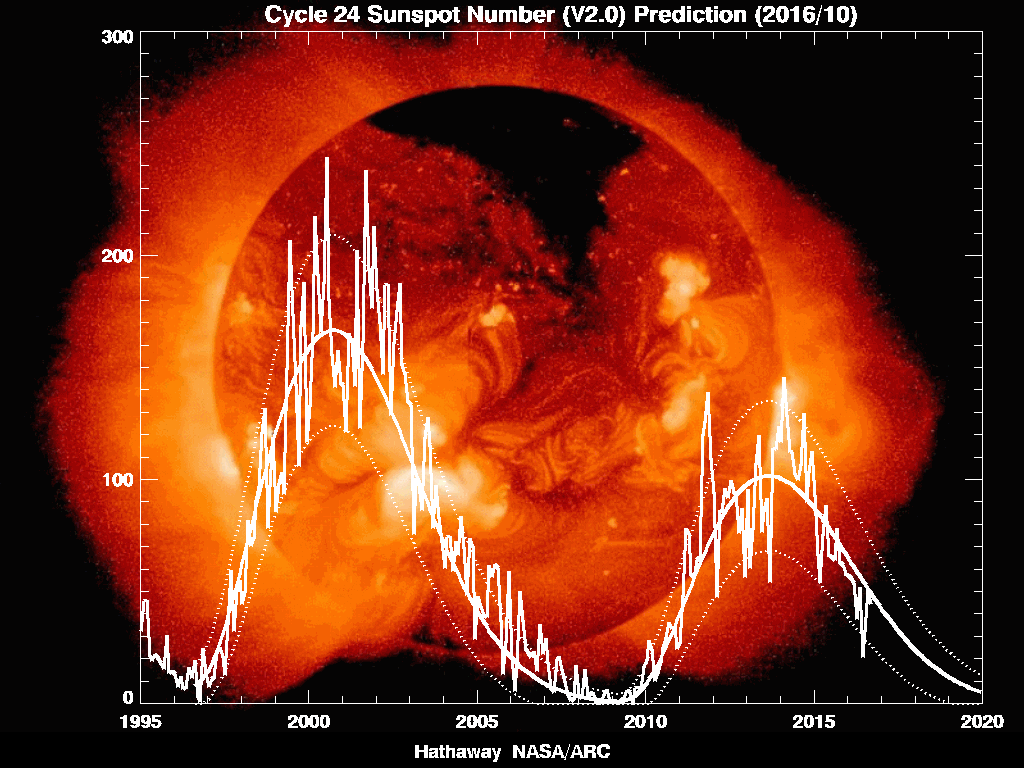
David Hathaway has a new forecast for solar cycle 24:
The current prediction for Sunspot Cycle 24 gives a smoothed sunspot number maximum of about 59 in early 2013. We are currently over three years into Cycle 24. The current predicted size makes this the smallest sunspot cycle in about 100 years.

SC24 forecast: updated 2nd March 2012
SC25 will likely be even smaller and it now remains to be seen if this Landscheidt Minimum is closer to a Dalton Minimum or a Maunder Minimum.
(more…)
Tags:David Hathaway, Landscheidt Minimum, Prediction, SC 24, SC25, solar cycle, Solar Cycle 24
Posted in Climate, Solar science | Comments Off on Solar Cycle 24 NASA forecast update
March 10, 2012
A recent post by John O’Sullivan reminded me that it is time for the next solar minimum that is on its way to be named after the man who predicted it. Theodor Landscheidt (born in 1927 in Bremen, Germany, died on May 20, 2004) was an author and amateur climatologist. In 1989, Landscheidt forecast a period of sunspot minima after 1990, accompanied by increased cold, with a stronger minimum and more intense cold which should peak in 2030 which he described as the “Landscheidt Minimum”.
The sun goes through its cycles as it will and at its own pace and we continue to struggle to try and decipher the various cycles that exist, what causes them and what effects they have on the earth. Some of the cycles known or hypothesised to exist are the:
- 11 year sunspot cycle
- 22 year magnetic cycle
- 87 year Gleissberg cycle
- 166 year “unnamed” cycle
- 210 years Suess or de Vries cycle
- 2,300 years Hallstat cycle
- 6000 years Xapsos and Burke cycle
Landscheidt’s paper is here: New Little Ice Age instead of Global Warming?
(more…)
Tags:Dalton minimum, Landscheidt Minimum, Little Ice Age, Maunder Minimum, solar cycle, Solar variation, Theodor Landscheidt
Posted in Climate, Science, Solar science | Comments Off on Solar cycles and the Landscheidt minimum
March 8, 2012
The evidence for the obvious mounts. The sun comes first and dominates and then come the oceans which provide the vehicle for distributing solar effects around the globe. The mythical effect of anthropogenic carbon dioxide on climate has yet to be supported by any direct evidence. Instead, the direct evidence observations of the last 12 years is that increasing carbon dioxide concentration in the atmosphere has been accompanied by a decline of “global” temperature.
A new paper by Jan-Erik Solheim (Department of Physics and Technology, University of Tromsø), Kjell Stordahl (Telenor Norway, Fornebu), Ole Humlum (Department of Geosciences, University of Oslo; Department of Geology, University Centre in Svalbard).
The long sunspot cycle 23 predicts a significant temperature decrease in cycle 24
Preprint: Accepted for publication in Journal of Atmospheric and Solar-Terrestrial Physics February 9, 2012
Abstract. Relations between the length of a sunspot cycle and the average temperature in the same and the next cycle are calculated for a number of meteorological stations in Norway and in the North Atlantic region. No significant trend is found between the length of a cycle and the average temperature in the same cycle, but a significant negative trend is found between the length of a cycle and the temperature in the next cycle. This provides a tool to predict an average temperature decrease of at least 1.0 “C from solar cycle 23 to 24 for the stations and areas analyzed. We find for the Norwegian local stations investigated that 25-56% of the temperature increase the last 150 years may be attributed to the Sun. For 3 North Atlantic stations we get 63-72% solar contribution. This points to the Atlantic currents as reinforcing a solar signal.
Tags:Atlantic Ocean, Norway, solar, solar cycle, Solar cycle 23, Solar Cycle 24
Posted in Climate, Norway, Solar science | Comments Off on Norway: “25–56% of the temperature increase the last 150 years may be attributed to the Sun”
March 2, 2012
Sticking to science – and experimental science at that – while ignoring the politicisation and religious overtones of “climate science”, Henrik Svensmark continues to painstakingly build his cosmic theory of climate change.
Supernova remnants → cosmic rays → solar modulation of cosmic rays →variations in cluster and sulphuric acid production → variation in cloud condensation nuclei → variation in low cloud formation → variation in climate.
When experiments or observations show that model predictions are wrong it is time to ditch the falsified hypotheses and to build new hypotheses. Far too often in ” global warming science” the hypotheses and the models become “incontrovertible dogma” and rather than test the falsifiability of the hypothesis with observations and experiment, data are fudged to fit the dogma. Svensmark’s approach is an oasis of proper science in a desert of pseudo-science.
Nigel Calder reports:
(more…)
Tags:climate change, Cloud condensation nuclei, cloud seeding, Cosmic ray, Henrik Svensmark, Nigel Calder, solar effects
Posted in Climate, Science, Solar science | 2 Comments »
February 3, 2012
As Europe freezes in Siberian weather and people die it is not so difficult to imagine what life would be like in the throes of a Little Ice Age. Humans have endured and survived during the ice ages but have only developed and thrived and expanded when the Earth goes through its interglacial periods.
It is global cooling and the potential for a little ice age that poses the real threat to humans. Not some fantasy about anthropogenic global warming. The demonisation of carbon dioxide in the assumed – but unproven – belief that it contributes to global warming will turn out to be one of the most wasteful contentions of modern science.
If only it was that easy to change the climate!
NoTricksZone reports:
Germany’s no. 1 daily Bild (by circulation numbers) reports on the Killer Cold now paralyzing Europe and Asia, and calls it the worst in 25 years. The cold has hit Eastern Europe especially hard, with temperatures plummeting to -30°C throughout the Ukraine and Poland. So far the cold has claimed 139 lives, with 3 in Germany.
(more…)
Tags:coldest winters, Europe, global cooling, global warming, Little Ice Age, winter
Posted in Climate, Solar science, Weather, Winter | Comments Off on Hundreds die as cold wave in Europe provides a taste of what a little ice age could do
February 1, 2012
Well now!!!
Perhaps this just panders to my opinions but I find this more convincing than the Hockey Stick.
Bicentennial Decrease of the Total Solar Irradiance Leads to Unbalanced Thermal Budget of the Earth and the Little Ice Age by Habibullo I. Abdussamatov, Pulkovo Observatory of the Russian Academy of Science, St. Petersburg, 196140, Russia
Applied Physics Research ISSN 1916-9639 (Print) ISSN 1916-9647 (Online)
Abstract
Temporal changes in the power of the longwave radiation of the system Earth-atmosphere emitted to space always lag behind changes in the power of absorbed solar radiation due to slow change of its enthalpy. That is why the debit and credit parts of the average annual energy budget of the terrestrial globe with its air and water envelope are practically always in an unbalanced state. Average annual balance of the thermal budget of the system Earth-atmosphere during long time period will reliably determine the course and value of both an energy excess accumulated by the Earth or the energy deficit in the thermal budget which, with account for data of the TSI forecast, can define and predict well in advance the direction and amplitude of the forthcoming climate changes. From early 90s we observe bicentennial decrease in both the TSI and the portion of its energy absorbed by the Earth. The Earth as a planet will henceforward have negative balance in the energy budget which will result in the temperature drop in approximately 2014. Due to increase of albedo and decrease of the greenhouse gases atmospheric concentration the absorbed portion of solar energy and the influence of the greenhouse effect will additionally decline. The influence of the consecutive chain of feedback effects which can lead to additional drop of temperature will surpass the influence of the TSI decrease. The onset of the deep bicentennial minimum of TSI is expected in 2042±11, that of the 19th Little Ice Age in the past 7500 years – in 2055±11.
The full paper (pdf) is here: Abdussamatov App Physics Research
(more…)
Tags:Abdussamatov, climate change, global cooling, Little Ice Age, Pulkovo Observatory, Russian Academy of Science, solar effects on climate
Posted in Climate, Solar science | 1 Comment »
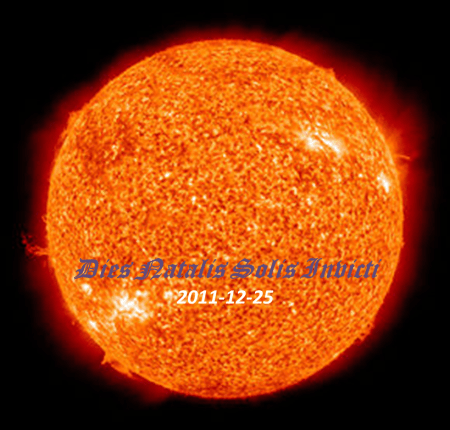
December 25, 2011
It is the 25th of December of the year 2011 of the Gregorian Calendar and it is the anniversary of the day of the birth of the Invincible Sun (Dies Natalis Solis Invicti).
More correctly, of course it is the presumed date of the birth of the Earth’s revolutions around the Sun. This revolution would have existed even when the Earth was just an amorphous conglomeration of gas and particles orbiting the Sun and still waiting to coalesce as the Earth. Since the seasonal celebrations could never be suppressed, it is the date which was hijacked as the day of the birth of Christ (first recorded in 354AD), some 1,657 years ago. But Natalis Solis Invicti goes back much longer than that. And to the best of our knowledge that was about 4,540,000,000 (±1%) years ago.
And while the celebrations around the world at this dark time of the year remain of vital importance in the human calendar, its relevance as the birthday of Christ has become largely meaningless. It is the celebration of renewal, of the beginning of a new year, of the coming lengthening of the days after the winter solstice which pre-dates Christian tradition and will continue long after its inevitable extinction. It is the certainty of belief that the earth will continue to revolve around the Sun and all that follows from that which lifts the human spirit.
Here the sun rises today at 08:48 and sets at 15:05 – a day-length of just over 6 hours. But the days are getting longer and already by next Saturday the day at this latitude will be 6 minutes longer. Over the next 200 days the length of each day will increase by an average of more than 3 minutes each day and by high summer the length of the day will be around 17 hours. And it is the affirmation of this renewal, this anticipation of what is to come and the reconfirmation of “certain” belief in Sol Invictus which lifts my spirit.
And so my greetings to all on this day to celebrate the day of the birth of the Invincible Sun.
Tags:25th December, Christmas, Dies Natalis Solis Invicti, Gregorian Calendar, Sol Invictus, Sun, Winter solstice
Posted in Solar science | Comments Off on Sol Invictus: Greetings on Dies Natalis Solis Invicti



 The k2p blog