Posts Tagged ‘Little Ice Age’

Solar Cycle 24 double peak now clearly evident

May 9, 2013

Already in March there were signs that this Solar Cycle 24 would exibit a double peak. NASA’s latest sunspot prediction for Solar Cycle 24 as of 1st May 2013 clearly shows that the sunspot activity is into its “double peak for this Cycle. A double peak was also evident in Cycles 22 and 23 and also in Cycles 5 and 14. The levels for SC24 are still going to be the lowest for 100 years and predictions for SC 25 are that they will be even lower still. Most second peaks have been somewhat smaller than the first – though not in SC5 – and seem to add around 6 months to the cycle time.

If this is indeed a double peak then I expect that solar maximum will perhaps be a few months delayed from the NASA prediction of Fall 2013. End 2013 now seems more likely.

SC24 may 2013

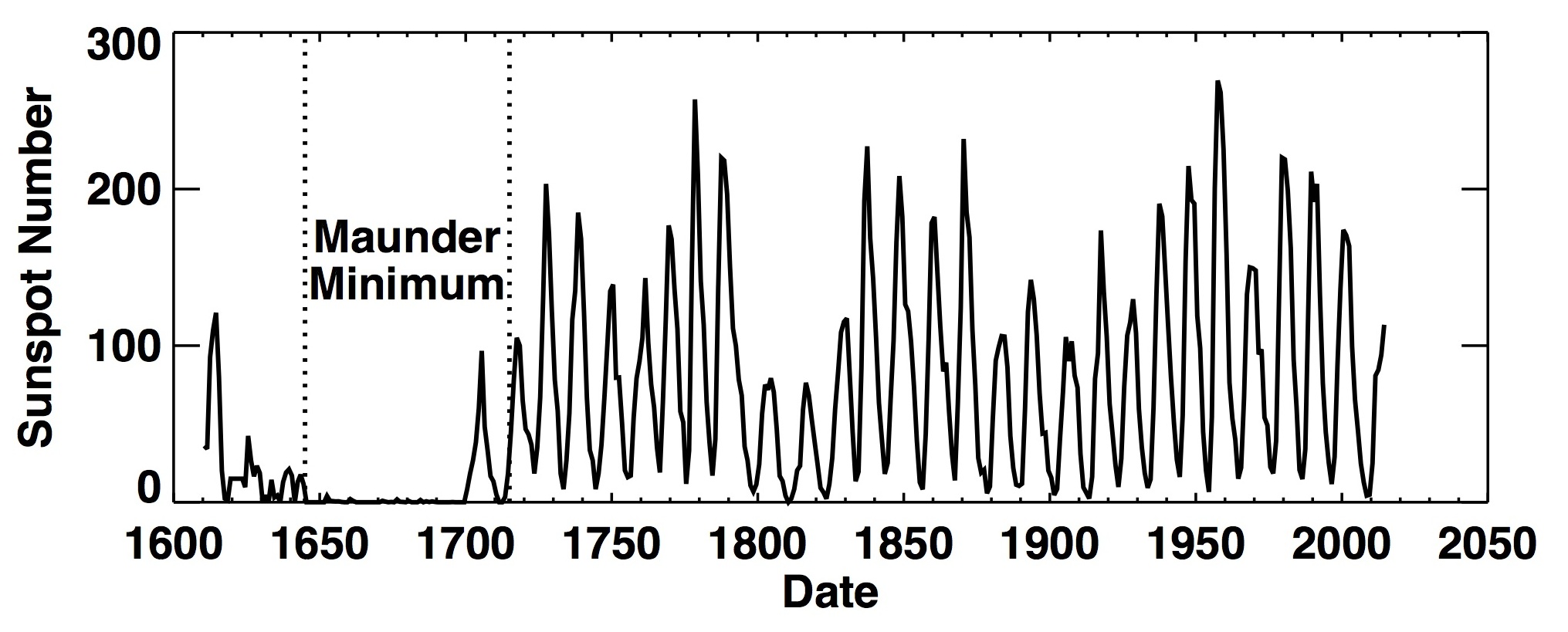
The Dalton minimum spanned Solar Cycles 5 and 6 from 1790 to 1820.  The Maunder Minimum from 1645 to 1715 preceded the numbering of Solar Cycles (Solar Cycle 1 started in 1755). The likelihood that SC 24 and 25 may be similar to SC 5 and 6 is growing and so is the likelihood that we will see 2  – 3 decades of global cooling. It is more likely that for the next 20- 30 years this Landscheidt Minimum will resemble the Dalton Minimum period, but if SC25 is a very small cycle then we may even approach the conditions of the Little Ice Age during the Maunder Minimum. Landscheidt’s prediction was that this minimum would last from 2000 to 2060 and the global temperature stand-still for the last 15 years gives greater credence to his forecasts.

NASA: The Sunspot Cycle —

The Maunder Minimum

Early records of sunspots indicate that the Sun went through a period of inactivity in the late 17th century. Very few sunspots were seen on the Sun from about 1645 to 1715 (38 kb JPEG image). Although the observations were not as extensive as in later years, the Sun was in fact well observed during this time and this lack of sunspots is well documented. This period of solar inactivity also corresponds to a climatic period called the “Little Ice Age” when rivers that are normally ice-free froze and snow fields remained year-round at lower altitudes. There is evidence that the Sun has had similar periods of inactivity in the more distant past. The connection between solar activity and terrestrial climate is an area of on-going research.

Carbon dioxide warming effect is just a “marketing trick”

April 11, 2013

P Gosselin of NoTricksZone reports on this Article in the Voice of Russia a month ago – but which got little attention from the global warming orthodoxy and the politically correct media. Not that everything from Russia makes sense but in this case I think they are far closer to reality than most others. I think they pay sufficient attention to solar effects and the oceans and are not easily diverted by the fanciful demonisation of carbon dioxide:

The world facing an ice age (in German)

Gosselin writes: The article writes that Russian scientists are predicting that “a little ice age will begin in 2014“. The article adds:

“They reject the claim of global warming and call it a marketing trick.”

When it comes to warming and the man-made CO2 greenhouse gas effect, the Voice of Russia writes that “Russian scientist Vladimir Bashkin is categorically in disagreement. He claims that the climatic changes are characterized by cycles and have nothing to do in any way with the activities of man.”

Together with his colleague Rauf Galiullin from the Institute for Fundamental Problems of Biology of the Russian Academy Of Science, he demonstrates that the current warming is a reverberation of the planet coming out of the ‘Little Ice Age’ and that in the near future, of course measured on geological timescales, we are at the threshold of an ice age.”

The Voice of Russia quotes Bashkin:

“The periods of a cooling and a warming follow each other at 30-40 year intervals. In Russia for example there was a warming in the 1930s, a time when seafaring at the Northern Sea Route was possible, then a cooling followed during the wartime years, and then warming followed in the 1970s, etc.. The current warming period ended at the end of the millennium.“

Note here that the Russian scientists confirm that the Arctic sea ice extent was also low in the 1930s. This tells us that nothing is really so unusual in the Arctic today.

The Voice of Russia then explains that the cooling is related to ”a change in solar activity” and that this “also has an impact on our climate“. Bashkin adds:

“The scientific research of the climate of the past geological epoch causes us to doubt the motives behind the demands of the IPCC. […] The greenhouse effect that is connected with the anthropogenic factor is about 4 or 5 percent of that from natural emissions. The eruption of a volcano produces more. A real contribution to the greenhouse effect is made by normal water vapor. Thank God nobody has gotten the idea that this too needs to be regulated.“

The Voice of Russia continues: “The world’s oceans contain 60 times more carbon dioxide than the atmosphere. When the temperature of the planet rises, it begins to be quickly released. This leads to an increase in atmospheric CO2 concentration, and not vice versa. A global warming that so many are talking about is not so much a scientific problem, rather it is much more a marketing trick. […] We do not have global warming ahead of us, rather we have global cooling, the Russian scientist claims. However, we do not need to fear the cooling because it will take place gradually and won’t be noticeable until the middle of the 21st century.”

The scientists add that part of the motive behind the “marketing trick” is to manipulate the market for fossil fuels.

Piers Corbyn: Mini Ice Age is upon us and the CO2 story is over

March 15, 2013

Piers Corbyn is not the most popular figure in “scientific” circles and is probably detested among “main-stream” weather pundits.  He just seems to get his forecasts right more often than conventional weather-men do, but he does not reveal his methods and this causes many to dismiss him as a lucky charlatan. They prefer to consider him an astrologer rather than a colourful but serious astrophysicist who might actually be considering the correct parameters. That he might also be making some money from his commercial weather forecasts is even more galling to some.

Weather Action: Our forecasts, which have independently proven peer-reviewed significant skill – unlike all others in the field – are based on our revolutionary Solar-Lunar-Action-Technique (SLAT) which is increasing in scope and skill as our researches advance.

But I like that he gives due importance to solar effects. And his track record in forecasting cannot be denied and I am inclined to take him rather seriously in spite of his  use of horribly garish colours in his presentations. His results if not his methods are getting some attention in Parliament.

Climate Realists have his article claiming that the Mini Ice Age is already here (pdf).

The new Mini Ice Age is upon us!

“MIA fingerprint now overwhelming” – astrophysicist

“March 10th 1947** was the day of the thaw ending the late snowy cold winter of 1947 in Britain & Europe and there was a giant sunspot group at the centre of the solar disc. This year, three magnetic (22yr) solar cycles later, solar activity has been generally very low and this day marked deep cold” – heralding more snow, on 12th , when snow-blizzards hit S/E England (Pic Folkstone) as WeatherAction forecasted in detail 25 days ahead (see map). “This is further evidence of the inevitable plunge – from now – into the new Mini-Ice Age we warned of some years ago”, said Piers Corbyn, astrophysicist of  WeatherAction.com, March 10th. “The CO2 story is over. It has been pointing the world in the wrong direction for too long. The serious implications of the developing MIA to agriculture and the world economy through the next 25 to 35 years must be addressed.”

(** Piers’ birthday!)

● The CO2 story is over

● World cooling is now ‘locked-in’

● Average solar activity way down

● Jet stream often way south

●Jet Stream develops wild waves giving very extreme weather events – hail, thunder, floods etc

Solar effects on climate – evidence mounts that the Little Ice Age was a global event

May 9, 2012

And another paper showing that the Little Ice Age was a global event.It is highly probable that the LIA was related to the solar effects which gave a dearth of sunspots during the Maunder Minimum.

GEOPHYSICAL RESEARCH LETTERS, VOL. 39, L09710, 7 PP., 2012, doi:10.1029/2012GL051260

Little Ice Age cold interval in West Antarctica: Evidence from borehole temperature at the West Antarctic Ice Sheet (WAIS) Divide

by

Anais J. Orsi , Bruce D. Cornuelle, Jeffrey P. Severinghaus – Scripps Institution of Oceanography, University of California, San Diego, La Jolla, California, USA

(more…)

Solar cycles and the Landscheidt minimum

March 10, 2012

A recent post by John O’Sullivan reminded me that it is time for the next solar minimum that is on its way to be named after the man who predicted it. Theodor Landscheidt (born in 1927 in Bremen, Germany, died on May 20, 2004) was an author and amateur climatologist. In 1989, Landscheidt forecast a period of sunspot minima after 1990, accompanied by increased cold, with a stronger minimum and more intense cold which should peak in 2030 which he described as the “Landscheidt Minimum”.

The sun goes through its cycles as it will and at its own pace and we continue to struggle to try and decipher the various cycles that exist, what causes them and what effects they have on the earth. Some of the cycles known or hypothesised to exist are the:

  • 11 year sunspot cycle
  • 22 year magnetic cycle
  • 87 year Gleissberg cycle
  • 166 year “unnamed” cycle
  • 210 years Suess or de Vries cycle
  • 2,300 years Hallstat cycle
  • 6000 years Xapsos and Burke cycle

Landscheidt’s paper is here: New Little Ice Age instead of Global Warming?

(more…)

Hundreds die as cold wave in Europe provides a taste of what a little ice age could do

February 3, 2012

As Europe freezes in Siberian weather and people die it is not so difficult to imagine what life would be like in the throes of a Little Ice Age. Humans have endured and survived during the ice ages but have only developed and thrived and expanded when the Earth goes through its  interglacial periods.

It is global cooling and the potential for a little ice age that poses the real threat to humans. Not some fantasy about anthropogenic global warming. The demonisation of carbon dioxide in the assumed – but unproven – belief that it contributes to global warming will turn out to be one of the most wasteful contentions of modern science.

If only it was that easy to change the climate!

NoTricksZone reports:

Germany’s no. 1 daily Bild (by circulation numbers) reports on the Killer Cold now paralyzing Europe and Asia, and calls it the worst in 25 years. The cold has hit Eastern Europe especially hard, with temperatures plummeting to -30°C throughout the Ukraine and Poland. So far the cold has claimed 139 lives, with 3 in Germany.

(more…)

Bicentennial cycle of deep cooling starting in 2014 – another little ice age in 2055±11 years

February 1, 2012

Well now!!!

Perhaps this just panders to my opinions but I find this more convincing than the Hockey Stick.

A new paper in Applied Physics Research:

Bicentennial Decrease of the Total Solar Irradiance Leads to Unbalanced Thermal Budget of the Earth and the Little Ice Age by Habibullo I. Abdussamatov, Pulkovo Observatory of the Russian Academy of Science, St. Petersburg, 196140, Russia

Applied Physics Research   ISSN 1916-9639 (Print)   ISSN 1916-9647 (Online)

Abstract 

Temporal changes in the power of the longwave radiation of the system Earth-atmosphere emitted to space always lag behind changes in the power of absorbed solar radiation due to slow change of its enthalpy. That is why the debit and credit parts of the average annual energy budget of the terrestrial globe with its air and water envelope are practically always in an unbalanced state. Average annual balance of the thermal budget of the system Earth-atmosphere during long time period will reliably determine the course and value of both an energy excess accumulated by the Earth or the energy deficit in the thermal budget which, with account for data of the TSI forecast, can define and predict well in advance the direction and amplitude of the forthcoming climate changes. From early 90s we observe bicentennial decrease in both the TSI and the portion of its energy absorbed by the Earth. The Earth as a planet will henceforward have negative balance in the energy budget which will result in the temperature drop in approximately 2014. Due to increase of albedo and decrease of the greenhouse gases atmospheric concentration the absorbed portion of solar energy and the influence of the greenhouse effect will additionally decline. The influence of the consecutive chain of feedback effects which can lead to additional drop of temperature will surpass the influence of the TSI decrease. The onset of the deep bicentennial minimum of TSI is expected in 2042±11, that of the 19th Little Ice Age in the past 7500 years – in 2055±11.

The full paper (pdf) is here: Abdussamatov App Physics Research

(more…)

New papers confirm solar effects could bring on little ice ages

October 10, 2011

There seems to be a renewal of interest in solar effects on climate change and especially on little ice ages. It would be too much to expect an early abandonment of the carbon dioxide hypothesis. Equally unlikely is any acknowledgement that carbon dioxide in the atmosphere is of insignificant influence for climate. But the acknowledgement of solar influences on climate helps to redress some of the balance.

The UK Met office research referred to in yesterday’s Sunday Times article might well refer to this paper in Nature Geoscience published online yesterday which makes the link between UV radiation variation during solar cycles and cold winters in the Northern hemisphere. The authors are from the Met Office Hadley Centre, Oxford and Imperial College.

Solar forcing of winter climate variability in the Northern Hemisphere by Sarah Ineson, Adam A. Scaife, Jeff R. Knight, James C. Manners, Nick J. Dunstone, Lesley J. Gray & Joanna D. Haigh  Nature Geoscience (2011) doi:10.1038/ngeo1282

Sarah Ineson – Met Office Hadley Centre, FitzRoy Road, Exeter, Devon EX1 3PB, UK 

Abstract:An influence of solar irradiance variations on Earth’s surface climate has been repeatedly suggested, based on correlations between solar variability and meteorological variables. Specifically, weaker westerly winds have been observed in winters with a less active sun, for example at the minimum phase of the 11-year sunspot cycle. With some possible exceptions, it has proved difficult for climate models to consistently reproduce this signal. Spectral Irradiance Monitor satellite measurements indicate that variations in solar ultraviolet irradiance may be larger than previously thought. Here we drive an ocean–atmosphere climate model with ultraviolet irradiance variations based on these observations. We find that the model responds to the solar minimum with patterns in surface pressure and temperature that resemble the negative phase of the North Atlantic or Arctic Oscillation, of similar magnitude to observations. In our model, the anomalies descend through the depth of the extratropical winter atmosphere. If the updated measurements of solar ultraviolet irradiance are correct, low solar activity, as observed during recent years, drives cold winters in northern Europe and the United States, and mild winters over southern Europe and Canada, with little direct change in globally averaged temperature. Given the quasiregularity of the 11-year solar cycle, our findings may help improve decadal climate predictions for highly populated extratropical regions.

A sceond paper in Nature Geoscience also released online yesterday reports that simulations with a climate model using new observations of solar variability suggest a substantial influence of the Sun on the winter climate in the Northern Hemisphere.

Atmospheric science: Solar cycle and climate predictions by Katja Matthes Nature Geoscience (2011) doi:10.1038/ngeo1298

Katja Matthes is at the Helmholtz Centre Potsdam, GFZ German Research Centre for Geosciences, Telegrafenberg, 14473 Potsdam, Germany

Interestingly a paper from 2001 with Michael Mann and Gavin Schmidt  (of climategate infamy) as co-authors has similar findings:

Solar Forcing of Regional Climate Change During the Maunder Minimum by Drew T. Shindell, Gavin A. Schmidt, Michael E. Mann, David Rind and Anne Waple,  Science 7 December 2001: Vol. 294 no. 5549 pp. 2149-2152 DOI: 10.1126/science.1064363

Abstract:We examine the climate response to solar irradiance changes between the late 17th-century Maunder Minimum and the late 18th century. Global average temperature changes are small (about 0.3° to 0.4°C) in both a climate model and empirical reconstructions. However, regional temperature changes are quite large. In the model, these occur primarily through a forced shift toward the low index state of the Arctic Oscillation/North Atlantic Oscillation as solar irradiance decreases. This leads to colder temperatures over the Northern Hemisphere continents, especially in winter (1° to 2°C), in agreement with historical records and proxy data for surface temperatures.

Update! The BBC reports on this story here but takes great care to pay due respect to global warming orthodoxy with the statement “The researchers emphasise there is no impact on global warming”.

Of course not – It’s only the sun stupid! And what can the sun possibly have to do with warming the planet?!

Related:

Colder winters to come and solar influence on climate beginning to get its due

Is the Landscheidt minimum a precursor for a grand minimum? 

UK Met office reported to be predicting a new little ice age!!

October 9, 2011

This report in GWPF where the UK Met Office is said to predicting a return of a little ice age is said to be based on a piece by Jonathan Leake in today’s Sunday Times (which I no longer read or access ever since they starting hiding behind a pay-wall). Somewhat surprising since it supports what I think is happening with our climate and especially since the Met Office, Nature, Jonathan Leake and the Sunday Times are all strong believers in the anthropogenic global warming orthodoxy.

Frost Fair on the Thames 1683-84 by Thomas Wyke. During the Great Frost of 1683–84, the worst frost recorded in England, the Thames was completely frozen for two months: wikipedia

Met Office U-Turn: Europe May be Facing Return Of ‘Little Ice Age’

Britain should brace itself for another freezing winter with the return of La Niña, a climate phenomenon known to disrupt global weather, ministers have warned.

La Niña, in which cold water piles up in the equatorial eastern Pacific, is linked to extreme winter weather in America. Some suggest that last year’s strong La Niña was linked to Britain’s icy winter, one of the coldest on record. The connection between La Niña and weather in Europe is scientifically uncertain but ministers have told transport organisations and emergency services to take no chances.

The warning coincides with research from the Met Office suggesting Europe could be facing a return of the “little ice age” that gripped Britain 300 years ago, causing decades of bitter winters. The prediction, to be published in Nature, is based on observations showing a slight fall in the sun’s emissions of ultraviolet radiation, which over a long period may trigger mini ice ages in Europe.

Some sort of confirmation is in this post here which quotes the same article but is equally incredulous about the U-turn by the Met Office:

Met Office Research Suggests Return of The Little Ice Age?

How many years of global cooling are needed to disprove AGW?

September 26, 2011

I am travelling this week.

I had an interesting – if rather depressing – discussion with a fellow traveler (a patent lawyer) at the airport yesterday. The discussion turned to the manner in which science which happened to be “in fashion” became political movements and  the manner in which science itself took on politically correct dimensions.

Sometimes – as with eugenics – the political movement came first and the science followed to fit the movement.  In fact, his contention was that even where the science had come  first, the development of a political movement would always lead to subsequent science being constrained to support the imperatives of the movement.

I brought up the caase of AGW and how  an uncertain science – in my opinion – had been hijacked by a political movement such that one particular hypothesis – which has still to be proven – had become the only politically correct or allowable science. I suggested that real observations might change what was considered politically correct. Since global temperature – if such a thing can be defined – has been declining for the last decade even though carbon dioxide has been increasing,  I expected that new science would have to take these real observations into account in their mathematical modelling and that the strength of the dogma would eventually decrease.

My companion however disagreed. He suggested that all political movements had to be fundamentally and economically viable to survive. If the movement was lucrative – as AGW had become – then there would be a vested interest in maintaining the science it was based on  even if the facts said otherwise. This would be achieved, he argued, by the “Science” allowing or accounting for some deviations – as for example with explanations made up for why a decade or two of cooling could occur without disturbing the central thesis of the “Science”. He cited medical science and examples of purported treatments which were continued for long periods after they were discredited because of the revenues that they were generating. He suggested that the chemical industry was the prime driver for the banning of some refrigerants (based on now outdated ozone depletion science) just so that they could shift production to newer refrigerants having much higher margins. Similarly he felt that the environmental benefits of switching to low energy lamps was minuscule but the lighting industry much preferred the margins and revenues generated by these to those generated by incandescent light bulbs which were suffering from intense competition.

His conclusion was that since the AGW “industry” was generating large revenues whether through carbon trading schemes or by the extraction of subsidies from taxpayer money for so-called “green” energy or “green” fuels, then the vested interest in showing that any conflicting measurements were a temporary aberration would be very strong. Since the timescales of climate change were in the order of hundreds of years, he felt that a mere 20 or 30 years of inconvenient measurements would do little to dent the momentum of a successful revenue generating “science”!!!

He made some good points. I am afraid that even 3 decades of cooling or the start of a mini-ice age will probably not suffice to dampen the ardour of the global warming enthusiast as long as the revenues from growing bio-fuels or getting subsidies for “green” energy keep rolling in. The AGW religion and its corresponding “science” will stop only if the revenues stop.